Force
In mechanics, a force is a vector quantity used to characterize an interaction capable of changing
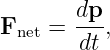
the momentum of a body or system. A modern Newtonian statement of the relation between net
force and momentum is
where p is linear momentum. For a particle of constant mass, p = mv, so that
The SI unit of force is the newton,
and the dimensions of force are
Because force has both magnitude and direction, forces combine by vector addition. The vector
sum of all external forces acting on a system is its net force. If the net external force vanishes, the
total momentum of the system is constant. For a constant-mass particle observed from an inertial
frame, zero net force therefore implies zero acceleration.
At the macroscopic level, familiar force models include gravitation, Normal contact forces, friction,
tension, elastic forces, drag, and distributed loads. Many everyday contact and elastic forces
ultimately arise from electromagnetic interactions among atoms and molecules. The rotational
effect of a force is described by torque.
Classical mechanics provides an extremely useful force-based description of motion.
Modern physics goes deeper: the known forces of nature are traced to four fundamental
interactions, while relativity and quantum theory modify the way the classical force concept is
interpreted.
Fundamental interactions
All presently known fundamental interactions are classified into four groups: the gravitational,
electromagnetic, strong, and weak interactions. The strong and weak interactions operate
over very short distances and govern subatomic processes involving quarks, leptons,
nucleons, and nuclei. Electromagnetism acts on Electric Charge, while gravitation couples to
mass-energy.
The macroscopic forces used in classical mechanics are not additional fundamental interactions.
Friction, normal forces, spring forces, and most other contact forces arise from electromagnetic
interactions together with quantum-mechanical constraints such as the Pauli exclusion principle.
Likewise, centrifugal force is not a fundamental interaction; it is an inertial or fictitious
force that appears when motion is described from an accelerating rotating reference
frame.
The history of physics includes several major unifications of apparently different forces.
Newton showed that terrestrial falling motion and celestial orbital motion could be
described by the same law of gravitation. Faraday and Maxwell unified electric and
magnetic phenomena into electromagnetism. In the twentieth century, quantum field
theory described electromagnetic, weak, and strong interactions in terms of quantum
fields and exchanged gauge bosons. The electromagnetic and weak interactions were
further unified in the electroweak theory, whose predictions were subsequently confirmed
experimentally.
Comparison of the four fundamental interactions
The following table summarizes the classification used in the source article. The relative strengths
are approximate order-of-magnitude comparisons and depend on the characteristic energy or
distance scale at which the interactions are compared.
|
|
Interaction | Summary |
|
|
Gravitation | Acts on mass-energy. In quantum descriptions a graviton is
the hypothetical mediator, but no graviton has been observed.
Approximate relative strength: 10−41 at the quark scale and
10−36 at the proton/neutron scale. |
|
|
Weak | Acts on quarks and leptons and can change particle flavor.
It is mediated by W+, W−, and Z0 bosons. Approximate
relative strength: 10−4 at the quark scale and 10−7 at the
proton/neutron scale. |
|
|
Electromagnetic | Acts on electric charge and is mediated by the photon (γ). Its
relative strength is taken as 1 in the comparison used here.
Together with the weak interaction it forms the electroweak
interaction. |
|
|
Strong,
fundamental | Acts on color charge and directly affects quarks and gluons.
It is mediated by gluons (g). Approximate relative strength at
the quark scale: 60. |
|
|
Strong, residual | Acts between color-neutral hadrons and is responsible for
nuclear binding. At low energies it can be modeled using meson
exchange. Approximate relative strength at the proton/neutron
scale: 20. |
|
|
Gravitational interaction
Newtonian gravitation describes gravity as an attractive force acting at a distance. In that theory,
changing the position of one mass changes the gravitational influence associated with it
everywhere else without an explicit propagation delay. This instantaneous-action picture is
incompatible with special relativity, in which physical influences cannot propagate faster than
light.
General relativity replaces Newton’s action-at-a-distance description with a geometrical
theory of spacetime. Freely falling bodies follow geodesics of curved spacetime; locally, an
ideal freely falling observer can regard the motion as inertial rather than as motion
driven by a conventional force. Newtonian gravity remains an excellent approximation
when gravitational fields are weak and speeds are small compared with the speed of
light.
Historically, the anomalous perihelion precession of Mercury was one of the major tests
distinguishing Einstein’s theory from Newtonian gravitation. General relativity correctly supplies
the additional orbital precession that is absent from the Newtonian prediction.
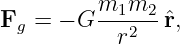
In ordinary engineering and introductory mechanics, however, it remains useful to describe gravity
by a force such as
or, near Earth’s surface and over modest height changes,
Electromagnetic interaction
Electric and magnetic forces are different manifestations of a single electromagnetic interaction. At
the classical level, electromagnetic fields are described by Maxwell’s Equations together with the
Lorentz force law,
Classical electromagnetism already has a relativistic structure: electric and magnetic fields mix
under changes of inertial frame. At the quantum level, electromagnetic interactions between
elementary particles are described by quantum electrodynamics (QED), in which the photon is the
gauge boson of the electromagnetic field.
Many macroscopic forces that appear unrelated to electromagnetism are ultimately
consequences of electromagnetic interactions among charged particles, combined with
quantum-mechanical structure. Examples include most contact forces, chemical bonding, elasticity,
and friction.
Strong interaction
The strong interaction is the fundamental interaction described by quantum chromodynamics
(QCD). It acts on color charge and directly affects quarks, antiquarks, and gluons. Gluons are the
gauge bosons of QCD and, unlike photons, themselves carry the charge associated with the
interaction.
The fundamental strong interaction is responsible for binding quarks into hadrons such as protons
and neutrons. Because of color confinement, isolated free quarks are not observed under ordinary
conditions.
A residual strong interaction remains between color-neutral hadrons. This residual nuclear force
binds protons and neutrons inside atomic nuclei and is strong enough at nuclear distances to
overcome the electromagnetic repulsion between positively charged protons. At low energies it can
be modeled in terms of meson exchange, although the underlying fundamental theory is
QCD.
Weak interaction
The weak interaction is responsible for processes in which particle flavor changes and is especially
familiar through beta decay and related radioactive processes. It does not form stable bound states
in the way the strong and electromagnetic interactions do.
The weak interaction is mediated by the massive
bosons. Processes involving W± are called charged-current interactions, while processes involving
the electrically neutral Z0 are called neutral-current interactions.
At ordinary energies the weak interaction is much less intense than the strong or electromagnetic
interactions, but it is still vastly stronger than gravitation at subatomic distances.
The weak and electromagnetic interactions are two low-energy manifestations of a unified
electroweak interaction. At sufficiently high temperatures or collision energies the distinction
between electromagnetic and weak interactions disappears. Such conditions existed during the very
early universe.
Related PhysicsLibrary entries in this article family
The historical, classical, relativistic, quantum, and engineering aspects of force are developed in
separate PhysicsLibrary entries, including development of the force concept; Newton’s laws;
combining forces; equilibrium; gravitational, electromagnetic, normal, friction, tension, spring, and
centripetal forces; continuum mechanics; fictitious forces; torque; impulse, work, and Power;
potential energy; conservation; units; special relativity; quantum mechanics; and quantum field
theory.
External links
References
[1] Daniel Kleppner and Robert J. Kolenkow, An Introduction to Mechanics, 2nd ed.,
Cambridge University Press, 2014.
[2] Richard P. Feynman, Robert B. Leighton, and Matthew Sands, The Feynman
Lectures on Physics, Vol. I, New Millennium ed., Basic Books, 2010.
[3] Elliott H. Lieb, “The stability of matter: from atoms to stars,” Bulletin of the
American Mathematical Society, 22(1), 1–49, 1990.
[4] Charles W. Misner, Kip S. Thorne, and John Archibald Wheeler, Gravitation, W.
H. Freeman, 1973.
[5] Yvonne Choquet-Bruhat, General Relativity and the Einstein Equations, Oxford
University Press, 2009.
[6] Wolfgang K. H. Panofsky and Melba Phillips, Classical Electricity and Magnetism,
2nd ed., Dover Publications, 2005.
[7] Anthony Zee, Quantum Field Theory in a Nutshell, 2nd ed., Princeton University
Press, 2010.
[8] Dave Goldberg, The Standard Model in a Nutshell, Princeton University Press, 2017.
[9] Walter Greiner and Berndt Müller, Gauge Theory of Weak Interactions, 4th ed.,
Springer, 2009.
[10] Ruth Durrer, The Cosmic Microwave Background, Cambridge University Press,
2008.
[11] Contemporary Physics Education Project, Standard Model of Particles and
Interactions, 2000.
Source and license
This PhysicsLibrary entry is an adapted and reorganized derivative of the Wikipedia
article “Force”, revision 1369185740 (13 August 2026). The source article is available
under the Creative Commons Attribution–ShareAlike 4.0 International License. The
present entry has been rewritten and reorganized for PhysicsLibrary rather than copied
verbatim.