Energy: Definition, Conservation, and Meaning Across Physics
Energy is one of the central organizing concepts of physics.
At the introductory level, it appears as kinetic energy, gravitational potential energy, elastic
potential energy, thermal energy, and chemical energy.
At more advanced levels, energy becomes:
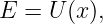
- the conserved quantity associated with time translation symmetry;
- the Hamiltonian that generates time evolution;
- the time component of relativistic four-momentum;
- an eigenvalue or expectation value of a quantum Hamiltonian;
- a density and flux carried by classical fields;
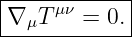
- a component of the stress-energy tensor in relativity.
These are not unrelated definitions. They are different manifestations of a common physical
structure.
A useful introductory description is:
Energy is a
scalar quantity used to account for physical change and for transfers
between parts of a
system.
The familiar phrase “capacity to do work” is useful at the beginning, but it is not a complete
modern definition.
The deeper statement is:
When the laws of a system are invariant under translations in time, there is an
associated conserved quantity called energy.
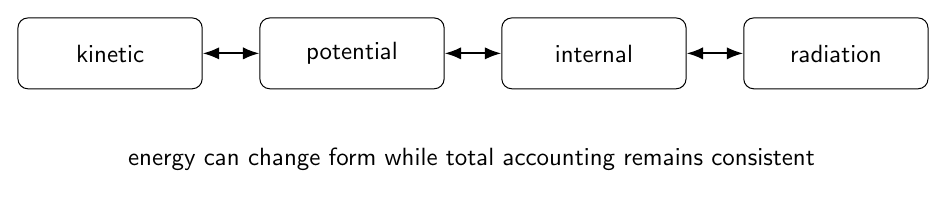
Figure 1. Energy can be stored in different physical forms and transferred between systems by
work, heating, radiation, and matter flow.
1 Dimensions and units
Energy has dimensions
The SI unit is the joule:
Other useful units include
| 1 erg | = 10−7 J, | (3)
|
| 1 eV | = 1.602176634 × 10⁻¹⁹ J. | (4) |
The electron volt is especially useful in atomic, nuclear, particle, and astrophysical physics.
2 Energy is a scalar
Energy is a scalar quantity.
It has magnitude but no spatial direction.
This distinguishes it from momentum.
Two particles moving in opposite directions can have equal kinetic energies even though their
momenta have opposite signs.
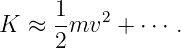
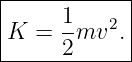
For a particle of mass m and velocity v,
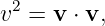
Since
the scalar nature is explicit.
3 Work as energy transfer
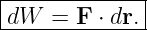
In undergraduate mechanics, energy is introduced most directly through work.
For an infinitesimal displacement dr under force F,
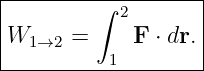
For motion from point 1 to point 2,
Work is not a substance stored inside an object.
Work describes a transfer of energy.
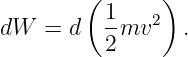
4 The work-energy theorem
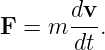
For a particle,
Using
we find
| dW | = F ⋅ dr | (11)
|
| = m ⋅ vdt ⋅ vdt | (12)
|
| = mv ⋅ dv. | (13) |
Because
we obtain
Integration gives
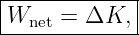
The kinetic-energy formula therefore has an operational meaning: net work changes kinetic
energy.
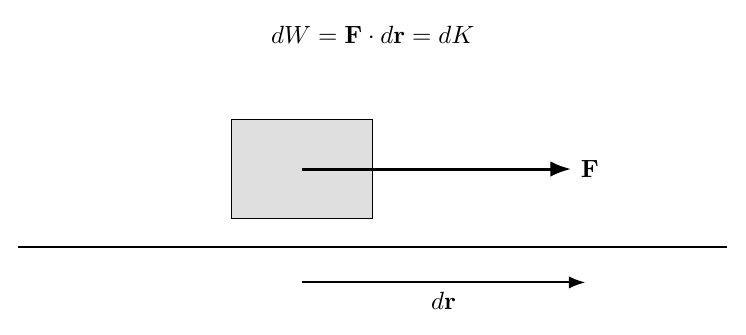
Figure 2. Net work transfers energy into or out of translational kinetic energy. The dot product
selects the force component along the displacement.
5 Potential energy
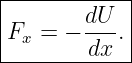
Some forces can be represented by a scalar potential-energy function.
For a conservative force,
In one dimension,
The work done by the conservative force is
Thus a conservative force doing positive work corresponds to a decrease in potential
energy.
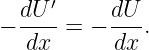
6 Potential energy is defined up to a constant
Only potential-energy differences affect the force.
If
then
The zero of potential energy may therefore often be chosen for convenience.
This freedom does not make potential-energy differences arbitrary.
7 Familiar potential energies
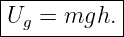
Near Earth’s surface,
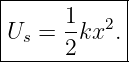
For a spring obeying Hooke’s law,
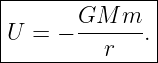
For Newtonian gravity between two point masses, choosing zero potential energy at infinite
separation gives
The negative sign is characteristic of a bound gravitational configuration under this choice of
zero.
8 Mechanical energy
For a system with kinetic and potential energy,
If only conservative forces do work and the potential has no explicit time dependence,
This is conservation of mechanical energy.
It is a special case of the broader conservation principle.
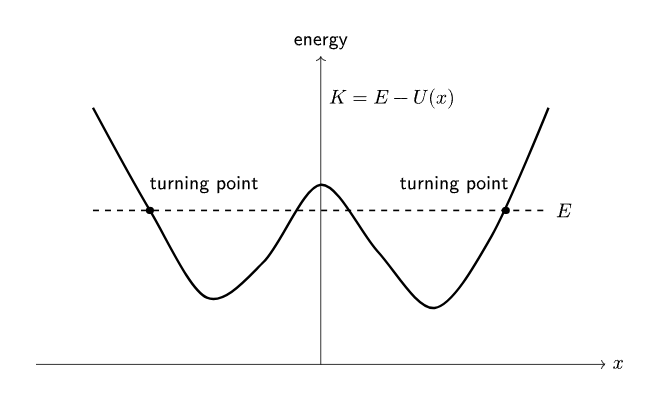
Figure 3. In one-dimensional conservative motion the total energy is fixed while kinetic and
potential energy exchange. Turning points occur where kinetic energy vanishes.
9 Energy diagrams and turning points
For one-dimensional conservative motion,
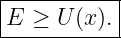
Because
the classically allowed region satisfies
Turning points occur where
and therefore
Energy diagrams can reveal qualitative motion before the equation of motion is solved
explicitly.
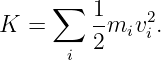
10 Energy in particle systems
For many particles,
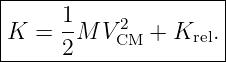
The kinetic energy separates into center of mass motion and motion relative to the center of
mass:
This decomposition is important in collisions, molecular physics, celestial mechanics, and
Thermodynamics.
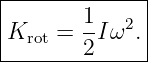
11 Rotational kinetic energy
For a rigid body rotating about a fixed axis,
For general rigid body motion, translational and rotational kinetic energies can both contribute to
the total energy.
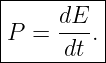
12 Power
Power is the rate of energy transfer:
For mechanical work,
For rotation about a fixed axis,
The SI unit is the watt:
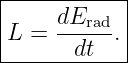
13 Luminosity as an energy rate
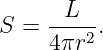
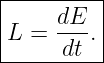
In astrophysics, luminosity is radiated power:
A source of nearly constant luminosity emits
during a sufficiently short interval.
This is the direct connection between the energy concept and the PhysicsLibrary luminosity
article.
14 Energy conservation is bookkeeping, not immobility
Energy conservation does not mean that the physical state remains unchanged.
A system can transform energy among different forms:
| K | ↔ U, | (41)
|
| Emechanical | → Einternal, | (42)
|
| Echemical | → Ethermal, | (43)
|
| Enuclear | → Eradiation. | (44) |
Conservation means that the total accounting remains consistent for an isolated system.
15 Thermodynamic internal energy
Thermodynamics introduces internal energy, usually written
It includes microscopic energy associated with degrees of freedom such as:
- molecular translation;
- rotation;
- vibration;
- intermolecular interactions;
- electronic states;
- chemical bonds;
- nuclear degrees of freedom when relevant.
Internal energy is a state function.
Its change depends on the initial and final equilibrium states.
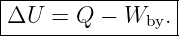
16 The first law of thermodynamics
Using the convention that Wby is work done by the system on its surroundings,
Equivalently, with Won = −Wby,
Here:
- U is a state function;
- Q is energy transferred because of a temperature difference;
- W is energy transferred by generalized mechanical means.
Heat and work are modes of transfer, not stored properties.
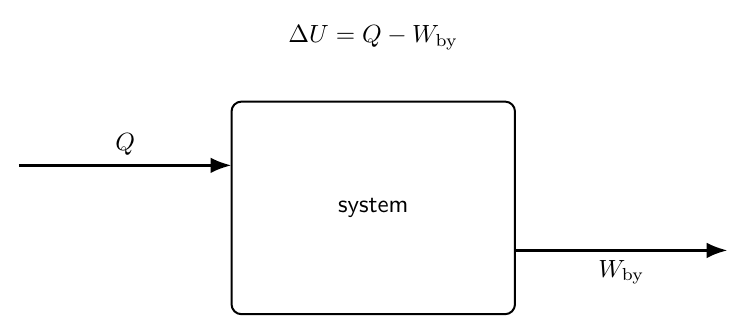
Figure 4. In thermodynamics, internal energy is a state function while heat and work describe
energy transferred across the system boundary.
17 Chemical, nuclear, and binding energy
Chemical energy is mainly associated with electromagnetic interactions and quantum states of
electrons and nuclei.
Nuclear energy is associated with changes in nuclear binding and nuclear quantum states.
A reaction releases energy when the final state has lower total energy than the initial
state.
For a bound system, one useful positive binding-energy convention is
The concept appears in gravitational systems, atoms, molecules, and nuclei.
18 Lagrangian mechanics
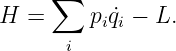
In analytical mechanics, dynamics can be described by a Lagrangian
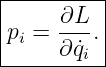
Define the generalized momentum
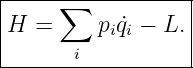
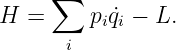
The associated energy function is
For a standard natural Lagrangian
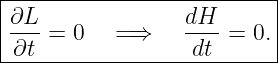
with time-independent generalized coordinates and a velocity-independent potential,
In this common case, the Hamiltonian equals the familiar total mechanical energy.
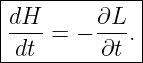
19 Why time independence implies conservation
Differentiate
Then
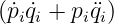
Expand
Using
and the Euler-Lagrange equation
the summed terms cancel:
Therefore,
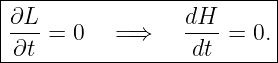
20 Noether’s theorem
Noether’s theorem gives the deeper interpretation.
Schematically,
Examples are:
Thus
Energy is the conserved quantity associated with time translation
symmetry.

Figure 5. When the laws describing an isolated system are invariant under shifts of the time
origin, Noether’s theorem associates that symmetry with a conserved energy.
21 A caution about the Hamiltonian
The Hamiltonian is often called the energy, but this should not be applied mechanically in every
formulation.
Subtleties can arise with:
- explicitly time-dependent coordinates;
- electromagnetic gauge choices;
- constraints;
- nonstandard velocity dependence;
- dynamical spacetime geometry.
For standard undergraduate systems, however, the Hamiltonian usually coincides with total
energy.
22 Relativistic energy
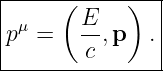
In special relativity, energy and momentum are components of four-momentum:
The invariant relation is
For a massive particle at rest,
so
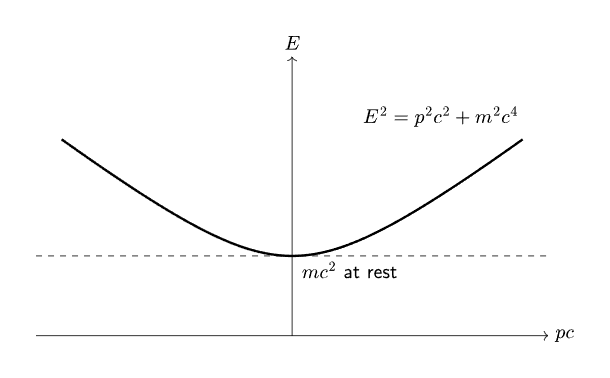
Figure 6. Relativistic energy and momentum satisfy an energy-momentum relation with a nonzero
rest-energy intercept for a massive particle.
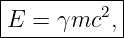
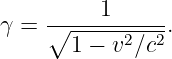
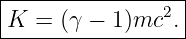
23 Relativistic kinetic energy
For speed v,
where
The kinetic energy is
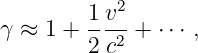
At low speed,
so
Newtonian kinetic energy is therefore the low-speed limit of the relativistic expression.
24 Photons and massless particles
For a massless particle,
so
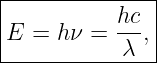
For a photon,
and
This connects energy with wave frequency and wavelength.
25 Energy is frame dependent in relativity
Different inertial observers generally assign different energies to the same moving particle.
Energy is the time component of four-momentum, so it changes under Lorentz transformations.
The invariant relation
is observer independent.
Thus relativistic energy is conserved in a chosen inertial frame for an isolated system, but its
numerical value depends on the observer.
26 Quantum energy
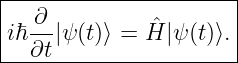
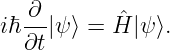
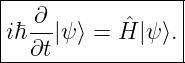
In quantum mechanics, energy is represented by the Hamiltonian operator
The Schrödinger equation is
The Hamiltonian therefore generates time evolution.
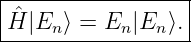
27 Energy eigenstates
An energy eigenstate satisfies
For a time-independent Hamiltonian,
The state changes only by an overall phase, so its observable probability distributions are
stationary.
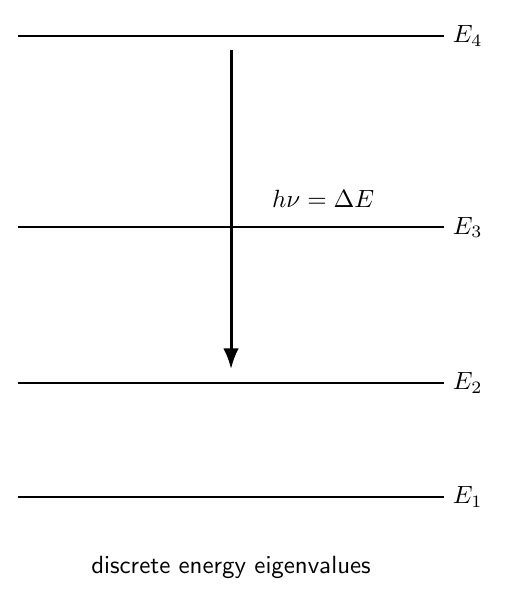
Figure 7. Quantum systems can possess discrete energy eigenvalues. Radiation exchanged in a
transition carries the energy difference between levels.
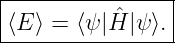
28 Expectation value and energy uncertainty
A general quantum state need not have a definite energy.
Its expectation value is
The energy uncertainty is
If the Hamiltonian is time independent, the expectation value of energy is conserved under
Schrödinger evolution.
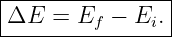
29 Quantum transitions
If a quantum system changes from energy Ei to energy Ef, conservation requires an energy
exchange
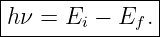
For photon emission,
and
This is the basis of discrete spectral-line energies.
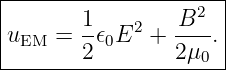
30 Energy in classical fields
Fields can store and transport energy.
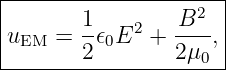
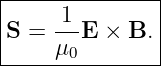
For the electromagnetic field in vacuum,
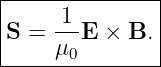
The electromagnetic energy flux is the Poynting vector:
The energy density has units of
while the Poynting vector has units of
31 Poynting’s theorem
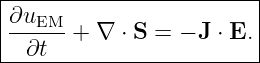
Electromagnetic energy conservation is expressed locally as
The terms describe:
- change of energy stored in the field;
- field energy flowing through space;
- energy exchanged between the field and charged matter.
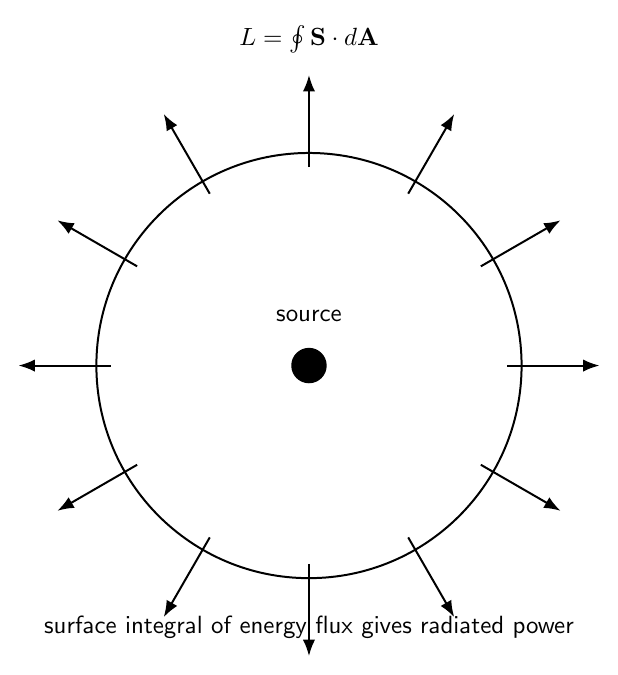
Figure 8. Electromagnetic fields store energy locally and carry it through space. The outward
Poynting flux through a closed surface gives radiated power.
32 Luminosity from field energy flux
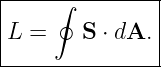
For radiation leaving a source,
For isotropic radiation,
Thus luminosity is a rate of electromagnetic energy crossing an enclosing surface.
33 Energy in continuous matter
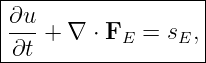
In fluids and continuous media, one often works with energy density u and energy flux
FE.
A generic local balance law has the form
where sE represents exchange with other subsystems.
For the complete isolated system, internal source and sink terms cancel in the total
accounting.
34 Energy in general relativity
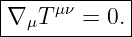
Matter and nongravitational fields are described by the stress-energy tensor
In a local inertial frame, T00 is associated with energy density, while mixed time-space components
are associated with momentum density and energy flux.
The local covariant conservation law is
This is the curved-spacetime form of local energy-momentum conservation for matter and
nongravitational fields.
35 Why global energy is subtle in general relativity
A general dynamical curved spacetime need not possess a unique globally conserved scalar energy
for the entire universe.
The reason again involves symmetry.
If spacetime has a suitable time translation symmetry, represented by a timelike Killing vector, a
conserved energy can often be defined.
If the spacetime itself changes with time and lacks that symmetry, the corresponding global
conserved energy need not exist.
This is not a failure of local conservation.
It reflects the role of spacetime geometry in gravitation.
36 Energy and cosmological redshift
A photon observed after cosmological expansion has lower frequency and therefore lower measured
energy:
In a spacetime without global time translation symmetry, asking where the photon’s “lost energy”
went can be misleading.
The local relativistic conservation laws remain valid, but a simple Newtonian-style energy ledger
for the entire expanding universe is not generally available.
37 Energy is not a material substance
Energy is extremely useful as a conserved accounting quantity, but it should not be imagined as a
literal invisible fluid.
Several facts illustrate this:
- the zero of Newtonian potential energy can often be shifted;
- relativistic energy is observer dependent;
- quantum states need not possess one definite energy;
- classical fields store energy throughout space;
- general relativity does not provide a unique local gravitational-energy density in
arbitrary coordinates.
What remains fundamental is the mathematical structure of energy, transfer, symmetry, and
conservation appropriate to the theory.
38 Energy conservation and entropy
Total energy can be conserved while its usefulness for producing macroscopic work decreases.
For example, organized mechanical motion can be converted by Friction into disordered internal
energy.
The energy has not disappeared, but the second law of thermodynamics can prevent complete
recovery of that energy as useful work in a cyclic process.
Therefore
Energy conservation and
entropy increase are fully compatible.
39 A hierarchy of meanings
The concept can be summarized by physical level.
39.1 Introductory mechanics
39.2 Thermodynamics
39.3 Analytical mechanics
39.4 Special relativity
39.5 Quantum mechanics
39.6 Field theory
Energy is represented locally by energy densities and energy fluxes.
39.7 General relativity
Local energy-momentum conservation survives, while global energy depends on spacetime
symmetry and boundary conditions.
40 Worked conceptual examples
40.1 Example 1: kinetic energy
A 2.0 kg object moves at 3.0 ms−1.
| K | =  (2.0)(3.0)2 (2.0)(3.0)2 | (101)
|
| = 9.0 J. | (102) |
If net work of 5.0 J is done on the object, its final kinetic energy is
40.2 Example 2: gravitational potential energy
Raise a 1.0 kg mass by 5.0 m near Earth’s surface.
Using
| ΔU | = mgh | (105)
|
| = (1.0)(9.81)(5.0) | (106)
|
| = 49.1 J. | (107) |
40.3 Example 3: photon energy
For
| E | =  | (109)
|
| ≈ 3.97 × 10⁻¹⁹ J | (110)
|
| ≈ 2.48 eV . | (111) |
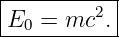
40.4 Example 4: rest energy
For
| E0 | = mc2 | (113)
|
| ≈ 8.99 × 10¹³ J. | (114) |
This enormous scale explains why small mass differences can correspond to large nuclear
energies.
41 Common mistakes
- Treating energy as a vector.
- Treating work as a substance stored in a body.
- Treating heat as a state variable contained in an object.
- Forgetting that potential-energy zero points can often be shifted by a constant.
- Assuming mechanical energy is conserved when nonconservative transfers occur.
- Confusing conservation of total energy with conservation of kinetic energy.
- Treating negative gravitational energy as physically impossible.
- Assuming the Hamiltonian equals T + U in every formulation.
- Interpreting E = mc2 as the complete energy formula for a moving particle.
- Forgetting that relativistic energy is observer dependent.
- Assuming every quantum state has one definite energy.
- Forgetting that fields can store and transport energy.
- Expecting a unique local gravitational-energy density in general relativity.
- Assuming global energy conservation has the same simple form in every curved
spacetime.
- Confusing energy conservation with the claim that all energy can always be converted
completely into useful work.
42 Connections to other PhysicsLibrary articles
In mechanics,
and
In the luminosity article,
In Electromagnetism,
and
In quantum mechanics, the Hamiltonian represents energy and generates time evolution.
These are successive extensions of one underlying physical concept.
43 Summary
At the mechanics level,
Work transfers energy:
Thermodynamics enlarges the accounting:
Analytical mechanics connects conservation to time translation symmetry:
Special relativity gives
Quantum mechanics uses
Field theory represents energy locally by densities and fluxes.
General relativity encodes local energy-momentum conservation through
A compact advanced definition is therefore:
Energy is the
physical quantity associated with time evolution and, when time
translation symmetry is present, with a corresponding conservation law.
References
References
[1] J. R. Taylor, Classical Mechanics, University Science Books, 2005.
[2] H. Goldstein, C. Poole, and J. Safko, Classical Mechanics, 3rd ed., Addison-Wesley,
2002.
[3] D. V. Schroeder, An Introduction to Thermal Physics, Addison-Wesley, 2000.
[4] D. J. Griffiths, Introduction to Electrodynamics, 4th ed., Pearson, 2013.
[5] D. J. Griffiths and D. F. Schroeter, Introduction to Quantum Mechanics, 3rd ed.,
Cambridge University Press, 2018.
[6] E. F. Taylor and J. A. Wheeler, Spacetime Physics, 2nd ed., W. H. Freeman, 1992.
[7] S. M. Carroll, Spacetime and Geometry, Addison-Wesley, 2004.
[8] E. Noether, Invariant Variation Problems, 1918.

![[E ] = ML2T −2.](https://images.physicslibrary.org/cache/objects/1432/make4ht/Energy0x.png)























 =
=