Conservation of Mechanical Energy
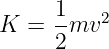
Kinetic energy describes energy associated with motion. Potential energy describes energy
associated with position in a conservative interaction. When only conservative forces do work,
these two forms can exchange while their sum remains constant.
Define the mechanical energy
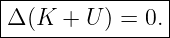
If only conservative forces do work,
Equivalently,
This is the conservation of mechanical energy.
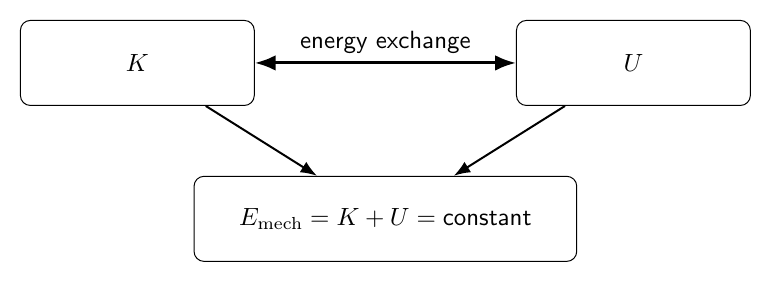
Figure 1. In a conservative system, kinetic and potential energy can convert into one another
while the total mechanical energy remains constant.
1 Derivation from the work-energy theorem
The work-energy theorem gives
Suppose every force doing work is conservative. Then
For a conservative force,
Therefore
Move both changes to the same side:
Since
we obtain
Thus
Between initial and final states,
2 Mechanical energy is a sum
Mechanical energy is not a new form of energy separate from kinetic and potential energy. It is the
sum
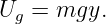
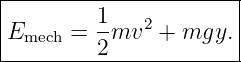
For a particle of mass m moving near Earth’s surface,
and
Thus
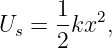
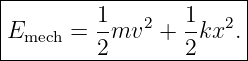
For a mass attached to an ideal spring,
so
If both gravity and a spring are relevant,
3 Energy-bar interpretation
A useful conceptual picture is to think of kinetic and potential energy as two accounts whose sum
remains fixed.
If
then
If
then
For a conservative system,
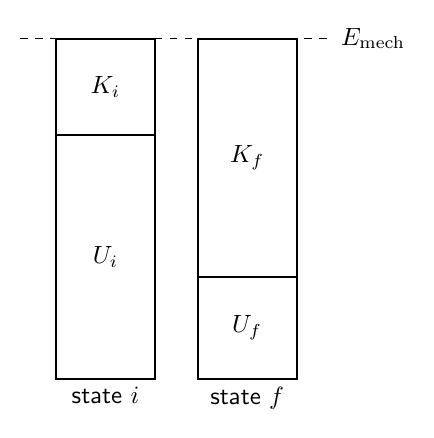
Figure 2. Two states of the same conservative system. The partition between kinetic and potential
energy changes, but the total mechanical energy is unchanged.
4 Solving for speed without time
Mechanical-energy conservation is especially powerful when speed is needed after a known change
in position.
From
we can write
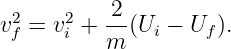
Solve for vf2:
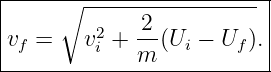
Therefore
The energy method often avoids finding acceleration and elapsed time.
5 Example 1: falling under uniform gravity
A ball is released from rest from height h above a reference level. Neglect air resistance.
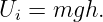
Initially,
and
At the reference level,
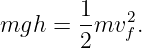
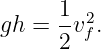
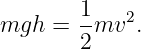
Conservation of mechanical energy gives
Cancel m:
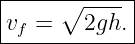
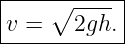
Thus
This is the same speed obtained from constant-acceleration kinematics, but the energy method
never uses the fall time.
6 Example 2: upward launch
A particle is launched vertically upward with speed v0. Neglect air resistance.
Take the launch point as
Initially,
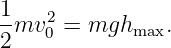
At the maximum height,
so
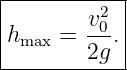
Therefore
Hence
7 Example 3: frictionless incline
A block starts from rest at vertical height h and slides down a frictionless incline.
Gravity is conservative and the Normal force does no work because it is perpendicular to the
displacement.
Thus
Therefore
The angle and length of the incline do not appear. Only the vertical height change
matters.
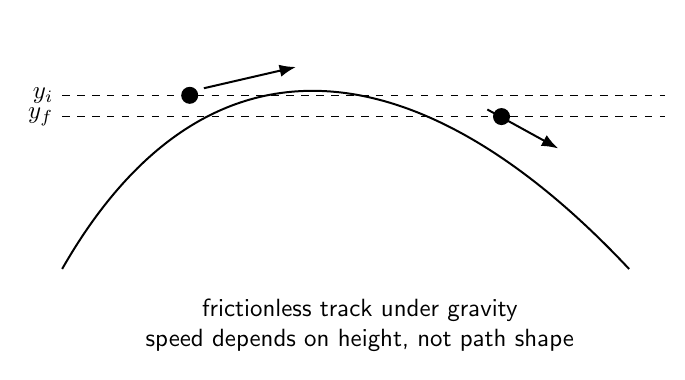
Figure 4. On a frictionless track under uniform gravity, the speed at a given height depends only
on the vertical change in gravitational potential energy, not on the shape of the path.
8 Spring-mass systems
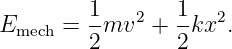
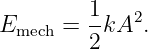
For a mass attached to an ideal spring on a frictionless horizontal surface,
At maximum extension or compression,
If the maximum displacement from equilibrium is A, then
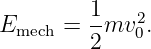
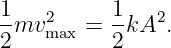
At equilibrium,
so all the mechanical energy is kinetic:
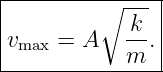
Thus
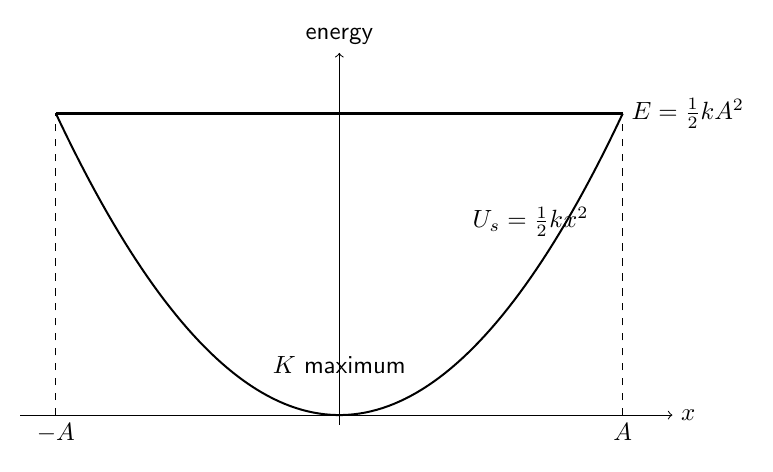
Figure 5. In an ideal spring-mass system, energy alternates between elastic potential energy and
kinetic energy. The total mechanical energy remains fixed.
9 Multiple conservative forces
If several conservative forces act, each can have its own potential energy.
Suppose gravity and a spring both act. Then
Mechanical energy is
If no nonconservative force does work,
The method is unchanged. Every conservative interaction contributes its potential-energy
term.
10 Choice of potential-energy zero
The absolute zero of potential energy is arbitrary.
Suppose
Then
| Ki + Ui′ | = Ki + Ui + C, | (53)
|
| Kf + Uf′ | = Kf + Uf + C. | (54) |
The constant appears on both sides of the energy equation and cancels.
Therefore the conservation law is unaffected by the chosen reference level.
A convenient choice can simplify the algebra substantially.
11 Potential-energy diagrams
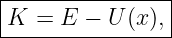
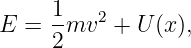
Suppose a particle moves in one dimension with conserved total mechanical energy
Then
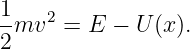
Therefore
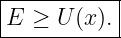
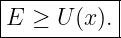
Because kinetic energy cannot be negative,
Hence allowed positions satisfy
Regions where
are classically forbidden.
12 Turning points
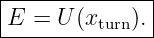
A turning point occurs where the particle momentarily stops before reversing direction.
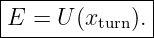
At a turning point,
so
Thus
On a potential-energy graph, turning points are the intersections between the horizontal
total-energy line and the potential curve.
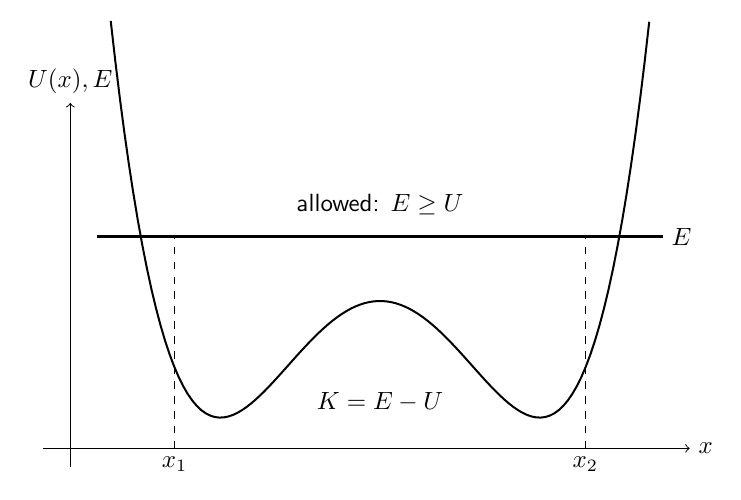
Figure 3. A particle with total mechanical energy E can occupy only regions where E ≥ U(x).
Points where E = U(x) are turning points because the kinetic energy vanishes there.
13 Speed from a potential-energy diagram
From
we obtain
Therefore
The speed is greatest where the potential energy is smallest.
At a turning point,
so the speed is zero.
14 Bound and unbound motion
Potential-energy diagrams can also classify motion.
If a particle is trapped between two turning points, the motion is bound.
If the energy is high enough to escape to arbitrarily large distance, the motion is unbound.
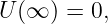
For example, with Newtonian gravity and the standard reference
the sign of the total mechanical energy distinguishes important regimes.
For a two-body gravitational system,
| E < 0 | corresponds to bound motion, | (69)
|
| E = 0 | marks the escape threshold, | (70)
|
| E > 0 | corresponds to unbound motion. | (71) |
A later celestial-mechanics treatment develops this in greater depth.
15 What changes when nonconservative forces do work?
Mechanical energy is conserved only when the net work done by nonconservative forces is
zero.
Start from
Split the net work into conservative and nonconservative parts:
Use
Then
Therefore
Hence
Between two states,
Thus nonconservative work changes the mechanical energy.
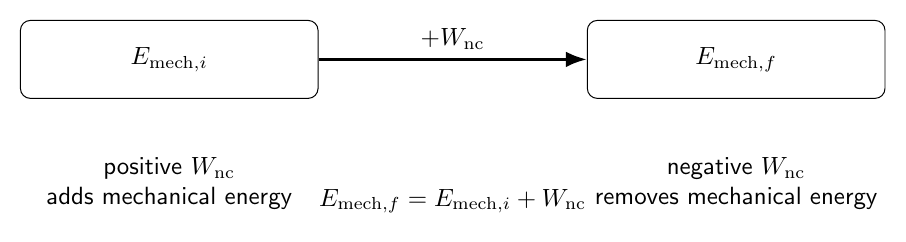
Figure 6. Nonconservative work changes the total mechanical energy. Positive nonconservative
work adds mechanical energy, while negative nonconservative work removes it.
16 Example 4: block with kinetic friction
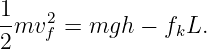
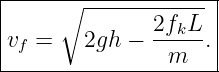
A block of mass m starts from rest at height h, slides down a track, and reaches the bottom after
kinetic friction has done work
Choose
Initially,
The mechanical-energy accounting equation is
Therefore
Thus
Friction reduces the final mechanical energy.
17 Energy conservation versus mechanical-energy conservation
The phrase conservation of energy is broader than conservation of mechanical energy.
Mechanical energy
may decrease because friction converts organized mechanical energy into internal energy.
The total energy of an appropriately defined closed system is still conserved.
For example, when a block slides with kinetic friction,
but the lost mechanical energy appears mainly as thermal energy of the surfaces.
Therefore:
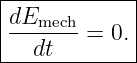
18 Power form of mechanical-energy conservation
If only conservative forces do work,
is constant.
Therefore
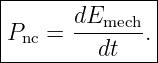
If nonconservative forces are present,
Taking the time derivative gives
Thus nonconservative Power measures the rate at which mechanical energy is added or
removed.
19 Common mistakes
- Using conservation of mechanical energy when friction or another nonconservative force
does net work.
- Forgetting to include all relevant conservative potential-energy terms.
- Setting kinetic energy equal to zero except at actual turning points.
- Confusing a turning point with an equilibrium point.
- Forgetting that allowed motion requires E ≥ U(x).
- Treating potential energy as necessarily positive.
- Assuming the zero of potential energy affects physical predictions.
- Mixing heights measured from different gravitational reference levels in the same
equation.
- Forgetting that the normal force can be nonzero while doing zero work.
- Saying energy is destroyed by friction instead of transferred into nonmechanical forms.
- Using K + U = constant when there is known nonconservative work.
20 Practice exercises
- A 2.0 kg object is dropped from rest through 10 m. Neglect air resistance. Find its
speed at the bottom.
- A projectile is launched vertically upward at 20 m∕s. Find its maximum height above
the launch point.
- A block slides frictionlessly from rest down a track through a vertical drop of 4.0 m.
Find its speed at the bottom.
- A spring with k = 300 N∕m is compressed by 0.15 m and launches a 0.50 kg block on
a frictionless surface. Find the block’s speed when the spring reaches equilibrium.
- A 1.0 kg particle has total mechanical energy 20 J and potential energy 12 J at some
position. Find its speed.
- For a potential U(x) and conserved energy E, explain why positions satisfying U(x) >
E are classically forbidden.
- A particle has E = 8 J and moves in a potential with turning points at x = −2 m and
x = 5 m. What is its kinetic energy at either turning point?
- A block starts from rest at height h and reaches the bottom with speed smaller than
 . Give two physically distinct reasons this can occur.
- Derive Wnc = ΔEmech from the work-energy theorem.
- A 4.0 kg block slides 6.0 m down a track while friction of magnitude 5.0 N acts. If the
block loses 50 J of gravitational potential energy, find its increase in kinetic energy.
- A spring-mass oscillator has amplitude A. Find the kinetic energy at x = A∕2 in terms
of k and A.
- For Newtonian gravity with U(∞) = 0, explain why negative total mechanical energy
corresponds to bound motion.
- If nonconservative power is Pnc(t), show that
21 Summary
Mechanical energy is
If only conservative forces do work,
Equivalently,
For one-dimensional motion in a potential,
so allowed motion requires
Turning points satisfy
If nonconservative forces do net work,
Thus mechanical-energy conservation is a special but extremely useful case of the broader
energy-accounting framework.
The next article, M03-07, develops nonconservative forces and mechanical-energy accounting in
more detail.
References
References
[1] J. R. Taylor, Classical Mechanics, University Science Books, 2005.
[2] D. Kleppner and R. Kolenkow, An Introduction to Mechanics, 2nd ed., Cambridge
University Press, 2014.
[3] H. Goldstein, C. Poole, and J. Safko, Classical Mechanics, 3rd ed., Addison-Wesley,
2002.
[4] H. D. Young and R. A. Freedman, University Physics with Modern Physics, 15th ed.,
Pearson, 2020.
[5] OpenStax, University Physics, Volume 1, Rice University, 2016.




































![|------------------------|
| ∘ -------------- |
|v(x) = 2-[E − U (x)].|
-----------m-------------](https://images.physicslibrary.org/cache/objects/1381/make4ht/ConservationOfMechanicalEnergy63x.png)