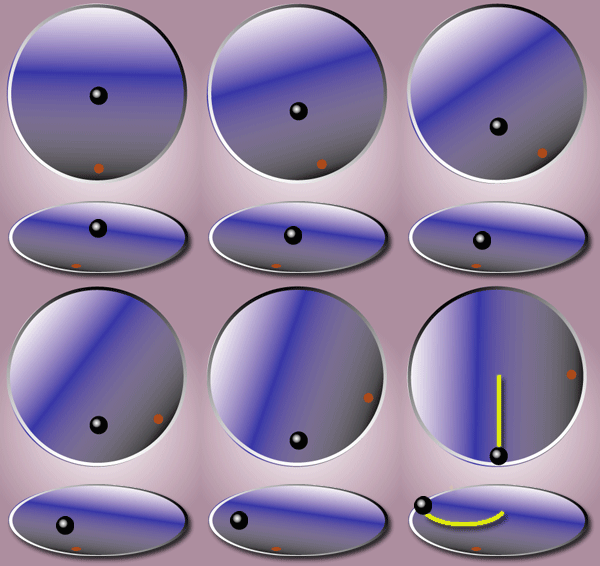
This contributed entry contains basic contents of balistics as well as three live animations/videos of
ballistics experiments to better illustrate this subject in Classical Mechanics.
Ballistics is the study of the kinematics and dynamics of a projected motion of an object. Such an
object in motion relative to the agency applying the force causing the beginning of the accelerated
motion of the object is thus called a “projectile”. Note however that in the presence of a
gravitational field the latter also contributes to either accelerating or decelerating the projectile
depending on the initial conditions, i.e. the orientation and direction of an applied force relative to
gravitational ones. The two following animations provide interesting visual and dynamic examples
of such projectile motions that are also represented graphically in the attached entry. As an
interesting illustration of the problem, one can see that in the above linked animation the
trajectories of a ball in the vertical and horizontal planes appear to be quite different; in the case
of the vertical spinning disk the trajectory is simply a straight line, whereas on the
horizontal spinning disk the trajectory of the same ball is quite visibly curved, but– of
course– it can be seen again as a straight line trajectory in a rotating frame from above as
shown in the linked web video. In the next animation, also shown as a quick movie
download, one sees the marked effects of a Coriolis force, and more generally the effects of
a spinning projectile (such as a football, soccer, tennis,ping-pong or golf ball) on its
trajectory.
Similarly, a spinning black hole behaves quite differently from a non-spinning one, but one would
not be able to correctly calculate such a major difference only with Newtonian mechanics.
Even special relativity is insufficient for this purpose, and General Relativity theory is
needed.
The two-dimensional (2D) projection is a major step in defining the trajectory of a projectile
object in its motion relative to that of an observer, or reference system. (Note also the exceptions
specified in the concluding remarks).
Let us define first a horizontal axis x and a vertical axis y in the latter reference system of the
observer.
0.1 Horizontal Motion
This will be considered first. Assuming that the drag force caused by the Friction with the
atmosphere surrounding the object is negligible, the sum of forces along the x axis ΣFx equals
zero, and so the acceleration along the axis ax is also insignificant. Thus, the velocity along the the
axis vx is constant and equal to the projection velocity V i,x. When dealing with a constant velocity
motion the following kinematic function is relevant:
(xi-the initial position, V x-the velocity along the axis, Δt-the duration)
0.2 Vertical Motion:
The motion along the y axis is under the effect of gravity (mg) when m is the object’s mass and g
is the the free fall acceleration on earth. → ΣFy = mg
Because the force along the y axis is constant, the motion along the axis is evenly accelerated, and
so the position of the object as a function of time y(t) is:
0.3 2D Motion:
The merging of the functions of place-time x(t),y(t) produces the route equation y(x):

Remarks: Ballistics has also been a subject of great interest to both army and navy
engineers that wished to improve the performance of various types of guns and succeded in
doing so by applying physical principles and mathematics. One such early apllications of
ballistics is discussed in the Old Testament, in the widely known story about David
and Golliath. Other earlier examples of the use of ballistics in battles and sieges were
the ancient uses of various catapults in Roman conquests. Perhaps even older was the
use of gun powder propelled rockets by the ancient Chinese entertainers, and also in
hunting by hurtling stones spears and arrows by primitive H. sapiens bands or tribes, and
earlier still by hominins and hominids; the latter, the Chinese and the Romans however
did not obviously benefit from the physical science of ballistics that began only with
Galileo Galilei’s foundation of experimental, classical kinematics, fully dveloped later by
Newton’s foundation of dynamics and Netwonian calculus. Ballistics is also of considerable
importance today in forensic science that also uses such physical principles combined with
actual experimental ballistic testing. Ballistic considerations were also of the essence
during the Cuban missile crisis, the earlier period of the Cold War, and in all earlier, ‘hot
wars’.
Intercontinental ballistics, satellite launches and NASA’s interplanetary programs also make
intensive use of ballistics, but in its more sophisticated forms; in such cases, the 2D projection
method outlined above for ballistic calculations is obviously insufficient.