Position and Displacement in Mechanics
Kinematics begins by answering the simplest possible question about motion: where is the object?
In mechanics the answer is called the object’s position. Motion is then described by how that
position changes with time.
The existing PhysicsLibrary position entry gives the essential definition: position is the
location of an object, commonly written as x in one dimension and treated as a vector in
more than one dimension. This article develops that definition into the form needed for
mechanics.
The central ideas are
and
Position depends on the chosen reference frame and coordinate origin. Displacement compares two
positions and points directly from the initial position to the final position.
1 Position requires a reference
A statement such as “the particle is at 4 m” is incomplete unless a reference origin and direction
have been specified. In one-dimensional motion we normally choose an x axis, an origin x = 0, and
a positive direction. The position coordinate x then tells where the particle is relative to that
origin.
In two or three dimensions, a position is conveniently represented by a position vector. In
Cartesian coordinates,
The vector begins at the chosen origin and ends at the point occupied by the particle.
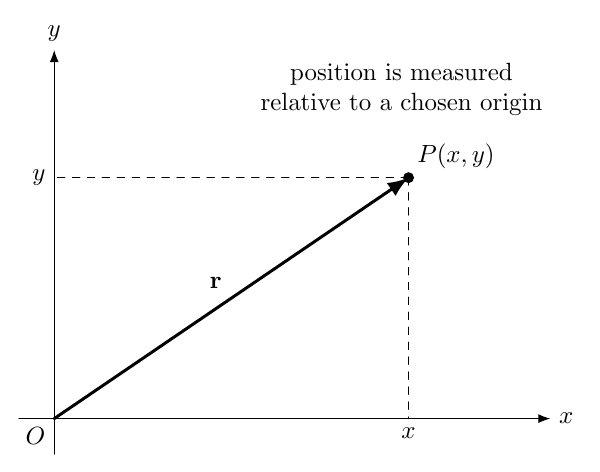
Figure 1. A position vector points from the chosen origin to the particle. Its Cartesian
components are the coordinates of the point.
The SI unit of position is the meter, written m. Position can also be expressed in centimeters,
kilometers, astronomical units, or any other appropriate unit of length.
2 Position in one dimension
For motion along a straight line, one signed coordinate is sufficient. We write
A negative coordinate does not mean a negative distance. It means that the particle lies on the
negative side of the chosen origin.
For example, the positions
and
are equally far from the origin but lie on opposite sides of it.
3 Position vectors in two and three dimensions
For planar motion,
For three-dimensional motion,
The magnitude of the position vector is
This magnitude is the straight-line distance from the chosen origin to the particle. It should not be
confused with distance traveled along a trajectory.
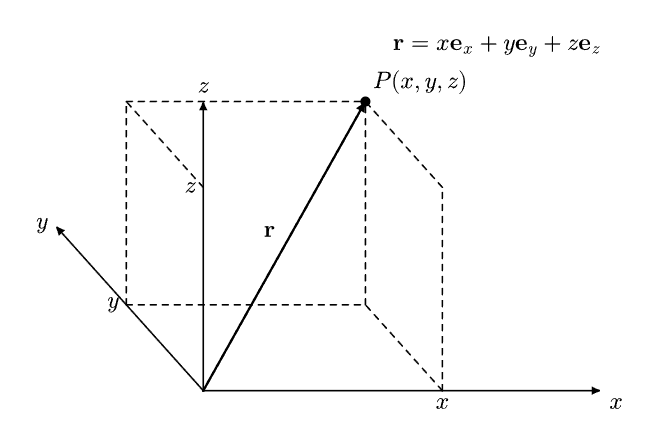
Figure 2. In three dimensions, the position vector is reconstructed from its Cartesian components.
4 Position as a function of time
A moving particle occupies different positions at different times. Its position is therefore commonly
written
As t varies, the endpoint of r(t) traces the particle’s trajectory through physical space.
A trajectory is not the same thing as a position-time graph. A trajectory shows where the particle
moves in space. A one-dimensional position-time graph plots a coordinate such as x(t) vertically
against time horizontally.
5 Displacement is change in position
Suppose a particle moves from an initial position ri to a final position rf. Its displacement is
defined by
The Greek capital letter Δ means a finite change. In one dimension,
In Cartesian three-dimensional form,
Thus displacement is obtained by subtracting the initial position vector from the final position
vector component by component.
6 Displacement depends only on the endpoints
The displacement vector connects the initial and final points directly. It does not record the path
followed between them.
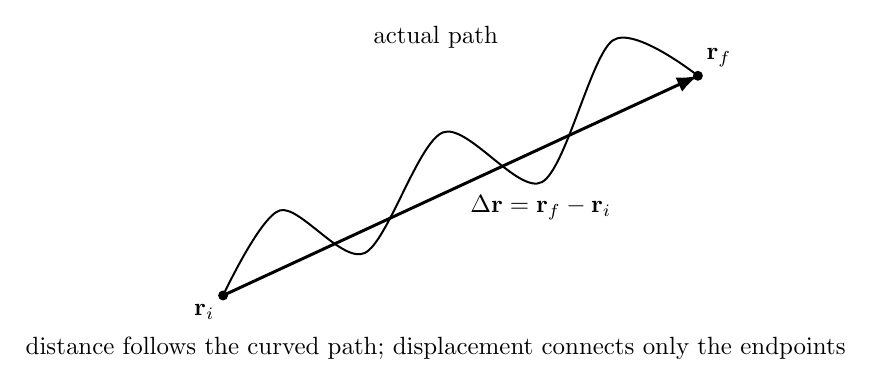
Figure 3. The curved trajectory represents the path traveled. The displacement Δr is the direct
vector from the initial point to the final point.
If the motion passes through intermediate positions r1,r2,…, then the individual displacements
add:
The intermediate position vectors cancel. This is the vector form of the familiar “final minus
initial” rule.
7 Displacement is not distance traveled
The distance traveled is the total length of the path followed by the particle. It is a nonnegative
scalar. Displacement is a vector determined only by the endpoints.
For any motion between two points,
If a particle returns to its starting point, then
although the distance traveled may be large.
This difference is fundamental. A runner who completes one full lap of a circular track has nonzero
distance traveled but zero total displacement.
8 Position-time graphs
For one-dimensional motion, a graph of x versus t records the coordinate position at each
time.
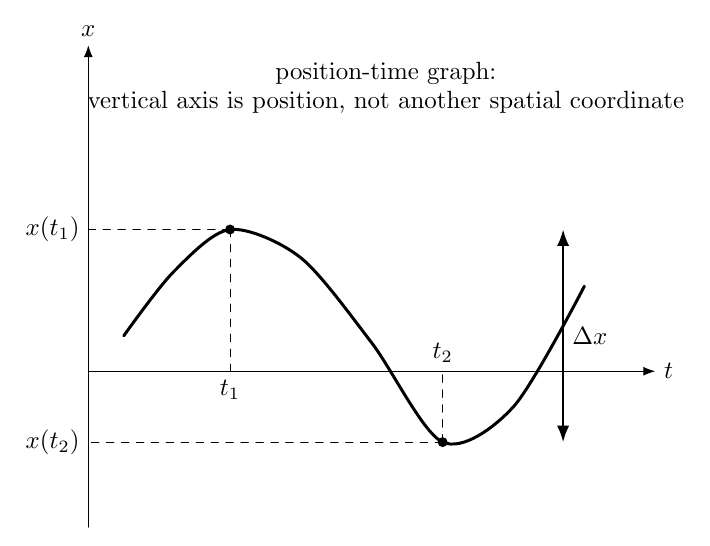
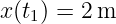
Figure 4. On a one-dimensional position-time graph, the displacement between t1 and t2 is
Δx = x(t2) − x(t1). The graph is not a drawing of the physical path.
If
and
then
The negative sign identifies the direction of the net change relative to the chosen positive
axis.
9 Changing the coordinate origin
Position depends on where the origin is placed. Suppose a new Cartesian origin is shifted by a
constant vector a while the axes keep the same orientation. The new position vector
is
For two positions,
Therefore
A constant shift of the coordinate origin changes the numerical position vectors but not the
physical displacement between the same two points.
This statement concerns a fixed coordinate translation. If two reference frames move relative to one
another during the time interval, their measured displacements can differ, as developed in
M00-06.
10 Differential displacement: a preview
For a small change of position in fixed Cartesian coordinates,
The finite displacement Δr compares two separated positions. The differential dr describes an
infinitesimal change along a trajectory. In the next kinematics articles, dividing changes of position
by changes of time leads to velocity.
11 Worked example 1: signed position, displacement, and distance
A cart begins at
moves to
and then moves back to
The first displacement is
The second displacement is
The total displacement is
The total distance traveled is
Thus
while
The difference occurs because the cart reversed direction.
12 Worked example 2: displacement in three dimensions
A particle moves from
to
The displacement is
Subtracting components gives
Its magnitude is
This is the straight-line separation of the endpoints, regardless of the actual path traveled between
them.
13 Worked example 3: quarter-circle path
A particle moves counterclockwise along a quarter circle of radius R = 2.0 m from the point (R, 0)
to (0,R).
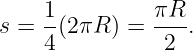
The path length is one quarter of the circumference:
For R = 2.0 m,
The displacement vector is
so
Its magnitude is
The traveled distance and displacement magnitude are different because the particle followed a
curved path.
14 Common mistakes
- Confusing position with distance from the origin. Position in one dimension is
signed, and in multiple dimensions it is a vector.
- Using initial minus final. Displacement is final position minus initial position.
- Adding path lengths to obtain displacement. Path length gives distance traveled,
not displacement.
- Subtracting vector magnitudes instead of vectors. In two or three dimensions,
compute rf − ri component by component.
- Treating a position-time graph as the physical trajectory. The axes of such a
graph are position coordinate and time, not two spatial coordinates.
- Assuming position is absolute. Numerical position depends on the chosen origin
and reference frame.
15 Practice problems
M01-01-P01
A particle is at Cartesian coordinates (3,−4) m. Write its position vector and find its
magnitude.
M01-01-P02
A cart moves from xi = 7 m to xf = −2 m. Find its displacement.
M01-01-P03
A person walks from x = 0 to x = 8 m, then back to x = 3 m. Find the total displacement and
total distance traveled.
M01-01-P04
A particle moves from (1, 2) m to (7,−6) m. Find the displacement vector and its magnitude.
M01-01-P05
A particle moves from (2,−1, 4) m to (−3, 5, 1) m. Find Δr and |Δr|.
M01-01-P06
A runner completes one full lap of a circular track of radius 50 m. Find the total displacement and
total distance traveled.
M01-01-P07
A particle moves along a semicircle of radius R from one end of a diameter to the other. Express
the distance traveled and displacement magnitude in terms of R.
M01-01-P08
The positions of a particle at three successive instants are r0, r1, and r2. Show algebraically that
Δr01 + Δr12 = Δr02.
M01-01-P09
A one-dimensional position is given by
with t in seconds. Find the positions at t = 1 s and t = 4 s and the displacement over that
interval.
M01-01-P10
A coordinate origin is shifted by a = 5ex − 2ey m. An object moves from ri = 8ex + ey m to
rf = 11ex + 7ey m. Find the initial and final position vectors in the shifted coordinates and verify
that the displacement is unchanged.
16 Practice answer check
- r = 3ex − 4ey m, |r| = 5 m.
- Δx = −9 m.
- Displacement = +3 m; distance = 13 m.
- Δr = 6ex − 8ey m; magnitude 10 m.
- Δr = −5ex + 6ey − 3ez m; magnitude
 m ≈ 8.37 m.
- Displacement = 0; distance = 100π m.
- Distance = πR; displacement magnitude = 2R.
- The r1 terms cancel, leaving r2 − r0.
- x(1) = 4 m, x(4) = −2 m, displacement = −6 m.
- ri′ = 3ex + 3ey m, rf′ = 6ex + 9ey m, and Δr = 3ex + 6ey m in either origin.
17 Summary
The essential results are:
- Position specifies where an object is relative to a chosen frame and origin.
- In three-dimensional Cartesian coordinates,
- Displacement is the change in position,
- Displacement depends only on the endpoints; distance traveled depends on the
path.
- For any path,
- A closed trip has zero total displacement even when the distance traveled is nonzero.
- A constant shift of coordinate origin changes position vectors but not the displacement
between the same two points.
The next article, M01-02, develops velocity from the rate of change of position.
Source and provenance note
This entry upgrades the existing PhysicsLibrary position definition (object 251). The exposition,
examples, figures, and exercise set are original PhysicsLibrary material. Scope and terminology
were benchmarked against the archived 2016 CC BY 4.0 University Physics volume 1 treatment of
position/displacement and the CC BY-SA 4.0 UCD Physics 9A Classical Mechanics treatment of
one- and multi-dimensional motion.
References
[1] PhysicsLibrary, position, object 251, existing definition entry.
[2] OpenStax / cnxuniphysics, University Physics Volume 1, archived 2016 BCcampus
clone, sections on position, displacement, and displacement vectors, CC BY 4.0.
[3] T. Weideman, UCD Physics 9A - Classical Mechanics, sections 1.3 and 1.6, Physics
LibreTexts, CC BY-SA 4.0.
[4] J. R. Taylor, Classical Mechanics, University Science Books, 2005.