The velocity of an object is the time derivative of its position. It is usually denoted by the symbol
v or by ẋ (where x stands for position and the dot for the time derivative). Velocity can be
considered either as a vector quantity or as a scalar quantity. If there is more than
one spatial dimension and the direction of motion is important, the vector quantity v
is used. In the case of one spatial dimension, it is common to view the velocity as a
scalar quantity, v (although it is formally a vector with only one component). In both
cases, if only the magnitude of the velocity is of importance, the speed can be used,
which is defined as the absolute value of the velocity and is also denoted by v, or by
|v|.
The SI unit of velocity is m∕s (metres per second). Other units of velocity are also used, such as
kilometres per hour (km∕h) and the speed of light, c = 299 792 458 m∕s.
The definition of velocity can be written as
In addition to this definition of velocity as the instantaneous rate of change of the position, the
average velocity, or the change in position Δx over a specified period of time Δt, is also
used:
In Classical Mechanics, the velocity of an object with mass m enters into the equations for its
momentum,
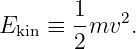
and its kinetic energy,
Notice that this last equation is an example where only the speed of the object, and not the
direction of motion, is important.
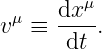
In special (and general) relativity, there are two distinct concepts of velocity. The first, called
coordinate velocity, is the rate of change of the position of an object with respect to time as
measured by the observer:
The second, called proper velocity or world velocity, is the derivative of the position of the object
with respect to its proper time, τ:
Only the proper velocity is a vector in the full sense of the word: to express the proper velocity
in a different coordinate system, all that needs to be done is multiplying the vector
on the left by the Jacobian matrix of the coordinate transformation (in the case of
Lorentz transformations in special relativity, this is just The Lorentz transformation
matrix itself). In mathematical terms, this is a consequence of the fact that the proper
velocity is a tangent vector to the spacetime manifold. To express the coordinate velocity
in a different coordinate system, on the other hand, the relation between coordinate
time and proper time in each of the two coordinate systems needs to be taken into
account.