Particle in Physics: Definition, Models, and Uses
The word particle is one of the most common words in physics, but it does not always mean “a
tiny hard ball.” In most physical theories, a particle is a model: an entity whose relevant state can
be described by a small set of variables, such as position, momentum, mass, Electric Charge, or
spin, while some or all of its internal structure is ignored.
A useful working definition is:
A particle is a physical entity or idealized model treated as spatially localized
enough that its motion and interactions can be represented by a finite set of
degrees of freedom rather than by resolving its full internal structure or spatial
extent.
The exact meaning depends on the theory. A baseball, planet, molecule, electron, photon, and
phonon can all be called particles, but they are not particles in precisely the same sense.
Understanding the word therefore requires understanding the modeling level being used
[1, 2, 4, 5].
1 The particle as a model
Suppose a real object has a characteristic size a, while the physical problem varies over a much
larger length scale L. If
then the object’s spatial extent may be unimportant for the question being asked. Instead of
tracking every point inside the object, we replace the object by one representative point, usually its
center of mass.

Figure 1. A finite object can be replaced by a point-particle model when its size is small
compared with the characteristic length scale of the problem and when rotation, deformation, and
internal structure do not matter.
The idealized particle then has a position
and its motion is described by the velocity
and acceleration
In elementary Classical Mechanics, a particle with constant mass m has linear momentum
and obeys Newton’s second law
For constant mass this becomes
The power of the particle model is that a complicated body has been reduced to a small number of
dynamical variables.
2 What a point particle means
A point particle is the limiting idealization in which the object’s spatial dimensions are taken to be
zero for the purposes of the model. Its mass, charge, and other properties are treated as if they
were concentrated at one location.
This does not mean that every object described as a point particle is physically infinitesimal. Earth
is not a point. A spacecraft is not a point. A baseball is not a point. They can nevertheless be
excellent point-particle models for some questions.
The approximation is appropriate when effects that depend on finite size are negligible. Examples
include:
- the trajectory of a baseball when spin and aerodynamic torque are ignored;
- Earth’s orbit around the Sun when Earth’s rotation, tides, oblateness, and internal
structure are not needed;
- a spacecraft orbit when attitude dynamics are temporarily separated from translation;
- a molecule in an ideal-gas model when its internal vibrational and rotational states are
not being resolved.
The same object can require a more detailed model for a different problem. Earth may be a point
mass in a first orbital calculation, a rotating rigid body in an attitude problem, an
oblate gravitating body in precision orbit determination, or a deformable continuum in
geophysics.
3 Particle state and trajectory
A classical particle traces a path through physical space. Its position at time t is r(t), so the
complete set of positions forms its trajectory.

Figure 2. A classical particle is represented by a position on a trajectory together with dynamical
quantities such as velocity, momentum, and applied force.
For a single particle moving in three dimensions, one often writes
The six numbers
form a point in the particle’s classical phase space.
If the forces are known, Newtonian mechanics provides differential equations that propagate this
state forward in time. In hamiltonian mechanics, the same information is organized as generalized
coordinates and conjugate momenta.
4 Particles in Lagrangian mechanics
The particle idea is not tied only to Newton’s force law. For a particle with kinetic energy T and
potential energy V , define the Lagrangian
For Cartesian motion of a particle of mass m,
The particle follows a stationary path of the action
Applying the Euler–Lagrange equation to each generalized coordinate qi,
produces the particle’s equations of motion [2, 1].
Thus the particle is also the basic dynamical object in analytical mechanics and the calculus of
variations.
5 Systems of particles
Many bodies are modeled as collections of particles. Consider N particles with masses mi and
positions ri. The total mass is
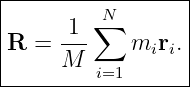
and the center of mass is
The total linear momentum is
For constant particle masses,
If internal forces obey Newton’s third law in the usual pairwise form, they cancel in the total
momentum balance and
This is why a complicated system can sometimes be treated as a single particle located at its
center of mass when only translational motion is of interest.
6 From particles to rigid bodies and continua
The point-particle model is only one level in a hierarchy of physical descriptions.

Figure 4. Model hierarchy. More detailed models retain more spatial information and more degrees
of freedom. The appropriate choice depends on the physical question and required accuracy.
A useful progression is
A rigid body retains finite size and orientation but neglects deformation. A continuum allows
density, stress, temperature, velocity, and other quantities to vary from point to point. A field
theory treats physical quantities as fields defined throughout spacetime.
These descriptions are not competing claims about what an object “really is.” They are models
with different resolutions.
7 Test particles, tracer particles, and material points
Several related terms appear frequently.
Test particle
A test particle is assumed to respond to a field without significantly changing that field. For
example, an ideal test charge probes an Electric Field while its own electric field is neglected. In
gravitation, a test mass follows The Gravitational Field while its contribution to the field is treated
as negligible.
Tracer particle
A tracer particle is used to follow motion in a medium. Its trajectory may be used to
infer a fluid velocity or transport process while its feedback on the flow is assumed
small.
Material point
In continuum mechanics, a material point labels a small piece of matter carried with the
continuum. It is a bookkeeping element of the continuum rather than necessarily an individual
atom or fundamental particle.
8 Particle approximation and scale
The quality of a particle approximation is often controlled by dimensionless ratios. Suppose an
object has radius a and moves in a field whose characteristic spatial variation occurs over scale L.
A simple measure is
When
finite-size corrections are often small.
As an illustration, Earth’s mean radius is approximately
while one astronomical unit is approximately
Therefore
For a first calculation of Earth’s heliocentric orbit, treating Earth as a particle is therefore
extremely natural. The approximation becomes insufficient when one asks about tides, Earth’s J2
gravity term, rotational attitude, or internal deformation.
9 Particles in special relativity
In relativity, a classical particle traces a worldline through spacetime. Its four-position may be
written
where τ is proper time for a massive particle.
The four-velocity is
and the four-momentum is
For a free massive particle,
for the + −−−metric convention. In three-vector language this gives the familiar energy–momentum
relation
Thus the particle concept survives relativity, but the natural geometry is a worldline in spacetime
rather than merely a path in three-dimensional space.
10 Particles in quantum mechanics
A quantum particle should not generally be imagined as a tiny classical ball following one definite
trajectory that is merely hidden from us. In nonrelativistic quantum mechanics, a particle is
represented by a quantum state such as a wavefunction
The probability density for a position measurement is
Position and momentum are observables represented by operators. The momentum operator in
position representation is
The particle can exhibit interference, diffraction, tunneling, and superposition. Nevertheless,
measurements may produce localized detection events, which is one reason particle language
remains useful [4].
Quantum particles may also possess intrinsic degrees of freedom, especially spin. These are not
interpreted as literal mechanical rotation of an extended classical object.
11 Identical particles
In classical mechanics, two particles can usually be labeled “particle 1” and “particle 2” without
physical ambiguity. Quantum mechanics changes this for identical particles.
For identical bosons, the many-particle wavefunction is symmetric under exchange.
For identical fermions, it is antisymmetric. The exchange properties are not merely
bookkeeping: they produce effects such as Bose–Einstein statistics and the Pauli exclusion
principle.
Thus in quantum theory the concept of a particle includes not only localization and dynamical
properties but also exchange symmetry.
12 Particles in quantum field theory
Modern high-energy physics goes one step further. The most fundamental description is not usually
“little particles moving through empty space.” Instead, quantum fields are treated as
fundamental dynamical objects, and particles arise as quantized excitations of those fields
[5].
In a free quantum field, a one-particle state can have definite momentum, energy, spin, and
other quantum numbers. For example, photons are excitations of the electromagnetic
field.
This viewpoint leads to an important conceptual refinement:
In quantum field theory, a particle is often best understood as a quantum
excitation characterized by definite conserved or approximately conserved
quantum numbers, rather than as a permanently identifiable microscopic object
with a classical trajectory.
The particle picture remains extremely powerful, especially for asymptotic states entering and
leaving scattering experiments, but the field description is more fundamental in relativistic
quantum theory.
13 Quasiparticles
Condensed-matter physics extends the particle idea even further. Collective motion inside matter
can behave mathematically like particles even though no corresponding elementary particle exists
in vacuum.
Examples include phonons, magnons, excitons, and other quasiparticles. A phonon, for example, is
a quantized excitation of a lattice vibration. It can carry energy and momentum through a crystal
and can be created or destroyed in interactions.
This demonstrates that “particle” in physics is fundamentally a statement about a useful
dynamical description, not necessarily about a tiny indivisible piece of matter.
14 When the particle model fails
A particle model should be replaced by a more detailed description whenever neglected degrees of
freedom affect the answer. Common failure modes include:
- rotation: torque and attitude matter, so a rigid-body model is required;
- deformation: shape changes matter, so continuum mechanics or elasticity is needed;
- finite-size forces: tidal or gradient effects vary significantly across the body;
- internal energy states: molecular rotation, vibration, or excitation cannot be
neglected;
- wave behavior: diffraction and interference require a wave or quantum description;
- strong interactions or particle creation: a quantum-field description may be
required.
The correct question is therefore not simply “Is this object a particle?” but rather
Is the particle model accurate enough for the physics I am trying to calculate?
15 Summary
A particle is one of the most useful abstractions in physics. In classical mechanics it is an object
represented primarily by position and momentum. A point particle neglects spatial extent. Systems
of particles build up center-of-mass dynamics and provide a bridge to rigid bodies and continua. In
relativity, a particle follows a worldline. In quantum mechanics, a particle is described by a
quantum state and need not possess a classical trajectory. In quantum field theory, particles appear
as excitations of fields, while condensed-matter physics uses particle-like quasiparticles to describe
collective motion.
The central modeling idea is
That principle explains why the same physical object may be treated as a point particle in one
calculation and as a rigid body, continuum, or quantum field in another.
References
References
[1] J. R. Taylor, Classical Mechanics, University Science Books, 2005.
[2] H. Goldstein, C. Poole, and J. Safko, Classical Mechanics, 3rd ed., Addison-Wesley,
2002.
[3] L. D. Landau and E. M. Lifshitz, Mechanics, 3rd ed., Butterworth-Heinemann, 1976.
[4] D. J. Griffiths and D. F. Schroeter, Introduction to Quantum Mechanics, 3rd ed.,
Cambridge University Press, 2018.
[5] M. E. Peskin and D. V. Schroeder, An Introduction to Quantum Field Theory,
Westview Press, 1995.
[6] C. W. Misner, K. S. Thorne, and J. A. Wheeler, Gravitation, W. H. Freeman, 1973.



![|------∫--t2------------|
|S[r] = L(r, ˙r,t)dt.
| t1 |
------------------------](https://images.physicslibrary.org/cache/objects/1280/make4ht/Particle11x.png)