The center of mass (en: centre of mass) of an object is a point in physical pace where, for
computational purposes in theoretical mechanics, the mass of the object can be considered to be
concentrated. This concept is most often used for rigid bodies, but applies to any macroscopic
arrangement of matter. The centre of mass can be used as a geometrical concept that allows in
several ways to simplify an apparently complicated system or problem by treating an entire rigid
body as a “point particle”. For example, a rigid body hung from a string in a uniform gravitational
field will have its centre of mass straight below the string if it is at rest. More generally,
as long as the only forces acting are gravity and the tension in the string, in order to
compute the motion of the object in space (disregarding possible rotations) one can
conceptually replace the solid object by a point particle located at the object’s centre of
mass.
The momentum of an object with total mass M is
and if a total force F acts on the object, Newton’s second law may be formulated as
In these equations vcm and acm are the velocity and the acceleration of its centre of mass,
respectively; these are defined below.
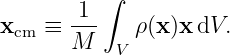
The centre of mass of a solid object, rigid body, etc., occupying a region V in space, is defined
as the average position of all the points of V , each point x being weighted with the
density of the object at that point, ρ(x). This average is a volume integral over the region
V :
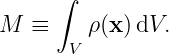
Here M is the total mass of the object:
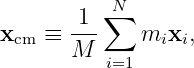
If the object consists of a number of point particles, these integrals become sums over the particles.
The centre of mass of a collection of N particles with masses m1,m2,…,mN located at the positions
x1,x2,…,xN is
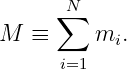
where M is now the sum of the masses of the particles:
The velocity and acceleration of the centre of mass are now simply defined as the first and second
time derivatives of xcm: