The following is a contributed topic on functorial algebraic geometry and physics:
“Functorial Algebraic Geometry: An Introduction” -by Alexander Grothendieck
0.0.1 Vol.1: Affine Algebraic Geometry
(Following the Notes typewritten in English and edited by P. Gaeta, without implying the approval
by A. Grothendieck of these notes.)
A century ago algebraic Geometry could be contained in Klein’s book (1880; Dover publs. 1963) :
“On Riemann’s theory of Algebraic Functions and Their Integrals”. Furthermore, “the
distinction between pure and applied mathematics was then to a large extent artificial and
unimportant” (viz. P. Gaeta). For example in Klein’s book cited above “the study of
Riemann surfaces was introduced by considering the practical physical problem of laminar
flow in a plane or arbitrary surface. He even quotes Maxwell’s treatise on page one.
The natural continuation of such a ‘transcedental approach’ in our times is the study
of complex algebraic manifolds...” In contrast with Algebraic Geometry, the popular
beliefs regarding Differential Geometry are totally different: the latter never lost its
flavor of applicability; such practical examples of differentiable manifolds are natural
examples of locally ringed spaces. “Thus, if a reader is familiar with differentiable manifolds,
Grothendieck’s schemes cannot look so terribly abstract...; we do not assume knowledge of
differentiable manifolds as a logical pre-requisite for this course, but a student interested
in applications should be interested in differentiable manifolds. The purpose of this
informal Introduction is to develop an analogy between these new mathematical objects
introduced by Grothendieck (that is, in Algebraic Geometry) and certain objects within
the structure of Mathematical Physics...” Consider the ‘configuration space’ V n or the
‘phase space’ W2n of a holonomic dynamical system ‘with n-degrees of freedom’; for any
problems concerning V n one should only consider local functions f : U → R defined
within an open set U ⊂ V n. As an example, a Lagrangian coordinate function qi (with
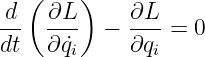
i = 1, 2,...,n) is only defined locally for a certain coordinate chart. The Lagrange equations of
motion:
are valid only in a certain local coordinate system (q1,...,qn). In order to examine the behavior of
the dynamic system globally one must piece together local functions corresponding to different sets
U, and this is achieved by verifying first that the set of functions [f : U → ℝ|U ⊂ V n] form a
commutative ring with unit Γ(U) under pointwise addition and multiplication for such U. If
V ⊂ U, then there is a natural restriction map rV U : Γ(U) → Γ(V ) which assigns to every
ϕ : U → ℝ its restriction map with respect to V , that is, rV U = ϕ|V : V → ℝ. This also means–in
other words–that the local C∞- differentiable functions on U form , or define, a ‘presheaf’ (viz.
Ch.III).
Next one must consider the “germ” of f : U → ℝ at any point x ∈ U. Thus, let f : U → ℝ and
g : V → ℝ be two such local functions; one then notes that f and g are equivalent
functions, f g, if they agree on W ⊂ U ∩ V |xnotin ⊂ U ∩ V . The germ of f at the
point x ∈ W denoted by x is the equivalence class of functions determined by this
g, if they agree on W ⊂ U ∩ V |xnotin ⊂ U ∩ V . The germ of f at the
point x ∈ W denoted by x is the equivalence class of functions determined by this  relation. One notes that this definition appears in elementary ‘complex analysis’ in one
variable. One can readily check that the germs x for all x ∈ W form a local ring (in
the modern sense of the concept). Henceforth, with the addition of several topological
properties, one can define a ‘sheaf of germs of local C∞-differentiable functions of M’
denoted by ΘM. ΘX in the case when X is a topological space can be then defined as the
disjoint sum ∪x∈MΘM,x of the local rings ΘM,x for every point of X. Therefore, the
differentiable manifold V n or W2n of Classical Mechanics (or indeed, any differential
manifold) is an example of a locally ringed space (X, Θx), that is a topological space X
with a structure sheaf ΘX. Grothendieck’s schemes are also locally ringed spaces
(X, ΘX).
relation. One notes that this definition appears in elementary ‘complex analysis’ in one
variable. One can readily check that the germs x for all x ∈ W form a local ring (in
the modern sense of the concept). Henceforth, with the addition of several topological
properties, one can define a ‘sheaf of germs of local C∞-differentiable functions of M’
denoted by ΘM. ΘX in the case when X is a topological space can be then defined as the
disjoint sum ∪x∈MΘM,x of the local rings ΘM,x for every point of X. Therefore, the
differentiable manifold V n or W2n of Classical Mechanics (or indeed, any differential
manifold) is an example of a locally ringed space (X, Θx), that is a topological space X
with a structure sheaf ΘX. Grothendieck’s schemes are also locally ringed spaces
(X, ΘX).
Thus, sheaves were introduced to provide a transition from local to global properties. Therefore,
“the global study of curves which solve the classical equations of motion–which is a difficult
problem–has been simplified by the introduction of sheaves”.
Following Dieudonné ’s and Grothendieck’s famous “Élements de Géometrie Algébrique”, and
Dieudonné ’s “Algebraic Geometry” and “Fondements de la Géometrie Algébrique.” Adv. in
Math. (1969), Alexander Grothendieck presented in 1973 a Buffalo Summer Course
entitled: “Survey on the functorial approach to affine algebraic groups”. This was preceded
by a lecture introducing the functorial ‘language’ approach (Introduction au Langage
Fonctoriel)
Grothendieck also organized and presented most of the four famous SGA seminars (SGA-1 to
SGA-4), “Séminaires de Géometrie Algébrique” (Seminars of Algebraic Geometry.) . Other
relevant references were: Kähler’s “Geometria arithmetica” (1958), S. MacLane’s “Homology”
(1963), Manin’s “Lectures on Algebraic Geometry”, Mumford’s “Introduction to Algebraic
Geometry”, and J.P. Serre’s “Faisceaux algébrique cohérents.” (Coherent Algebraic Sheaves). In
1968 was also published by North-Holland the book “Dix exposés sur la cohomologie des
schémes” (Ten expositions on the cohomology of schemes) by J. Giraud and Alexander
Grothendieck.