Physics Library
 An open source physics library
Encyclopedia | Forums | Docs | Random  

Lagrange's equations

(Definition)

There are certain general principles or theorems in mechanics, such as Lagrange’s equations, Hamilton’s principle, the principle of least work, and Gauss’ principle of least constraint, which afford general solutions of certain types of problems. Such general principles have therefore the advantage over ordinary methods in that once having found the general solution, any particular problem may be solved by merely routine processes.

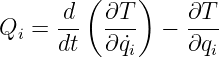
The general form of Lagrange’s equation for the generalized coordinates qi is given as

        (    )
      d   ∂T      ∂T
Qi =  --  ---   − ---
      dt  ∂q˙i     ∂qi
(1)

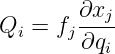
where T is the kinetic energy and Qi is the generalized forces which is related to the system forces through

Q  = f  ∂xj-
  i    j∂qi

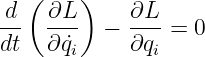
The more common form, used when the forces for the dynamical system can be found from a scalar potential function V , is

  (     )
d   ∂L      ∂L
dt  ∂-˙q   − ∂q- = 0
       i       i
(2)

where L, the Lagrangian function (or, simply, Lagrangian), is the difference between the kinetic and potential energy

L =  T − V

"Lagrange's equations" is owned by bloftin.
(view preamble)
View style:
See Also: Functorial Algebraic Geometry and Physics

Also defines:  Lagrangian, Lagrangian function

Cross-references: potential energy, function, scalar, dynamical system, system, forces, kinetic energy, generalized coordinates, types, work, Hamilton's principle, mechanics, theorems
There are 32 references to this object.

This is version 6 of Lagrange's equations, born on 2008-07-16, modified 2010-02-17.
Object id is 284, canonical name is LagrangesEquations.
Accessed 3903 times total.

Classification:
Physics Classification: 45.20.Jj (Lagrangian and Hamiltonian mechanics)

Pending Errata and Addenda

None.

Discussion

No messages.

Interact