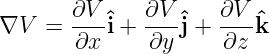
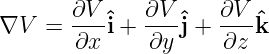
The gradient is the vector sum of the resultant rate of increase of a scalar funcion V and is denoted
∇V . It represents a directed rate of change of V . A directed derivative or vector derivative of V , so
to speak. In Cartesian coordinates
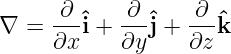
It is common to regard ∇ as the gradient operator which obtains a vector ∇V from a scalar
function V of position in space.
Thus it is easy to work with just the gradient operator
This symbolic operator ∇ was introduced by Sir W. R. Hamilton. It has been found by experience
that the monosyllable del is so short and easy to pronounce that even in complicated formulas in
which ∇ occurs a number of times no inconvenience to the speaker or hearer arises from the
repetition. ∇V is read simply as ”del V .”
0.1 Coordinate System Independence
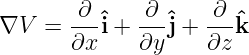
Although this operator ∇ has been defined as
so that it appears to depend upon the choice of the axes, it is in reality independent of them. This
would be surmised from the interpretation of ∇ as the magnitude and direction of the most rapid
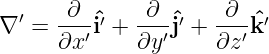
increase of V . To demonstrate the independence take another set of axes, î′, ĵ′, k′
and a new set of variables x′, y′, z′ referred to them. Then ∇ referred to this system
is
Leaving behind the proof of coordinate system independence, here is the gradient opertor in the
most common coordinate systems.
Cartesian Coordinates
Cylindrical coordinates
Spherical coordinates
0.2 References
[1] Wilson, E. ”Vector Analysis.” Yale University Press, New Haven, 1913.
This entry is a derivative of the Public domain work [1].