Weight and Normal Force
Weight and normal force often appear together in introductory mechanics, but they arise from
different interactions and obey different rules. Weight is the gravitational force exerted by Earth on
a body. The normal force is a contact force exerted by a surface and directed perpendicular to that
surface.
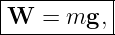
The most important distinction is
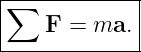
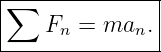
near Earth’s surface, while the magnitude of the normal force usually has to be determined from
Newton’s second law:
There is no universal formula N = mg. That equality is only a result of particular force
balances.
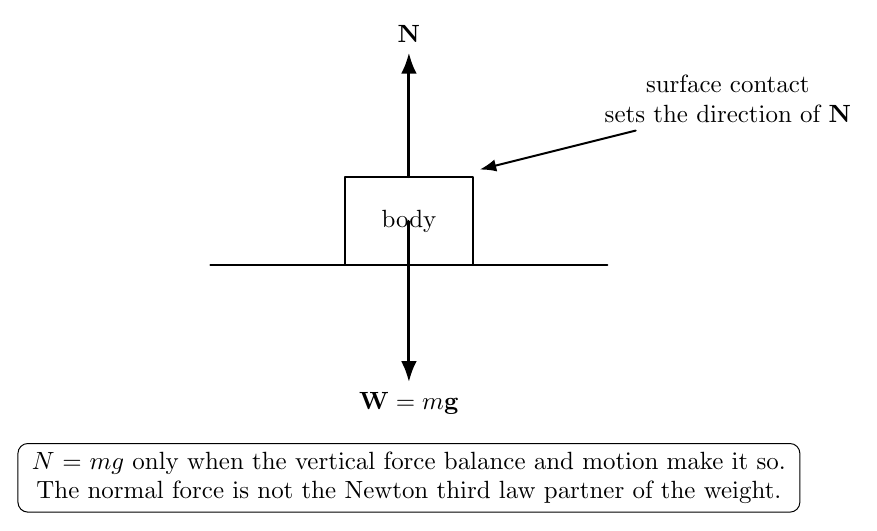
Figure 1. Weight and normal force are different interactions. Weight points with the local
gravitational field, while the normal force is perpendicular to the contact surface. The equality
N = mg occurs only in special cases.
1 Weight near Earth’s surface
Near Earth’s surface, when The Gravitational Field can be treated as uniform, the weight of a
body of mass m is
If the positive y direction is upward, then
so
The magnitude is
Mass and weight are not the same quantity. Mass is measured in kilograms, while weight is a force
measured in newtons. The same body can have the same mass in two locations but different weight
if the local value of g differs.
2 The normal force
When a body is in contact with a surface, the surface can exert a contact force. The component
perpendicular to the surface is called the normal force.
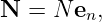
For a frictionless contact, the contact force is purely normal:
where en is the unit vector pointing away from the surface and into the body.
The direction of N is therefore determined by geometry. Its magnitude is determined by the
motion and by the other forces acting on the body.
A simple contact surface can push on a body but cannot pull it. For that reason,
If an equation of motion would require N < 0, the assumed contact cannot be maintained. The
body loses contact and the correct model changes to N = 0 until contact is restored.
3 Why N = mg is not a general law
Consider a body resting on a horizontal floor with no other vertical forces. Taking upward as
positive,
If
then
The equality follows from this particular acceleration and force set. Change the acceleration or add
another vertical force and the result changes.
For example, if an external force F pulls upward at angle α above the horizontal while ay = 0,
then
so
An upward component reduces the normal force. A downward applied component increases
it.
4 Weight and normal force are not a Newton third law pair
It is common to see N and mg drawn as equal and opposite on a stationary body and then
incorrectly call them a Newton third law pair. They are not.
The force
is Earth’s gravitational force on the body. Its Newton third law partner is the body’s gravitational
force on Earth.
The force
is the surface’s contact force on the body. Its Newton third law partner is the body’s contact force
on the surface.
The normal force and weight can balance on one body, but a third law pair always acts on two
different bodies.
5 Apparent weight and scale readings
A bathroom scale does not directly measure the gravitational force mg. It measures a contact force
associated with the deformation of the scale. In the usual model this reading is the normal force
magnitude N.
This measured support force is often called the apparent weight.
For a person of mass m in an elevator, choose upward as positive. Newton’s second law
gives
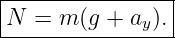
Hence
This one signed equation covers all vertical elevator cases.
If the acceleration is upward,
If the acceleration is zero,
If the acceleration is downward but smaller in magnitude than g,
The direction of the velocity does not determine the scale reading. An elevator can be moving
upward while slowing down; its acceleration is then downward and the scale reads less than
mg.
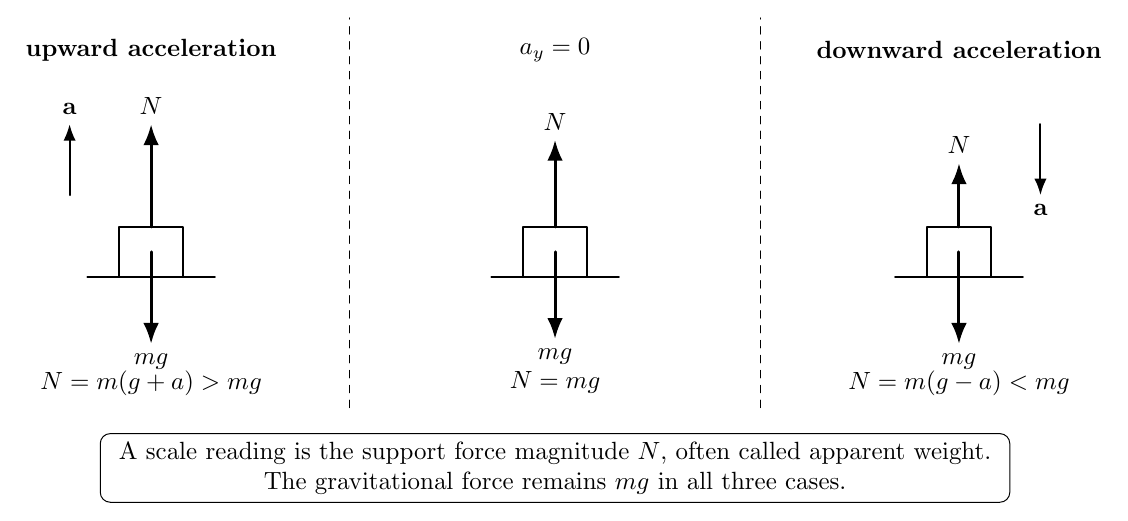
Figure 2. Apparent weight is the support force measured by a scale. Upward acceleration raises
the scale reading, downward acceleration lowers it, and zero acceleration gives N = mg. The
gravitational force remains mg in all three cases.
6 Free fall and apparent weightlessness
If the elevator and person are both in ideal free fall, then
Therefore
which gives
The person is not without gravity. Gravity is precisely what produces the free fall. The apparent
weight is zero because there is no supporting contact force.
This distinction is important in orbital motion as well: astronauts in orbit experience gravity but
are in continuous free fall, so local support forces can be very small.
7 Normal force on an inclined plane
For a body on a plane inclined by angle 𝜃, choose one axis parallel to the plane and one axis
normal to it. The normal component of weight is
while the component parallel to the plane is
If the body has no acceleration normal to the plane and no other force has a normal component,
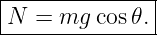
then
so
Again, this is not a universal normal force formula. It follows from the stated geometry, force set,
and normal acceleration.
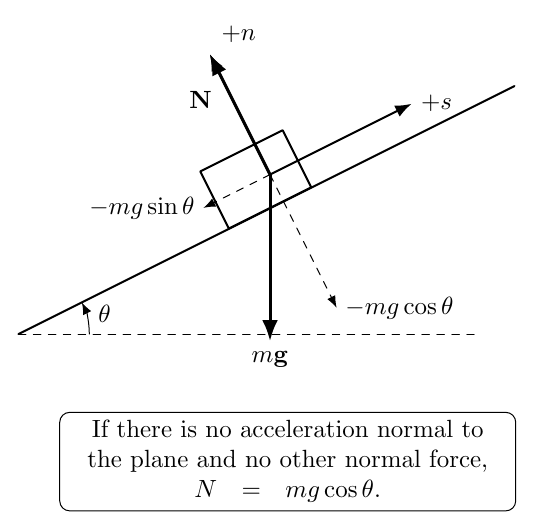
Figure 3. On an inclined plane, resolving weight into axes parallel and normal to the surface
makes the normal force equation transparent. The result N = mg cos𝜃 requires zero normal
acceleration and no additional normal force.
8 Normal force on a curved path
A contact surface can constrain a body to follow a curved path. Even if the speed is constant, the
body can have normal acceleration
where R is the local radius of curvature.
The normal force must then participate in whatever inward net force is required.
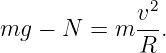
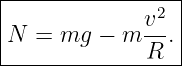
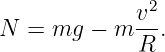
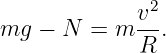
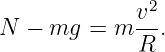
At the crest of a convex hill, the inward direction is downward. For a vehicle whose only vertical
forces are weight and the road’s normal force,
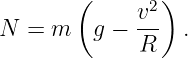
Therefore
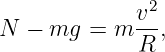
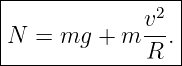
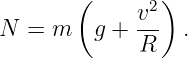
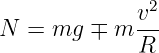
At the bottom of a concave valley, inward is upward, so
and
Thus a rider generally feels lighter at the top of a hill and heavier at the bottom of a
valley.
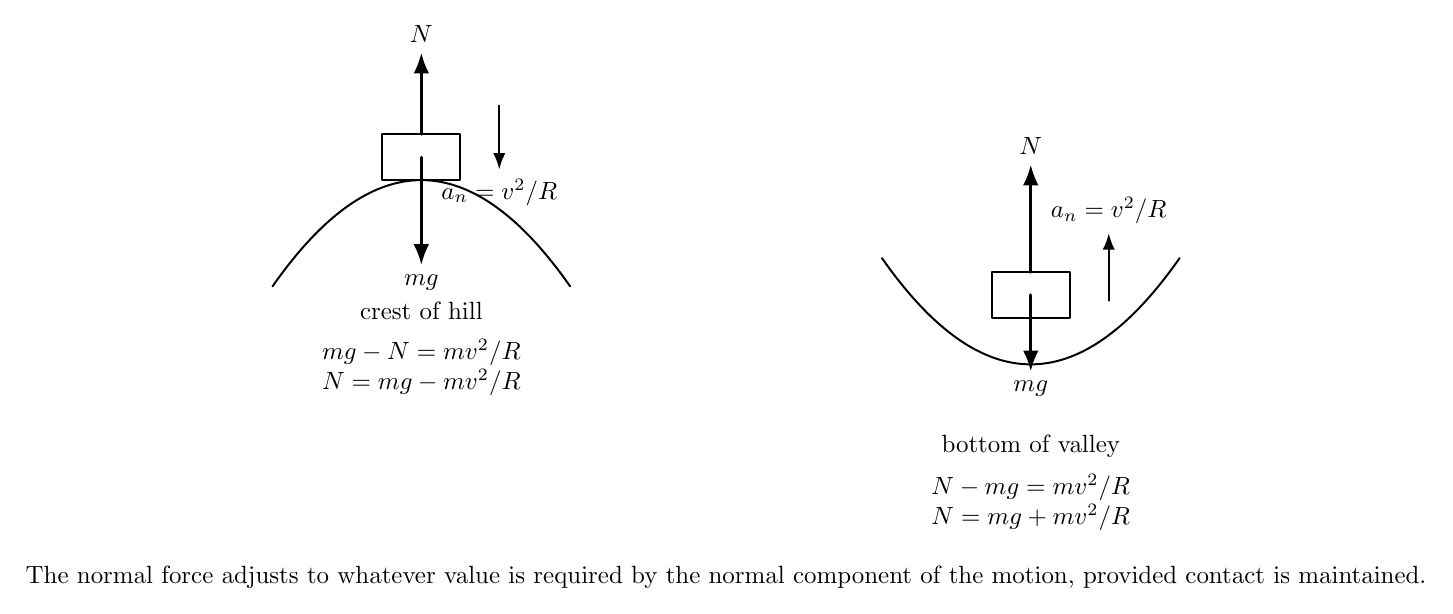
Figure 4. On a curved path, the normal force is determined by the inward acceleration
requirement. At a hill crest it can be smaller than mg; at the bottom of a valley it can be larger
than mg.
9 Loss of contact
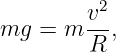
At the crest of a hill,
As the speed increases, the required normal force decreases. The limiting condition for contact
is
Therefore
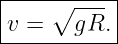
and the threshold speed is
Above this value, the equation for maintained contact would demand a negative normal force. An
ordinary road surface cannot pull the vehicle downward, so the vehicle leaves the surface
instead.
10 A systematic procedure
Normal force problems become much easier if the geometry is handled before the algebra.
- Choose the body or system.
- Draw only the external forces acting on it.
- Identify the contact surface and draw N perpendicular to it.
- Choose an axis normal to the surface or inward toward the local center of curvature.
- Determine the acceleration component along that axis.
- Apply Newton’s second law along that direction.
- Check that the final result satisfies N ≥ 0 when contact is assumed.
11 Worked example 1: scale reading in an accelerating elevator
A person of mass
stands on a scale in an elevator accelerating upward at
Taking upward as positive,
Therefore
Using g = 9.81 m∕s2,
Thus the scale reads
The person’s gravitational force is still
The larger scale reading is caused by the upward acceleration, not by a change in gravity.
12 Worked example 2: block on an incline
A 12.0 kg block rests on a frictionless plane inclined at
There is no acceleration normal to the plane. Therefore
Substituting,
so
Notice that the normal force is smaller than the full weight mg ≃ 117.7 N because only the
component of weight perpendicular to the plane is balanced by N.
13 Worked example 3: vehicle at the crest of a hill
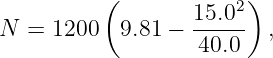
A 1200 kg vehicle crosses the crest of a hill whose local radius of curvature is
at speed
At the crest, inward is downward. Thus
The mass cancels if we solve symbolically first:
Therefore
which gives
The vehicle’s weight is about 1.18 × 10⁴ N, so the road supports it with substantially less force at
the crest.
The contact threshold is
At that speed the required normal force would fall to zero.
14 Worked example 4: rider at the bottom of a valley
A 60.0 kg rider passes through the bottom of a circular valley of radius
at speed
At the bottom, inward is upward. Therefore
Hence
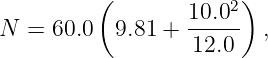
Substituting,
so
The rider’s ordinary weight is only
so the support force at the bottom is nearly twice as large.
15 Practice problems
- A 5.0 kg book rests on a horizontal table with no other vertical forces. Find its weight
magnitude and the normal force magnitude.
- A 65 kg passenger stands on a scale in an elevator accelerating upward at 2.0 m/s2.
Find the scale reading.
- The same passenger is moving upward but slowing at 2.0 m/s2. Find the scale reading
and explain why the direction of motion is not enough to determine the result.
- A 10 kg block rests on a frictionless 30∘ incline. Find the normal force.
- A 20 kg crate is on a horizontal floor. A rope pulls with force 80 N at 35∘ above
horizontal, and there is no vertical acceleration. Find the normal force.
- A 1000 kg CAR crosses the crest of a hill of radius 50 m at 18 m/s. Find the normal
force from the road.
- For the hill in Problem 6, find the speed at which the car just loses contact with the
road.
- A 75 kg rider passes through the bottom of a circular dip of radius 20 m at 12 m/s.
Find the support force on the rider.
- A person stands on a scale inside an elevator in ideal free fall. What does the scale
read? Is the gravitational force zero?
- A block remains in contact with a moving platform. Explain how a calculated value
N < 0 should be interpreted physically.
16 Answer check
- W = 49.1 N and N = 49.1 N.
- N = 65(9.81 + 2.0) = 768 N.
- The acceleration is downward, so N = 65(9.81 − 2.0) = 508 N. Velocity direction does
not set the force balance.
- N = mg cos 30∘ = 85.0 N.
- N = mg − F sin 35∘ ≃ 150 N.
- N = m(g − v2∕R) = 3.33 × 10³ N.
- v =
 = 22.1 m/s.
- N = m(g + v2∕R) = 1.28 × 10³ N.
- N = 0. Gravity is not zero; the person and scale are both in free fall.
- An ordinary contact surface cannot supply a negative normal force. Contact is lost and
the correct model sets N = 0 until the bodies meet again.
17 Summary
Weight and normal force are fundamentally different interactions. Near Earth’s surface,
while the normal force is determined from the contact geometry and Newton’s second
law.
For common situations,
for a vertical elevator when upward is positive,
for a simple incline with zero normal acceleration, and
at the crest or bottom of a vertical curved path when weight and the support force are the only
forces in the normal direction.
The common theme is not memorizing separate formulas. It is choosing the correct normal
direction and applying
References
[1] PhysicsLibrary, M02-01, Newton’s Laws of Motion.
[2] PhysicsLibrary, M02-02, Free Body Diagrams.
[3] PhysicsLibrary, M02-03, Common Forces in Mechanics.
[4] J. Moore et al., Mechanics Map, CC BY-SA 4.0. Used as an open reference for force
modeling and free body diagram structure.
[5] University of California, Davis, Physics 9A: Classical Mechanics, CC BY-SA 4.0.
[6] Archived 2016 revision of University Physics, Volume 1, CC BY 4.0.