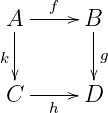
Definition 0.1. A square commutative diagram (as for example in an abelian category 𝒜):
is called commutative iff
where A,B,C, and D are objects of a category 𝒞, and f,g,h and k are, in general, arrows
or “morphisms” (mappings, functions, homomorphisms, homeomorphisms, and so on) of 𝒞.
Remark 0.1. One can intuitively understand commutativity as the equivalence of the two
morphism paths involved, or as an internal, mirror-like symmetry property of the square
diagram with respect to the top-right to bottom-left diagonal. The diagonal morphism,
d : A → D (not shown) is thus equal to both g ∘ f and h ∘ k. The concept of commutative
diagram can be thus generalized for any polyhedron with “diagonal mirror symmetry” of
morphisms oriented in the same direction of the type described for the square diagram shown
above.