Let us now examine the mechanism of conduction in metals, as all good Conductors are metals. We
picture the interior of a conductor as a three dimensional lattice of atoms with free electrons
moving about between the atoms and colliding frequently with them. As the effective radius of an
atom is of the order of (10)−8 cm, while that of an electron is of the order of (10)−13 cm,
we may neglect the collisions between electrons and atoms. The atoms vibrate about
their equilibrium positions, and the electrons move, with a mean energy determined
by the absolute temperature. Tn fact, the atoms have the usual thermal agitation of
any solid, while the electrons collectively behave like a gas at the temperature of the
conductor.
As long as no external electric field is applied to the conductor, the average field in the interior is
zero, since there is as much positive charge as negative in any small volume. Therefore, there is on
the whole no motion of free charges through the conductor. If now we apply a field of
intensity E each charge experiences an acceleration of magnitude eE∕m, where m is the
mass of the charge. This superposes on the random thermal motions of the charges a
general drift, which constitutes the current. The drift velocity is small compared with
the thermal velocities, so that the two motions may be treated as independent. The
mean free time tf between successive collisions of a free charge with some atom is
thus determined by the structure of the conductor and the temperature, but not by
E.
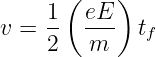
We may now calculate the mean drift velocity and hence the current. Between collisions
the drift velocity is increased on the average by the amount (eE∕m)tf. The effect of
each collision, however, is to restore the random thermal distribution of velocities, that
is, to reduce the drift velocity to zero. Therefore, the mean drift velocity v is given
by
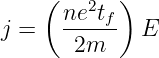
combining this with current density we get
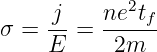
Defining the electrical conductivity σ as the current density produced by a field of unit
strength, we have
Under all ordinary conditions the conductivity is a characteristic of the conducting substance
independent of j or E. It does, however, vary with the temperature. According to the kinetic
theory of gases tf is inversely proportional to the square root of the absolute temperature.
Experimentally it is found, however, that σ is more nearly proportional to the inverse first Power of
the absolute temperature.
The most satisfactory check on the general validity of the electron theory of conduction is obtained
by considering thermal conduction as well as electrical. The mean energy of both the electrons
and the atoms in a body depends on the temperature, so that when a temperature
gradient exists there is also an energy gradient. Energy is transferred from a region of
higher temperature to one of lower by diffusion of the electrons. We may ascribe heat
conduction almost entirely to this cause, since in dielectrics, where there are no free
charges, there is very small conduction of heat. By an analysis similar to that used
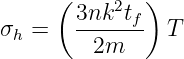
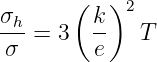
for electrical conductivity it may be shown that the thermal conductivity σh is given
by
where k is a universal constant having the value 1.38 × 10⁻¹⁶ erg per degree, and T is the absolute
temperature.
Taking the ratio of (3) to (2) we find
a relation known as the law of Wiedemann and Franz. It is found to be in good agreement
with experiment, at least in the case of the best conductors, such as gold, silver and
copper.
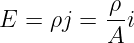
Returning now to (2), the resistivity ρ is defined as the reciprocal of the conductivity, so that,
using (2)
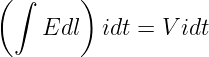
Let us apply the last equation to a wire of length l, the composition and cross section being
uniform throughout its length. Since E is then constant and directed along the wire, El is the
electromotive force V and we may write
The quantity ρl∕A depends only on the absolute temperature under ordinary conditions, being in
fact approximately proportional to it. If we denote ρl∕A by R, we have
which is Ohm’s law. R is called the resistance of the conductor and its reciprocal the
conductance. In the practical system of units, where V is measured in volts and i in apmeres, R
is measured in ohms. Very large resistances are sometimes measured in megohms, a megaohm being
a million ohms.
Ohm’s law may be stated in general terms as follows: The ratio of the electromotive force between
two points on a conductor to the current flowing between these points is a constant, at any given
temperature, known as the resistance.
The passage of current through a conductor evidently is attended by an evolution of heat, since the
moving charges lose their energy to the atoms at each collision. The heat generated per second in a
conductor is easily calculated. The force on the moving charge contained in a length dl is
(Anedl)E. Therefore, the work done on the charge in the length dl of the conductor in a time dt
is
The work for the entire conductor is
so that the work done per second, called the power, is V i. This energy all appears in heat,
as there is no storage of energy in the interior of the conductor. Denoting power by
P,
In the practical system the unit is the joule per second or watt. As the joule is (10)7 ergs, the watt
is (10)7 ergs per second. The number of calories developed per second is obtained by multiplying
the power in watts by 0.238. The total resistance of a conductor of any length and cross section is
calculated by means of the relation
The resistivity at a temperature not greatly different from 00C is given by the formula
where ρ0 is the resistivity at 00C, t is the centrigrade temperature, and α is the temperature
coefficient.
References
[1] Page, Leigh, Adams, Norman Principles of Electricity. S. Chand & CO., Delhi, 1955.
This entry is a derivative of the Public domain work [1]