Induction in Physics: Electromagnetic Induction, Faraday’s Law, and Inductance
In Electromagnetism, induction is the production of an electromotive force, and possibly an
electric current, through a change in magnetic environment. The change may come from a
magnetic field that varies with time, from motion of a Conductor through a magnetic field, or from
a combination of both effects.
The central physical principle is Faraday’s law: changing magnetic flux through a circuit is
associated with an induced electromotive force. The direction of the induced response is described
by Lenz’s law. These ideas underlie electric generators, transformers, induction motors,
wireless charging, pickup coils, many sensors, and the behavior of inductors in electrical
circuits.
The word induction is also used in other contexts. Electrostatic induction refers to redistribution of
Electric Charge caused by an external electric field, while mathematical induction is a method
of proof. Unless otherwise stated, this article uses induction to mean electromagnetic
induction.
1 Magnetic flux
Electromagnetic induction is most naturally expressed using magnetic flux. Consider an oriented
surface S with unit normal n. The vector area element is
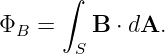
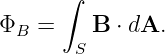
The magnetic flux through the surface is
For a uniform magnetic field over a flat surface of area A,
where 𝜃 is the angle between B and the chosen surface normal.
The SI unit of magnetic flux is the weber:
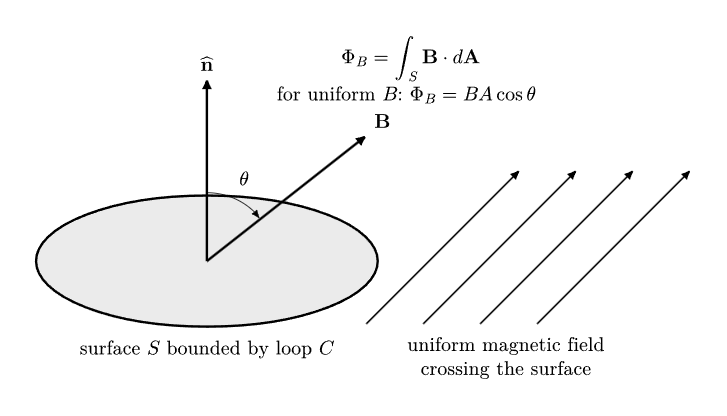
Figure 1. Magnetic flux measures the component of the magnetic field passing through an
oriented surface. The sign depends on the chosen surface normal.
Magnetic flux is not simply “the amount of magnetic field.” It combines field strength, surface
area, orientation, and spatial variation. A flux can change because B changes, because the area
changes, because the surface rotates, or because the circuit moves into a region where the field is
different.
2 Electromotive force
The quantity induced around a closed conducting path is the electromotive force, abbreviated emf
and commonly written ℰ. Despite its historical name, emf is not a force. It is energy transferred
per unit charge around a circuit:
Its SI unit is the volt:
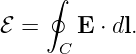
For a closed stationary path C, the emf associated with an electric field is
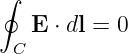
This expression is a line integral. In electrostatics the electric field is conservative, so the
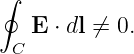
closed-loop integral vanishes. An induced electric field produced by changing magnetic flux is
different: it can have a nonzero circulation around a closed path.
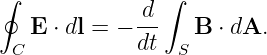
3 Faraday’s law
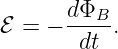
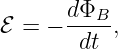
For a fixed conducting loop bounding a surface S, Faraday’s law states
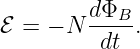
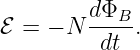
For a coil of N identical turns linked by the same magnetic flux,
The law says that it is the rate of change of flux, not merely the presence of magnetic field, that
produces the induced emf. A large steady magnetic field can produce zero induced emf in a
stationary loop, while a much smaller field changing rapidly can produce a substantial
emf.
For a uniform field through a flat loop,
so induction can result from changes in any of the quantities B, A, or 𝜃.
4 Lenz’s law and the minus sign
The minus sign in Faraday’s law expresses Lenz’s law: the induced effect acts in a direction that
opposes the change in magnetic flux that produced it.
Suppose the magnetic flux through a loop is increasing in one direction. The induced current, if the
circuit is closed, creates its own magnetic field in the opposite direction. If the original flux is
decreasing, the induced current tends to reinforce the original direction and resist the
decrease.
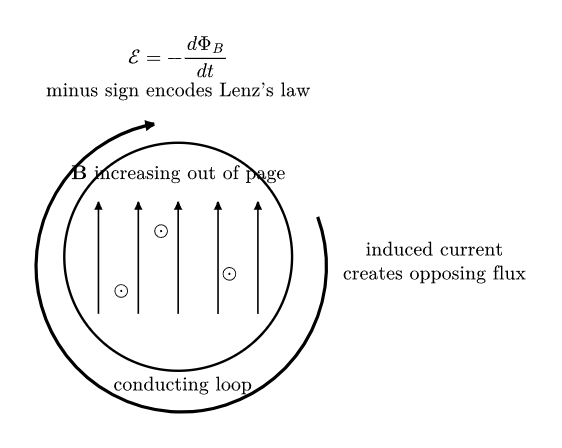
Figure 2. Lenz’s law. The induced current produces magnetic flux that opposes the change in the
original flux. The opposition is to the change, not necessarily to the original magnetic field itself.
Lenz’s law is closely related to energy conservation. If the induced current assisted the flux change
that produced it, a small change could reinforce itself and generate energy without an external
source. Instead, mechanical work or another energy source is required to sustain the
change.
5 A simple worked example
Consider a single circular loop of radius
in a uniform magnetic field perpendicular to the loop. Suppose the field increases from
to
in
The loop area is
Because the field is perpendicular to the loop,
Thus
The magnitude of the average induced emf is therefore
Hence
The current direction is then determined by Lenz’s law after the direction of the original increasing
field is specified.
6 Induction by changing field: transformer emf
A time-varying magnetic field can induce an electric field even when the conducting loop itself does
not move. For a fixed contour, Faraday’s law can be written
This is sometimes called transformer induction. The electric field is not electrostatic: its circulation
around a closed path need not vanish.
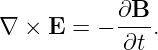
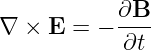
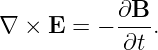
The local, differential form is the Maxwell-Faraday equation,
This equation says that a time-varying magnetic field is associated with a circulating electric
field. It is one of Maxwell’s Equations and is therefore more general than a circuit-only
description.
7 Induction by motion: motional emf
Induction can also occur when a conductor moves through a magnetic field. A charge q moving
with velocity v in a magnetic field experiences the magnetic Lorentz force
If a conducting rod of length ℓ moves with speed v perpendicular to a uniform magnetic field,
charges in the rod are pushed toward opposite ends. For the simple perpendicular geometry, the
resulting motional emf has magnitude
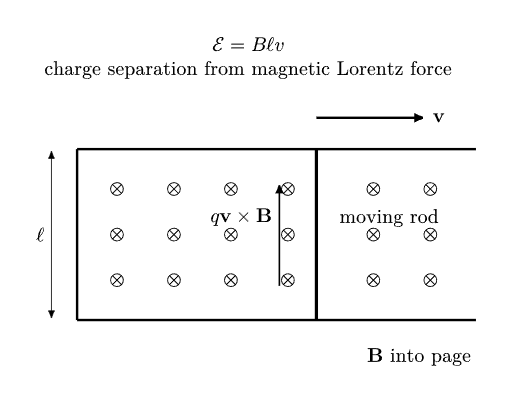
Figure 3. Motional induction. Charges in a moving conductor experience the magnetic part of the
Lorentz force, producing charge separation and an emf.
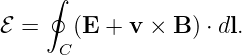
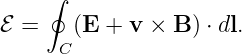
For a moving conducting path, a useful general expression is
The E term describes force per unit charge from the electric field, while the v × B term accounts
for magnetic force on charges carried with the moving conductor.
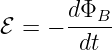
The familiar flux rule
can describe both transformer and motional induction when the changing geometry and sign
conventions are handled consistently. The underlying force mechanisms, however, need not be
identical.
8 Induced electric fields are not electrostatic fields
A static electric field generated by fixed charges satisfies
for any closed path in an electrostatic region.
An electric field induced by a changing magnetic field can instead satisfy
Therefore it cannot generally be represented everywhere by a single-valued electrostatic potential
V with
This is an important conceptual change from electrostatics. Induction introduces electric fields
whose geometry naturally involves circulation and curl.
9 Self-induction
A changing current produces a changing magnetic field. That changing magnetic field can change
the flux through the same circuit that carries the current. The resulting effect is called
self-induction.
For a coil with N turns, define the flux linkage
In a linear magnetic system, the flux linkage is proportional to current:
where L is the self-inductance.
The SI unit of inductance is the henry:
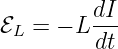
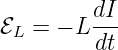
Faraday’s law then gives the induced emf
when L is constant.
The minus sign again represents Lenz’s law: the induced emf opposes the change in current
responsible for the changing flux.
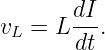
In circuit analysis, the passive-sign-convention voltage across an ideal inductor is usually
written
This is compatible with the induced-emf expression; the apparent sign difference comes from which
direction is chosen as the circuit voltage reference.
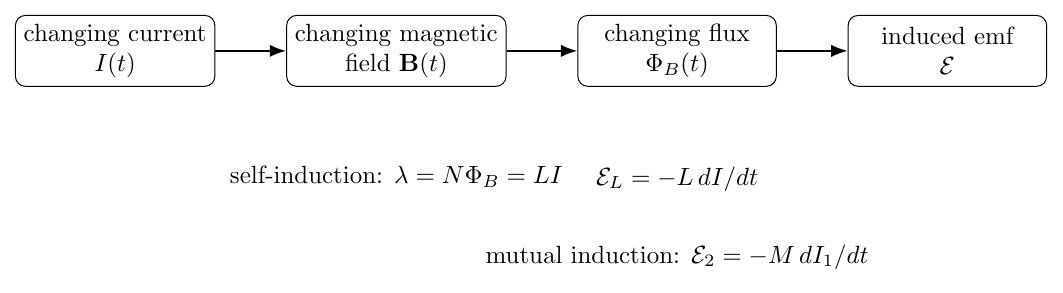
Figure 4. Self- and mutual-induction chain. Changing current produces changing magnetic field
and flux, which in turn produces an induced emf.
10 Mutual induction
A changing current in one circuit can produce changing magnetic flux through another circuit.
This is called mutual induction.
For two circuits in a linear system, the flux linkage of circuit 2 due to current I1 may be
written
where M is the mutual inductance.
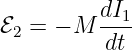
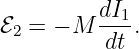
The emf induced in circuit 2 is then
for constant M.
This is the basic physical principle behind a transformer. An alternating current in the primary
winding produces changing magnetic flux, and that changing flux induces an emf in the secondary
winding.
11 Energy stored in an inductor
Building current in an inductor requires work because the induced emf resists the increase in
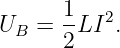
current. For an ideal linear inductor, the energy stored in its magnetic field is
This energy can later be returned to the circuit as the current decreases. Thus an inductor is an
energy-storage element, just as a capacitor stores electric-field energy.
The energy viewpoint reinforces Lenz’s law: induction resists abrupt changes because changing the
current requires changing stored field energy.
12 Induction and generators
A generator converts mechanical work into electrical energy through electromagnetic induction. A
loop rotating in a magnetic field has time-varying flux. If
then Faraday’s law gives
for a single turn, up to the chosen orientation convention.
A coil with N turns gives
The mechanical torque required to keep the generator rotating provides the energy
that appears electrically. This is another direct manifestation of Lenz’s law and energy
conservation.
13 Induction and transformers
In an ideal transformer, both windings link approximately the same time-varying magnetic flux.
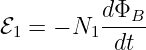
Faraday’s law gives
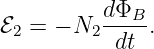
and
Therefore
The voltage ratio is set by the turns ratio in the idealized model. Real transformers additionally
involve winding resistance, leakage flux, finite permeability, hysteresis, eddy currents, and
frequency-dependent losses.
14 A broader field viewpoint
At an introductory circuit level, induction is often summarized as “changing magnetic flux
produces emf.” At a deeper level, the electromagnetic field viewpoint is more fundamental.
For a stationary contour,
relates local field variation to electric-field circulation.
For moving matter, the Lorentz force introduces the additional magnetic-force term
The complete physical description therefore involves fields, moving charges, geometry, and the
choice of circuit path. The flux rule is an extraordinarily useful compact result, but the
Maxwell-Lorentz description reveals the local physics behind it.
15 Common misconceptions
A magnetic field by itself does not guarantee induction
A stationary loop in a steady magnetic field can have nonzero flux but zero induced emf. Induction
depends on changing flux or motion through the field.
The induced current does not always oppose the magnetic field
It opposes the change in flux. If the original field is decreasing, the induced field can point in the
same direction as the original field.
Emf is not a mechanical force
Emf has units of volts, or energy per charge. The name is historical.
Flux is not a substance flowing through the loop
Magnetic flux is a surface integral of the magnetic field. It is a mathematical measure of field
crossing an oriented surface.
Motional and transformer induction are related but not identical mechanisms
A moving conductor in a static magnetic field can acquire emf through the magnetic Lorentz force.
A stationary loop in a changing magnetic field experiences a circulating induced electric
field.
16 Connections to other PhysicsLibrary topics
Electromagnetic induction naturally connects several topics:
- magnetic flux and surface integrals;
- line integrals and circulation;
- the Lorentz force;
- Maxwell’s equations;
- inductors and RL circuits;
- LC oscillations;
- mutual inductance and transformers;
- electric generators and motors;
- electromagnetic energy and the Poynting vector;
- electromagnetic waves.
In particular, the Maxwell-Faraday equation provides one half of the feedback structure needed
for electromagnetic wave propagation: changing magnetic fields generate circulating
electric fields, while the Ampere-Maxwell law relates changing electric fields to magnetic
fields.
17 Summary
Electromagnetic induction is the production of emf through a changing magnetic environment. The
basic flux definition is
Faraday’s law gives
and for N turns,
Lenz’s law determines the direction of the induced effect: it opposes the change in flux.
For a moving conductor, magnetic Lorentz force contributes through
For a stationary contour, Faraday’s law is equivalent to
Self-induction and mutual induction are summarized by
and
These relations connect basic field physics directly to generators, transformers, inductors,
oscillating circuits, and electromagnetic waves.
References
[1] M. Faraday, Experimental Researches in Electricity, Taylor and Francis, collected
papers originally published beginning in 1832.
[2] J. C. Maxwell, A Treatise on Electricity and Magnetism, Clarendon Press, 1873.
[3] D. J. Griffiths, Introduction to Electrodynamics, 4th ed., Pearson, 2013.
[4] E. M. Purcell and D. J. Morin, Electricity and Magnetism, 3rd ed., Cambridge
University Press, 2013.
[5] R. P. Feynman, R. B. Leighton, and M. Sands, The Feynman Lectures on Physics,
Vol. II, Basic Books, New Millennium ed., 2011.
[6] J. D. Jackson, Classical Electrodynamics, 3rd ed., Wiley, 1999.