Tensors are another abstract mathematical tool at our disposal for solving problems from rotating
rigid bodies to the structure of the universe. Not only does the use of tensor notation clean up
complex equations, but also allows us to embody the invariance of physical quantities within
tensors. This is worth repeating: we can use tensors to write physical equations independent of the
choice of coordinate systems.
In the most general way we define a tensor T based on how it behaves under coordinate
transformations
where the tensor rank is n = p + q, the contravariant rank is p and the covariant rank is q. Note
that rank is also referred to as the tensor order.
Although Eq. (1) can be intimidating at first, one can familiarize themselves by working simple
examples and pulling from experience with scalars, vectors and matrices. A scalar quantity such as
temperature or density is invariant under coordinate transformation and is labeled as a tensor of
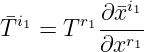
rank zero. The next step is a tensor of rank 1. If p = 1 and q = 0, then n = 1 and we have a
contravariant vector
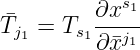
If p = 0 and q = 1, then n = 1 and we have a covariant vector
It is important to realize the differences between Eq. (2) and Eq. (3), i.e. Eq. (2) can represent the
transformation of familiar vectors, while Eq. (3) can represent the transformation between basis
vectors. This can best be illustrated with the simple examples of the transformation between
cartesian coordinates and polar coordinates and the transformation between cartesian basis vectors
and polar basis vectors.