Torque and Fixed-Axis Rotational Dynamics
Rotational kinematics describes how angular position, angular velocity, and angular acceleration
change.
Rotational dynamics asks what causes those changes.
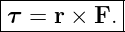
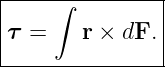
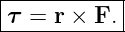
The rotational analogue of force is torque. For a force F applied at position r relative to a chosen
origin,
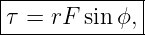
Its magnitude is
where ϕ is the angle between r and F.
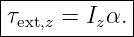
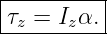
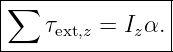
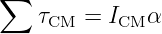
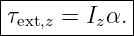
For a rigid body constrained to rotate about a fixed inertial axis, the component of the net
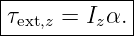
external torque along that axis satisfies
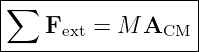
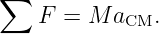
This equation is the fixed-axis rotational analogue of
The analogy is powerful:
| Fnet | ↔τnet, | (5)
|
| m | ↔I, | (6)
|
| a | ↔α. | (7) |
But the rotational equation carries an important condition: the axis must be specified, and the
relevant torque and moment of inertia must refer to that same axis.
1 Torque as a vector
Torque is defined by the cross product
Its direction follows the right-hand rule.
Its magnitude is
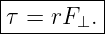
Only the component of force perpendicular to r contributes:
Thus
Equivalently, define the perpendicular lever arm or moment arm
Then
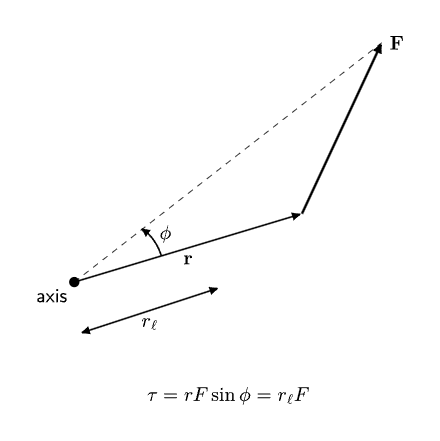
Figure 1. Torque magnitude can be written either as rF sinϕ, as rF⊥, or as rℓF, where rℓ is the
perpendicular lever arm from the axis to the force line of action.
2 Line of action and lever arm
The line of action of a force is the infinite straight line passing through the force vector.
The lever arm is the perpendicular distance from the rotation axis to that line.
This interpretation is often more useful than measuring the distance to the point of
application.
If the line of action passes through the axis,
and therefore
A large force can produce zero torque if its line of action passes through the axis.
3 Sign convention for planar fixed-axis rotation
For rotation in the xy plane about the z axis, torque has only the relevant axial component
A common convention is:
- counterclockwise torque is positive,
- clockwise torque is negative.
This is equivalent to the right-hand-rule convention:
- positive τz points along +ez,
- negative τz points along −ez.
The signed torque should be used consistently with signed angular acceleration.
4 Net torque
Several forces can act simultaneously on a rigid body.
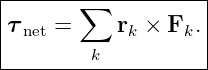
The net torque about the chosen origin is
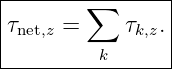
For fixed-axis planar motion,
Torques must be summed algebraically, including signs.
5 Torque and angular momentum
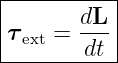
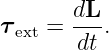
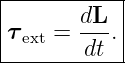
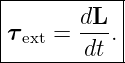
The fundamental rotational dynamics law is
about an inertial origin.
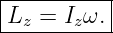
For a rigid body rotating about a fixed z axis, the axial angular momentum is
Because the body is rigid and the axis is fixed relative to the body geometry,
Therefore
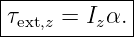
| τext,z | =  | (22)
|
| =   | (23)
|
| = Iz . . | (24) |
Hence
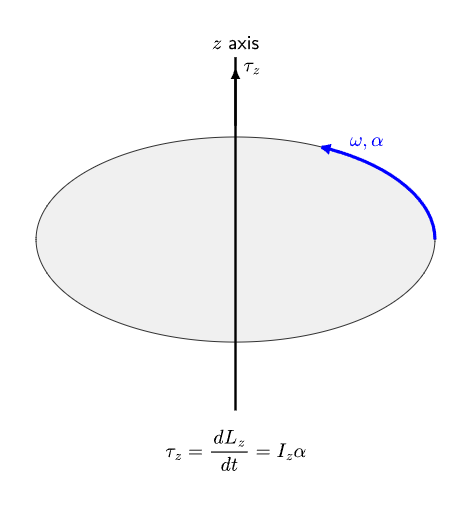
Figure 2. For a rigid body constrained to rotate about a fixed z axis, the axial torque changes the
axial angular momentum according to τz = dLz∕dt = Izα.
6 Why the scalar equation is axial
The full vector relation is
It is generally not correct to replace this by
for arbitrary three-dimensional rigid body motion.
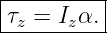
For a fixed axis, however, the axial component satisfies
Other components of external torque can be balanced by constraint forces and moments at
bearings or supports.
This distinction becomes essential when the inertia tensor is introduced later in M05.
7 Particle derivation of the fixed-axis equation
The same result can be seen particle by particle.
For mass element mi at perpendicular radius ri⊥, tangential acceleration is
The tangential net force component is
Its axial torque contribution is
Summing gives
| τz | = ∑
imiri⊥2α | (32)
|
| = 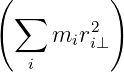 α. α. | (33) |
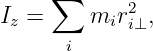
Since
we recover
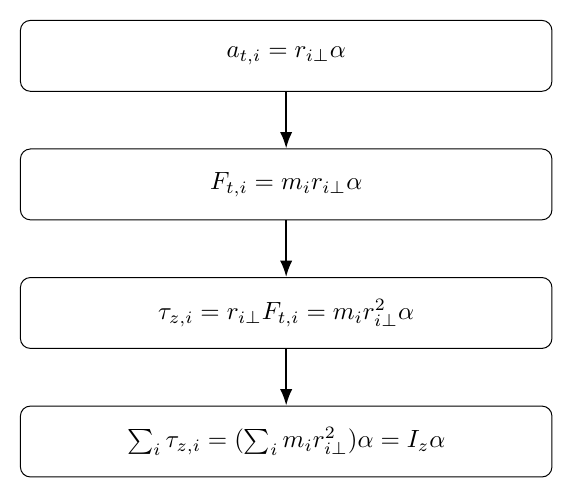
Figure 3. Each mass element contributes miri⊥2α to the axial rotational response. Summing over
the rigid body produces τz = Izα.
8 Internal forces and external torque
For the whole rigid body, internal forces occur between particles of the body.
When internal forces satisfy Newton’s third law along the line joining each interacting pair, their
torques cancel in the total system torque.
The rotational equation for the body therefore uses the net external torque:
This is analogous to translational dynamics:
9 Moment of inertia is the rotational inertia
For a given torque,
Thus a larger moment of inertia produces a smaller angular acceleration:
for fixed torque magnitude.
Mass distribution matters as strongly as total mass.
A ring and disk with equal mass and radius respond differently to the same torque
because
| Iring | = MR2, | (40)
|
| Idisk | =  MR2. MR2. | (41) |
The disk therefore has twice the angular acceleration of the ring under the same axial
torque.
10 Example 1: force applied to a disk
A uniform disk has
| M | = 4.0 kg, | (42)
|
| R | = 0.30 m. | (43) |
A tangential force
acts at the rim.
The torque magnitude is
The disk moment of inertia is
| I | =  MR2 MR2 | (46)
|
| =  (4.0)(0.30)2 (4.0)(0.30)2 | (47)
|
| = 0.18 kg m2. | (48) |
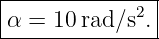
Therefore
| α | =  | (49)
|
| =  | (50)
|
| = 10 rad∕s2. | (51) |
Thus
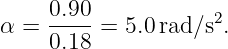
11 Example 2: same force at a different angle
Suppose the same
force is applied at the rim, but the angle between r and F is
The torque is
| τ | = RF sin 30∘ | (55)
|
| = (0.30)(6.0)(0.5) | (56)
|
| = 0.90 N m. | (57) |
Thus
Only the perpendicular component of the applied force contributes to the torque.
12 Gravity acting on an extended rigid body
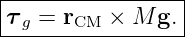
In a uniform gravitational field, the total gravitational force on an extended body can be treated as
acting at the center of mass for the purpose of computing net torque.
If the center of mass position relative to a pivot is
then
The torque magnitude is
Here ϕ is the angle between rCM and g.
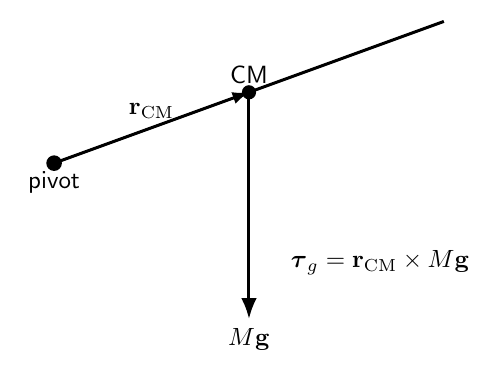
Figure 4. In a uniform gravitational field, the net gravitational torque about a pivot can be
computed using the total Weight Mg acting at the center of mass.
13 Example 3: uniform rod pivoted at one end
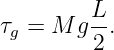
A uniform rod of length L and mass M is horizontal and pivoted at one end.
Gravity acts at the center of mass,
The gravitational torque magnitude is
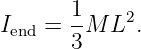
The moment of inertia about the pivot is
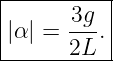
Therefore the initial angular acceleration magnitude is
| |α| | =  | (65)
|
| =  | (66)
|
| =  . . | (67) |
Thus
The mass cancels.
14 Pivot and bearing forces
A fixed pivot or bearing can exert forces on a rotating body.
If the torque origin is chosen at the pivot and the pivot force acts through that point, then its
torque about the pivot is zero:
This is one reason pivot points are often convenient torque origins.
However, a real bearing can also exert a reaction couple or Friction torque.
A force passing through the axis has zero moment arm, but a pure applied couple need
not.
15 Constraint reactions and full force balance
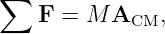
The equation
does not replace translational force balance.
A body rotating about a fixed axis generally has a moving center of mass unless the center of mass
lies on the axis.
Therefore support forces may be required to produce the center of mass acceleration.
A complete rigid body problem may require both:
and
16 Distributed forces
If force is distributed continuously over a body, the differential torque is
The total torque is
For a tangential force per unit length f(s) acting along a rim or rod,
and the torque can be integrated directly.
A single resultant force can replace a distributed load for torque calculations only if its line of
action is chosen to preserve the same net moment.
17 Couples
A couple consists of two equal and opposite parallel forces whose lines of action are
separated.
The net force is zero:
But the net torque is nonzero.
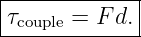
If the perpendicular separation between the force lines is d,
The torque of a pure couple is independent of the choice of origin.
This makes a couple fundamentally different from a single force.
18 Tension and pulley torque
Consider a Pulley of radius R and moment of inertia I.
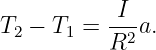
If tensions T1 and T2 act tangentially on opposite sides, the net pulley torque is
Thus
If a string does not slip on the pulley,
This couples translational dynamics of the masses to rotational dynamics of the pulley.
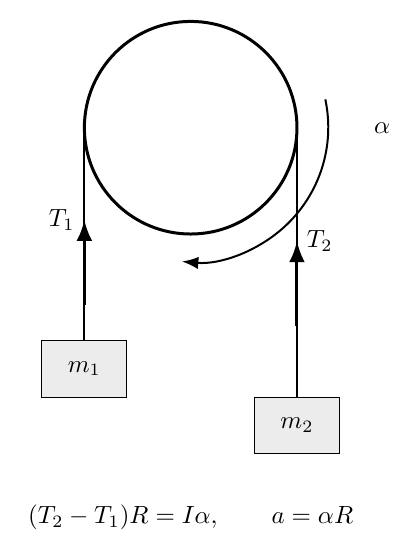
Figure 5. A massive pulley requires unequal tensions when it has angular acceleration. The
difference in tangential tensions supplies the net torque (T1 − T2)R = Iα.
19 Example 4: two masses and a massive pulley
Masses m1 and m2 hang from a light string over a pulley of radius R and moment of inertia
I.
Assume
and no slipping.
For m1 moving upward,
For m2 moving downward,
For the pulley,
Since
Add the two mass equations:
Substitute the pulley relation:
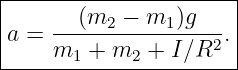
Therefore
The pulley inertia reduces the acceleration compared with an ideal massless pulley.
20 Why the two tensions differ
If the pulley were massless,
Then the pulley equation gives
For a massive pulley with nonzero angular acceleration,
so
The tension difference is exactly what produces the pulley’s rotational acceleration.
21 Constant net torque
If the moment of inertia is constant and the net axial torque is constant,
then
is constant.
The constant-angular-acceleration equations from M05-01 apply:
| ω | = ω0 + αt, | (96)
|
| 𝜃 − 𝜃0 | = ω0t +  αt2, αt2, | (97)
|
| ω2 | = ω
02 + 2α(𝜃 − 𝜃
0). | (98) |
Thus a constant net torque produces the rotational analogue of constant linear acceleration.
22 Example 5: constant motor torque
A rotor has
and is driven from rest by constant torque
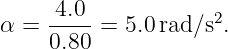
Its angular acceleration is
After
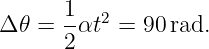
Its angular displacement is
23 Braking torque
A braking torque acts opposite the angular velocity.
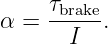
For constant moment of inertia,
If the torque opposes positive rotation,
and
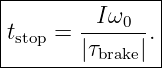
For constant braking torque, the stopping time is
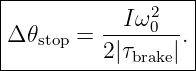
The stopping angle follows from
Hence
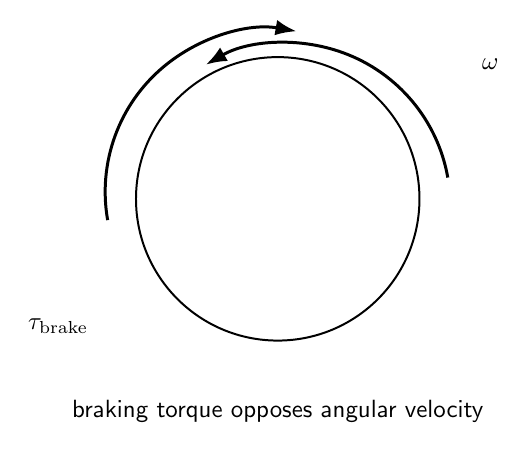
Figure 6. A braking torque points opposite the angular velocity. With constant I and constant
braking torque, the angular velocity decreases linearly to zero.
24 Example 6: braking a flywheel
A flywheel has
and initial angular speed
A constant braking torque of magnitude
is applied.
Then
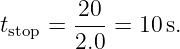
The stopping time is
The stopping angle is
| Δ𝜃 | =  | (116)
|
| =  | (117)
|
| = 100 rad. | (118) |
Thus
25 Rotational work
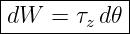
For a small angular displacement
a torque does work
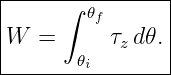
for fixed-axis motion.
Therefore
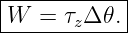
For constant torque,
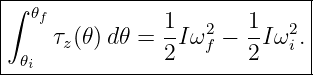
26 Work-energy check
Start from
Use
Then
Integrate:
| W | = ∫
ωiωf
Iω dω | (127)
|
| =  Iωf2 − Iωf2 − Iωi2. Iωi2. | (128) |
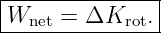
Thus
This agrees with the rotational work-energy relation developed in M03.
27 Rotational power
Power is
Since
| P | = τz | (132)
|
| = τzω. | (133) |
Therefore
for fixed-axis motion.
In vector form for an applied torque and angular velocity,
28 Angular impulse
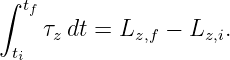
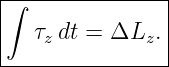
From
integrate over a time interval:
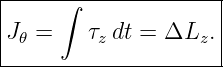
Thus the angular impulse is
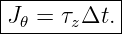
For constant torque,
For a fixed rigid body axis,
Therefore
when torque is constant.
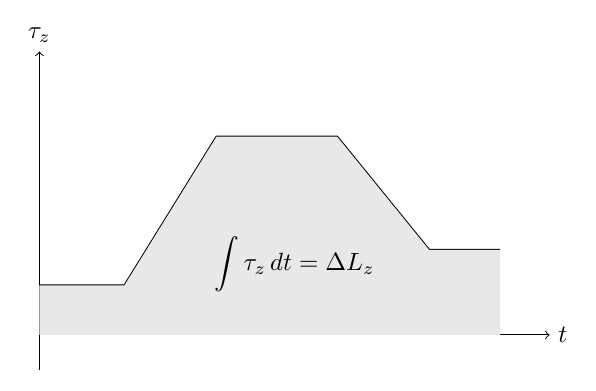
Figure 7. The area under a torque-versus-time graph is angular impulse, equal to the change in
axial angular momentum.
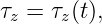
29 Variable torque
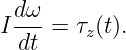
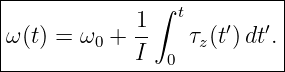
If torque depends on time,
then
For constant I,
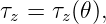
If torque depends on angular position,
the work-energy form is often more convenient:
30 Example 7: linearly increasing torque
Suppose
with constant
For constant I,
Integrating from rest,
| ω(t) | =  ∫
0tt′dt′ ∫
0tt′dt′ | (150)
|
| =  t2. t2. | (151) |
Then
| 𝜃(t) − 𝜃0 | = ∫
0tω(t′) dt′ | (152)
|
| =  ∫
0t(t′)2 dt′ ∫
0t(t′)2 dt′ | (153)
|
| =  t3. t3. | (154) |
31 Static rotational equilibrium
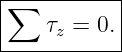
If a body is in rotational equilibrium about a fixed axis,
Therefore
If the center of mass is also not accelerating,
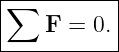
Both translational and rotational equilibrium conditions are required for complete static
equilibrium.
32 Dynamic rotational equilibrium
A body can have
while still rotating.
Then
and
Zero net torque means constant angular velocity, not necessarily zero angular velocity.
33 Torque about different origins
Torque depends on the chosen origin:
Changing the torque origin changes r and generally changes the torque.
Therefore every torque calculation should state or make clear:
A pure couple is a special exception: its net torque is independent of origin.
34 Axis reactions
A bearing constraining a rigid body to a fixed axis can supply reaction forces and possibly reaction
moments.
The equation
uses the component of net external torque along the allowed rotation axis.
Constraint reactions perpendicular to the allowed rotational degree of freedom can enforce the
fixed-axis condition.
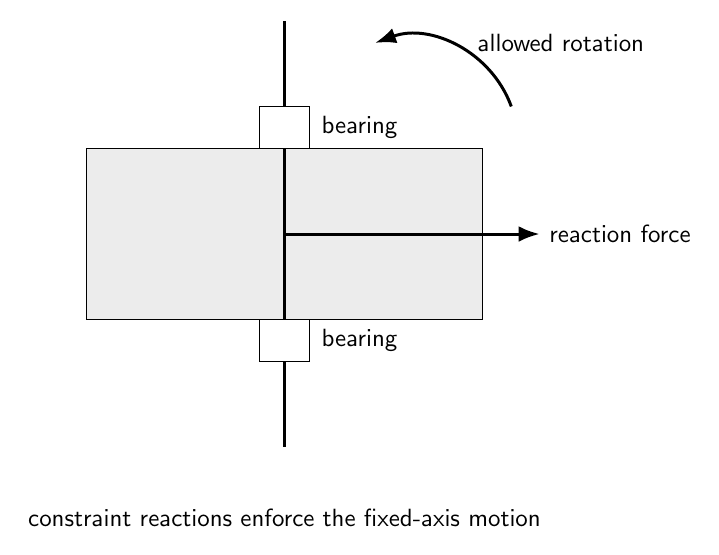
Figure 8. Fixed-axis bearings can exert constraint reactions that suppress unwanted translation or
rotation. The scalar dynamics equation uses the torque component along the permitted axis.
35 When τ = Iα is not enough
The scalar relation
is appropriate when:
- the body is rigid,
- the rotation axis is fixed in an inertial frame,
- Iz is constant,
- torque and angular acceleration are referred to the same axis.
More general situations require additional mechanics.
Examples include:
- changing mass distributions,
- free three-dimensional rotation,
- precession,
- moving rotation axes,
- deformable bodies.
For these problems the full vector angular-momentum equation remains fundamental:
36 Connection to rolling
A rolling body combines translation of the center of mass with rotation.
The rotational equation remains useful:
for planar rigid body rolling under the appropriate conditions, while translation obeys
The no-slip kinematic condition then couples the two motions.
That is the subject of M05-07.
37 Common mistakes
- Using the full force magnitude in τ = rF when the force is not perpendicular to r.
- Measuring the lever arm to the force application point instead of perpendicular to the
force line of action.
- Forgetting the sign of clockwise versus counterclockwise torque.
- Mixing torques calculated about different origins.
- Using a moment of inertia about an axis different from the torque axis.
- Writing τ = Iα as a universally valid three-dimensional vector law.
- Forgetting that only the axial component gives τz = Izα in the fixed-axis scalar
formulation.
- Including pivot force torque about the pivot when its line of action passes through the
pivot.
- Assuming a real bearing can never exert a friction torque or reaction couple.
- Using T1 = T2 for a massive accelerating pulley.
- Forgetting the no-slip relation a = αR in pulley problems.
- Assuming zero net torque means zero angular velocity.
- Ignoring translational force balance when the center of mass accelerates.
- Forgetting that a couple can have zero net force but nonzero torque.
- Using constant-angular-acceleration equations when torque or moment of inertia varies.
38 Practice exercises
- A force of magnitude F is applied at distance r from an axis at angle ϕ to the radius
vector. Derive the torque magnitude.
- Explain geometrically why a force whose line of action passes through the axis produces
zero torque.
- Derive τz = Izα from Lz = Izω for a fixed rigid body axis.
- Derive τz = Izα by summing particle tangential equations.
- A disk of mass M and radius R is acted on by a tangential rim force F. Find α.
- Repeat the previous problem when the force makes angle 30∘ with the radius vector.
- A uniform rod of length L is horizontal and pivoted at one end. Derive its initial angular
acceleration under gravity.
- A rotor has I = 1.5 kg m2 and a constant net torque of 6 N m. Starting from rest, find
ω after 4 s.
- Derive the acceleration of two hanging masses connected by a string over a massive
pulley.
- Explain why the tensions on the two sides of a massive accelerating pulley are unequal.
- A flywheel with moment of inertia I and initial speed ω0 is stopped by a constant
opposing torque τb. Derive the stopping time and stopping angle.
- Show that integrating τz = Iα over angle produces the rotational work-energy theorem.
- Show that integrating torque over time produces angular impulse.
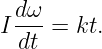
- A torque varies as τ(t) = kt. Starting from rest, derive ω(t) and 𝜃(t).
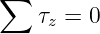
- Explain why ∑
τz = 0 does not imply ω = 0.
39 Summary
Torque is
Its magnitude can be written
The fundamental angular-momentum law is
For a rigid body rotating about a fixed inertial axis,
Rotational work and power are
| W = ∫
τz d𝜃, | | (172)
|
| P = τzω. | | (173) |
Angular impulse is
Together with
these equations provide the dynamics foundation for rigid body rolling, developed next in
M05-07.
References
References
[1] J. R. Taylor, Classical Mechanics, University Science Books, 2005.
[2] D. Kleppner and R. Kolenkow, An Introduction to Mechanics, 2nd ed., Cambridge
University Press, 2014.
[3] K. R. Symon, Mechanics, 3rd ed., Addison-Wesley, 1971.
[4] OpenStax, University Physics, Volume 1, Rice University, 2016.