Physics Library
 An open source physics library
Encyclopedia | Forums | Docs | Random | Template Test |  
Login
create new user
Username:
Password:
forget your password?
Main Menu
Sections

Meta

Talkback

Downloads

Information
vector addition (Definition)

If successive displacements carry a point from $A$ to $B$ and then from $B$ to $C$, the net displacement is

$\displaystyle \overrightarrow{AB}+\overrightarrow{BC}=\overrightarrow{AC}. \tag{1} $
This is the triangle rule for vector addition.
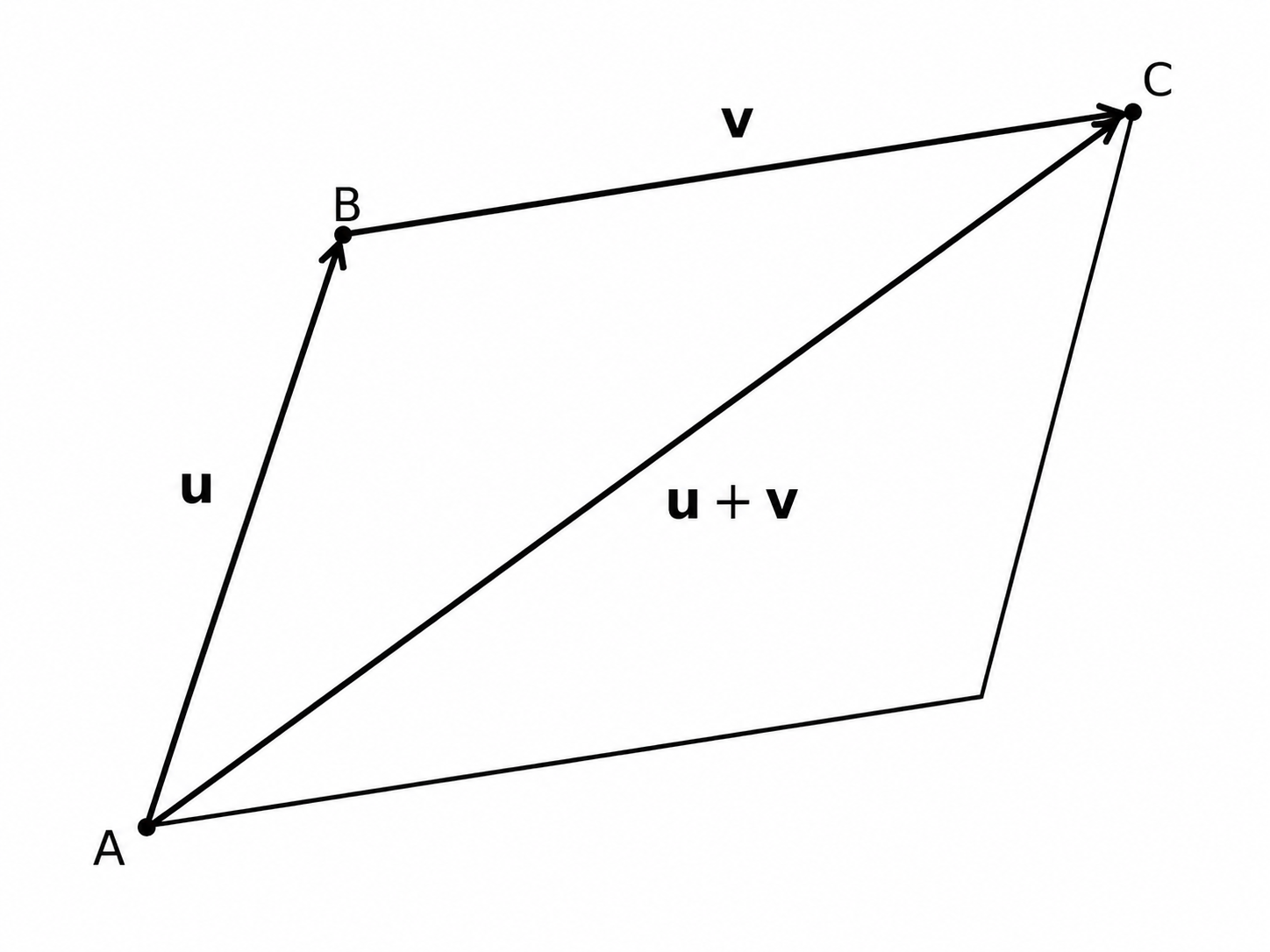
Image brand_fig_3a
Figure 3a, modernized: triangle/parallelogram rule for vector addition.

Drawing both vectors from a common tail gives the equivalent parallelogram rule. Vector addition satisfies

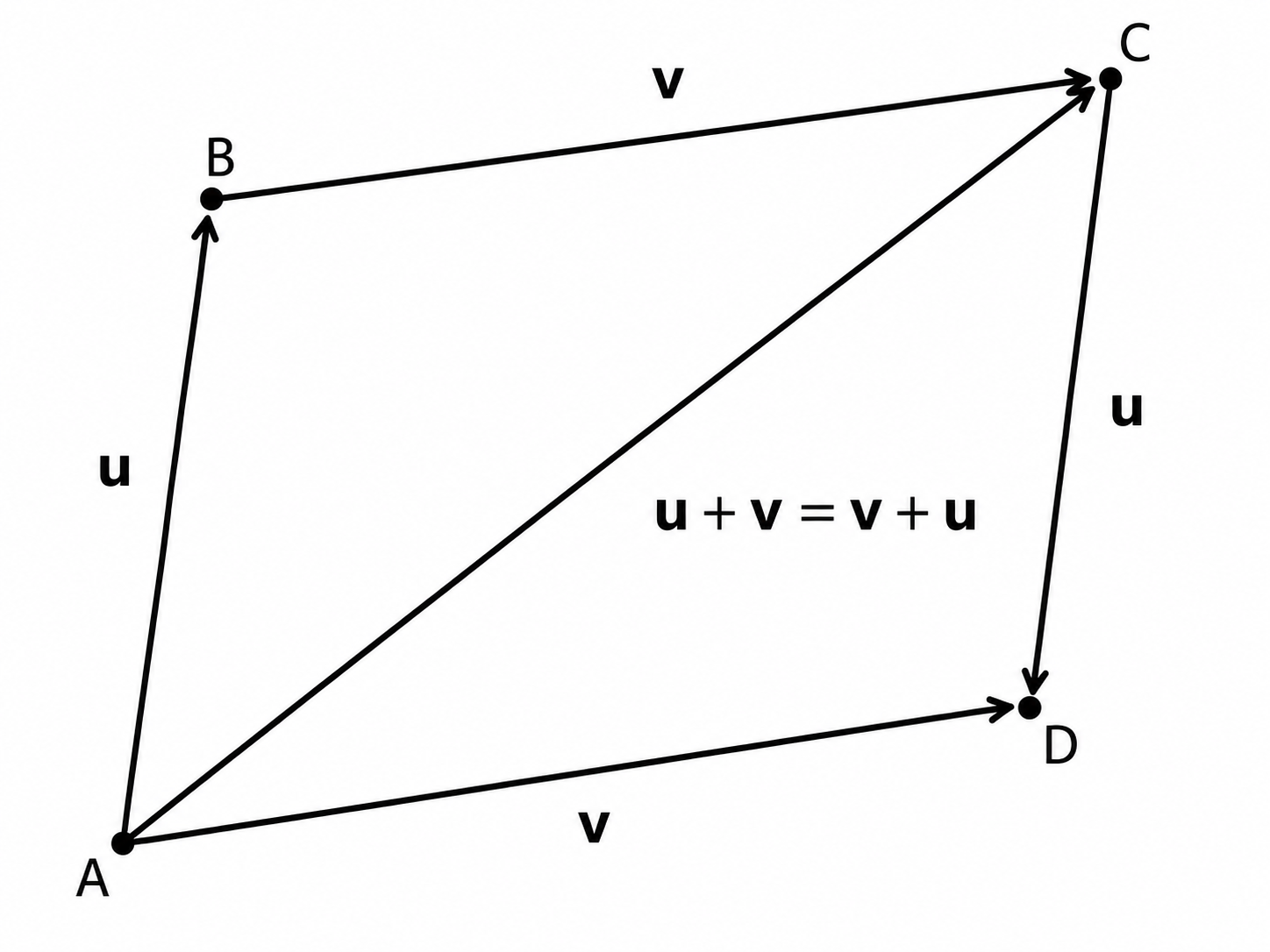
$\displaystyle \mathbf{u}+\mathbf{v}=\mathbf{v}+\mathbf{u} \tag{2} $
and

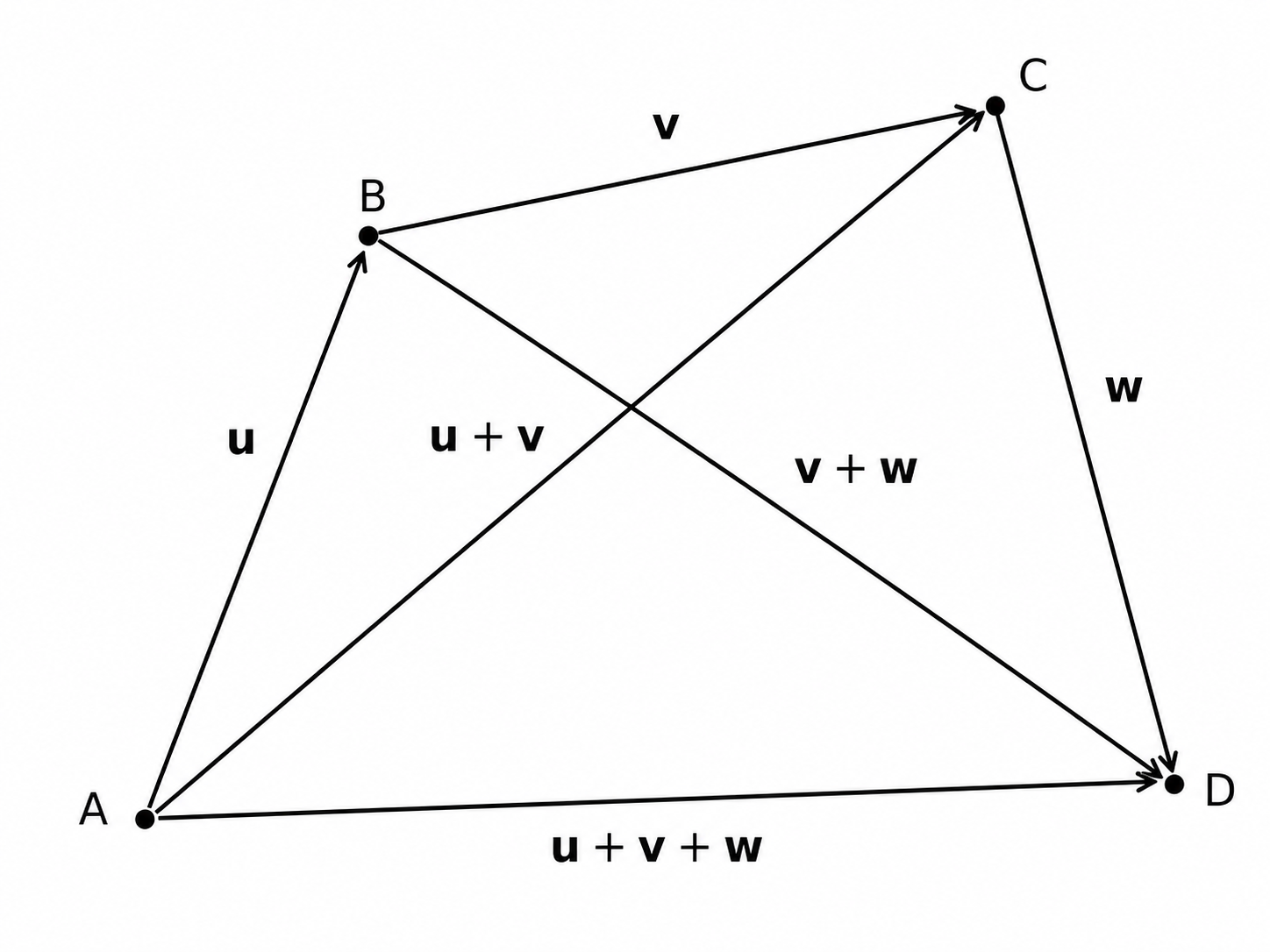
$\displaystyle (\mathbf{u}+\mathbf{v})+\mathbf{w} =\mathbf{u}+(\mathbf{v}+\mathbf{w}). \tag{3} $
Image brand_fig_3b
Figure 3b, modernized: commutativity of vector addition.
Image brand_fig_3c
Figure 3c, modernized: associativity of vector addition.

The magnitude satisfies the triangle inequality

$\displaystyle \lVert\mathbf{u}+\mathbf{v}\rVert\le \lVert\mathbf{u}\rVert+\lVert\mathbf{v}\rVert, $
with equality when the nonzero vectors point in the same direction.

For many vectors, place them head-to-tail in any order. The resultant joins the initial point to the final point. A closed vector polygon has zero sum:
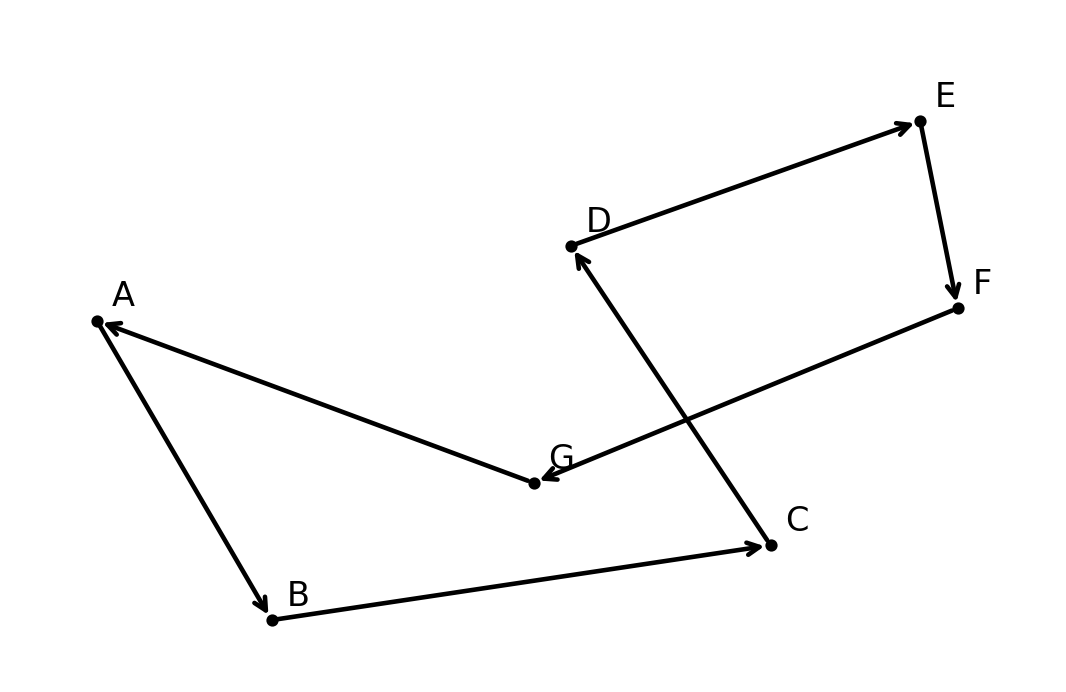
$\displaystyle \overrightarrow{AB}+\overrightarrow{BC}+\cdots+ \overrightarrow{GA}=\mathbf 0. $
Image brand_fig_3d
Figure 3d, modernized: vector polygon and closure.

Problems

  1. For a regular hexagon $ABCDEF$ with center $O$, construct $\overrightarrow{AB}+\overrightarrow{AC}+\overrightarrow{AD}+ \overrightarrow{AE}+\overrightarrow{AF}$ and compare it with $\overrightarrow{AO}$.
  2. For triangle $ABC$, let $P,Q,R$ be the midpoints of its sides and choose any point $O$ in its plane. Construct and compare

    $\displaystyle \overrightarrow{OA}+\overrightarrow{OB}+\overrightarrow{OC}, \qquad \overrightarrow{OP}+\overrightarrow{OQ}+\overrightarrow{OR}. $
  3. For any quadrilateral $ABCD$, let $P,Q$ be the midpoints of diagonals $AC,BD$, and $M$ the midpoint of $PQ$. Construct

    $\displaystyle \overrightarrow{MA}+\overrightarrow{MB}+\overrightarrow{MC}+ \overrightarrow{MD}. $

Source

This article is a modernized restatement of the corresponding Public domain article in Louis Brand, Vectorial mechanics, John Wiley & Sons, New York, 1930, Chapter I, “Vector Algebra.” The original 1930 edition is the source basis.



"vector addition" is owned by bloftin.
(view preamble)
View style:
See Also: equality of vectors, vector, vector algebra, negative of a vector, scalar multiplication of vectors, point division and position vectors, vectors in a plane


Cross-references: mechanics, domain, regular, magnitude, commutativity, vectors
There are 3 references to this object.

This is version 1 of vector addition, born on 2026-08-20.
Object id is 1068, canonical name is VectorAddition.
Accessed 9 times total.

Classification:
Physics Classification02. (Mathematical methods in physics)
Pending Errata and Addenda
None.
Discussion
Style: Expand: Order:

No messages.

Interact
rate | post | correct | update request | add derivation | add example | add (any)