Scalars and Vectors in Mechanics
Mechanics uses two different kinds of physical quantities repeatedly. Some quantities are
completely specified by a magnitude, while others require both magnitude and direction. The
distinction is not merely graphical notation: it determines how physical quantities combine, how
their components change when axes are changed, and which mathematical operations are
physically meaningful.
A scalar is a physical quantity represented by a single value that is independent of the orientation
of the coordinate axes. A vector is a geometric quantity with magnitude and direction whose
components transform together when the coordinate basis is changed.
Examples of scalars in mechanics include mass, time, temperature, distance, speed, energy, and
power. Examples of vectors include position, displacement, velocity, acceleration, momentum,
force, torque, and angular momentum.
The main ideas of this article are:
- distinguish scalars from vectors and vectors from their components;
- represent vectors using magnitude, direction, and Cartesian components;
- add and subtract vectors geometrically and componentwise;
- use unit vectors to encode coordinate directions;
- understand the dot product as a scalar measure of directional overlap;
- understand the cross product as a vector measure of perpendicular action;
- connect these operations to work, projection, torque, and angular momentum.
1 Scalars
A scalar quantity is described by one numerical value together with its unit. If a particle has
mass
then no spatial direction is needed to specify the mass.
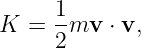
Likewise, a kinetic energy
is a scalar. Energy can increase or decrease, but it does not point north, upward, or along a
coordinate axis.
A scalar may be positive, negative, or zero when the physical definition permits signed values. For
example, an electric potential or a one-dimensional coordinate may be signed. Being scalar does
not mean being positive; it means that a spatial orientation is not part of the quantity
itself.
2 Vectors
A vector has both magnitude and direction. A displacement from one location to another is a
vector because both the distance and the direction of the change matter. A velocity is a vector
because two objects moving at the same speed in different directions do not have the same
velocity.
A vector is written here in boldface, for example
Its magnitude is written
The magnitude is a scalar and is nonnegative.
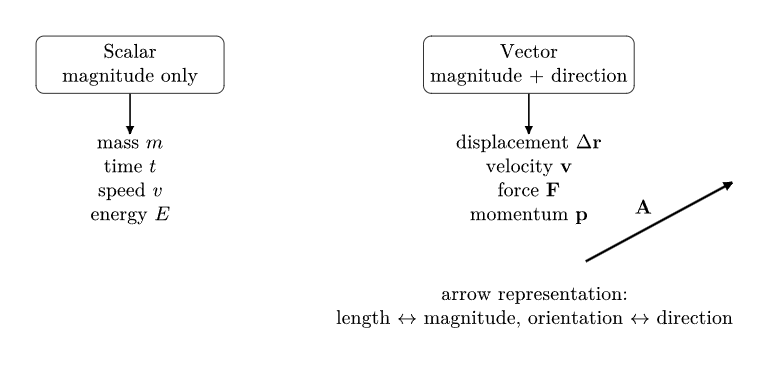
Figure 1. Scalars require only magnitude, while vectors require magnitude and direction. The
same distinction appears throughout mechanics.
2.1 A vector is not the same thing as its components
Suppose a vector is represented in a Cartesian basis by
The numbers Ax, Ay, and Az are components of the vector relative to the chosen basis. If the
coordinate axes are rotated, these components generally change even though the physical vector
does not.
This distinction is important in mechanics: a force does not physically change merely because the
analyst chooses a different set of axes.
3 Unit vectors and Cartesian components
The Cartesian unit vectors
all have magnitude one and point along the positive coordinate directions.
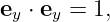
For an orthonormal Cartesian basis,
and different basis vectors are perpendicular, so
with analogous relations for the other pairs.
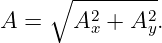
A two-dimensional vector may be written
Its magnitude is
In three dimensions,
4 Resolving a vector into components
Suppose a vector A lies in the xy plane and makes an angle 𝜃 measured counterclockwise from the
positive x axis. Then
Hence
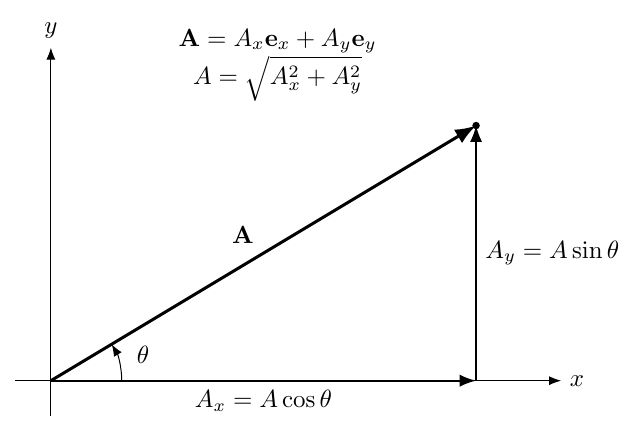
Figure 2. A vector can be resolved into perpendicular Cartesian components. The components
depend on the chosen axes; the geometric vector does not.
If the components are known, the direction can be reconstructed using trigonometry. The safest
computational form is a quadrant-aware two-argument arctangent. Conceptually,
but the signs of both components must be used to place 𝜃 in the correct quadrant.
5 Worked example 1: force components and reconstruction
A cable exerts a force of magnitude
at an angle of 35∘ above the positive horizontal direction. Find its Cartesian components. Then
verify that the components reproduce the original magnitude.
The horizontal component is
Numerically,
The vertical component is
so
Thus
Reconstructing the magnitude,
which gives approximately
The component representation and the magnitude-angle representation describe the same
vector.
6 Vector addition and subtraction
Vectors add geometrically by the head-to-tail rule. If an object undergoes displacement A followed
by displacement B, the net displacement is
Componentwise,
and similarly in three dimensions.
Vector subtraction is defined by adding the negative vector:
The vector −B has the same magnitude as B and points in the opposite direction.
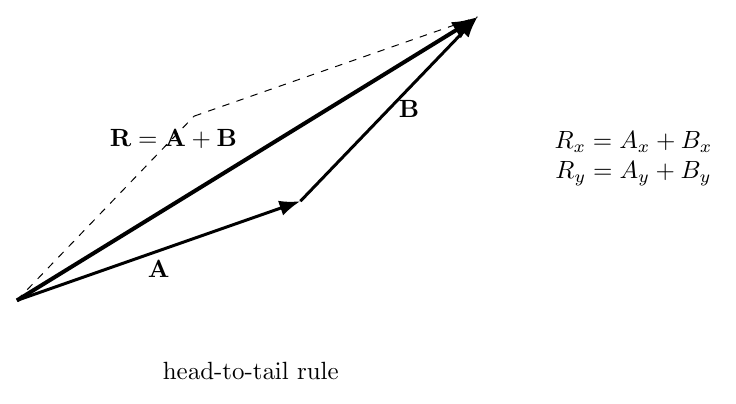
Figure 3. Head-to-tail vector addition. The resultant runs from the tail of the first vector to the
head of the final vector.
Vector addition is commutative,
and associative,
7 Worked example 2: two displacement vectors
A hiker walks 3.0 km east and then 4.0 km north. Find the net displacement magnitude and
direction.
Choose east as +x and north as +y. The two displacements are
Therefore
The magnitude is
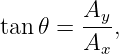
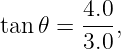
The direction satisfies
so
The hiker is therefore displaced 5.0 km at 53.1∘ north of east.
This example illustrates why traveled distance and displacement are different. The total distance
walked is 7.0 km, a scalar, while the displacement is a 5.0 km vector.
8 Multiplication of a vector by a scalar
If c is a scalar, then
means every component of A is multiplied by c. If c > 0, the direction is unchanged. If c < 0, the
direction reverses.
For example, momentum for a particle of mass m is
The scalar mass multiplies the velocity vector, so momentum points in the same direction as
velocity for positive mass.
9 The dot product
The dot product of two vectors is a scalar:
where 𝜃 is the angle between the vectors.
In Cartesian components,
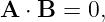
Several important special cases follow immediately. If two nonzero vectors are perpendicular,
so
If they point in the same direction,
If they point in opposite directions,
9.1 Projection
The scalar component of A along a unit vector e is
The corresponding vector projection is
This is the mathematical structure behind resolving gravity along an incline, finding the
component of velocity along a line, and determining the component of force along a
displacement.
9.2 Work as a dot product
For a constant force acting through displacement Δr, the work is
Thus
Only the component of force parallel to the displacement contributes to work.
10 Worked example 3: work from a force at an angle
A person pulls a crate through a horizontal displacement of 5.0 m using a constant force of
magnitude 40 N directed 30∘ above the horizontal. Find the work done by this pulling
force.
The displacement is horizontal, so the angle between force and displacement is 30∘.
Therefore
Substituting,
so
The vertical component of the pulling force contributes no work in this idealized example because
the crate has no vertical displacement.
11 The cross product
The cross product of two vectors is a vector perpendicular to the plane containing them. Its
magnitude is
Its direction is set by the right-hand rule.
In a right-handed Cartesian basis,
Reversing the order changes the sign:
A vector crossed with itself is zero.
For
and
the component form is
11.1 Torque and angular momentum
Torque about an origin is
Its magnitude is
Equivalently,
where d⊥ is the perpendicular lever arm from the origin to the line of action of the
force.
Angular momentum of a particle is
Both quantities depend on cross products because the rotational effect is associated with
perpendicular geometry. More precisely, torque and angular momentum are axial vectors
(sometimes called pseudovectors): under ordinary rotations they behave like vectors, while
reflections introduce an additional sign distinction. That refinement is deferred to later
three-dimensional mechanics.
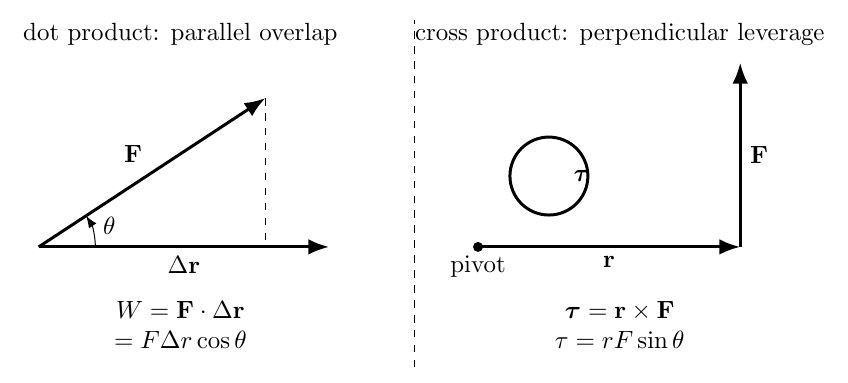
Figure 4. The dot product selects the component parallel to a displacement and therefore appears
in work. The cross product measures perpendicular leverage and therefore appears in torque.
12 Worked example 4: torque from a force on a wrench
A force of magnitude 80 N is applied to a wrench at a point 0.25 m from the bolt. The angle
between the position vector from the bolt to the hand and the applied force is 60∘. Find the torque
magnitude.
Using
we obtain
Therefore
If the force were applied parallel to the wrench handle, then 𝜃 = 0 and the torque would vanish
even though the force itself is nonzero. Rotational effectiveness depends on the perpendicular
component.
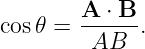
13 Angle between two vectors
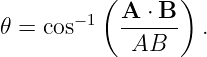
If A and B are nonzero, the dot product can be used to determine the angle between
them:
Therefore
This relation is useful when the vectors are given by components rather than by a diagram.
14 Why vector equations are powerful
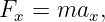
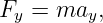
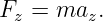
A vector equation packages several component equations into one geometric statement. Newton’s
second law,
means simultaneously that
and
The vector equation is independent of a particular Cartesian orientation. The component equations
depend on the chosen axes, but the physical relation does not.
15 Scalars formed from vectors
Many important scalars are constructed from vectors. Examples include speed,
kinetic energy,
and work,
The dot product is especially important because it produces a scalar that is independent of a
rotation of Cartesian axes.
16 Common mistakes
- Confusing speed and velocity. Speed is the scalar magnitude of the velocity vector.
- Confusing distance and displacement. Distance is total path length; displacement
is the vector from initial to final position.
- Adding vector magnitudes instead of components. Magnitudes add directly
only when vectors are collinear and oriented consistently.
- Using sine and cosine without defining the angle. Components depend on which
axis the angle is measured from.
- Ignoring quadrants when reconstructing direction. The signs of both
components matter.
- Treating components as physical vectors. Components depend on the chosen
coordinate basis.
- Assuming the dot product is a vector. It is a scalar.
- Assuming the cross product is commutative. Reversing the order reverses the
result.
- Forgetting units. Vector operations do not remove physical dimensions; for example,
torque has units N m.
- Using a cross product for parallel projection. Projection is naturally a
dot-product operation.
17 Problem-solving workflow
For a vector mechanics problem, a reliable workflow is:
- draw the geometry and define the coordinate axes;
- identify which quantities are scalars and which are vectors;
- resolve vectors into components using clearly defined angles;
- perform vector addition or subtraction componentwise;
- use the dot product for parallel projection, work, and angle tests;
- use the cross product for torque, angular momentum, and perpendicular orientation;
- reconstruct a magnitude or direction only after the component calculation is complete;
- inspect units, signs, quadrants, and limiting cases.
18 Practice problems
The following problems use stable mechanics identifiers. Short answers are supplied after the
GRE-speed questions.
MECH-VEC-001 — Scalar or vector?
Classify each quantity as scalar or vector: mass, displacement, distance, speed, velocity,
acceleration, kinetic energy, momentum, force, work, torque, and power.
MECH-VEC-002 — Components from magnitude and direction
A displacement has magnitude 12 m and points 40∘ above the positive x axis. Find its x and y
components.
MECH-VEC-003 — Magnitude and direction from components
A velocity is
Find its speed and direction measured counterclockwise from the positive x axis.
MECH-VEC-004 — Resultant displacement
A robot moves 5 m east, 2 m north, and then 3 m west. Find the resultant displacement vector and
its magnitude.
MECH-VEC-005 — Vector addition in three dimensions
Let
and
Find A + B and A − B.
MECH-VEC-006 — Dot product and angle
For
and
compute A ⋅ B and determine the angle between the vectors.
MECH-VEC-007 — Projection along an incline
A gravitational force has magnitude mg vertically downward. An incline is at angle 𝜃 above
the horizontal. Show that the component of gravity down the incline has magnitude
mg sin 𝜃.
MECH-VEC-008 — Work by a constant force
A force
acts through displacement
Find the work done.
MECH-VEC-009 — Cross product
Let
and
Find A × B.
MECH-VEC-010 — Torque in components
A force
is applied at position
Find the torque about the origin.
MECH-VEC-011 — Momentum and impulse direction
A 2 kg particle has velocity
Find its momentum vector and magnitude. If an impulse 8ey N s is applied, find the final
momentum.
MECH-VEC-012 — Unit vector along a direction
Find a unit vector in the direction of
Verify that your result has magnitude one.
19 GRE-speed questions
MECH-GRE-VEC-001
Which quantity is a vector?
- kinetic energy
- speed
- momentum
- work
MECH-GRE-VEC-002
A vector of magnitude 10 points 60∘ above the positive x axis. Its x component is
- 5
- 5

- 10
- 10

MECH-GRE-VEC-003
If two nonzero vectors satisfy
then the vectors are
- parallel
- antiparallel
- perpendicular
- equal in magnitude
MECH-GRE-VEC-004
The magnitude of A × B is largest when the angle between A and B is
- 0∘
- 30∘
- 60∘
- 90∘
MECH-GRE-VEC-005
A force is perpendicular to a displacement. The work done by that force is
- positive
- negative
- zero
- equal to FΔr
MECH-GRE-VEC-006
A force acts directly along the position vector from a pivot to its point of application. The torque
about the pivot is
- maximum
- zero
- equal to rF
- impossible to determine
20 Short answer key
Practice problems:
- Scalars: mass, distance, speed, kinetic energy, work, power. Vectors: displacement,
velocity, acceleration, momentum, force, torque.
- Ax = 9.19 m, Ay = 7.71 m.
- Speed 10 m/s; direction 126.9∘ counterclockwise from +x.
- R = 2ex + 2ey m; R = 2
 = 2.83 m.
- A + B = −2ex + 4ey + 4ez; A − B = 6ex − 6ey + 2ez.
- Dot product 0; angle 90∘.
- mg sin 𝜃 down the incline.
- W = 38 J.
- A × B = −14ez.
- τ = 6ez N m.
- pi = 6ex − 8ey kg m/s, |pi| = 10 kg m/s; pf = 6ex kg m/s.
- eA = (2ex − 2ey + ez)∕3.
GRE-speed answers:
- C
- A
- C
- D
- C
- B
21 Connections to later mechanics
This article provides the vector language used throughout the mechanics curriculum. The next
foundations article develops coordinate systems. Later articles apply these tools to kinematics,
Free-body diagrams, Newton’s laws, work and energy, momentum, angular momentum,
central-force motion, rotating frames, and rigid-body mechanics.
References
[1] T. Weideman, UCD Physics 9A: Classical Mechanics, University of California, Davis
/ LibreTexts, CC BY-SA 4.0.
[2] J. W. Schnick, Calculus-Based Physics I, Saint Anselm College / BCcampus Open
Education, CC BY-SA 3.0.
[3] J. R. Taylor, Classical Mechanics, University Science Books, 2005.
[4] D. Kleppner and R. Kolenkow, An Introduction to Mechanics, 2nd ed., Cambridge
University Press, 2014.