Electrostatics on PhysicsLibrary(Topic)
Electrostatics asks what fields stationary charges create and how other charges respond. This
PhysicsLibrary series starts with a few point charges, then develops methods for extended sources,
Conductors and dielectrics. Its worked examples progress from coordinate geometry to Green
functions and multipole expansions.
1 Start with the first calculation
Use SI units. Before calculating, sketch the source geometry and label the observation point. For a
source at  , the displacement to the observation point  is  . Compute the field
from the source charges, then multiply by the probe charge to find the probe force. If a source or
probe has negative charge, keep its sign in the formula. Read ES01, Electric Charge and the electric field, which is also EM05. Work ES01E2 for force
components on a triangle and ES01E3 for a two-source field and negative probe. ES01E1 provides
a set of shorter exercises and complete solutions. Then try the field zero, the field map, and the
inverse problem in ES01E4, ES01E6, and ES01E7.
2 Choose a method
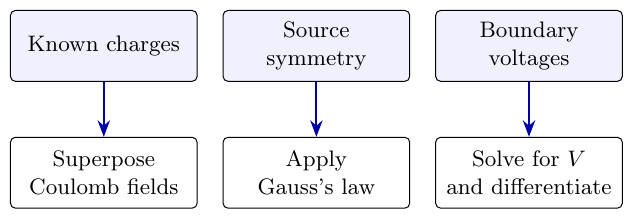
Figure 1. Three starting points for finding an electrostatic field. Begin with the information the
problem gives you.
-
Direct superposition
- Use a sum or integral when the source geometry and charges are
given. Predict which components cancel before integrating.
-
Gauss’s law
- Use it to extract the field when the physical symmetry fixes the direction and
makes the flux integral simple. Use it to check the enclosed charge even in a problem
without that symmetry.
-
Electric potential
- Add scalar contributions where that is simpler than adding vectors.
When a conductor voltage or boundary condition is given, solve for
 in the
appropriate region and recover  .
3 The introductory route
-
ES01 Charge, force, and fields.
- From signed Coulomb forces to two-dimensional field
measurements and charged-particle motion. ES01E1–ES01E8 provide practice.
-
ES02 Dipoles and distributed charge.
- From torque and the exact dipole to its far
field, then rod, arc, ring, and disk integrals. ES02A develops the continuous-source
method. See ES02E1–ES02E8.
-
ES03 flux and Gauss’s Law.
- Read ES03A before ES03. Work the signed-solid-angle
proof and the planar, cylindrical and spherical problems in ES03E1–ES03E8.
-
ES04 Potential, work, and energy.
- Read potential from fields or sources, keep track
of reference values, assemble a charge configuration, and recover fields from gradients.
See ES04E1–ES04E8.
-
ES05 Conductors, capacitors, and dielectrics.
- Follow induction and cavity charge
into capacitance, field energy, and the role of a battery. ES05E10 ties the methods
together in a dielectric-filled coax. See ES05E1–ES05E10.
4 The advanced route
-
ES06 Boundary values and images.
- Prove uniqueness and solve grounded plane,
sphere, and wedge geometries.
-
ES07 Separation and Green functions.
- Project boundary data onto
Fourier, Legendre and Bessel modes. Build a Dirichlet Green function for a grounded
sphere.
-
ES08 Multipoles and interactions.
- Compute quadrupole moments, assess
approximation error and translate the origin. Then calculate the interaction of a fixed
distribution with an external field.
-
ES09 Fields in dielectric matter.
- Match Normal displacement and tangential field,
solve a polarization problem and an interface image problem, and calculate a dielectric
force under two electrical constraints.
Each advanced unit has four worked examples. The advanced problems assume multivariable
calculus. Review Fourier series and the divergence theorem when they first enter.
5 How to use the worked articles
Try the setup and direction estimate before reading the solution. Then check your result with
units, a limit, or a second method. Do each variation on its own to see which parts of
the solution depend on the original assumptions. The same ring, spherical gap, and
capacitor recur so that you can compare field, voltage, and energy methods on familiar
geometries.
References
- MIT Open Learning Library, Electricity and Magnetism: Electrostatics (8.02.1x),
course materials.
- P. Dourmashkin et al., Electricity and Magnetism, MIT TEAL, chapters 1–5.
- D. J. Griffiths, Introduction to Electrodynamics, 4th ed., chapters 2–4.
- J. D. Jackson, Classical Electrodynamics, 3rd ed., chapters 1–4.
"Electrostatics on PhysicsLibrary" is owned by bloftin.(view preamble)
See Also: Electromagnetic Waves, Antennas, and RF: Electric Charge and the Electric Field, Electrostatic Fields, Coulomb's Law, and Superposition, Electromagnetic Waves: Gauss's Law, Electric Charge, Electric Potential, and Voltage, capacitance
| Keywords: |
electrostatics, electric field, Gauss's law, electric potential, capacitance, dielectric, self-study |
Cross-references: divergence theorem, Fourier series, polarization, Normal, boundary data, field energy, capacitance, induction, gradients, energy, Gauss's Law, flux, torque, two-dimensional, boundary, voltage, vectors, scalar, flux integral, superposition, electrostatic field, ES01E7, ES01E6, ES01E4, ES01E1, ES01E3, ES01E2, work, electric field, ES01, formula, negative charge, force, source charges, displacement, observation point, units, multipole expansions, Green functions, Conductors, charges
This is version 1 of Electrostatics on PhysicsLibrary, born on 2026-11-26.
Object id is 1597, canonical name is ElectrostaticsOnPhysicsLibrary.
Accessed 7 times total.
Classification:
|
