1 Problem
A point charge  lies at the origin. Construct a field map at
 ,
 ,
 , and
 , where
 . Then determine the field lines through those points.
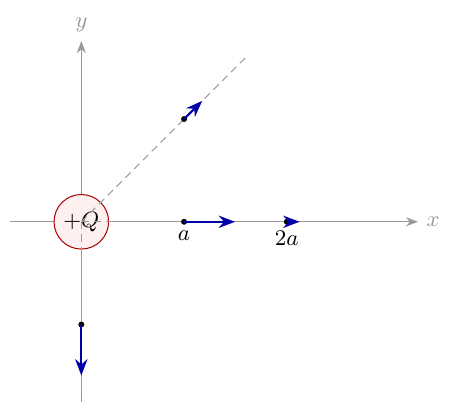
Figure 1. Dashed rays give field-line geometry. Solid arrows show four local vectors, all on the
same scale.
Try first.
Distinguish a vector drawn at a sample point from a curve tangent to the field at all of its
points.
2 Worked solution
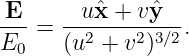
Use 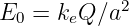 . For
 and
 , the dimensionless field is
Thus the four sample vectors in units of  are
 ,
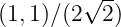 ,
 , and
 , respectively. Draw the arrow tails at the corresponding sample points and use the same
scale for all four.
For a field line, a tangent vector is parallel to  . Radial fields have zero angular component, so
their field lines stay at fixed polar angle. The first and third samples share the positive
 -axis
line. The other two lie on the rays at
 and
 . The arrows on all rays point out from the
positive source.
Check.
The diagonal sample lies at radius  and has magnitude
 . Its equal Cartesian
components each have magnitude
 .
3 Practice variation
Change the source to  . Describe the change to the vectors and lines.
Solution.
Multiply all sample vectors by  . The same radial curves carry arrows pointing toward the
source.
References
- P. Dourmashkin et al., Electricity and Magnetism, MIT TEAL, chapters 1–2.
- D. J. Griffiths, Introduction to Electrodynamics, 4th ed., chapter 2.