Two-Body Reduction and Relative Motion
Many mechanics problems begin with two interacting particles:
| m1r1 | = F12, | (1)
|
| m2r2 | = F21. | (2) |
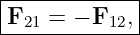
If the interaction obeys Newton’s third law,
then the six scalar coordinates contained in r1 and r2 can be reorganized into two much more
useful vectors:
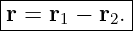
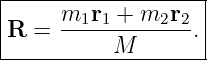
Define
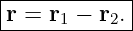
and
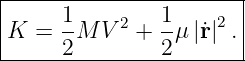
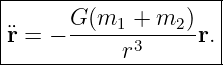
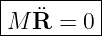
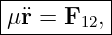
For an isolated two-body system, these coordinates separate the dynamics into
and
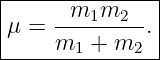
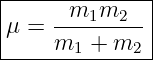
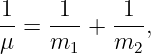
where
is the reduced mass.
Thus the internal two-body motion is dynamically equivalent to a single effective particle of mass μ
moving in the relative coordinate.
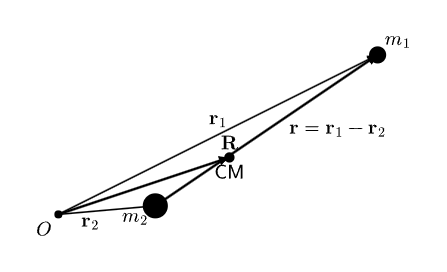
Figure 1. A two-particle configuration can be described by the center of mass position R and
relative position r = r1 − r2.
1 Why change coordinates?
The original coordinates r1 and r2 mix two distinct motions:
- translation of the pair as a whole,
- motion of the particles relative to one another.
The center of mass and relative coordinates separate these roles.
The center of mass answers:
The relative coordinate answers:
For isolated systems, the first problem is trivial uniform motion. The second contains the actual
interaction dynamics.
2 Definitions
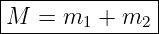
Let
be the total mass.
The center of mass coordinate is
The relative coordinate is chosen as
Thus r points from particle 2 toward particle 1.
The choice of sign is conventional. If the opposite definition is used, all corresponding force and
angular-momentum signs must be changed consistently.
3 Inverse coordinate transformation
Starting from
| MR | = m1r1 + m2r2, | (14)
|
| r | = r1 − r2, | (15) |
solve for the original positions.
From
substitute into the center of mass equation:
| MR | = m1(r + r2) + m2r2 | (17)
|
| = m1r + Mr2. | (18) |
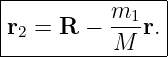
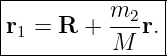
Therefore
Then
These equations reconstruct the individual particle positions from R and r.
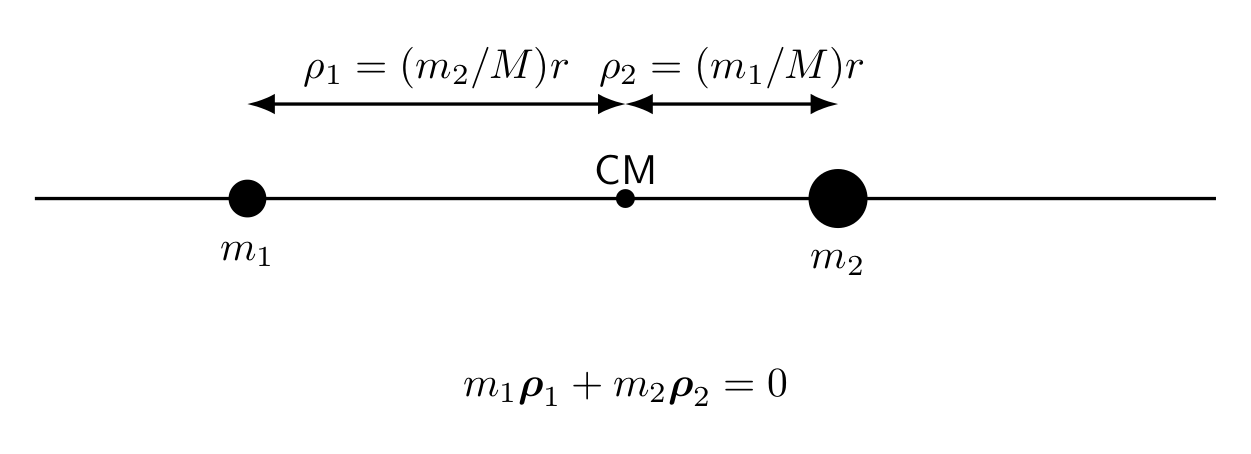
Figure 2. The relative separation is divided about the center of mass inversely in proportion to
the particle masses.
4 Distances from the center of mass
Define positions relative to the center of mass:
| ρ1 | = r1 − R, | (21)
|
| ρ2 | = r2 − R. | (22) |
Using the inverse transformation,
ρ1 =  r, r, | | (23)
|
ρ2 = − r. r. | | (24) |
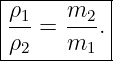
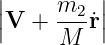
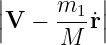
Their magnitudes satisfy
The more massive particle stays closer to the center of mass.
5 Velocity transformation
Differentiate the inverse position relations:
v1 = V +  r, r, | | (26)
|
v2 = V − r, r, | | (27) |
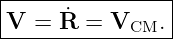
where
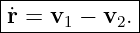
The relative velocity is
Thus r is the velocity of particle 1 relative to particle 2.
6 Total momentum
The total linear momentum is
| P | = m1v1 + m2v2 | (30)
|
| = m1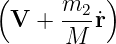 + m2 + m2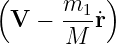 . . | (31) |
The relative-velocity terms cancel:
Therefore the center of mass motion carries the total linear momentum.
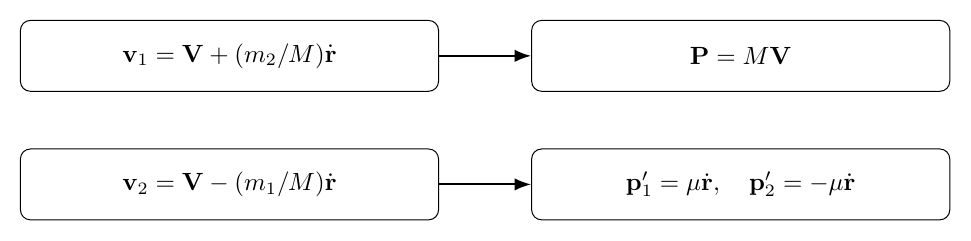
Figure 3. Individual velocities separate into common center of mass translation plus
equal-and-opposite relative-motion contributions weighted by the opposite mass.
7 The center of mass frame
In the center of mass frame,
Then
| v1′ | =  r, r, | (34)
|
| v2′ | = − r. r. | (35) |
The corresponding momenta are
| p1′ | = m1v1′ =  r, r, | (36)
|
| p2′ | = m2v2′ = − r. r. | (37) |
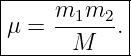
Define the reduced mass
Then
| p1′ = μr, | | (39)
|
| p2′ = −μr. | | (40) |
This motivates the definition of the relative momentum
8 Reduced mass
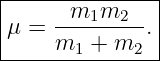
The reduced mass is
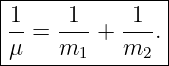
It also satisfies
Several useful limits are:
8.1 Equal masses
If
then
8.2 One mass much larger
If
then
The lighter particle behaves approximately as though it were moving around a fixed heavy
center.
8.3 Reduced mass is smaller than either mass
For finite positive masses,
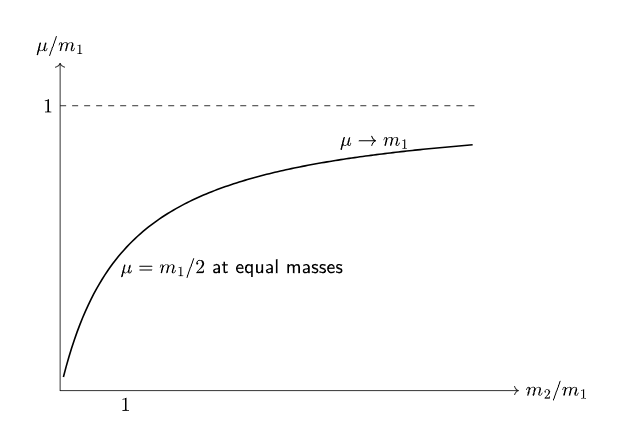
Figure 5. The reduced mass approaches the smaller physical mass when the other mass becomes
very large, and equals m∕2 for equal masses.
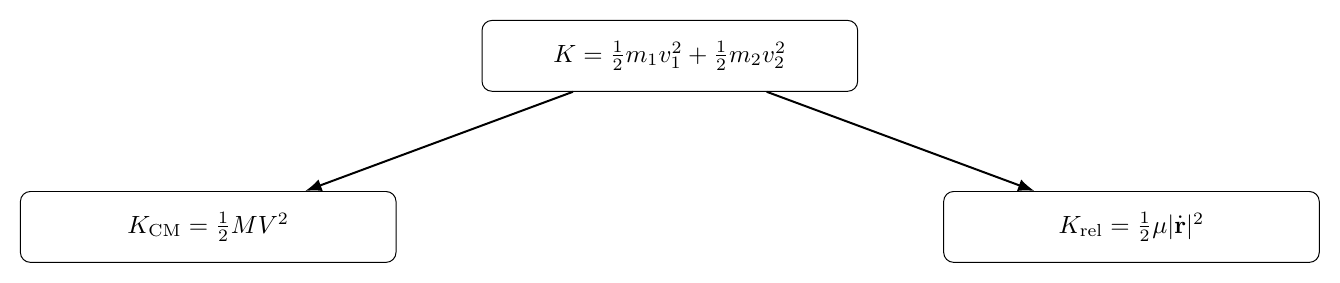
9 Kinetic-energy decomposition
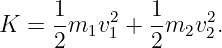
The total kinetic energy is
Substitute
| v1 | = V +  r, r, | (50)
|
| v2 | = V − r. r. | (51) |
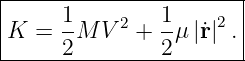
Then
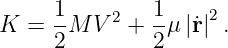
The cross terms cancel. The result is
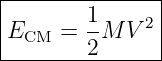
Thus
The two terms are
KCM =  MV 2, MV 2, | | (55)
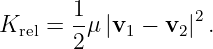
|
Krel =  μ μ 2. 2. | | (56) |
10 Why the cross terms cancel
The cross terms from the two kinetic energies are
They are equal and opposite.
Therefore
This cancellation is the energy analogue of the cancellation of the relative-motion terms in total
linear momentum.
11 Equations of motion without external forces
Let F12 be the force on particle 1 due to particle 2.
Then
| m1r1 | = F12, | (59)
|
| m2r2 | = −F12. | (60) |
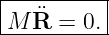
Add the two equations:
Since
we obtain
Thus
12 Relative equation of motion
Subtract the particle accelerations:
| r | = r1 −r2 | (65)
|
| =  + +  . . | (66) |
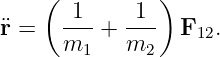
Factor:
Using
we obtain
This is the essential two-body reduction.
Two interacting particles have become one effective particle of mass μ moving in the relative
coordinate.
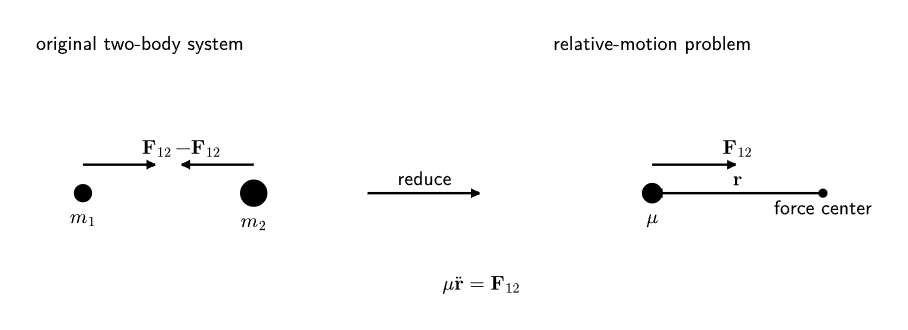
Figure 6. The internal two-body dynamics reduce to a single effective particle of mass μ acted on
by the interaction force in the relative coordinate.
13 External forces
If external forces also act,
| m1r1 | = F12 + F1,ext, | (70)
|
| m2r2 | = −F12 + F2,ext. | (71) |
Adding gives
Subtracting gives
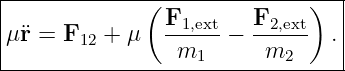
Thus external forces can affect both:
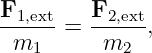
If both particles experience the same external acceleration,
then the external field does not directly alter the relative equation.
A spatially uniform gravitational field is an important example.
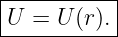
14 Potential energy depending only on separation
Suppose the internal interaction is conservative and depends only on
Then
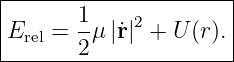
The total mechanical energy is
Using the kinetic-energy decomposition,
Define
and
For an isolated conservative system, both parts are independently constant because the center of
mass and relative motions separate.
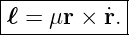
15 Angular-momentum decomposition for two particles
The total angular momentum about an origin is
For a two-particle system,
Substitute
| ρ1 | =  r, r, | v1′ | =  r, r, | (83)
|
| ρ2 | = − r, r, | v2′ | = − r. r. | (84) |
After collecting terms,
Therefore the relative motion has the angular momentum of an effective particle of mass
μ.
Define
16 Central interaction
If the internal force is central,
then
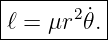
The relative angular momentum is therefore conserved:
In planar polar coordinates,
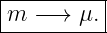
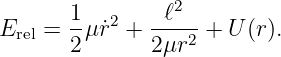
The relative orbit therefore obeys exactly the same central-force structure developed in M04-08,
with the replacement
17 Relative effective potential
For a conservative central interaction,
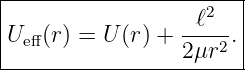
Define
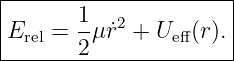
Then
Thus all of the turning-point, circular-orbit, and stability methods from M04-08 apply directly to
the relative coordinate.
18 Newtonian gravitational two-body problem
For two point masses,
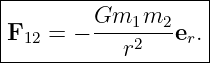
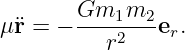
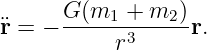
The relative equation is
Use
Divide by μ:
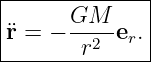
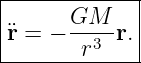
Equivalently,
The relative coordinate therefore moves exactly like a test particle in a Kepler problem with
gravitational parameter
This is one of the most useful results in celestial mechanics.
19 Gravitational relative energy
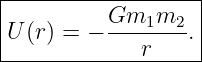
The gravitational potential energy is
Thus
Because
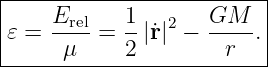
we can divide by μ and define the specific relative energy
This is the familiar specific orbital energy written for the relative orbit.
20 Circular gravitational two-body motion
For a circular relative orbit of constant separation r,
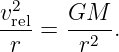
The relative equation gives
Therefore
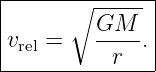
Since
we obtain
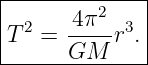
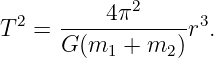
The orbital period is
so
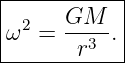
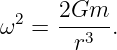
For the two-body problem, the mass entering the gravitational parameter is the total mass
m1 + m2.
21 Barycentric radii and speeds
For circular motion about the center of mass,
| ρ1 | =  r, r, | (112)
|
| ρ2 | =  r. r. | (113) |
Both particles have the same angular speed ω.
Their speeds are
| v1′ | = ωρ1 =  vrel, vrel, | (114)
|
| v2′ | = ωρ2 =  vrel. vrel. | (115) |
Thus
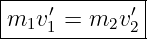
in magnitude, consistent with zero total momentum in the center of mass frame.
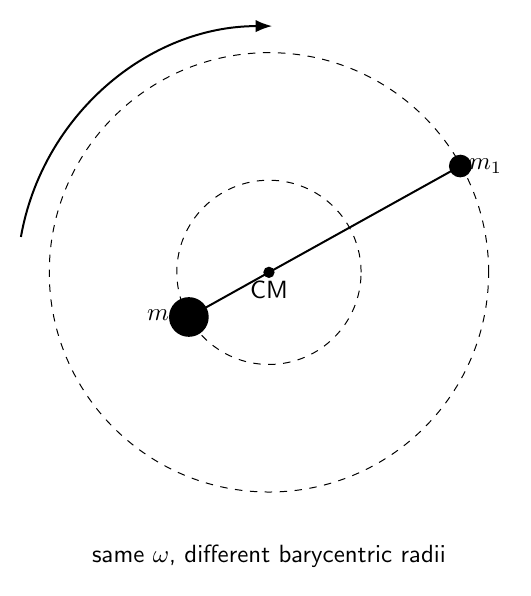
Figure 7. In a circular two-body system, both masses orbit the common center of mass with the
same angular speed. The more massive body follows the smaller barycentric orbit.
22 Example 1: equal masses
Let
Then
and
The center of mass lies halfway between the particles:
| ρ1 | =  r, r, | (120)
|
| ρ2 | = − r. r. | (121) |
In a circular gravitational orbit of separation r,
Each body moves on a circle of radius
about the barycenter.
23 Example 2: large mass-ratio limit
Let
Then
and
| μ | =  | (126)
|
| =  m1 m1 | (127)
|
| ≈ 0.990m1. | (128) |
Thus
The center of mass lies close to the heavy body:
| ρ2 | =  r r | (130)
|
| =  r. r. | (131) |
The familiar “light particle orbiting a fixed heavy body” model is therefore the large mass-ratio
limit of the exact two-body problem.
24 Mapping the relative orbit back to the individual orbits
Suppose the relative coordinate traces a curve
The particle motions about the center of mass are
ρ1(t) =  r(t), r(t), | | (133)
|
ρ2(t) = − r(t). r(t). | | (134) |
Thus both individual barycentric trajectories have the same shape as the relative orbit, scaled by
different factors and located on opposite sides of the center of mass.
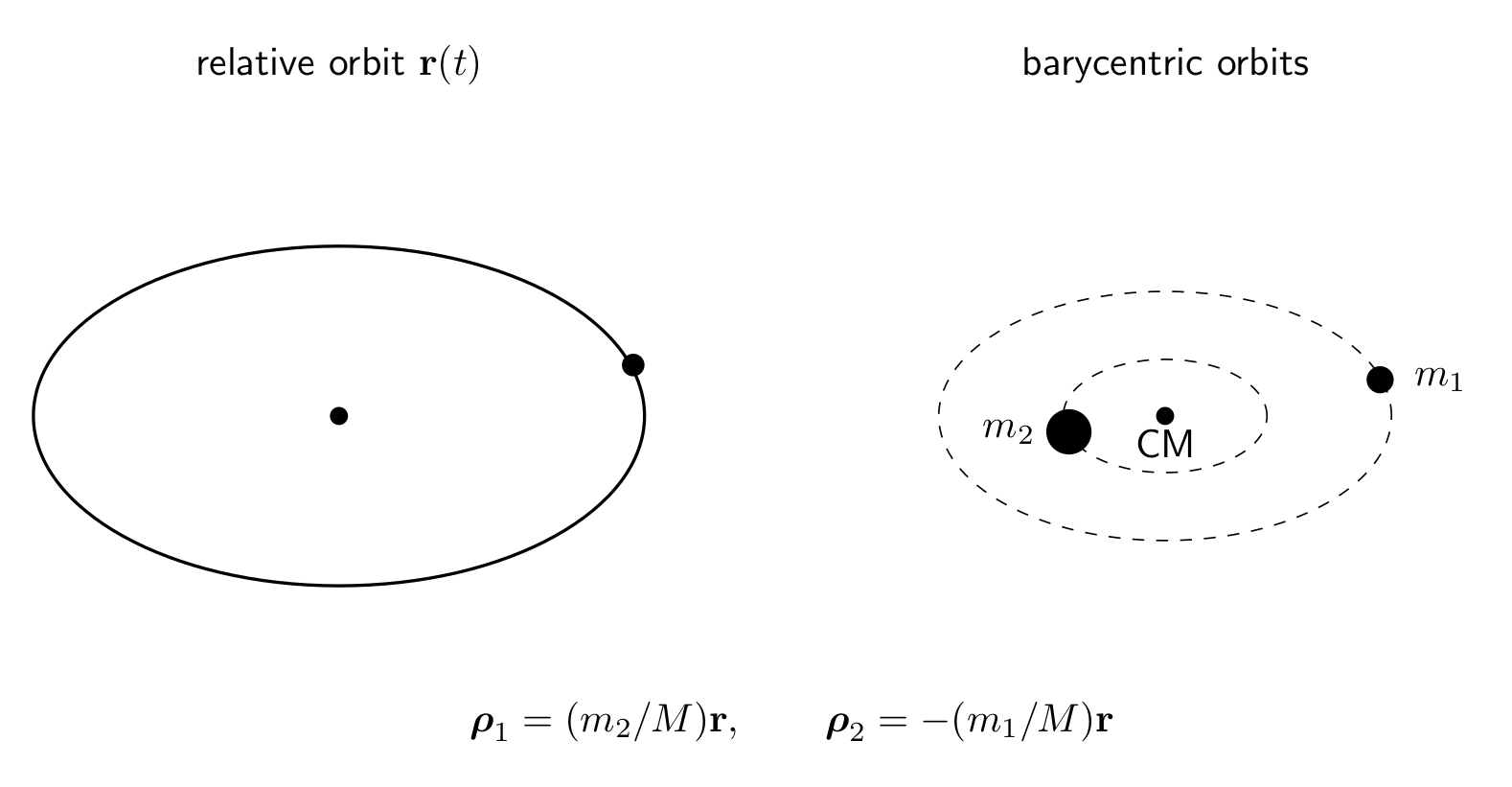
Figure 8. Once the relative orbit r(t) is known, each barycentric trajectory follows immediately by
multiplying by its mass-dependent scale factor.
25 Example 3: reconstructing positions
Let
| m1 | = 2 kg, | (135)
|
| m2 | = 3 kg, | (136) |
so
At one instant, suppose
and
Then
| r1 | = R +  r r | (140)
|
| = (4ex + ey) + (3ex − 1.2ey) | (141)
|
| = (7ex − 0.2ey) m. | (142) |
Similarly,
| r2 | = R − r r | (143)
|
| = (4ex + ey) − (2ex − 0.8ey) | (144)
|
| = (2ex + 1.8ey) m. | (145) |
The difference is
as required.
26 Example 4: relative kinetic energy
Two particles have
| m1 | = 2 kg, | (147)
|
| m2 | = 6 kg, | (148) |
and relative speed
The reduced mass is
| μ | =  | (150)
|
| = 1.5 kg. | (151) |
Therefore
Thus
27 Connection to collision mechanics
The same reduced mass appeared in one-dimensional collision energy:
This is not a coincidence.
Collision mechanics and orbital mechanics both involve the same decomposition:
- center of mass motion,
- relative motion.
In a collision, the relative kinetic energy can be redistributed or dissipated.
In a conservative central-force problem, the relative energy evolves between kinetic and potential
forms while remaining constant.
28 Connection to scattering
In the center of mass frame,
A two-body scattering event can therefore be analyzed as the deflection of the relative
momentum
by an interaction potential U(r).
This reduction is the starting point for classical scattering theory.
29 Common mistakes
- Confusing the center of mass coordinate R with the relative coordinate r.
- Forgetting which direction the chosen relative vector points.
- Using m1 + m2 instead of the reduced mass in the relative kinetic energy.
- Using either physical mass directly in μr = F12.
- Forgetting that r = v1 − v2.
- Assuming the center of mass is fixed in every inertial frame. It is fixed only in the
center of mass frame for an isolated system.
- Forgetting that the more massive particle lies closer to the center of mass.
- Treating the relative orbit as identical in scale to either barycentric orbit.
- Forgetting that G(m1 + m2), not merely Gm2, governs the exact relative gravitational
motion.
- Using the single-particle angular momentum mr2𝜃 instead of μr2𝜃 for genuine two-body
relative motion.
- Mixing laboratory-frame total energy with center of mass-frame relative energy.
- Assuming uniform external gravity alters the relative motion. A perfectly uniform
gravitational field accelerates both masses equally.
- Forgetting that tidal or otherwise nonuniform external forces can alter relative motion.
30 Practice exercises
- Starting from R = (m1r1 + m2r2)∕M and r = r1 − r2, derive the inverse coordinate
transformation.
- Show that r = v1 − v2.
- Derive P = MVCM using the transformed velocities.
- Show that in the center of mass frame,
- Derive the identity 1∕μ = 1∕m1 + 1∕m2.
- Prove the kinetic-energy decomposition
- Derive MR = 0 for an isolated two-body system.
- Derive the reduced relative equation μr = F12.
- Derive the external-force relative equation
- Derive LCM = μr ×r.
- For a central interaction, show that ℓ = μr2𝜃 is conserved.
- Derive the relative effective potential for a conservative central force.
- For Newtonian gravity, derive
- Derive the circular two-body result
- Show how a known relative orbit r(t) maps into the two individual barycentric
orbits.
31 Summary
Define
with
The inverse transformation is
r1 = R +  r, r, | | (164)
|
r2 = R − r. r. | | (165) |
The reduced mass is
For an isolated two-body system,
| MR = 0, | | (167)
|
| μr = F12. | | (168) |
The kinetic energy separates as
For a central interaction,
is conserved.
For Newtonian gravity,
The two-body problem has therefore been reduced to center of mass translation plus a one-particle
relative-motion problem.
References
References
[1] J. R. Taylor, Classical Mechanics, University Science Books, 2005.
[2] D. Kleppner and R. Kolenkow, An Introduction to Mechanics, 2nd ed., Cambridge
University Press, 2014.
[3] H. Goldstein, C. Poole, and J. Safko, Classical Mechanics, 3rd ed., Addison-Wesley,
2002.
[4] K. R. Symon, Mechanics, 3rd ed., Addison-Wesley, 1971.
[5] OpenStax, University Physics, Volume 1, Rice University, 2016.

























![|--------------[--------------]--|
| 1- 2 1- 2 |
|E = 2M V + 2μ |˙r| + U(r) .|
---------------------------------](https://images.physicslibrary.org/cache/objects/1404/make4ht/TwoBodyReductionAndRelativeMotion67x.png)