Energy Methods for Particle Systems
The work-energy theorem for one particle extends directly to a system of particles,
but the extension introduces an important distinction between external and internal
interactions.
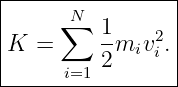
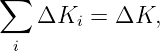
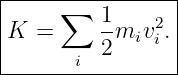
For a system containing particles i = 1,…,N, define the total kinetic energy
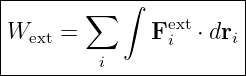
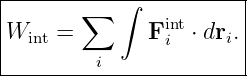
Applying the work-energy theorem to every particle and adding the results gives
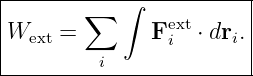
where Wext is the actual work done by external forces on the particles and Wint is the actual work
done by internal forces.
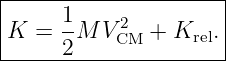
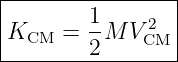
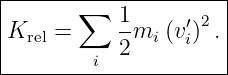
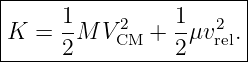
The total kinetic energy can also be decomposed into motion of the center of mass and motion
relative to the center of mass:
These two relations form the foundation of energy methods for particle systems.
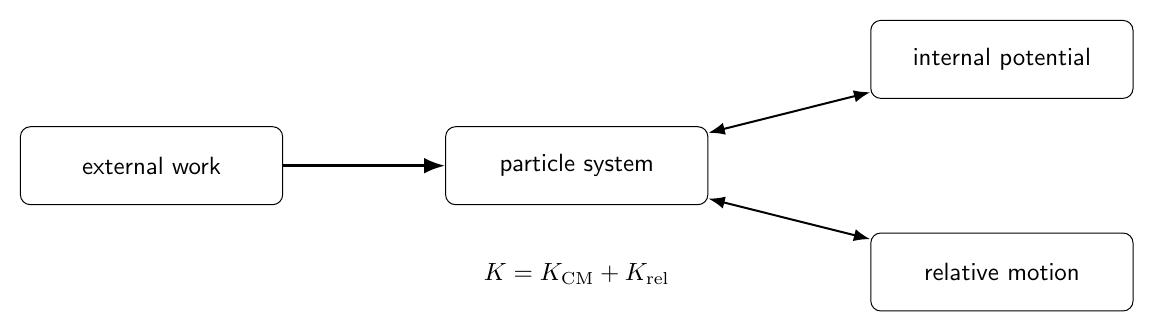
Figure 1. A particle system can exchange energy with its surroundings through external work
while internal interactions redistribute energy among center-of-mass motion, relative motion, and
internal potential energy.
1 Total kinetic energy of a particle system
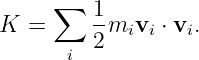
For particles with masses mi and velocities vi,
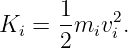
Kinetic energy is additive. Each particle contributes
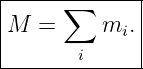
The total mass is
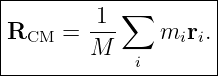
The center-of-mass position is
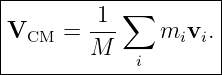
Differentiating,
Therefore the total linear momentum is
2 System work-energy theorem
For particle i,
Write the force on particle i as the sum of external and internal forces:
Then
Sum over all particles:
Since
define
and
Thus
This is the work-energy theorem for a particle system.
3 Internal forces cancel in momentum, but not generally in work
Newton’s third law causes internal forces to cancel from the net force on the system when the
internal forces occur in equal-and-opposite pairs:
That cancellation gives
It does not imply that internal work vanishes.
For a pair of particles i and j,
| dWijint | = F
ij ⋅ dri + Fji ⋅ drj | (20)
|
| = Fij ⋅ (dri − drj). | (21) |
Therefore
This is generally not zero because the two particles need not undergo the same displacement.
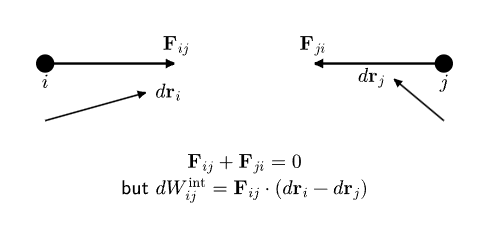
Figure 3. Equal-and-opposite internal forces cancel in the system force balance, but their work
does not generally cancel because the two particles can move through different displacements.
4 Conservative internal forces and internal potential energy
Suppose the internal force between each interacting pair is conservative.
For pair i,j, define a pair potential
Then the internal pair work satisfies
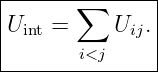
Summing over distinct pairs gives the internal potential energy
Hence
for conservative internal interactions.
The system work-energy theorem becomes
Therefore
If external conservative potentials are also included in U, then the same bookkeeping extends to
the full mechanical energy.
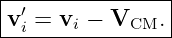
5 Center-of-mass and relative velocities
Define the velocity of each particle relative to the center of mass:
Therefore
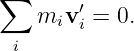
The relative velocities satisfy
To verify this,
| ∑
imivi′ | = ∑
imi(vi − VCM) | (32)
|
| = ∑
imivi − VCM ∑
imi | (33)
|
| = MVCM − MVCM | (34)
|
| = 0. | (35) |
6 Derivation of the kinetic-energy decomposition
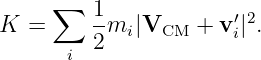
Start with
Expand the square:
| K | = ∑
i miV CM2 + ∑
imiVCM ⋅ vi′ + ∑
i miV CM2 + ∑
imiVCM ⋅ vi′ + ∑
i mi mi 2. 2. | (37) |
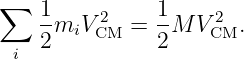
The first term is
The cross term is
| ∑
imiVCM ⋅ vi′ | = VCM ⋅∑
imivi′ | (39)
|
| = 0. | (40) |
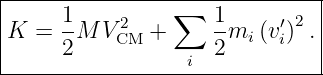
Therefore
Define
and
Thus
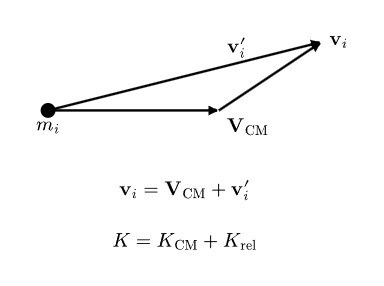
Figure 2. Each particle velocity can be decomposed into center-of-mass velocity plus velocity
relative to the center of mass. The total kinetic energy separates into center-of-mass and relative
parts.
7 Physical meaning of the decomposition
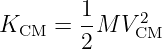
The term
is the kinetic energy the system would have if all its mass moved together with the center of
mass.
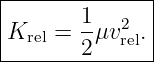
The term
measures kinetic energy associated with motion of the particles relative to the center of
mass.
Relative kinetic energy can include
- particles approaching or separating,
- vibration,
- orbital motion about the center of mass,
- rotation of a rigid particle assembly,
- random microscopic motion in a many-particle system.
The exact interpretation depends on the physical model.
8 Example 1: two-particle kinetic-energy decomposition
Two particles move along the x axis.
Let
| m1 | = 2.0 kg, | v1 | = 4.0 m∕s, | (47)
|
| m2 | = 3.0 kg, | v2 | = −1.0 m∕s. | (48) |
The total mass is
The center-of-mass velocity is
| V CM | = 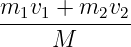 | (50)
|
| = 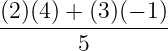 | (51)
|
| = 1.0 m∕s. | (52) |
The total kinetic energy is
| K | =  (2)(42) + (2)(42) +  (3)(12) (3)(12) | (53)
|
| = 17.5 J. | (54) |
The center-of-mass kinetic energy is
The relative velocities are
| v1′ | = 4 − 1 = 3 m∕s, | (56)
|
| v2′ | = −1 − 1 = −2 m∕s. | (57) |
Thus
| Krel | =  (2)(32) + (2)(32) +  (3)(22) (3)(22) | (58)
|
| = 15 J. | (59) |
Therefore
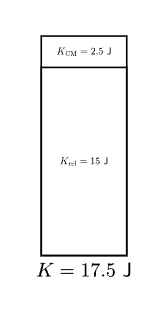
Figure 5. Example decomposition of the total kinetic energy into center-of-mass and relative
kinetic energy for two particles moving in one dimension.
9 Center-of-mass equation and pseudowork
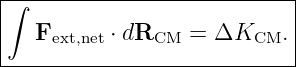
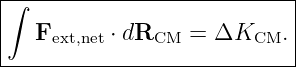
The center of mass obeys
Dot this equation with
Then
Integrating gives
The integral on the left is often called pseudowork.
It must not be confused with the actual external work
Actual work uses the displacement of each force’s point of application. Pseudowork uses the
displacement of the center of mass.
They are generally different.
10 Example 2: actual work versus pseudowork
Consider two equal particles of mass m initially at rest. Particle 2 remains fixed while a constant
external force F acts on particle 1 and moves it through distance d.
The actual external work is
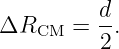
The center of mass moves only half as far:
The net external force on the system is
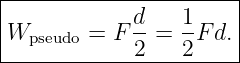
Therefore the pseudowork is
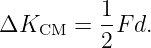
The pseudowork equals the change in center-of-mass kinetic energy:
The actual external work equals the change in total kinetic energy:
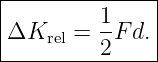
The difference appears as relative kinetic energy:
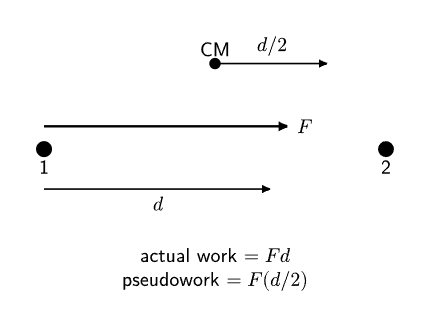
Figure 4. Actual external work uses the displacement of the force application point.
Center-of-mass pseudowork uses the displacement of the center of mass and determines only the
change in KCM.
11 Why the distinction matters
For a single particle,
so actual work and pseudowork coincide.
For a multi-particle system, they generally do not.
The difference between external work and center-of-mass pseudowork can change
Therefore one should not write
unless the conditions of the specific problem justify it.
12 Two-particle relative motion and reduced mass
For two particles, define the relative coordinate
and relative velocity
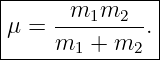
Define the reduced mass
For a two-particle system,
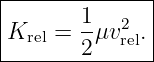
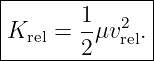
Therefore
This decomposition is central to two-body mechanics, collisions, binary orbits, and molecular
motion.
13 Derivation of the two-particle relative kinetic energy
The center-of-mass condition is
The relative velocity is
Solving,
| v1′ | =  vrel, vrel, | (82)
|
| v2′ | = − vrel. vrel. | (83) |
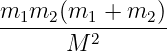
Then
| Krel | =  m1 m1 2 + 2 +  m2 m2 2 2 | (84)
|
| =  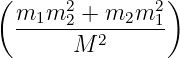 vrel2 vrel2 | (85)
|
| =   vrel2 vrel2 | (86)
|
| =   vrel2. vrel2. | (87) |
Therefore
14 Internal springs
Consider two particles connected by an ideal spring.
The spring interaction is internal to the two-particle system.
Let the spring extension from its natural length be
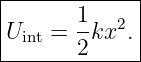
The internal potential energy is
If no external work is done,
Using the center-of-mass decomposition,
If no net external force acts,
is separately constant, so the spring exchanges energy with the relative motion.
15 Explosions and release of internal energy
Suppose a system is initially at rest and an internal process causes it to separate into
pieces.
If the net external impulse is negligible,
remains constant.
If the initial center of mass is at rest,
before and after the event.
Therefore
Yet the fragments can acquire substantial kinetic energy.
That kinetic energy is relative kinetic energy and must come from another internal energy
reservoir, such as
- chemical energy,
- elastic energy,
- nuclear energy,
- stored pressure energy.
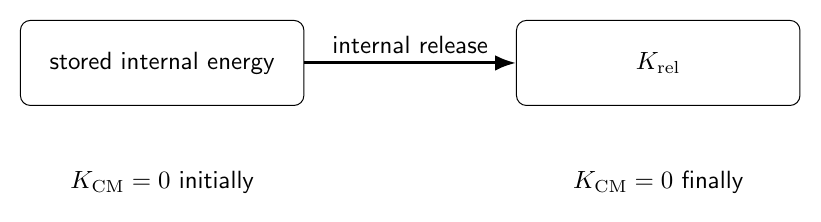
Figure 6. An internal energy release can create relative kinetic energy without changing
center-of-mass kinetic energy when no net external impulse acts.
16 Example 3: two-fragment explosion
A system initially at rest separates into two fragments:
| m1 | = 2.0 kg, | (97)
|
| m2 | = 3.0 kg. | (98) |
After separation, fragment 1 moves at
Momentum conservation gives
Thus
| v2 | = − v1 v1 | (101)
|
| = − (6) (6) | (102)
|
| = −4.0 m∕s. | (103) |
The final kinetic energy is
| Kf | =  (2)(62) + (2)(62) +  (3)(42) (3)(42) | (104)
|
| = 36 + 24 | (105)
|
| = 60 J. | (106) |
Because the center of mass remains at rest,
Therefore all 60 J is relative kinetic energy:
At least 60 J of internal energy has been converted into kinetic energy in this idealized
model.
17 External conservative potentials for a system
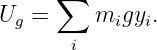
Suppose each particle also moves in an external conservative field.
For example, near Earth’s surface,
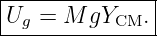
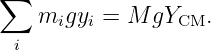
If The Gravitational Field is uniform,
| Ug | = g ∑
imiyi | (110)
|
| = MgY CM. | (111) |
Therefore
In a uniform gravitational field, the gravitational potential energy of the entire particle system
depends only on the center-of-mass height.
This is a useful simplification.
18 General mechanical-energy accounting for a particle system
Let
include all conservative interactions represented by potentials.
Then define
Any remaining nonconservative external work or modeled dissipative transfer changes this
mechanical energy:
Using the kinetic-energy decomposition,
This form makes clear where energy can reside within a particle system.
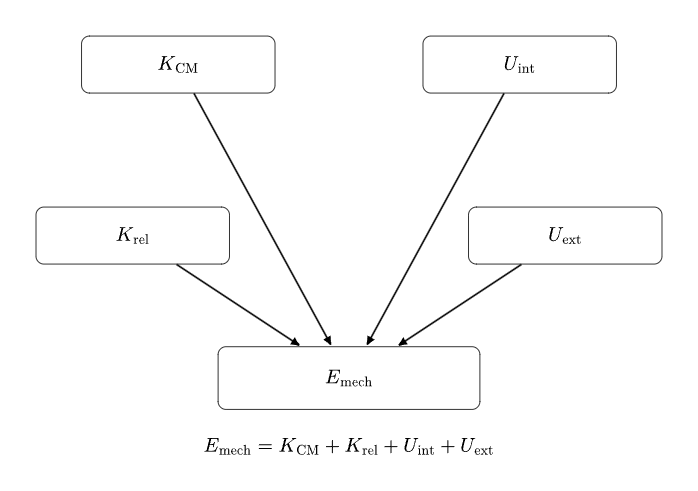
Figure 7. Mechanical energy of a particle system can be partitioned into center-of-mass kinetic
energy, relative kinetic energy, internal potential energy, and external potential energy.
Nonconservative transfers change the total of these terms.
19 Internal nonconservative interactions
Not all internal interactions are conservative.
A system can contain
- internal friction,
- inelastic deformation,
- damping,
- collisions with permanent deformation,
- microscopic dissipation.
In such cases, macroscopic mechanical energy can decrease even if no energy crosses the system
boundary.
The missing macroscopic mechanical energy appears as internal energy.
For a closed system,
in a simplified model with no other energy transfer.
Thus the larger total-energy balance remains valid even when the mechanical-energy balance does
not close by itself.
20 A system-energy workflow
For a multi-particle energy problem:
- Define the particles included in the system.
- Identify the center-of-mass motion.
- Decide whether relative motion matters.
- Separate external and internal interactions.
- Represent conservative interactions with potential-energy functions.
- Identify nonconservative work or internal-energy conversion.
- Use
- Apply the appropriate work-energy or mechanical-energy equation.
- Check momentum or center-of-mass motion when useful.
21 Common mistakes
- Assuming internal forces do zero work merely because they cancel in the net force.
- Replacing actual external work with Fext,net ⋅ ΔRCM without justification.
- Forgetting that pseudowork determines ΔKCM, not generally ΔK.
- Omitting relative kinetic energy.
- Double counting a conservative internal force as both work and potential energy.
- Summing pair potentials over both i,j and j,i instead of using each pair once.
- Assuming zero net external force implies zero total kinetic energy.
- Assuming a center of mass at rest means all particles are at rest.
- Ignoring internal energy release in an explosion.
- Applying one-particle energy formulas to a multi-particle system without defining the
system boundary.
22 Practice exercises
- Two particles have masses m1 = 1 kg and m2 = 2 kg with velocities 3 m∕s and −1 m∕s.
Find V CM and the total kinetic energy.
- For the preceding system, calculate KCM and Krel and verify K = KCM + Krel.
- Starting from vi = VCM + vi′, derive the system kinetic-energy decomposition.
- Show that ∑
imivi′ = 0.
- For an internal pair satisfying Fij = −Fji, derive
- Explain why equal-and-opposite internal forces can do nonzero net internal work.
- Two equal masses are connected by an ideal spring and move with no external force.
Explain which energy terms can change and which center-of-mass quantity remains
constant.
- Derive Krel =
 μvrel2 for two particles.
- A two-fragment explosion starts from rest. If m1 = 1 kg moves at 8 m∕s and m2 = 4 kg, find
the second fragment’s velocity and the final total kinetic energy.
- In a uniform gravitational field, prove
- Explain the difference between actual external work and center-of-mass pseudowork.
- A constant external force F moves one of two equal particles through distance d
while the other remains fixed. Find the actual work, pseudowork, ΔKCM, and
ΔKrel.
- Give an example in which KCM is constant while Krel increases.
- Give an example in which the system’s total momentum is zero but its total kinetic energy is
not zero.
- Explain how internal friction can reduce mechanical energy without violating total-energy
conservation.
23 Summary
The total kinetic energy of a particle system is
The system work-energy theorem is
Internal forces can do net work even when they cancel from the net-force equation.
The kinetic energy decomposes as
For two particles,
The center-of-mass equation gives the pseudowork relation
This is not generally equal to the actual external work.
With conservative internal and external potentials,
These ideas provide the bridge from particle mechanics to collisions, rigid bodies, orbital two-body
motion, and continuum systems.
The next article, M03-09, develops energy methods for rigid bodies.
References
References
[1] J. R. Taylor, Classical Mechanics, University Science Books, 2005.
[2] D. Kleppner and R. Kolenkow, An Introduction to Mechanics, 2nd ed., Cambridge
University Press, 2014.
[3] H. Goldstein, C. Poole, and J. Safko, Classical Mechanics, 3rd ed., Addison-Wesley,
2002.
[4] K. R. Symon, Mechanics, 3rd ed., Addison-Wesley, 1971.
[5] OpenStax, University Physics, Volume 1, Rice University, 2016.