Parallel-Axis and Perpendicular-Axis Theorems
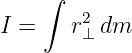
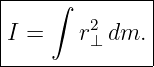
Direct evaluation of
is the fundamental way to compute a moment of inertia.
Once one moment of inertia is known, however, two geometric theorems can often generate others
immediately.
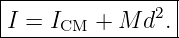
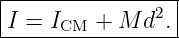
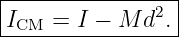
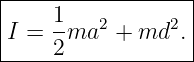
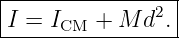
The parallel-axis theorem relates moments of inertia about two parallel axes:
Here:
- ICM is the moment of inertia about an axis through the center of mass,
- the new axis is parallel to the center of mass axis,
- d is the perpendicular distance between the two axes,
- M is the total mass.
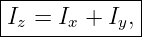
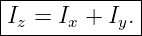
The perpendicular-axis theorem applies to a planar lamina:
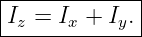
where the x and y axes lie in the plane of the lamina and the z axis is perpendicular to the plane,
with all three axes passing through the same point.
These theorems solve different geometric problems and have different conditions of validity.
1 Why axis changes matter
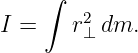
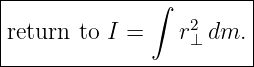
Moment of inertia is
Changing the axis changes the perpendicular distance r⊥ of essentially every mass element.
Therefore the moment of inertia generally changes.
The parallel-axis theorem answers:
The perpendicular-axis theorem answers:
The two theorems should not be interchanged.
2 Geometry of two parallel axes
Let an axis through the center of mass be parallel to a second axis displaced by perpendicular
vector d.
For a mass element dm, let ρ denote its position measured from the center of mass.
Only components perpendicular to the two axes contribute to the distance from either
axis.
Let
be the perpendicular component of ρ.
Relative to the shifted axis, the perpendicular displacement is
Its squared distance is
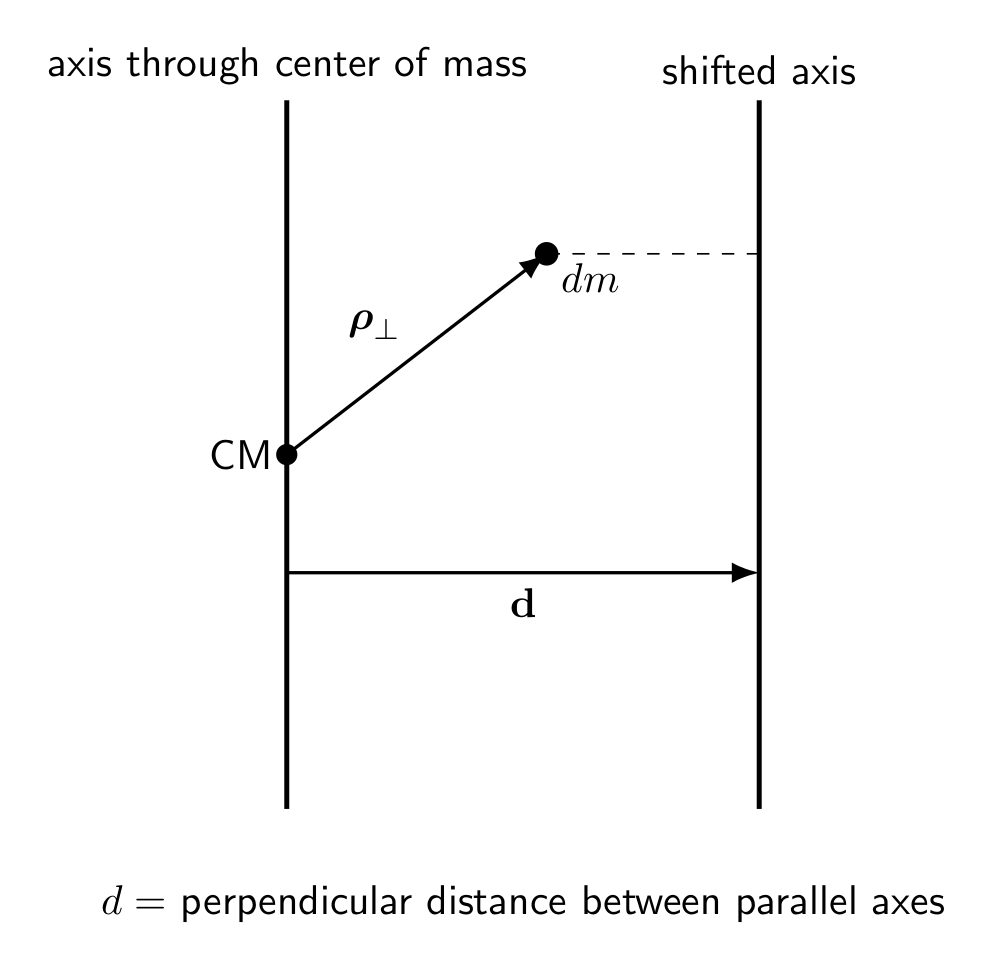
Figure 1. The parallel-axis theorem compares a reference axis through the center of mass with a
second parallel axis displaced by perpendicular distance d.
3 Derivation of the parallel-axis theorem
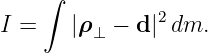
Start with the moment of inertia about the shifted axis:
Expand the square:
Therefore
| I | = ∫
ρ⊥2 dm + ∫
d2 dm − 2d ⋅∫
ρ⊥dm. | (12) |
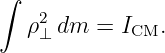
The first term is the center of mass axis moment:
The second term is
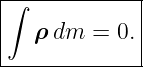
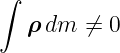
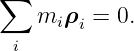
The final term vanishes because ρ is measured from the center of mass:
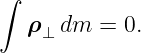
Therefore its perpendicular projection also vanishes:
Hence
This is the parallel-axis theorem.
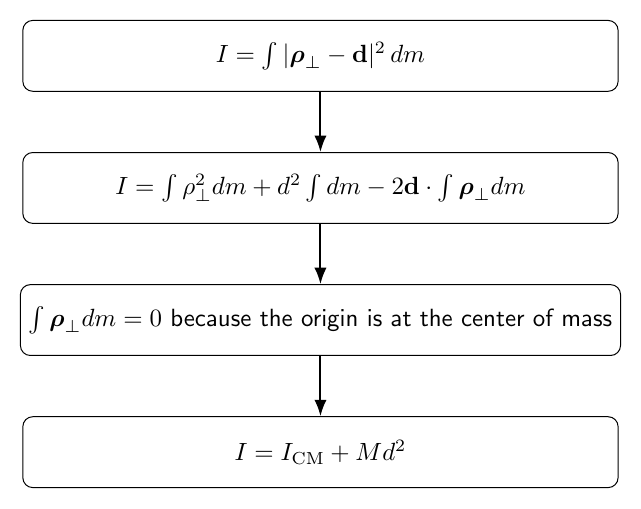
Figure 2. The cross term in the shifted-axis expansion vanishes because the first mass moment
about the center of mass is zero.
4 Why the center of mass is essential
Suppose the reference axis is parallel to the final axis but does not pass through the center of
mass.
Then
in general.
The cross term does not vanish, so the simple formula
is not generally valid.
The theorem has a very specific form:
The known axis must pass through the center of mass and be parallel to the desired
axis.
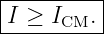
5 The center of mass axis is the minimum parallel-axis inertia
Since
the theorem immediately implies
for every axis parallel to a given center of mass axis.
Equality occurs only when
Thus, among a family of parallel axes, the axis through the center of mass has the smallest
moment of inertia.
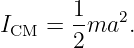
6 Example 1: thin rod about one end
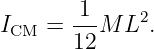
From M05-04, a uniform thin rod of length L and mass M has moment of inertia about a
perpendicular axis through its center:
The parallel axis through one end is displaced by
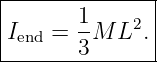
Therefore
| Iend | = ICM + Md2 | (26)
|
| =  ML2 + M ML2 + M 2 2 | (27)
|
| =  ML2 + ML2 +  ML2 ML2 | (28)
|
| =  ML2. ML2. | (29) |
Hence
This reproduces the direct integration result from M05-04.
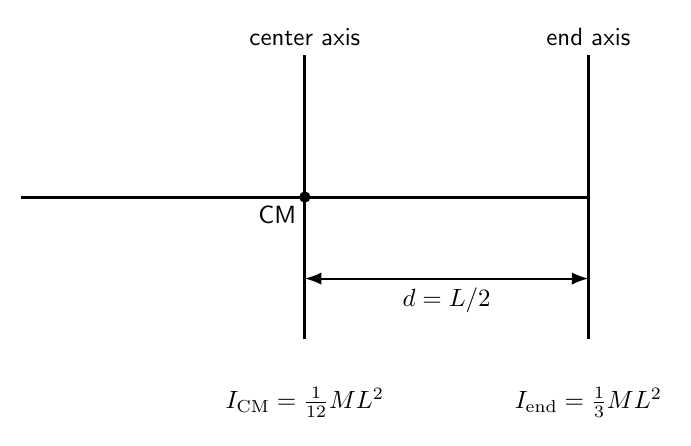
Figure 3. The perpendicular end axis of a uniform rod is parallel to the perpendicular center axis
and displaced by L∕2, so the parallel-axis theorem gives Iend = ICM + M(L∕2)2.
7 Example 2: disk about a tangent axis perpendicular to its plane
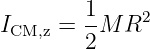
A uniform disk has
about its symmetry axis through the center.
A tangent axis perpendicular to the disk is parallel to the symmetry axis and displaced
by
Thus
| Itangent,z | =  MR2 + MR2 MR2 + MR2 | (33)
|
| =  MR2. MR2. | (34) |
8 Example 3: thin ring about a tangent axis perpendicular to its plane
For a thin ring,
A parallel tangent axis lies a distance
away.
Therefore
| Itangent,z | = MR2 + MR2 | (37)
|
| = 2MR2. | (38) |
9 Parallel-axis theorem for discrete masses
The theorem is equally valid for a discrete collection of particles.
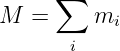
Let
and let
be each particle position relative to the center of mass.
Then
For a parallel axis displaced by d,
| I | = ∑
imi|ρi⊥− d|2 | (42)
|
| = ICM + Md2. | (43) |
The continuous theorem is therefore the integral form of the same center of mass cancellation.
10 Inverse use of the parallel-axis theorem
Sometimes a moment of inertia about an offset axis is known and the center of mass value is
desired.
Rearrange:
Because
the result must remain nonnegative.
A negative answer signals an incorrect axis, distance, mass, or input value.
11 Perpendicular-axis theorem
Now consider a thin planar lamina lying in the xy plane.
Let the x and y axes lie in the plane and intersect at point O.
Let the z axis pass through the same point and be perpendicular to the lamina.
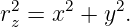
For a mass element at coordinates
the squared distance to the z axis is
The squared distance to the x axis is
and to the y axis,
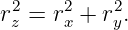
Therefore
Multiply by dm and integrate:
| Iz | = ∫
(x2 + y2) dm | (51)
|
| = ∫
y2 dm + ∫
x2 dm. | (52) |
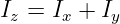
Thus
This is the perpendicular-axis theorem.
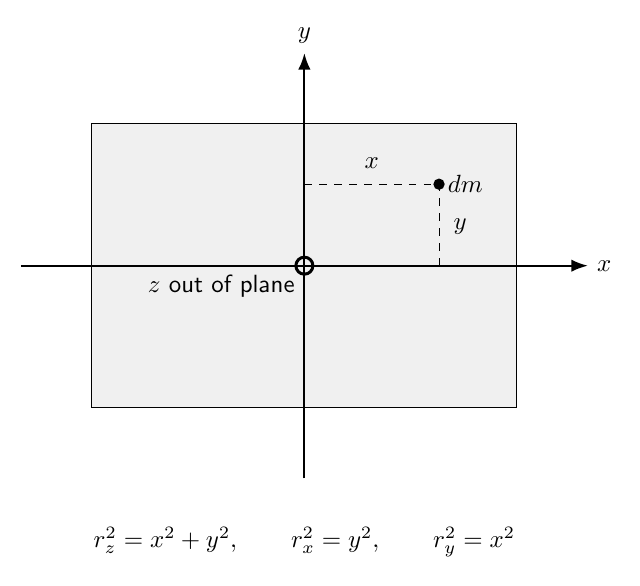
Figure 4. For a planar lamina, the distance squared to the perpendicular z axis is x2 + y2, while
the distances squared to the in-plane x and y axes are y2 and x2.
12 Conditions for the perpendicular-axis theorem
The formula
requires:
- the body is planar, or treated as an ideal thin lamina,
- the x and y axes lie in the plane,
- the z axis is perpendicular to the plane,
- all three axes intersect at the same point.
It is not generally valid for a three-dimensional body of finite thickness.
For example, it should not be applied directly to a solid sphere.
13 Why the theorem fails for a general three-dimensional body
For a three-dimensional mass element at
the moments about the coordinate axes are
| Ix | = ∫
(y2 + z2) dm, | (56)
|
| Iy | = ∫
(x2 + z2) dm, | (57)
|
| Iz | = ∫
(x2 + y2) dm. | (58) |
Then
| Ix + Iy | = ∫
(x2 + y2 + 2z2) dm. | (59) |
Only when
for every mass element does this reduce to
That is precisely the planar-lamina condition.
14 Example 4: disk about a diameter
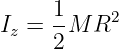
A uniform thin disk has
about its central symmetry axis perpendicular to the disk.
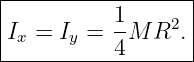
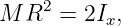
By rotational symmetry in the plane,
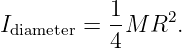
The perpendicular-axis theorem gives
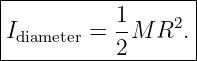
Therefore
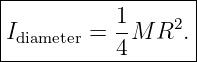
Thus the moment of inertia of a thin disk about any diameter is
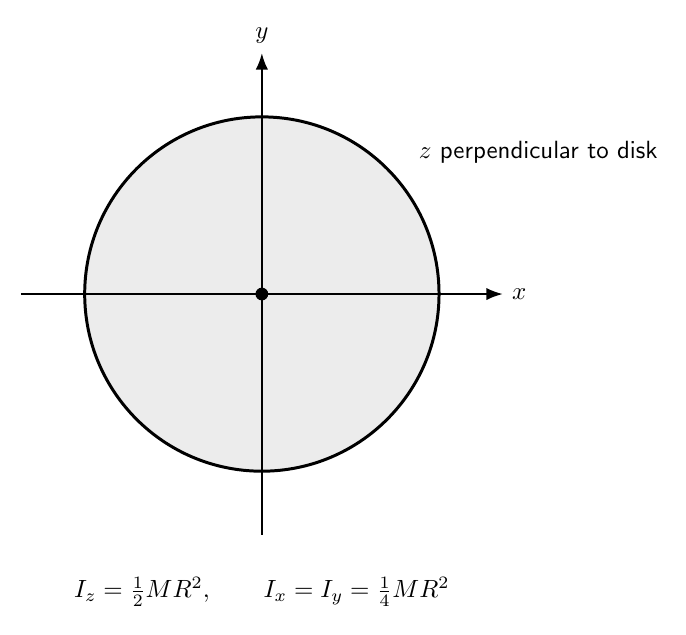
Figure 5. For a thin disk, the perpendicular-axis theorem and in-plane symmetry give
Ix = Iy = MR2∕4 when Iz = MR2∕2.
15 Example 5: thin ring about a diameter
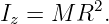
For a thin ring,
By symmetry,
Therefore
so
16 Example 6: rectangular plate
Consider a uniform rectangular plate with side length a along x and side length b along
y.
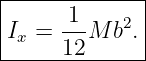
About the central x axis,
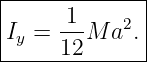
About the central y axis,
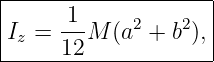
Therefore the perpendicular-axis theorem gives
| Iz | = Ix + Iy | (73)
|
| =  M(a2 + b2). M(a2 + b2). | (74) |
Hence
matching the direct two-dimensional integration from M05-04.
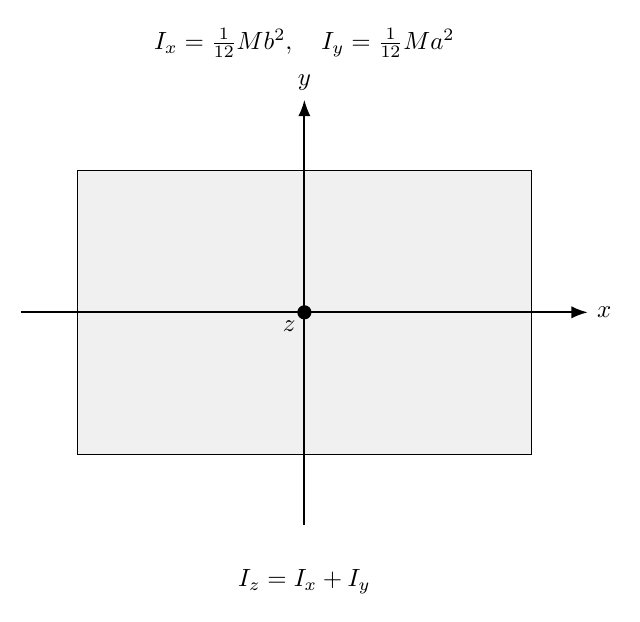
Figure 6. For a thin rectangular plate, the two in-plane central moments add to the perpendicular
central moment: Iz = Ix + Iy.
17 Combining the two theorems
The two theorems can be used sequentially.
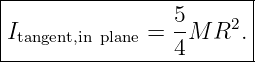
For example, find the moment of inertia of a thin disk about a tangent line lying in the plane of
the disk.
First use the perpendicular-axis theorem to find the moment about a central diameter:
Then use the parallel-axis theorem to shift that diameter to the parallel tangent line:
| Itangent,in plane | = Idiameter + MR2 | (77)
|
| =  MR2 + MR2. MR2 + MR2. | (78) |
Thus
This is a useful example because neither theorem alone completes the problem.
18 Example 7: rectangular plate about an edge in its plane
Take the rectangular plate of side lengths a and b.
Suppose the desired axis is parallel to the x axis and lies along an edge at
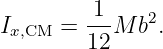
The central parallel-axis value is
The displacement is
Therefore
| Iedge | =  Mb2 + M Mb2 + M | (83)
|
| =  Mb2. Mb2. | (84) |
Notice that the dimension a does not appear because distance to this axis depends only on the y
coordinate.
19 Composite bodies
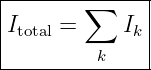
For a body composed of several pieces,
provided each Ik is evaluated about the same final axis.
A useful workflow is:
- identify the final axis,
- take each component’s known center of mass inertia about a parallel axis,
- shift it to the final axis using
- add all component contributions.
For holes or cavities, treat removed material as a negative contribution.
20 Offset cavity
Suppose a circular hole is cut from a thin plate.
Let the full plate have inertia
about the desired axis.
Let the removed circular disk have mass
and center of mass moment
If the hole center is displaced by distance d from the desired axis, its contribution about that axis
would have been
Therefore the remaining body’s moment of inertia is
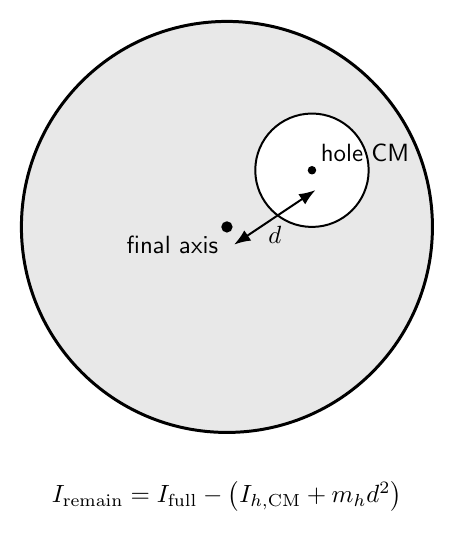
Figure 7. An offset cavity can be handled as negative mass. Shift the removed piece’s center of
mass inertia to the desired axis before subtracting it.
21 Example 8: numerical composite rotor
A rotor contains:
- a uniform disk of mass 4.0 kg and radius 0.30 m centered on the axis,
- a point mass of 1.0 kg attached at radius 0.50 m.
The disk contributes
| Id | =  MR2 MR2 | (92)
|
| =  (4.0)(0.30)2 (4.0)(0.30)2 | (93)
|
| = 0.180 kg m2. | (94) |
The point mass contributes
Thus
This example does not require a parallel-axis shift for the disk because its center of mass axis
already coincides with the final axis.
22 Example 9: offset disk component
A small uniform disk of mass m and radius a is mounted so that its symmetry axis is parallel to
the final rotation axis but displaced by distance d.
Its center of mass inertia is
Therefore
This pattern appears frequently in gears, flywheels, eccentric rotors, and composite
mechanisms.
23 A useful theorem-selection strategy
Ask the following questions.
If the new axis is parallel to a known axis through the center of mass:
If the body is a planar lamina and three axes intersect at the same point, with two in the plane
and one perpendicular:
If neither geometry applies:
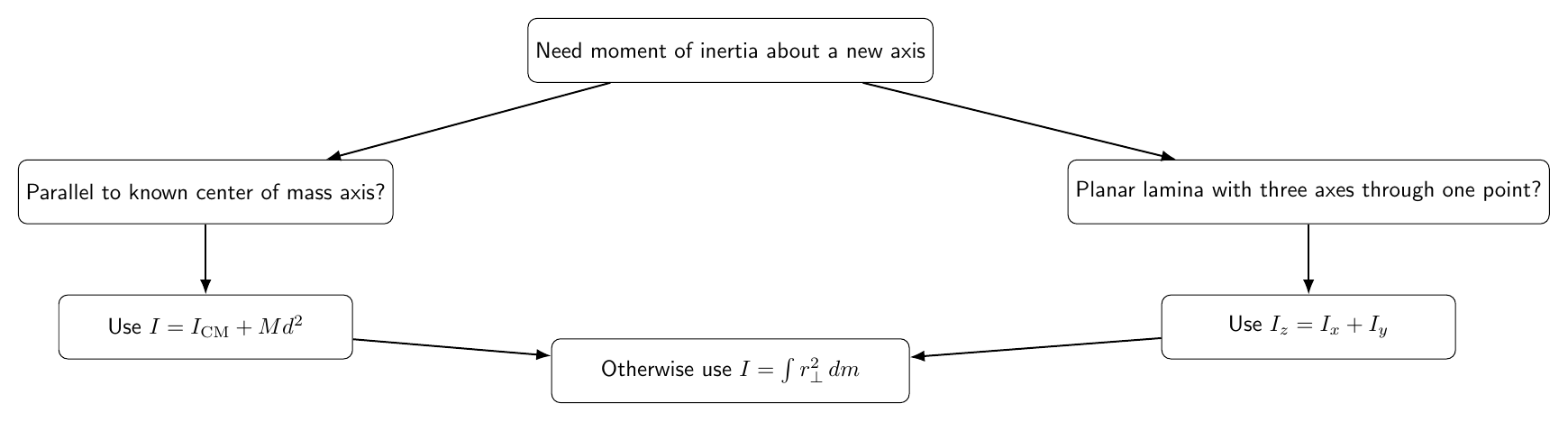
Figure 8. The parallel-axis and perpendicular-axis theorems apply to different geometries. When
their conditions are not met, return to the defining mass integral.
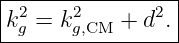
24 Parallel-axis theorem and radius of gyration
Write
and
The parallel-axis theorem gives
Divide by M:
Thus shifting the axis increases the squared radius of gyration by exactly d2.
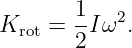
25 Energy consequence of an axis shift
For the same rigid body rotating at the same angular speed ω about two parallel axes,
Using
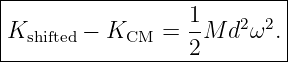
the energy difference is
| ΔK | =  Md2ω2. Md2ω2. | (108) |
Therefore
This is not an independent theorem, but it makes the physical effect of the larger shifted-axis
inertia clear.
26 Connection to the inertia tensor
The parallel-axis theorem has a three-dimensional tensor generalization.
The perpendicular-axis theorem does not become a general three-dimensional identity of the same
form because it relies on every mass element having zero coordinate Normal to the
lamina.
Later articles introduce the inertia tensor, principal axes, and the full three-dimensional relation
between angular momentum and angular velocity.
For now, the scalar axis moments are sufficient.
27 Common mistakes
- Using the parallel-axis theorem when the two axes are not parallel.
- Using I = I0 + Md2 when the known axis does not pass through the center of mass.
- Using the distance from the center of mass to a point instead of the perpendicular
distance between the two parallel axes.
- Subtracting Md2 when shifting away from the center of mass axis.
- Forgetting that the center of mass axis gives the minimum moment among parallel
axes.
- Using the perpendicular-axis theorem for a solid three-dimensional body.
- Applying Iz = Ix + Iy when the three axes do not intersect at the same point.
- Forgetting that the x and y axes must lie in the plane of the lamina.
- Assuming Ix = Iy without an actual symmetry that justifies it.
- Combining component moments that are referred to different final axes.
- Subtracting a cavity’s center of mass inertia without first shifting it to the desired axis.
- Confusing the parallel-axis theorem with the perpendicular-axis theorem because both
involve axis geometry.
- Using a standard table value without checking which axis that table value refers to.
- Forgetting that a tangent axis in the plane of a disk and a tangent axis perpendicular
to the disk have different moments of inertia.
28 Practice exercises
- Starting from I = ∫
r⊥2 dm, derive the parallel-axis theorem in vector form.
- Explain exactly why the cross term vanishes when the reference axis passes through
the center of mass.
- Use the parallel-axis theorem to derive the moment of inertia of a uniform rod about
a perpendicular axis through one end.
- A disk has mass M and radius R. Find its inertia about an axis perpendicular to the
disk and tangent to its rim.
- A thin ring has mass M and radius R. Find its inertia about an axis perpendicular to
the ring and tangent to its rim.
- Prove the perpendicular-axis theorem directly from the coordinates (x,y) of a planar
mass element.
- Explain why the perpendicular-axis theorem fails for a general three-dimensional body.
- Use the perpendicular-axis theorem to derive the moment of inertia of a thin disk about
a diameter.
- Use the perpendicular-axis theorem to derive the moment of inertia of a thin ring about
a diameter.
- Use both the perpendicular-axis and parallel-axis theorems to find the moment of
inertia of a thin disk about a tangent line in the plane of the disk.
- Find the moment of inertia of a rectangular plate about an in-plane axis along one
edge.
- A body has ICM = 3.0 kg m2, M = 5.0 kg, and an offset parallel axis at d = 0.40 m.
Find I.
- A body has I = 8.0 kg m2 about an offset axis, M = 10 kg, and d = 0.50 m. Find I
CM.
- Derive kg2 = k
g,CM2 + d2.
- Explain how to compute the inertia of a plate with an off-center circular hole using
negative mass and the parallel-axis theorem.
29 Summary
For an axis parallel to a center of mass axis and displaced by perpendicular distance
d,
The center of mass axis has the smallest moment of inertia among all parallel axes:
For a planar lamina with x and y axes in the plane and a perpendicular z axis through the same
point,
The parallel-axis theorem shifts an axis.
The perpendicular-axis theorem relates orthogonal axis moments of a planar body.
When neither theorem applies, the fundamental definition remains
These tools complete the geometric foundation needed for M05-06, where moment of inertia enters
rotational dynamics through torque and angular acceleration.
References
References
[1] J. R. Taylor, Classical Mechanics, University Science Books, 2005.
[2] D. Kleppner and R. Kolenkow, An Introduction to Mechanics, 2nd ed., Cambridge
University Press, 2014.
[3] K. R. Symon, Mechanics, 3rd ed., Addison-Wesley, 1971.
[4] OpenStax, University Physics, Volume 1, Rice University, 2016.