|
|
|
|||||||
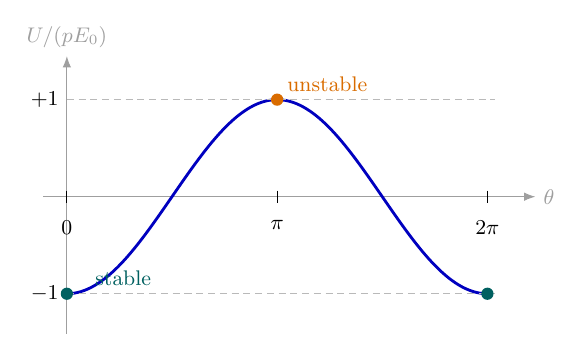
For E0 > 0, 𝜃 = 0 is stable and 𝜃 = π is unstable, as the second derivatives +pE0 and −pE0 show. For the aligned pair take +q at z = d∕2 and −q at z = −d∕2. Its force is
This is exact for a linear axial field and the specified fixed orientation. For a smooth field it is the leading term for d small. Check. α has units of N∕(C m), so pα has units of force. A uniform field gives zero translation in this model.
3 Practice variationHold the aligned dipole upside down in the same axial field. Solution. The charge positions swap, so Fz = −pα. Its uniform-field orientation energy is +pE0, the maximum.
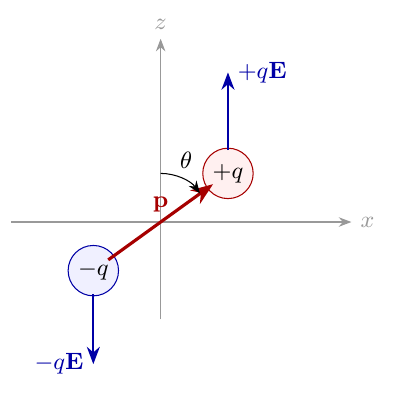
4 Derive the torque and orientation energyLet d be the separation, q > 0 the positive charge, and d the unit vector from −q to +q. Then p = qdd. The dipole torque is the sum of moments of the external forces about the midpoint:
For rotation about +y that increases 𝜃, the signed torque is τy = −pE0 sin 𝜃. The orientation energy is the negative integral of this torque with respect to angle. Taking zero at π∕2,
Near alignment, U = −pE0 + (pE0∕2)𝜃2 + O(𝜃4), so the torque is restoring. Near anti-alignment the quadratic change has the opposite sign.
5 Worked example 2: next correction in a smooth axial fieldKeep the dipole aligned at height z0, and suppose the external field is smooth near both charges. The axial force is q[Ez(z0 + d∕2) − Ez(z0 − d∕2)]. Expand each about z0 through cubic order:
The zeroth and quadratic terms are equal at the two ends and cancel. The linear and cubic coefficients double. The remainder statement assumes bounded derivatives through fifth order in the interval. For a linear profile the gradient expression holds exactly. The externally imposed axial profile applies along the dipole axis. A vacuum field with a nonzero axial derivative generally also has transverse derivatives away from the axis.
Figure 2. Orientation energy in a uniform field. Alignment minimizes energy and opposite alignment maximizes it.
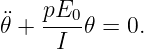
6 Worked example 3: oscillation about stable alignmentConsider a rigid permanent dipole of moment of inertia I about its center of rotation. The axis is free to turn in the plane containing its moment and a uniform applied field. Angular momentum balance gives
For small angular displacements |𝜃|≪ 1 rad, use the Taylor series sin 𝜃 = 𝜃 −𝜃3∕6 +
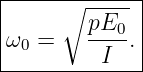
Thus the natural angular frequency is
The quadratic expansion of the energy supplies an independent check:
The curvature of the energy near alignment is positive, consistent with a restoring torque. At 𝜃 = π the curvature is negative, so a small displacement grows rather than oscillating about a stable equilibrium.
7 Worked example 4: force in a genuinely three-dimensional fieldAn electrostatic field with a nonzero axial derivative cannot, in a charge-free region, be represented globally by Ez = E0 + αz with all other components zero. One compatible local model is
Its divergence is −α∕2 − α∕2 + α = 0, and its curl is zero, satisfying the charge-free electrostatic equations. For a sufficiently small fixed dipole aligned with +z on the axis,
For an arbitrarily oriented fixed p, the same derivative rule gives
The result agrees with ∇(p ⋅ E) for an electrostatic field. This example also shows why an on-axis formula must not be extended to every point without checking Maxwell’s equations.
8 Worked example 5: permanent versus induced dipoleA polar molecule may possess a permanent moment, while a nonpolar molecule or object may acquire a moment through polarization. In a simple isotropic linear-response model,
where αe has SI units C m2∕V. An induced dipole has no fixed magnitude independent of the applied field. Its stored interaction energy is therefore obtained by gradually building the field:
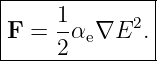
Its force in a slowly varying electrostatic field is
For αe > 0, the object is attracted toward regions of stronger field. The factor 1∕2 distinguishes induced from fixed-moment energy, and avoids double counting the work required to induce the dipole.
9 ExercisesExercise 1. How much work does the uniform field do as the dipole rotates from π∕2 to zero? Solution. W = U(π∕2) − U(0) = pE0. There is no net force, so this work results from rotation. Exercise 2. What axial force does an aligned pair centered at zero experience when Ez(z) = E0 + βz2? Solution. The fields at z = ±d∕2 both equal E0 + βd2∕4. The signed forces cancel exactly even though the axial field varies.
10 Further exercises and complete solutions
References
References
"Example of Torque and Force on a Dipole in an External Field" is owned by bloftin.
This object's parent. Cross-references: work, polarization, molecule, Maxwell's equations, formula, curl, divergence, electrostatic field, displacement, angular frequency, Taylor series, angular displacements, angular momentum, moment of inertia, dipole axis, gradient, external forces, unit vector, positive charge, energy, positions, units, charge, dipole moment, force, transverse field, equilibrium, torque, magnitude There is 1 reference to this object. This is version 1 of Example of Torque and Force on a Dipole in an External Field, born on 2026-11-27. Object id is 1609, canonical name is ExampleOfTorqueAndForceOnADipoleInAnExternalField. Accessed 13 times total. Classification:
|
|
|
|
Pending Errata and AddendaNone.
|
DiscussionNo messages.
|
Interact |







 . Keeping
the linear term gives