Any power series represents on its convergence domain a function. One may set a converse task: If
there is given a function f(x), on which conditions one can represent it as a power series; how one
can find the coefficients of the series? Then one comes to Taylor polynomials, Taylor formula and
Taylor series.
Definition. The Taylor polynomial of degree n of the function f(x) in the point x = a means the
polynomial Tn(x,a) of degree at most n, which has in the point the value f(a) and for which the
derivatives Tn(j)(x,a) up to the order n have the values f(j)(a).
It is easily found that the Taylor polynomial in question is uniquely
Tn(x,a) = f(a) +  (x−a) + (x−a) +  (x−a)2 + … + (x−a)2 + … +  (x−a)n (x−a)n | | (1) |
When a given function f(x) is replaced by its Taylor polynomial Tn(x,a), it’s important to
examine, how accurately the polynomial approximates the function, in other words one has to
examine the difference
Then one is led to the
Taylor formula. If f(x) has in a neighbourhood of the point x = a the continuous derivatives up
to the order n+1, then it can be represented in the form
f(x) = f(a)+ (x−a)+ (x−a)+ (x−a)2+ … + (x−a)2+ … + (x−a)n+R
n(x) (x−a)n+R
n(x) | | (2) |
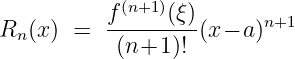
with
where ξ lies between a and x.
If the function f(x) has in a neighbourhood of the point x = a the derivatives of all orders, then
one can let n tend to infinity in the Taylor formula (2). One obtains the so-called Taylor
series
∑
n=0∞ (x−a)n = f(a) + (x−a)n = f(a) +  (x−a) + (x−a) +  (x−a)2 + … (x−a)2 + … | | (3) |
theorem. A necessary and sufficient condition for that the Taylor series (3) converges and that its
sum represents the function f(x) at certain values of x is that the limit of Rn(x) is 0 as n tends to
infinity. For these values of x on may write
f(x) = f(a) +  (x−a) + (x−a) +  (x−a)2 + … (x−a)2 + … | | (4) |
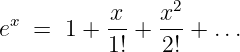
The most known Taylor series is perhaps
which is valid for all real (and complex) values of x.
There are analogical generalisations of Taylor theorem and series for functions of several real
variables; then the existence of the partial derivatives is needed. For example for the function
f(x,y,z) the Taylor series looks as follows:


![[ ( ) ]
∑∞ 1 ∂ ∂ ∂ n
f (X, Y,Z ) = f(a,b,c) + n! (X − a)∂x-+ (Y − b)∂y-+ (Z− c)∂z- f
n=1 (x,y,z)=(a,b,c)](https://images.physicslibrary.org/cache/objects/762/make4ht/TaylorSeries14x.png)