Collisions in Two Dimensions
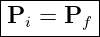
The basic conservation law does not change when a collision becomes two-dimensional:
when the net external impulse during the collision is negligible.
What changes is that momentum is now a vector with independent components.
For two particles,
In Cartesian components,
| m1u1x + m2u2x = m1v1x + m2v2x, | | (3)
|
| m1u1y + m2u2y = m1v1y + m2v2y. | | (4) |
A planar collision therefore provides two momentum equations rather than one.
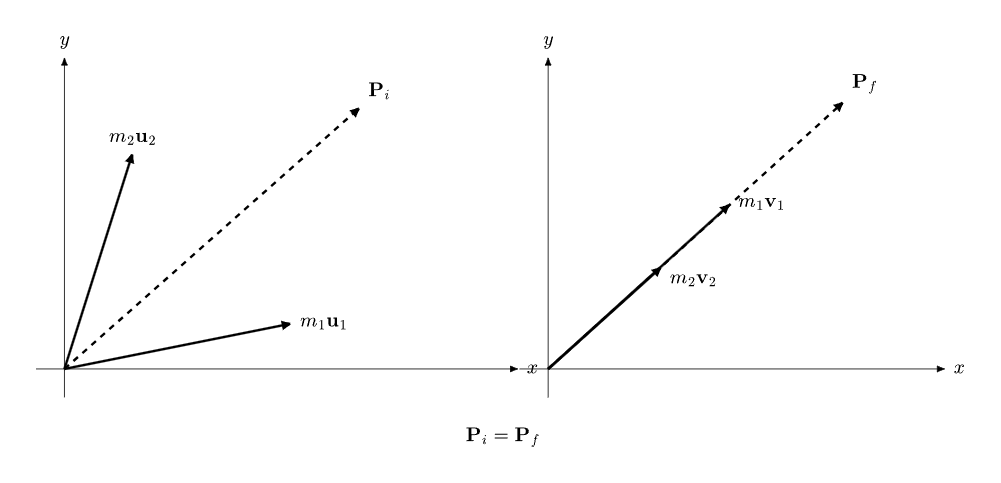
Figure 1. In a two-dimensional collision, the vector sum of the momenta before impact equals the
vector sum after impact when external impulse is negligible.
1 Choose the coordinate axes deliberately
A good coordinate choice can simplify the algebra dramatically.
Common choices are:
- align the x axis with the initial velocity of one particle,
- align one axis with the line of impact,
- use Normal and tangential directions at the contact point,
- use the center of mass frame when symmetry is important.
The conservation law is independent of coordinates, but the component equations are not equally
convenient in every coordinate system.
2 Momentum conservation by components
Suppose the collision takes place in the xy plane.
Then
and
Vector equality requires
| Pxi | = Pxf, | (7)
|
| Pyi | = Pyf. | (8) |
Therefore
| m1u1x + m2u2x | = m1v1x + m2v2x, | (9)
|
| m1u1y + m2u2y | = m1v1y + m2v2y. | (10) |
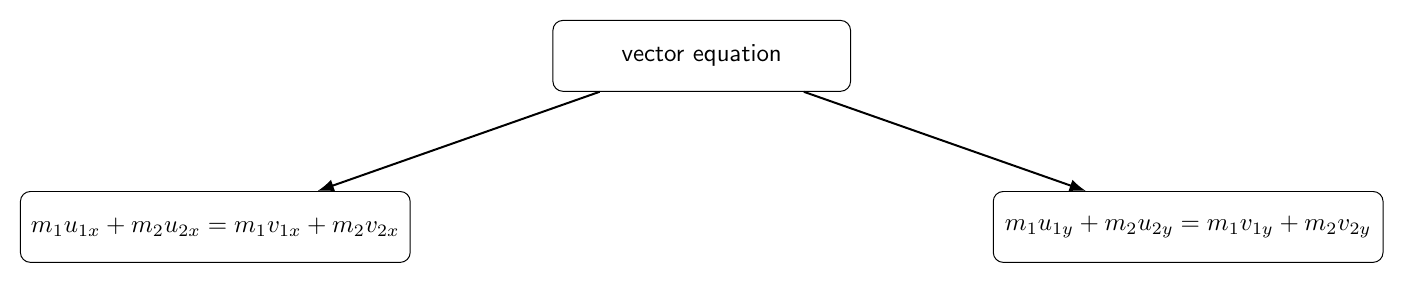
Figure 2. Vector momentum conservation is equivalent to separate conservation equations along
the chosen coordinate axes.
3 Velocity components from speed and direction
If a velocity of magnitude v makes angle 𝜃 with the positive x axis,
| vx | = v cos 𝜃, | (11)
|
| vy | = v sin 𝜃. | (12) |
Thus
Signs should come from the geometry and the chosen axis directions.
A velocity below the positive x axis has
4 Example 1: perfectly inelastic collision in two dimensions
A 2.0 kg puck moves east at
A 3.0 kg puck moves north at
They collide and stick.
The initial momentum components are
| Pxi | = (2.0)(4.0) = 8.0 kg m∕s, | (17)
|
| Pyi | = (3.0)(2.0) = 6.0 kg m∕s. | (18) |
The combined mass is
Therefore
| vfx | =  = 1.6 m∕s, = 1.6 m∕s, | (20)
|
| vfy | =  = 1.2 m∕s. = 1.2 m∕s. | (21) |
The final speed is
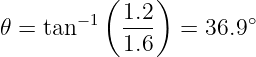
The direction is
north of east.
Thus
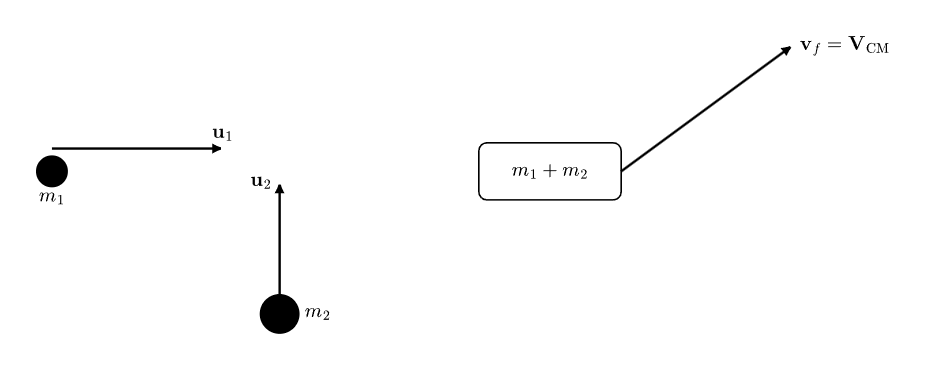
Figure 3. In a perfectly inelastic planar collision, the common final velocity points in the direction
of the initial total momentum vector.
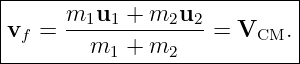
5 Center of mass interpretation of sticking
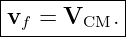
For any perfectly inelastic collision,
Momentum conservation gives
Therefore
This result is dimension independent.
6 Elastic collisions in two dimensions
An elastic collision conserves both momentum and translational kinetic energy:
and
In two dimensions this gives three scalar equations:
That may still be insufficient if four post-collision components are unknown. Additional geometry,
contact constraints, or a measured scattering angle is often needed.
7 Equal masses with one initially at rest
A particularly important case is an elastic collision between equal masses,
with particle 2 initially at rest:
Momentum conservation gives
Cancel m:
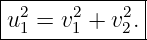
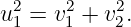
Kinetic-energy conservation gives
Square the momentum relation:
| u12 | = |v
1 + v2|2 | (35)
|
| = v12 + v
22 + 2v
1 ⋅ v2. | (36) |
Compare with the energy relation:
Therefore
so
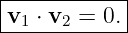
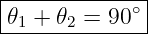
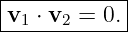
Hence the outgoing velocities are perpendicular:
when the particles scatter to opposite sides of the original direction.
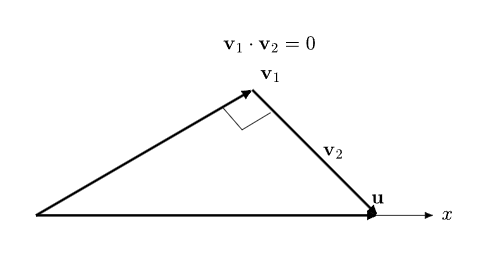
Figure 4. For an elastic collision of equal masses with one initially at rest, the two outgoing
velocity vectors are perpendicular.
8 Example 2: equal-mass elastic scattering
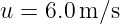
An incoming puck of speed
strikes an identical stationary puck elastically.
After collision, puck 1 moves at angle
above the original direction.
For equal masses with one initially at rest,
Thus puck 2 moves at
below the original direction.
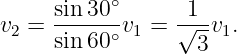
From y-momentum conservation,
Hence
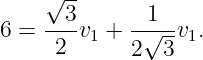
From the x equation,
Substitute the relation above:
Therefore
and
9 Collision geometry and the line of impact
For smooth rigid bodies such as frictionless spheres or disks, the collision impulse acts along the
common normal at the contact point.
This direction is called the line of impact.
Define:
- en: unit vector normal to the contact surfaces along the line of impact,
- et: unit vector tangent to the contact surfaces.
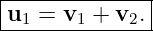
Any velocity can be decomposed as
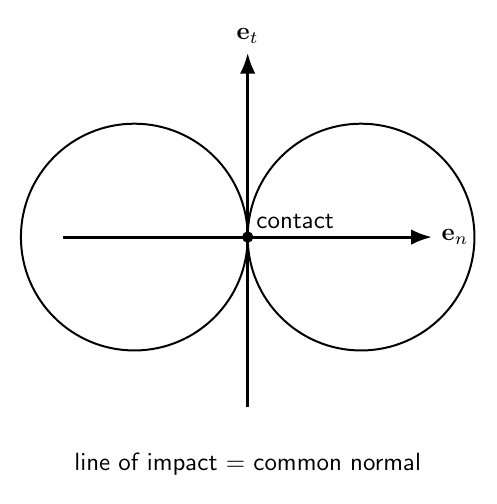
Figure 5. For smooth-body impact, the contact impulse acts along the common normal, or line of
impact. Velocity is naturally decomposed into normal and tangential components.
10 Smooth-contact assumption
If the contacting surfaces are idealized as smooth and frictionless, the collision impulse has no
tangential component:
Therefore each particle’s tangential velocity component remains unchanged during the short
collision:
| v1t | = u1t, | (53)
|
| v2t | = u2t. | (54) |
Only the normal components change.
This reduces an oblique two-dimensional impact to a one-dimensional collision problem along the
normal direction.
11 Momentum along the line of impact
Along the normal direction,
Along the tangent direction, for smooth bodies,
| v1t = u1t, | | (56)
|
| v2t = u2t. | | (57) |
Thus the impact calculation can be performed entirely in the normal direction and then
recombined with the unchanged tangential components.
12 Coefficient of restitution in oblique impact
For an oblique collision, the coefficient of restitution applies to the normal relative velocity, not to
the entire velocity vector.
The correct relation is
Equivalently,
For ordinary passive impacts,
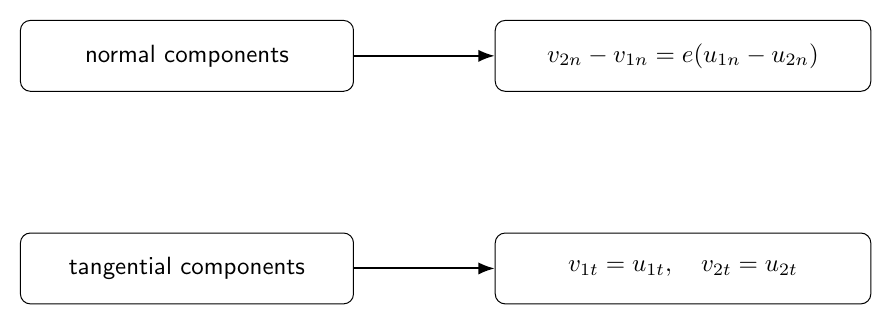
Figure 6. In oblique impact, restitution acts on the normal relative velocity. For smooth contact,
tangential components pass through the collision unchanged.
13 General smooth oblique-collision solution
For the normal components,
| m1u1n + m2u2n | = m1v1n + m2v2n, | (61)
|
| v2n − v1n | = e(u1n − u2n). | (62) |
This is exactly the same algebra as a one-dimensional collision.
Thus
and
Then restore the tangential components:
| v1 | = v1nen + u1tet, | (65)
|
| v2 | = v2nen + u2tet. | (66) |
14 Example 3: smooth oblique impact
Two identical pucks collide.
Let the normal direction be the x axis and the tangential direction be the y axis.
Initially,
| u1 | = (4ex + 3ey) m∕s, | (67)
|
| u2 | = (0ex + 1ey) m∕s. | (68) |
Let
For equal masses, the normal restitution formulas give
| v1x | =  u1x + u1x +  u2x, u2x, | (70)
|
| v2x | =  u1x + u1x +  u2x. u2x. | (71) |
Thus
| v1x | =  (4) = 1.0 m∕s, (4) = 1.0 m∕s, | (72)
|
| v2x | =  (4) = 3.0 m∕s. (4) = 3.0 m∕s. | (73) |
Smooth contact leaves the tangential components unchanged:
| v1y | = 3.0 m∕s, | (74)
|
| v2y | = 1.0 m∕s. | (75) |
Therefore
| v1 = (1ex + 3ey) m∕s, | | (76)
|
| v2 = (3ex + 1ey) m∕s. | | (77) |
15 Impulse geometry
For a smooth collision, particle 1 receives an impulse
and particle 2 receives
Thus
| m1(v1 − u1) | = Jen, | (80)
|
| m2(v2 − u2) | = −Jen. | (81) |
Because the impulse has no tangential component,
for each smooth body.
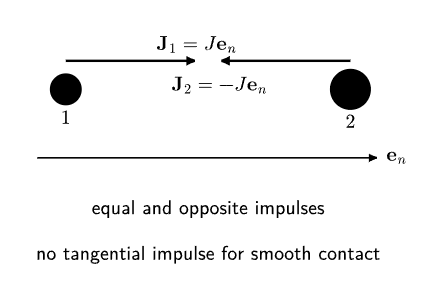
Figure 8. In a smooth oblique collision, equal-and-opposite impulses lie along the line of impact
and alter only the normal velocity components.
16 Finding the impulse magnitude
For particle 1,
Using the restitution solution,
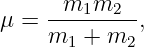
With the reduced mass
this becomes
The sign depends on the chosen normal direction.
17 Energy loss in smooth oblique impact
Only the normal relative motion is affected by a smooth collision.
The normal relative kinetic energy before impact is
After impact,
Since the normal relative speed is multiplied by e,
Therefore
for the smooth, nonrotating point-mass model.
Tangential kinetic energy is unchanged under the smooth-contact assumption.
18 Center of mass frame in two dimensions
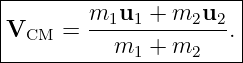
The center of mass velocity is
Define center of mass-frame velocities:
| u1′ | = u1 − VCM, | (92)
|
| u2′ | = u2 − VCM. | (93) |
Then
Therefore the two incoming momenta are equal and opposite in the center of mass frame.
The same is true after collision.
For an elastic collision,
and the magnitudes remain unchanged while the directions can rotate.
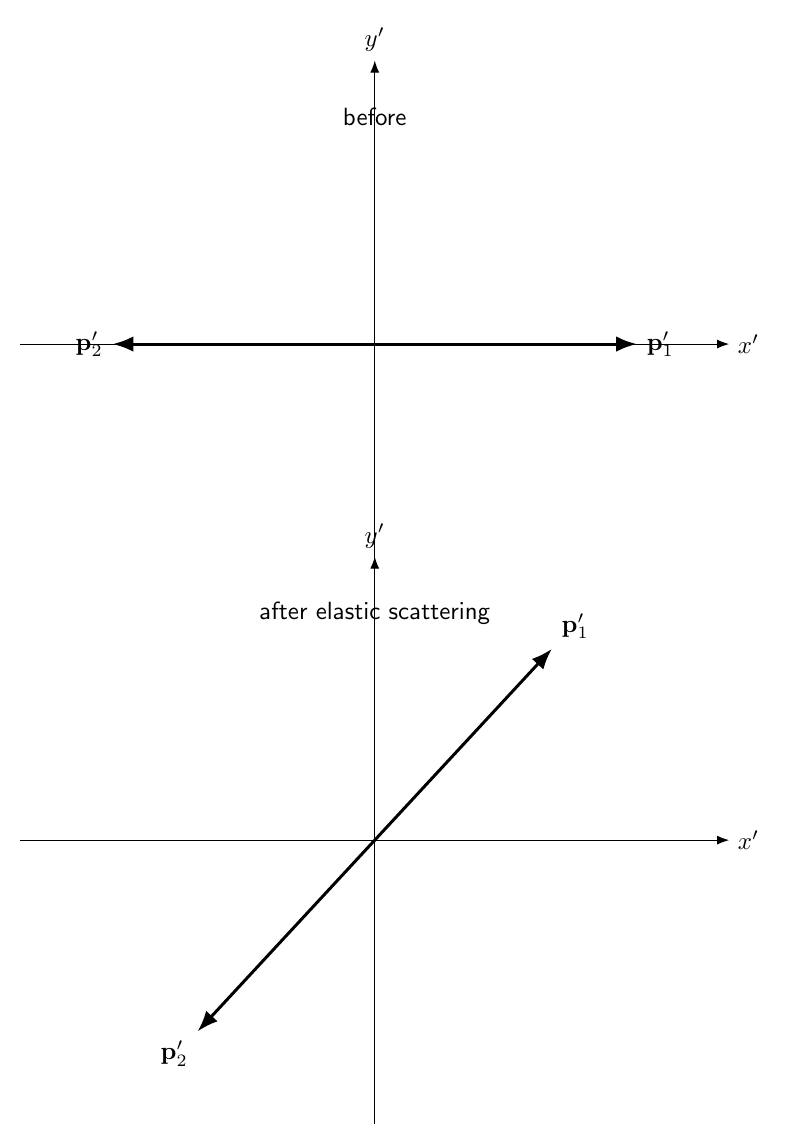
Figure 7. In the center of mass frame, the two momenta are equal and opposite before and after
an elastic collision. Elastic scattering changes their directions while preserving their magnitudes.
19 Scattering angle in the center of mass frame
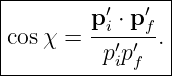
In the center of mass frame, an elastic collision can often be described by a single scattering angle
χ.
If the initial momentum is
and the final momentum is
then
For an elastic collision,
so only the direction changes.
This viewpoint becomes fundamental in scattering theory.
20 When momentum and energy are not enough
In a general two-dimensional elastic collision there may be more unknowns than conservation
equations.
For two outgoing velocity vectors, there can be four scalar unknown components.
Momentum conservation gives two equations.
Kinetic-energy conservation gives one more.
A fourth relation may come from:
- known contact geometry,
- a known scattering angle,
- the line-of-impact condition,
- smooth-contact constraints,
- measured direction of one outgoing body.
Conservation laws constrain the solution, but geometry completes it.
21 Rough contact and spin
The smooth-contact model assumes
If friction acts during impact, there can be a tangential impulse:
Then:
Such rough-body collisions require rigid-body impact mechanics beyond the point-particle model
developed here.
22 Example 4: checking a proposed elastic result
Two equal masses undergo an isolated elastic collision.
Initially,
A proposed result is
| v1 | = (3ex + 1ey) m∕s, | (103)
|
| v2 | = (2ex − 1ey) m∕s. | (104) |
Momentum is conserved:
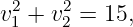
But the final squared speeds are
| v12 | = 10, | (106)
|
| v22 | = 5. | (107) |
Thus
while initially
Therefore kinetic energy is not conserved.
The proposed velocities could describe an inelastic collision, but not an elastic one.
23 A reliable workflow for planar collision problems
- Define the two-body system.
- Check whether external impulse is negligible.
- Choose useful axes.
- Resolve every known velocity into components.
- Write momentum conservation in each relevant direction.
- Identify the collision model: sticking, elastic, restitution, smooth oblique impact, or
another constraint.
- Add the required second relation or geometric constraint.
- Solve the scalar equations.
- Reconstruct velocity vectors.
- Check momentum, kinetic energy, restitution, and geometry.
24 Common mistakes
- Treating momentum conservation as a scalar equation in two dimensions.
- Using speeds instead of signed components.
- Conserving kinetic energy for an inelastic collision.
- Assuming momentum conservation and kinetic-energy conservation uniquely determine
every two-dimensional elastic collision.
- Applying the coefficient of restitution to the full velocity magnitude in an oblique
collision.
- Forgetting that restitution acts along the line of impact.
- Changing tangential velocity components in an ideal smooth collision.
- Forgetting that frictional or rough contact can invalidate the smooth-contact
assumption.
- Mixing laboratory-frame and center of mass-frame velocities.
- Assuming equal masses always leave at right angles without checking the required
conditions: elastic collision and one mass initially at rest.
- Forgetting that external impulse can invalidate the two-body momentum balance.
- Ignoring rotational motion when the impact is off-center and contact is rough.
25 Practice exercises
- A 2.0 kg puck moves east at 5.0 m∕s and a 3.0 kg puck moves north at 4.0 m∕s. They
stick. Find the final velocity vector, speed, and direction.
- Derive the vector formula for the final velocity of a perfectly inelastic two-body collision.
- An equal-mass elastic collision has one puck initially at rest. Prove that the final
velocity vectors are perpendicular.
- In the previous case, one outgoing puck moves at 25∘ above the initial direction. Find
the direction of the other outgoing puck.
- A 1.0 kg puck moving at 8.0 m∕s hits an identical stationary puck elastically. The first
leaves at 45∘. Find both final speeds.
- For a smooth collision, show that zero tangential impulse implies unchanged tangential
velocity components.
- Two masses m1 and m2 collide obliquely with restitution e. Derive the
normal-component formulas.
- A smooth impact has m1 = m2, e = 0.80, u1n = 5 m∕s, u2n = 0, u1t = 2 m∕s, and
u2t = −1 m∕s. Find both final velocity components.
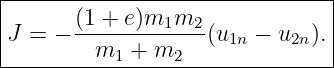
- Derive the impulse formula
- Derive the kinetic-energy loss for a smooth oblique collision.
- Show that total momentum is zero in the center of mass frame.
- Explain why an elastic collision in the center of mass frame changes directions but not
momentum magnitudes.
- Give an example where momentum and kinetic-energy conservation are insufficient to
determine a unique two-dimensional collision.
- Explain why rough contact can create spin.
- Check whether the proposed final velocities (4, 0) and (1, 0) from an initial equal-mass state
(5, 0) and (0, 0) can represent an elastic collision.
26 Summary
For a two-dimensional collision with negligible external impulse,
Momentum conservation applies componentwise:
| Pxi = Pxf, | | (112)
|
| Pyi = Pyf. | | (113) |
For a perfectly inelastic collision,
For equal masses in an elastic collision with one initially at rest,
For smooth oblique impact,
| v1t = u1t, | | (116)
|
| v2t = u2t, | | (117) |
and restitution applies along the line of impact:
The center of mass frame makes elastic scattering especially simple because the two particle
momenta remain equal and opposite.
The next article develops center of mass motion and system dynamics more systematically.
References
References
[1] J. R. Taylor, Classical Mechanics, University Science Books, 2005.
[2] D. Kleppner and R. Kolenkow, An Introduction to Mechanics, 2nd ed., Cambridge
University Press, 2014.
[3] K. R. Symon, Mechanics, 3rd ed., Addison-Wesley, 1971.
[4] H. D. Young and R. A. Freedman, University Physics with Modern Physics, 15th ed.,
Pearson, 2020.
[5] OpenStax, University Physics, Volume 1, Rice University, 2016.