Energy Methods for Rigid Bodies
A rigid body is a system of particles whose mutual distances remain fixed. Because the particles
cannot move independently, the particle-system energy decomposition developed in M03-08 takes a
particularly useful form.
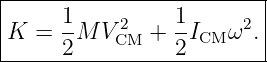
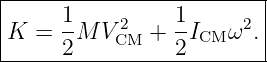
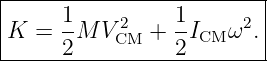
For planar rigid body motion,
The first term describes translation of the center of mass. The second describes rotation about the
center of mass.
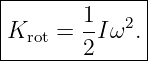
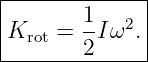
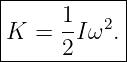
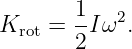
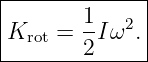
For pure rotation about a fixed axis,
These results make many rigid body problems much easier than treating every mass element
separately.
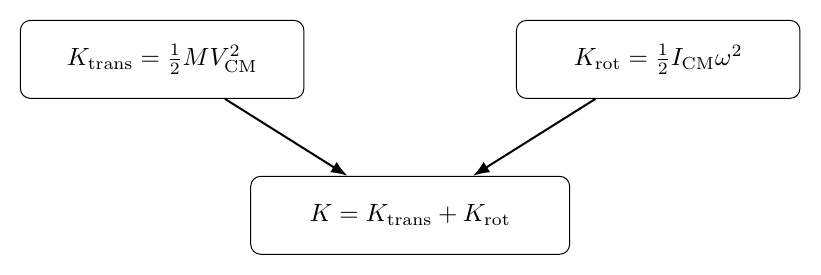
Figure 1. The kinetic energy of a rigid body separates into center-of-mass translation and rotation
about the center of mass.
1 Rigid body motion as a particle system
Consider a rigid body made of particles indexed by i.
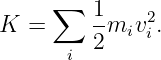
The total kinetic energy is
From the particle-system result,
For a rigid body, the motion relative to the center of mass is constrained to be rotational.
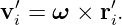
In planar motion,
where ri′ is measured from the center of mass.
Thus
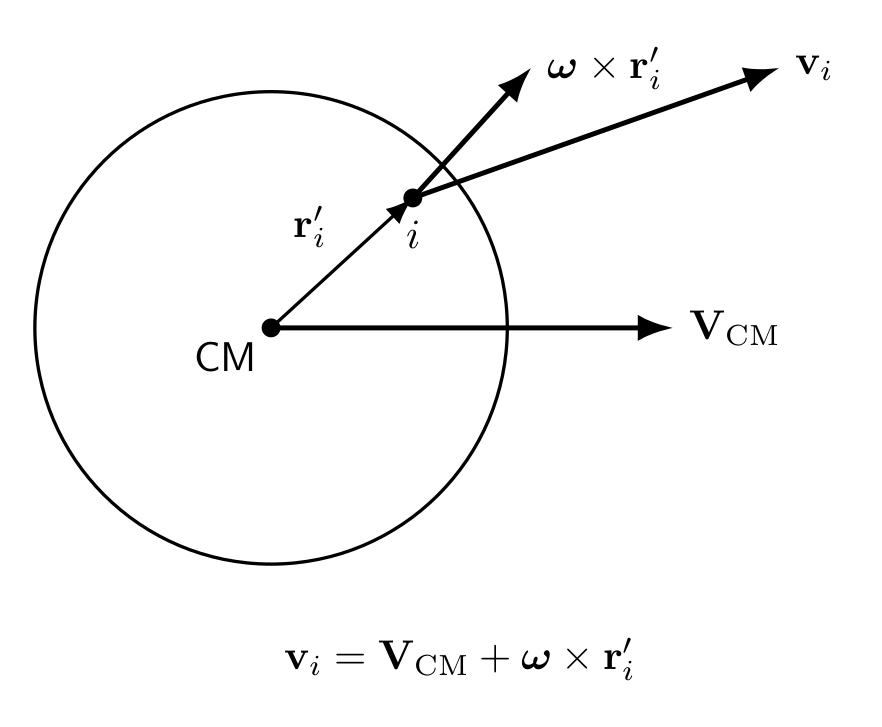
Figure 2. The velocity of each particle equals the center-of-mass velocity plus the rotational
velocity relative to the center of mass.
2 Derivation of rotational kinetic energy
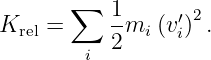
The relative kinetic energy is
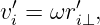
For planar rotation about the center of mass,
where ri⊥′ is the perpendicular distance to the rotation axis.
Therefore
| Krel | = ∑
i miω2 miω2 2 2 | (9)
|
| =  ω2 ∑
imi ω2 ∑
imi 2. 2. | (10) |
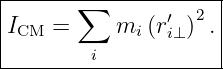
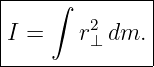
Define the moment of inertia about the center-of-mass axis:
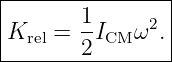
Hence
The total kinetic energy is therefore
3 Continuous rigid bodies
For a continuous mass distribution,
Thus
The moment of inertia plays the same role in rotational kinetic energy that mass plays in
translational kinetic energy.
For common bodies about symmetry axes through the center of mass:
| Ihoop | = MR2, | (16)
|
| Isolid disk | =  MR2, MR2, | (17)
|
| Isolid sphere | =  MR2, MR2, | (18)
|
| Ithin spherical shell | =  MR2. MR2. | (19) |
4 Pure translation
If
then every point of the body has the same velocity.
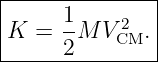
The kinetic energy becomes
This is exactly the kinetic energy of a particle of mass M moving with the center of
mass.
5 Pure rotation about a fixed axis
If the body rotates about a fixed axis and the center of mass has no translational motion,
for an axis through the center of mass.
Then
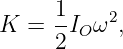
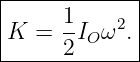
If the fixed axis does not pass through the center of mass, the body still has total kinetic
energy
where IO is the moment of inertia about the fixed axis O.
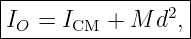
The parallel-axis theorem,
makes this equivalent to the center-of-mass decomposition.
6 Derivation using the parallel-axis theorem
Suppose a body rotates about a fixed axis O located a distance d from the center-of-mass
axis.
The center of mass moves with speed
Thus
| K | =  M(ωd)2 + M(ωd)2 +  ICMω2 ICMω2 | (27)
|
| =  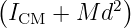 ω2. ω2. | (28) |
Since
we obtain
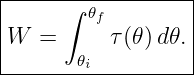
7 Work done by a torque
For a force F acting at a point whose position from a chosen origin is r, the torque
is
For an infinitesimal rigid rotation d𝜃, the displacement of the force application point due to
rotation is
The corresponding work is
Use the scalar triple-product identity:
| dW | = F ⋅ (d𝜃 × r) | (34)
|
| = (r × F) ⋅ d𝜃. | (35) |
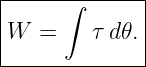
Therefore
For fixed-axis rotation,
Integrating,
For constant torque,
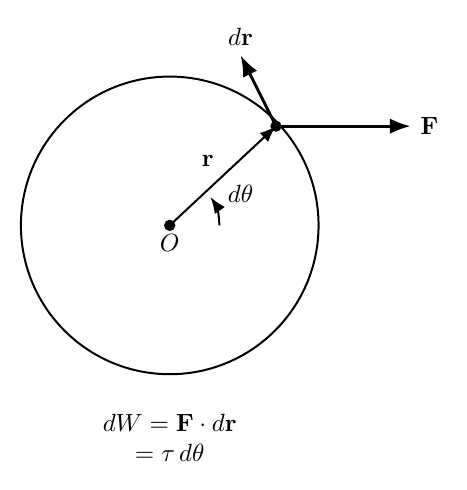
Figure 3. During a small rotation, the tangential displacement of the force application point gives
dW = τ d𝜃 for fixed-axis motion.
8 Rotational work-energy theorem
For rotation about a fixed axis,
Multiply by d𝜃:
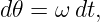
Using
and
we obtain
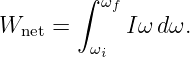
| Iαd𝜃 | = I ω dt ω dt | (44)
|
| = Iω dω. | (45) |
Integrating,
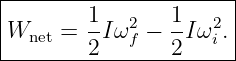
For constant I,
Thus
9 Power in rotational motion
Instantaneous power is
Using
we obtain
Therefore
for fixed-axis rotation.
More generally,
For a rigid body undergoing translation and rotation, external mechanical power can be
written
when the torque is taken about the center of mass.
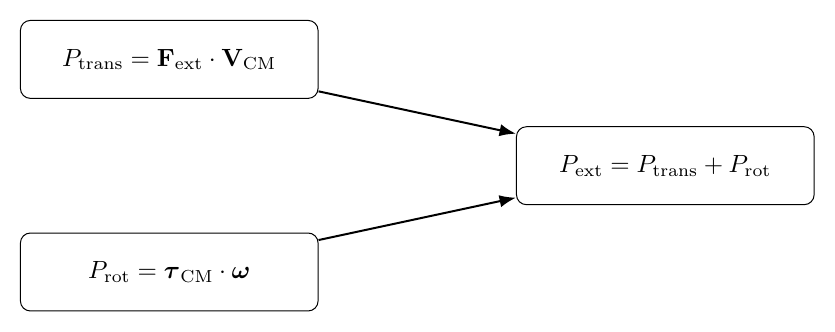
Figure 4. Rigid body power can be separated into translational power of the center of mass and
rotational power about the center of mass.
10 Rigid body work-energy theorem
For an ideal rigid body,
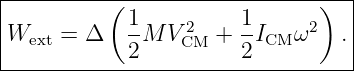
The work-energy theorem becomes
when internal rigid constraints do no net work and no additional internal-energy storage is
modeled.
Thus
If conservative potentials are present,
11 Ideal rigid constraints and internal work
A perfect rigid body maintains fixed distance between every pair of material points.
Under the ideal rigid body model, constraint forces enforce the geometry without changing the
internal separations.
Thus they do no net internal work associated with deformation.
Real materials are never perfectly rigid. They can store elastic energy, vibrate, heat, and
dissipate energy. The rigid body model intentionally suppresses those internal degrees of
freedom.
This is why the rigid body work-energy theorem can be written using only external work and rigid
body kinetic energy.
12 Rolling without slipping
A rigid body rolling without slipping combines translation and rotation.
The no-slip kinematic condition is
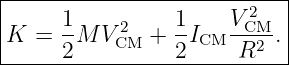
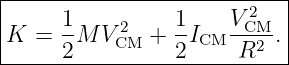
The kinetic energy is
Using
we obtain
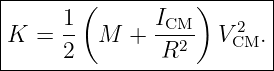
Factor:
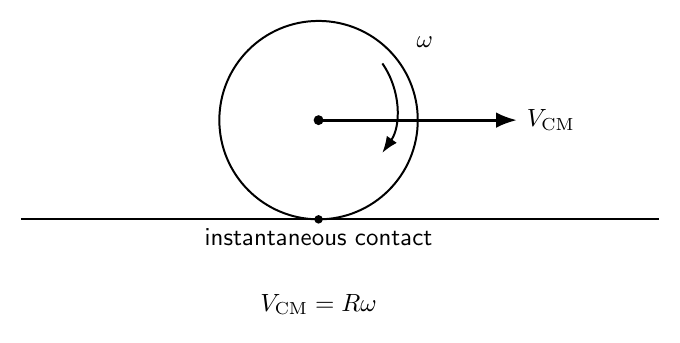
Figure 5. Pure rolling combines center-of-mass translation with rotation and satisfies V CM = Rω.
13 Static friction in ideal rolling
For pure rolling on a fixed surface, the instantaneous contact point is momentarily at rest relative
to the surface.
Therefore the static friction force can act while doing zero instantaneous work at the point of
contact:
Static friction can still be essential dynamically because it produces torque and determines the
rotational acceleration.
This is an important distinction:
This statement applies to ideal rolling on a fixed, nondeforming surface. Moving or deforming
contacts require more careful energy accounting.
14 Rolling down a frictionless-energy incline
Consider a rigid body of mass M, radius R, and center-of-mass moment of inertia ICM rolling
without slipping from rest through a vertical drop h.
Static friction does no work in the ideal model, so mechanical energy is conserved:
Use
Then
Factor:
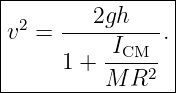
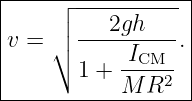
Therefore
Hence
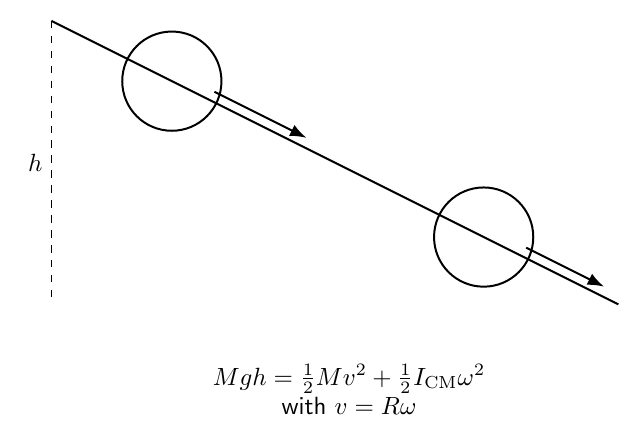
Figure 6. A rolling body’s gravitational potential energy becomes both translational and
rotational kinetic energy.
15 Example 1: solid cylinder rolling downhill
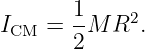
For a solid cylinder,
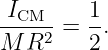
Then
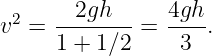
Therefore
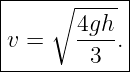
Thus
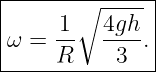
The corresponding angular speed is
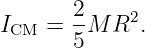
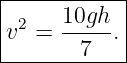
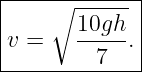
16 Example 2: solid sphere rolling downhill
For a solid sphere,
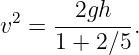
Therefore
Since
we obtain
Thus
17 Which rolling object reaches the bottom faster?
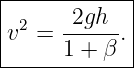
Write
Then
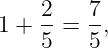
For objects released from the same height, a smaller β gives larger final speed.
Examples:
| βhoop | = 1, | (84)
|
| βshell | =  , , | (85)
|
| βdisk | =  , , | (86)
|
| βsphere | =  . . | (87) |
Therefore the solid sphere has the greatest final speed among these ideal examples because the
smallest fraction of its energy is stored in rotation.
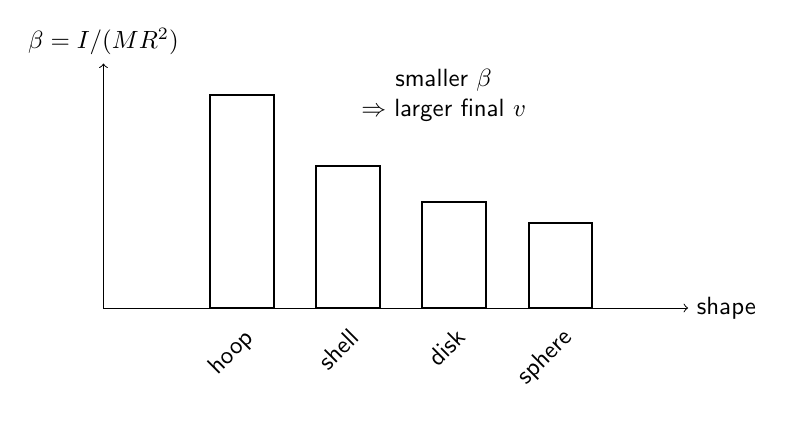
Figure 7. For equal mass and radius rolling from the same height, smaller I∕(MR2) leaves a larger
fraction of the energy in center-of-mass translation.
18 Example 3: torque accelerating a flywheel
A flywheel has moment of inertia
A constant torque
acts through
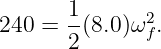
The work is
Thus
If the flywheel starts from rest,
Therefore
so
19 Example 4: motor power and torque
A motor supplies
to a shaft rotating at
Using
the torque is
| τ | =  | (99)
|
| =  | (100)
|
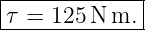
| = 125 N m. | (101) |
Thus
20 Energy method for a rolling body with external work
Suppose a rolling body is acted on by a motor or applied force while changing height.
A general energy equation is
For rolling,
Thus
|  MV i2 + MV i2 +  ICMωi2 + U
i + Wnc ICMωi2 + U
i + Wnc | (105)
|
| =  MV f2 + MV f2 +  ICMωf2 + U
f. ICMωf2 + U
f. | (106) |
If no slip holds,
can be used to reduce the number of unknowns.
21 Work of a force applied away from the center of mass
A force applied away from the center of mass can change both translation and rotation.
For a rigid body, the external power can be decomposed as
The first term changes center-of-mass kinetic energy.
The second changes rotational kinetic energy.
This provides a useful energy interpretation of why an off-center force can simultaneously
accelerate the center of mass and spin the body.
22 Three-dimensional rotational kinetic energy
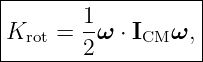
For general three-dimensional rigid body rotation,
where ICM is the inertia tensor about the center of mass.
If the body rotates about a principal axis,
and the expression reduces to
The full tensor treatment belongs naturally in a later rotational-dynamics article, but the energy
structure is already visible here.
23 Common mistakes
- Using only
 MV CM2 for a rolling or rotating body.
- Using only
 Iω2 when the center of mass also translates.
- Using the wrong moment of inertia axis.
- Forgetting the parallel-axis theorem for rotation about an offset fixed axis.
- Writing W = τΔ𝜃 when torque varies strongly with angle.
- Confusing torque with work; torque has units of N m but is not energy.
- Forgetting that rotational power is P = τω.
- Assuming static friction must do negative work during pure rolling on a fixed surface.
- Using V CM = Rω when slipping occurs.
- Treating all rolling objects as having the same final speed from the same height.
- Forgetting that moment of inertia depends on mass distribution, not only total mass.
24 Practice exercises
- A solid disk of mass M and radius R rotates about its symmetry axis with angular
speed ω. Find its rotational kinetic energy.
- A solid sphere rolls without slipping at speed v. Write its total kinetic energy entirely
in terms of M and v.
- Starting from the particle-system expression for kinetic energy, derive
for planar rigid body motion.
- Derive the fixed-axis rotational work-energy theorem from τ = Iα.
- A constant torque of 5 N m acts through 12 rad. Find the work done.
- A shaft rotates at 80 rad∕s while transmitting 4.0 kW. Find the torque.
- A hoop rolls without slipping from rest through vertical drop h. Find its final center-of-mass
speed.
- Repeat the previous problem for a solid disk.
- Repeat the previous problem for a solid sphere.
- Rank a hoop, spherical shell, disk, and solid sphere by final speed after rolling from the same
height.
- Explain why static friction can produce torque while doing zero work in ideal pure
rolling.
- Show that K =
 IOω2 for rotation about a fixed offset axis using the parallel-axis
theorem.
IOω2 for rotation about a fixed offset axis using the parallel-axis
theorem.
- A wheel rolls without slipping while a horizontal external force acts at its axle. Write an
energy equation relating applied work to translation and rotation.
- For three-dimensional rotation, explain why Krot =
 ω ⋅ Iω reduces to
  Iω2 about a
principal axis.
Iω2 about a
principal axis.
- Give a physical example where an off-center force adds both translational and rotational
kinetic energy.
25 Summary
For planar rigid body motion,
For fixed-axis rotation,
Rotational work is
For constant torque,
Rotational power is
For rigid body translation and rotation,
For rolling without slipping,
A rolling body’s kinetic energy is
These results extend the particle-system energy method directly into rigid body mechanics.
The next article, M03-10, develops rotational work, power, and energy transfer in greater
depth.
References
References
[1] J. R. Taylor, Classical Mechanics, University Science Books, 2005.
[2] D. Kleppner and R. Kolenkow, An Introduction to Mechanics, 2nd ed., Cambridge
University Press, 2014.
[3] K. R. Symon, Mechanics, 3rd ed., Addison-Wesley, 1971.
[4] H. D. Young and R. A. Freedman, University Physics with Modern Physics, 15th ed.,
Pearson, 2020.
[5] OpenStax, University Physics, Volume 1, Rice University, 2016.