Physics Library
 An open source physics library
Encyclopedia | Forums | Docs | Random  

[parent] GRE Physics Companion: Collisions in One Dimension

(Example)

GRE Physics Companion: Collisions in One Dimension

For every isolated one-dimensional collision,

|-----------------------------|
m1u1--+-m2u2--=-m1v1-+--m2v2.--
(1)

The second equation depends on collision type:

elastic: Ki = Kf, (2)
perfectly inelastic: v1 = v2, (3)
general restitution: v2 − v1 = e(u1 − u2). (4)

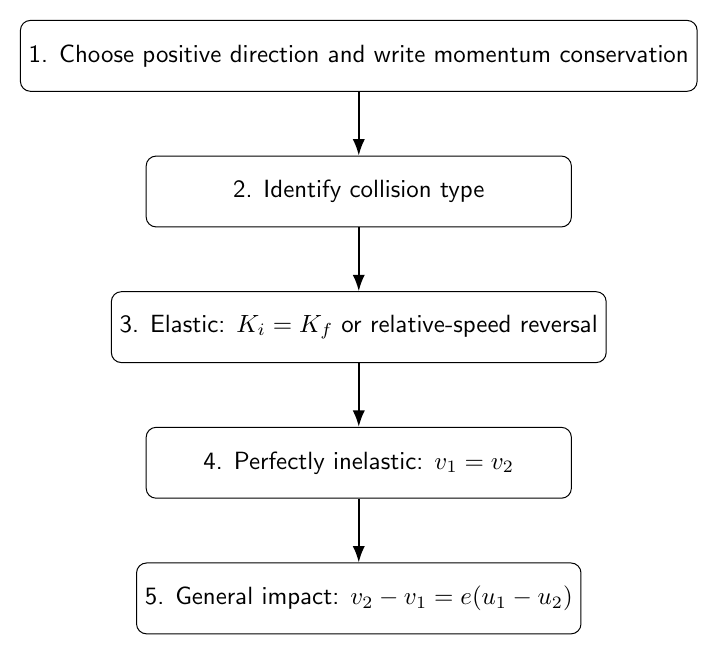
PIC

Figure 1. A compact strategy for one-dimensional collision problems. Momentum conservation is the first equation; collision type supplies the second.

1 High-value GRE facts

  1. Momentum is conserved when external impulse is negligible.
  2. kinetic energy is conserved only in elastic collisions.
  3. Perfectly inelastic means the objects stick together.
  4. Equal masses exchange velocities in a one-dimensional elastic collision.
  5. For an elastic collision, separation speed equals approach speed.
  6. For a target initially at rest, use the standard elastic formulas only if the collision is elastic.
  7. e = 1 is elastic and e = 0 is perfectly inelastic.
  8. In the center of mass frame, elastic collision velocities reverse.
  9. Equal-and-opposite collision impulses do not imply equal velocity changes for unequal masses.
  10. Always keep the velocity signs.

Part I: Original GRE-style problems

Problem 1: perfectly inelastic velocity

A mass m moving at speed v sticks to an identical stationary mass. Their final speed is

  1. 0
  2. v∕4
  3. v∕2
  4. v
  5. 2v

Problem 2: perfectly inelastic kinetic energy

For the collision in Problem 1, the final translational kinetic energy is what fraction of the initial kinetic energy?

  1. 1∕4
  2. 1∕2
  3. 3∕4
  4. 1
  5. 2

Problem 3: equal-mass elastic collision

A mass m moving at +v collides elastically with an identical stationary mass. The first mass leaves with velocity

  1. −v
  2. −v∕2
  3. 0
  4. v∕2
  5. v

Problem 4: elastic relative speed

For a one-dimensional elastic collision,

  1. v1 + v2 = u1 + u2 always
  2. v2 − v1 = u1 − u2
  3. v1 − v2 = u1 − u2
  4. v1 + v2 = 0
  5. both final velocities must be positive

Problem 5: restitution

A collision has coefficient of restitution e = 0.40 and approach relative speed 10 m∕s. The separation relative speed is

  1. 2 m∕s
  2. 4 m∕s
  3. 6 m∕s
  4. 10 m∕s
  5. 25 m∕s

Problem 6: heavy wall limit

A Light ball collides elastically with a stationary wall of effectively infinite mass. The ball’s final velocity is approximately

  1. 0
  2. +u∕2
  3. +u
  4. −u∕2
  5. −u

Problem 7: heavy projectile limit

A very heavy object moving at speed u strikes a very light stationary object elastically. The light object’s final speed approaches

  1. 0
  2. u∕2
  3. u
  4. 2u
  5. 4u

Problem 8: kinetic energy and restitution

For fixed masses and initial relative speed, the fraction of relative kinetic energy remaining after impact is

  1. e
  2. e2
  3. 1 − e
  4. 1 − e2
  5. 2e

Problem 9: collision impulse

During a collision, object 1 receives impulse −7 N s. External impulse is negligible. Object 2 receives

  1. −14 N s
  2. −7 N s
  3. 0
  4. +7 N s
  5. +14 N s

Problem 10: perfectly inelastic center of mass

Two objects stick together in an isolated collision. Their common final velocity equals

  1. the faster initial velocity
  2. the slower initial velocity
  3. the initial center of mass velocity
  4. zero in every case
  5. the arithmetic average of the initial speeds

Problem 11: target at rest, elastic

A mass m moving at speed u elastically strikes a stationary mass 3m. The first mass’s final velocity is

  1. −u
  2. −u∕2
  3. 0
  4. u∕2
  5. u

Problem 12: identifying collision type

An isolated collision conserves momentum and leaves the two bodies moving together afterward. The collision is

  1. necessarily elastic
  2. perfectly inelastic
  3. impossible
  4. superelastic
  5. a non-collision

Part II: Complete worked solutions

Solution 1

Momentum conservation gives

mv  = (2m )vf.
(5)

Thus

vf = v-.
     2
(6)

Answer: (C).

Solution 2

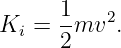
Initially,

      1   2
Ki =  -mv  .
      2
(7)

Finally,

Kf = 1-
2(2m)(  )
 v-
 22 (8)
= 1
--
4mv2. (9)

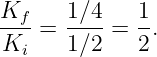
Therefore

Kf- =  1∕4-= 1-.
Ki     1∕2   2
(10)

Answer: (B).

Solution 3

Equal masses exchange velocities in a one-dimensional elastic collision.

The moving mass stops:

v1 = 0.
(11)

Answer: (C).

Solution 4

For elastic one-dimensional impact,

v2 − v1 = u1 − u2.
(12)

Answer: (B).

Solution 5

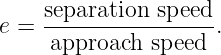
By definition,

    separation-speed-
e =  approach speed  .
(13)

Thus

vrel,f = (0.40 )(10 ) = 4 m ∕s.
(14)

Answer: (B).

Solution 6

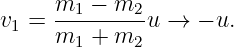
For m2 ≫ m1 and u2 = 0,

v1 =  m1-−-m2-u →  − u.
      m1 + m2
(15)

Answer: (E).

Solution 7

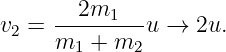
For m1 ≫ m2,

       2m1
v2 = ---------u → 2u.
     m1 +  m2
(16)

Answer: (D).

Solution 8

Because relative speed is multiplied by e and kinetic energy depends on speed squared,

K     = e2K    .
  rel,f       rel,i
(17)

Answer: (B).

Solution 9

Internal collision impulses are equal and opposite:

J1 + J2 = 0.
(18)

Thus

J2 = +7 N s.
(19)

Answer: (D).

Solution 10

When the objects stick, their common final velocity is

v =  m1u1-+--m2u2- = V   .
 f     m1 +  m2       CM
(20)

Answer: (C).

Solution 11

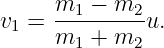
For an elastic collision with the target at rest,

     m1 −  m2
v1 = ---------u.
     m1 +  m2
(21)

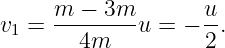
With m1 = m and m2 = 3m,

v1 = m-−--3m-u = − u-.
       4m          2
(22)

Answer: (B).

Solution 12

If two bodies stick together after impact, the collision is perfectly inelastic.

Answer: (B).

2 GRE checklist

  1. Choose a positive direction and keep every velocity sign.
  2. Write momentum conservation first.
  3. Identify the collision type before choosing the second equation.
  4. Elastic means conserve kinetic energy.
  5. Perfectly inelastic means set v1 = v2.
  6. For restitution problems, use v2 − v1 = e(u1 − u2).
  7. Check equal-mass and heavy-mass limiting cases.
  8. Do not assume equal-and-opposite impulses produce equal speed changes.

References

References

[1]   J. R. Taylor, Classical Mechanics, University Science Books, 2005.

[2]   D. Kleppner and R. Kolenkow, An Introduction to Mechanics, 2nd ed., Cambridge University Press, 2014.

[3]   OpenStax, University Physics, Volume 1, Rice University, 2016.


"GRE Physics Companion: Collisions in One Dimension" is owned by bloftin.
(view preamble)
View style:
Other names:  M04-03G
Also defines:  elastic collision, inelastic collision, perfectly inelastic collision, coefficient of restitution
Keywords:  GRE physics, one-dimensional collisions, elastic collision, inelastic collision, perfectly inelastic collision, restitution, momentum conservation, kinetic energy, center of mass frame

This object's parent.

Cross-references: center of mass velocity, relative kinetic energy, Light, translational kinetic energy, impulses, center of mass, formulas, speed, velocities, masses, kinetic energy, external impulse, momentum, type, collision
There are 3 references to this object.

This is version 1 of GRE Physics Companion: Collisions in One Dimension, born on 2026-10-04.
Object id is 1393, canonical name is GREPhysicsCompanionCollisionsInOneDimension.
Accessed 5 times total.

Classification:
Physics Classification: 45.50.-j (Dynamics and kinematics of a particle and a system of particles)
 45.20.Dd (Newtonian mechanics)
Pending Errata and Addenda
None.
Discussion
Style: Expand: Order:

No messages.

Interact
rate | post | correct | update request | add example | add (any)