Gyroscopes, Precession, and Nutation
A rapidly spinning rigid body can respond to an applied torque in a way that initially seems
counterintuitive.
Instead of simply tipping in the direction of the torque, its angular-momentum vector changes
direction.
This produces precession.
If the inclination angle also oscillates, the motion includes nutation.
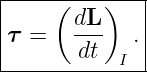
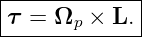
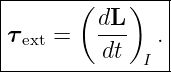
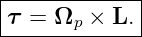
The underlying law is still
The distinctive behavior of a gyroscope follows from the fact that a rapidly spinning body can
carry a large angular momentum
A torque perpendicular to
changes the direction of angular momentum more strongly than its magnitude.
This article develops that geometry, connects it to Euler’s equations from M05-11, and then derives
precession and nutation for a symmetric top.
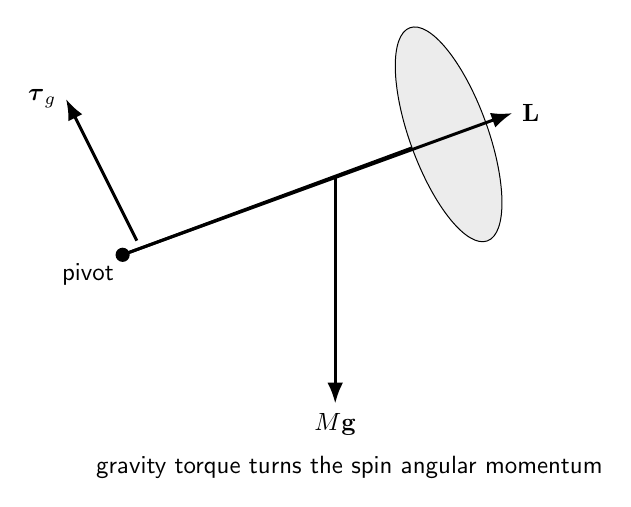
Figure 1. A spinning gyroscope carries angular momentum approximately along its symmetry
axis. Gravity acting at an offset center of mass produces a torque perpendicular to that angular
momentum and causes the spin axis to precess.
1 Spin, precession, and nutation
Three different angular motions must be distinguished.
- Spin is rapid rotation about the body’s symmetry axis.
- Precession is the slower rotation of the symmetry axis around another direction, often
the vertical or the conserved angular-momentum direction.
- Nutation is variation of the inclination angle of the symmetry axis.
For a heavy symmetric top, these motions can occur simultaneously.
A useful mental picture is:
- spin moves material points rapidly around the body axis,
- precession moves the body axis around a cone,
- nutation changes the opening angle of that cone.
2 A gyroscope as a spinning symmetric rigid body
Consider an approximately axisymmetric rigid body with principal moments
Let
be the symmetry axis.
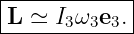
For rapid spin dominated by
the angular momentum is approximately
This approximation becomes especially useful when
is much larger than the transverse angular-velocity components.
3 Torque changes angular momentum
Over a short interval
If
then to first order
does not change.
Instead, the vector turns.
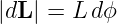
For a small angular change
of a vector with fixed magnitude,
when the turning is perpendicular to the vector itself.
Therefore
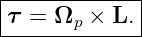
This is the simplest geometric origin of gyroscopic precession.
4 Precession as vector rotation
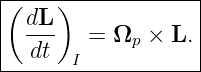
Suppose the angular-momentum vector precesses with angular velocity
For a vector of fixed magnitude,
Therefore
If the angle between
and
is
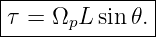
then
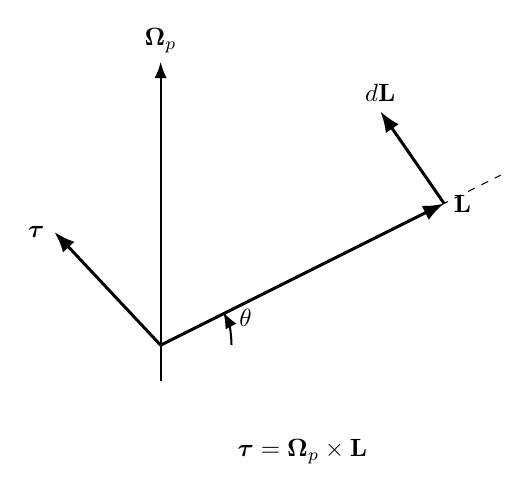
Figure 2. A torque perpendicular to angular momentum changes its direction. During steady
precession, the angular-momentum vector sweeps around the precession axis with τ = Ωp × L.
5 Gravity torque on a top
Let a top be supported at a fixed pivot.
Let the center of mass lie a distance
from the pivot along the symmetry axis.
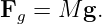
Gravity exerts
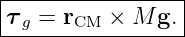
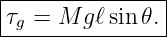
The torque about the pivot is
If the symmetry axis makes angle
with the vertical,
The gravitational torque is horizontal and perpendicular to the vertical plane containing the
symmetry axis.
6 Fast steady precession
For a rapidly spinning top, approximate
If the symmetry axis precesses steadily around the vertical at angular speed
then
Gravity gives
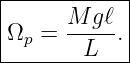
Equating the two:
For
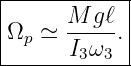
Using
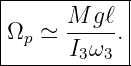
This is the standard fast-top or slow-precession approximation.
7 Why faster spin gives slower gravitational precession
The formula
shows that increasing spin angular momentum decreases the precession rate.
Physically, a given torque changes a large angular-momentum vector more slowly than a small
one.
Thus:
- larger gravitational torque increases precession,
- larger spin angular momentum decreases precession.
8 Example 1: rapidly spinning wheel gyroscope
Let
| M | = 1.5 kg, | (38)
|
| ℓ | = 0.10 m, | (39)
|
| I3 | = 0.020 kg m2, | (40)
|
| ω3 | = 300 rad∕s. | (41) |
The spin angular momentum is approximately
| L | = I3ω3 | (42)
|
| = (0.020)(300) | (43)
|
| = 6.0 kg m2∕s. | (44) |
The fast-precession estimate is
| Ωp | = 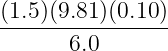 | (45)
|
| ≈ 0.245 rad∕s. | (46) |
Thus
This corresponds to approximately
9 The direction of precession
The direction should be found from the vector equation
One should not memorize a clockwise or counterclockwise rule without specifying:
- the spin direction,
- the location of the pivot,
- the direction of gravity,
- the viewing direction.
The cross product determines the correct precession direction unambiguously.
10 Euler angles for the symmetric top
A standard description uses three Euler Angles:
- ϕ: precession angle about the vertical,
- 𝜃: inclination or nutation angle,
- ψ: spin angle about the symmetry axis.
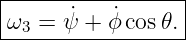
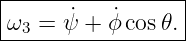
The angular velocity of a symmetric top satisfies
The squared transverse angular velocity is
Therefore the kinetic energy is
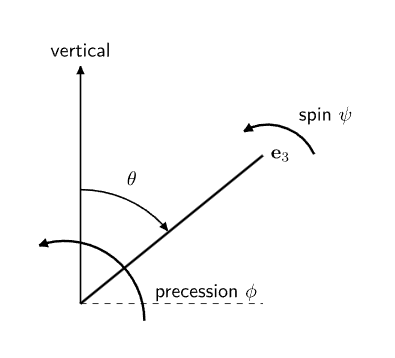
Figure 3. The symmetric top is described by spin ψ, precession ϕ, and inclination 𝜃. Nutation is
the time variation of 𝜃.
11 Potential energy of the heavy symmetric top
Choose
as the angle between the symmetry axis from the pivot toward the center of mass and the upward
vertical.
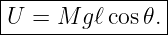
Then the center of mass has height
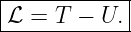
The gravitational potential energy is
The Lagrangian is
12 Two cyclic coordinates
The Lagrangian does not depend explicitly on
or
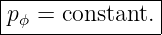
Therefore their generalized momenta are conserved.
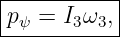
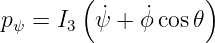
For
| pψ | =  | (60)
|
| = I3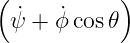 . . | (61) |
Hence
This is the angular-momentum component along the symmetry axis.
For
| pϕ | =  | (64)
|
| = I1ϕ sin 2𝜃 + p
ψ cos 𝜃. | (65) |
Thus
This conserved quantity is the angular-momentum component along the vertical.
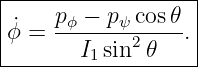
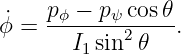
13 Precession rate from the constants of motion
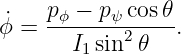
Solve the equation for
Therefore
This expression shows that the precession rate generally changes when
changes.
Thus precession and nutation are dynamically coupled.
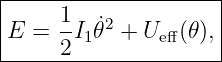
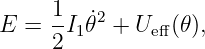
14 Energy reduction to one coordinate
The total energy is
Use
and
After substitution,
where
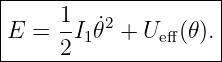
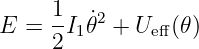
This reduces the nutation problem to an effective one-dimensional motion in
15 Nutation
From
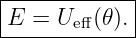
The inclination can move only where
Turning points occur where
If two turning angles
exist, then
oscillates between them.
That oscillation is nutation.
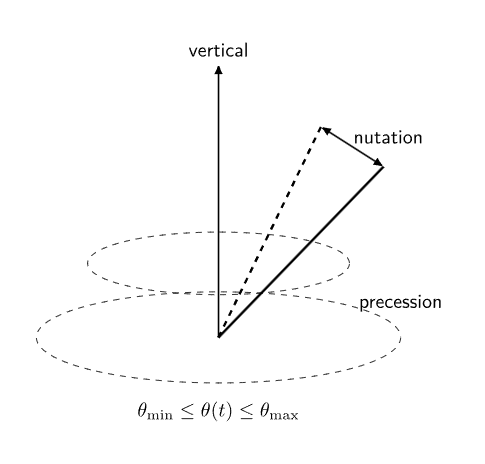
Figure 5. During nutation the symmetry axis does not remain on one cone. The inclination
oscillates between turning angles while the axis also precesses around the vertical.
16 Effective-potential picture of nutation
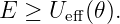
The equation
has the same mathematical structure as one-dimensional particle motion.
Interpret:
Then:
- allowed regions satisfy E ≥ Ueff,
- nutation turning points satisfy E = Ueff,
- steady precession occurs at a stationary point of Ueff.
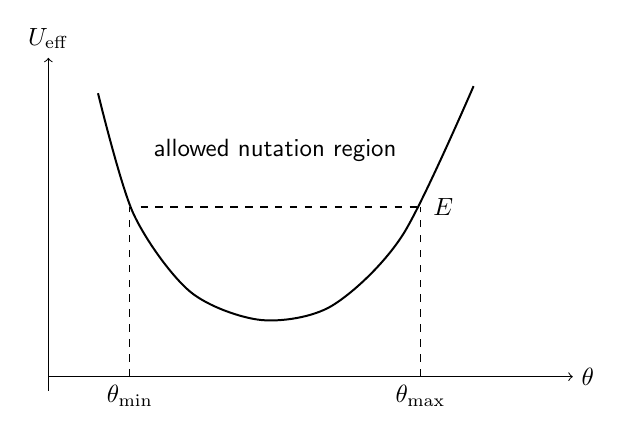
Figure 6. Nutation can be understood as one-dimensional motion in an effective potential. The
inclination oscillates between turning points where the total energy intersects Ueff(𝜃).
17 Steady precession as an equilibrium in inclination
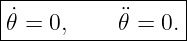
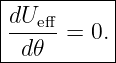
For steady precession,
In the effective-potential description,
Thus steady precession is an equilibrium of the nutation coordinate.
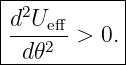
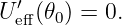
Stable steady precession corresponds to a local minimum:
Small disturbances then produce nutation about the steady-precession inclination.
18 Small nutations about steady precession
Let
where
and
Expand:
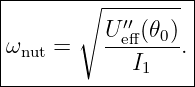
The inclination equation becomes approximately
Therefore the small-nutation angular frequency is
This is a direct bridge from rigid body dynamics to small-oscillation theory.
19 Exact condition for steady precession
For steady motion,
The Euler-Lagrange equation for
gives
For a nonvertical top,
so
This is the exact steady-precession condition for the symmetric top under the stated angle
convention.
20 Two steady-precession branches
The quadratic equation
has solutions
for
The two branches are commonly described as:
- slow precession,
- fast precession.
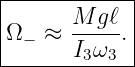
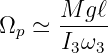
For sufficiently rapid spin, the slow branch reduces to
The fast branch is much larger.
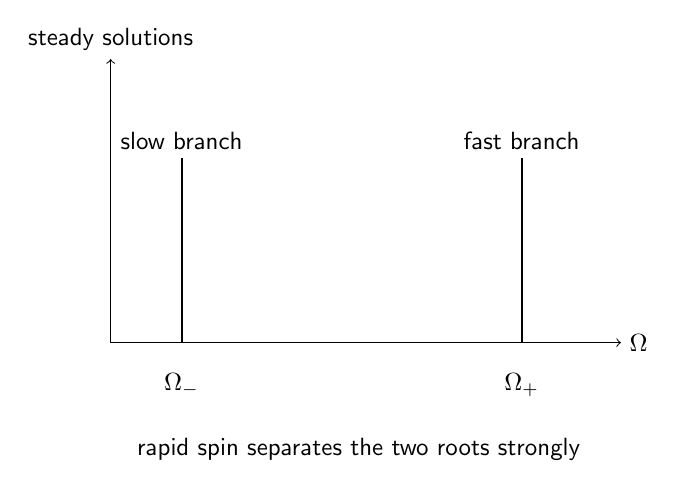
Figure 4. The exact steady-precession condition is quadratic in the precession rate. Rapid spin
separates the solutions into a familiar slow-precession branch and a much larger fast-precession
branch.
21 Condition for real steady-precession rates
The discriminant must be nonnegative:
Thus
For configurations with
this gives a minimum spin magnitude for this form of steady precession.
Rapid spin makes the condition easier to satisfy.
22 Example 2: exact slow and fast branches
Let
| I1 | = 0.050 kg m2, | (105)
|
| I3 | = 0.100 kg m2, | (106)
|
| ω3 | = 100 rad∕s, | (107)
|
| Mgℓ | = 1.00 N m, | (108)
|
| 𝜃 | = 30∘. | (109) |
Then
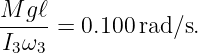
The slow branch is approximately
Using the exact quadratic gives approximately
| Ω− | ≈ 0.100 rad∕s , | (112)
|
| Ω+ | ≈ 230.8 rad∕s . | (113) |
The large separation demonstrates why the slow-precession approximation works well for a fast
top.
23 Torque-free symmetric top revisited
M05-11 showed that for a torque-free symmetric body,
and
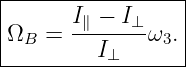
The transverse angular-velocity components rotate in the body frame at
This is body-frame precession of
It must not be confused with gravity-driven precession of a heavy top.
24 Inertial precession of the symmetry axis for a free symmetric body
For a torque-free symmetric body,
is fixed in inertial space.
The symmetry axis
moves around
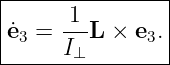
Because
But
Therefore
The symmetry axis precesses around fixed
with inertial angular speed
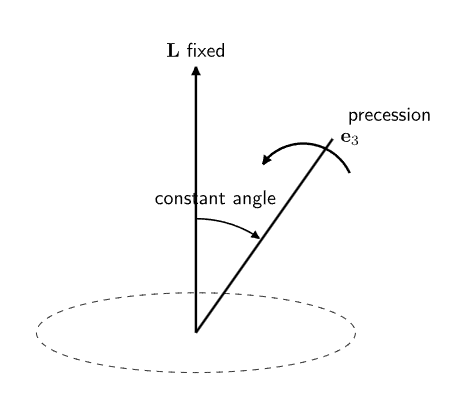
Figure 7. For a torque-free symmetric body, angular momentum is fixed in inertial space while the
symmetry axis precesses around it at a constant inclination.
25 No nutation for the ideal free symmetric top
For the torque-free symmetric top, the angle between
and
is constant.
Therefore there is steady inertial precession without nutation in the ideal symmetric
case.
Nutation appears when:
- external torque changes the effective inclination dynamics,
- the initial state is not a steady-precession state,
- the body is not exactly axisymmetric.
26 Gyroscopic reaction torque
Suppose a spinning rotor has angular momentum
and is forced to precess with angular velocity
The external torque required to turn its angular momentum is
By Newton’s third law, the rotor exerts the opposite torque on its support:
This reaction torque is important in:
- spinning machinery,
- aircraft engines,
- spacecraft momentum wheels,
- control-moment gyroscopes,
- vehicle dynamics.
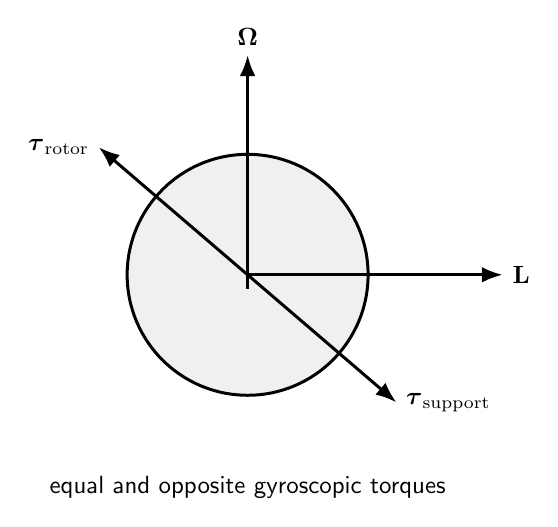
Figure 8. Forcing a spinning rotor to precess requires torque Ω × L. The support experiences an
equal and opposite gyroscopic reaction torque.
27 Gyroscopes do not oppose all changes in orientation
A gyroscope is sometimes described loosely as resisting any attempt to turn it.
The more precise statement is:
If
is large, a given torque causes only a small angular rate of change of its direction.
Thus gyroscopic behavior follows from angular momentum, not from a new force.
28 Precession is not automatically steady
The simple formula
assumes a fast top close to steady precession.
A top released with arbitrary initial conditions generally undergoes both:
The inclination can initially fall or rise while the precession rate changes according
to
Only special initial states produce exactly constant
29 Relationship to Euler’s equations
The Euler-angle and Euler-equation approaches describe the same physics from different
viewpoints.
Euler’s equations use:
- body-frame angular-velocity components,
- body-frame torque components.
The Euler-angle Lagrangian uses:
- orientation coordinates ϕ,𝜃,ψ,
- generalized momenta,
- conserved quantities from cyclic coordinates.
For the symmetric top, the Euler-angle formulation is especially effective because the two cyclic
coordinates immediately produce two constants of motion.
30 Common mistakes
- Treating gyroscopic precession as a new force rather than angular-momentum
dynamics.
- Using Ωp = Mgℓ∕(I3ω3) without checking that the fast steady-precession
approximation is appropriate.
- Forgetting that L need not be exactly parallel to the symmetry axis outside the
rapid-spin approximation.
- Memorizing a clockwise precession direction without using the torque cross product.
- Confusing spin, precession, and nutation.
- Assuming precession always occurs at constant inclination.
- Assuming a released top must immediately enter steady precession.
- Confusing body-frame precession of ω with inertial precession of the symmetry axis.
- Forgetting the precession contribution in ω3 = ψ + ϕ cos 𝜃.
- Forgetting that pψ and pϕ are conserved because ψ and ϕ are cyclic coordinates.
- Treating the effective potential Ueff(𝜃) as the actual gravitational potential alone.
- Forgetting that nutation turning points satisfy E = Ueff.
- Assuming the two exact steady-precession branches are the same physical regime.
- Ignoring the reaction torque exerted by a forced precessing rotor on its support.
- Confusing the intermediate-axis instability of a free triaxial body with nutation of a
heavy symmetric top.
31 Practice exercises
- Starting from τ = dL∕dt, derive τ = Ωp×L for a vector undergoing steady precession.
- Derive the magnitude relation τ = ΩpL sin 𝜃.
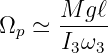
- Derive the fast-top gravitational precession formula Ωp ≃ Mgℓ∕(I3ω3).
- Reproduce the numerical precession rate in Example 1 and convert it to revolutions
per minute.
- Use a cross-product diagram to determine the precession direction for a specified spin
direction and pivot geometry.
- Derive the symmetric-top kinetic energy in terms of ϕ, 𝜃, and ψ.
- Derive the conserved momentum pψ.
- Derive the conserved momentum pϕ and solve for ϕ.
- Starting from the total energy, derive the effective potential Ueff(𝜃).
- Explain why nutation turning points satisfy E = Ueff(𝜃).
- Show that a stable steady-precession angle is a local minimum of the effective potential.
- Derive the small-nutation frequency ωnut =
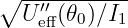 .
.
- Derive the exact quadratic condition for steady precession.
- Show that the slow branch of the exact quadratic reduces to Mgℓ∕(I3ω3) for rapid
spin.
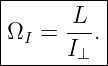
- Derive the inertial precession rate ΩI = L∕I⊥ for a torque-free symmetric body.
32 Summary
Gyroscopic behavior follows from
For steady rotation of the angular-momentum direction,
For a rapidly spinning heavy symmetric top,
The symmetric-top angular velocity satisfies
Two conserved generalized momenta are
and
The nutation coordinate obeys
Thus:
- precession changes the azimuth of the symmetry axis,
- nutation changes its inclination,
- steady precession is an equilibrium of the inclination dynamics,
- small nutations are small oscillations about a stable effective-potential minimum.
This completes the M05 rigid body sequence and provides the natural bridge to oscillations in
M06.
References
References
[1] PhysicsLibrary, M05-11, Euler’s Equations for Rigid Body Rotation.
[2] PhysicsLibrary, M05-10, Principal Axes and Principal Moments of Inertia.
[3] J. R. Taylor, Classical Mechanics, University Science Books, 2005.
[4] H. Goldstein, C. Poole, and J. Safko, Classical Mechanics, 3rd ed., Addison-Wesley,
2002.
[5] L. D. Landau and E. M. Lifshitz, Mechanics, 3rd ed., Butterworth-Heinemann, 1976.
[6] K. R. Symon, Mechanics, 3rd ed., Addison-Wesley, 1971.








































![|---------------------|
𝜃˙2 = -2 [E − Ueff (𝜃 )]. |
-----I1----------------](https://images.physicslibrary.org/cache/objects/1486/make4ht/GyroscopesPrecessionAndNutation68x.png)








![[ ]
sin 𝜃 I1Ω2 cos𝜃 − I3ω3Ω + M gℓ = 0.](https://images.physicslibrary.org/cache/objects/1486/make4ht/GyroscopesPrecessionAndNutation85x.png)