|
|
|
|||||||
and
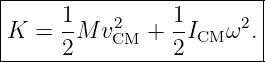
when consistent rolling magnitudes are used. The total kinetic energy is
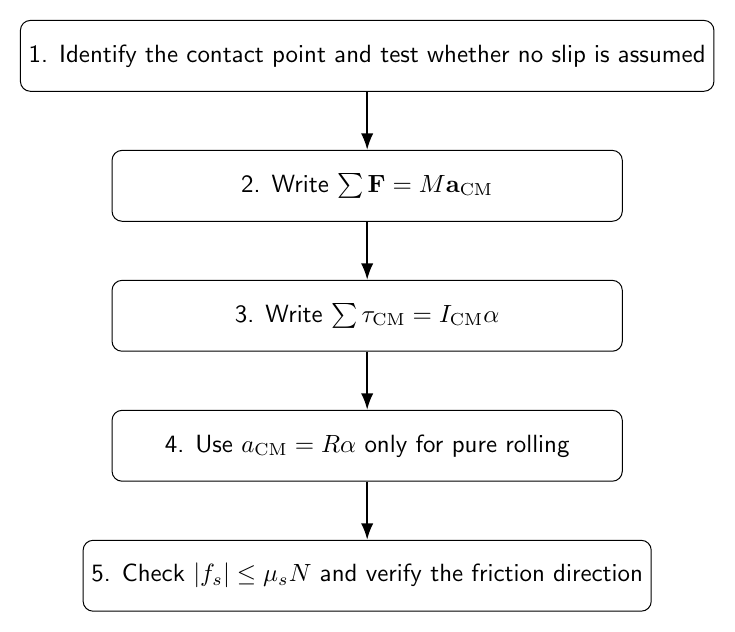
Figure 1. A compact strategy for rolling problems: test the contact constraint, write translation and rotation separately, connect them with aCM = Rα only if no slipping occurs, and verify the required static friction.
1 High-value GRE facts
Part I: Original GRE-style problems
Problem 1: top-point speedA wheel rolls without slipping to the right with center of mass speed v. The speed of the top point is
Problem 2: contact-point speedFor the same wheel on a stationary surface, the instantaneous speed of the material point touching the ground is
Problem 3: contact accelerationFor uniform-speed rolling on a horizontal surface, the instantaneous contact point has
Problem 4: disk kinetic energyA uniform disk rolls without slipping at center of mass speed v. Its total kinetic energy is
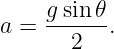
Problem 5: solid cylinder inclineA uniform solid cylinder rolls without slipping down an incline of angle 𝜃. Its acceleration is
Problem 6: hoop inclineA thin hoop rolls without slipping down the same incline. Its acceleration is
Problem 7: rolling raceA solid sphere, uniform disk, and thin hoop of equal outer radius roll without slipping from rest down the same incline. Which reaches the bottom first?
Problem 8: static-friction direction on inclineA symmetric body rolls freely down an incline without slipping. The static friction on the body points
Problem 9: work by ideal static frictionFor pure rolling on a stationary ideal rigid surface, the instantaneous power delivered by static friction at the contact point is
Problem 10: insufficient frictionIf the static friction required for rolling exceeds μsN, then
Problem 11: force through centerA horizontal force is applied through the center of a wheel initially at rest on a rough horizontal surface. To make the wheel roll right without slipping, static friction generally points
Problem 12: applied clockwise torqueA clockwise torque is applied to a wheel on a rough horizontal surface with no separate horizontal force through the center. If the wheel rolls right without slipping, static friction points
Part II: Complete worked solutions
Solution 1The top-point rotational velocity is in the same direction as the center of mass translation:
Using
Answer: (D).
Solution 2Pure rolling on a stationary surface requires zero relative contact velocity:
Answer: (A).
Solution 3The contact point is instantaneously at rest, but the normal rotational acceleration remains nonzero:
Answer: (B).
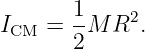
Solution 4For a uniform disk,
Thus
Answer: (C).
Solution 5For a solid cylinder,
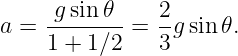
Therefore
Answer: (B).
Solution 6For a thin hoop,
Thus
Answer: (A).
Solution 7The dimensionless inertia factors are
The smallest β gives the largest acceleration. Therefore the solid sphere arrives first. Answer: (C).
Solution 8For a freely rolling symmetric body, gravity accelerates the center down the slope while uphill static friction supplies the torque needed to spin the body up. Answer: (B).
Solution 9The instantaneous contact point has zero velocity:
Hence
Answer: (C).
Solution 10Static friction cannot exceed its limiting value. If the rolling constraint demands more than
the contact slips. Answer: (B).
Solution 11The force through the center creates translation but no torque about the center. Backward static friction supplies the clockwise torque required for rightward rolling. Answer: (B).
Solution 12A clockwise applied torque tends to spin the bottom point backward relative to the surface. Static friction therefore acts forward to prevent slipping and accelerate the center to the right. Answer: (A).
2 GRE checklist
References
References
"GRE Physics Companion: Rolling Without Slipping" is owned by bloftin.
This object's parent. Cross-references: rotational kinetic energy, spin, torque, friction, force, center of mass velocity, angular velocity, instantaneous power, Normal, mass, solid, material point, center of mass, rolling constraint, rolling kinetic energy, acceleration, speed, contact point, velocity, static friction, kinetic energy, magnitudes This is version 1 of GRE Physics Companion: Rolling Without Slipping, born on 2026-10-17. Object id is 1477, canonical name is GREPhysicsCompanionRollingWithoutSlipping. Accessed 9 times total. Classification:
|
|
|
|
Pending Errata and AddendaNone.
|
DiscussionNo messages.
|
Interact |
![[parent]](https://images.physicslibrary.org/images/uparrow.png)