Electric Charge: Its Physical Meaning, Conservation, and Role in Electromagnetism
Electric charge is a property of matter that determines how it interacts with electric and magnetic
fields. There are two signs of charge, positive and negative. Charges of the same sign repel, and
charges of opposite signs attract when their electrostatic interaction is considered. A body with
zero net charge is electrically neutral, even though it can contain large amounts of positive and
negative charge internally.
Protons have charge +e, electrons have charge −e, and neutrons have zero electric charge.
For ordinary objects made from atoms, a net charge usually reflects a small imbalance
between the number of protons and the number of electrons. In a solid, this imbalance
is commonly produced by transfer of electrons, not by moving protons between the
solids.
We begin with these elementary properties and develop their physical consequences. In particular,
charge is additive, quantized, and conserved. Stationary charge distributions create electrostatic
fields. Charge in motion produces electric current and participates in magnetic interactions. These
are the foundations of electrostatics and electrodynamics.
1 What is electric charge?
Electric charge is an intrinsic physical property of particles and systems. A charged particle
experiences the electric part of the Lorentz force in an electric field E:
The sign of q determines the direction of this force relative to E. A positive charge
experiences a force parallel to the field; a negative charge experiences a force in the opposite
direction.
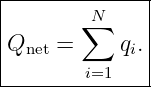
Charge is a scalar with sign. It is not a vector, a force, an energy, or a measure of the number of
electrons alone. The total charge of a system is the algebraic sum of the charges of its
parts:
For an idealized body with Np protons and Ne electrons, and no other charged constituents,
Equal numbers of protons and electrons therefore give Qnet = 0. Neutrality does not mean an
absence of electric charge.
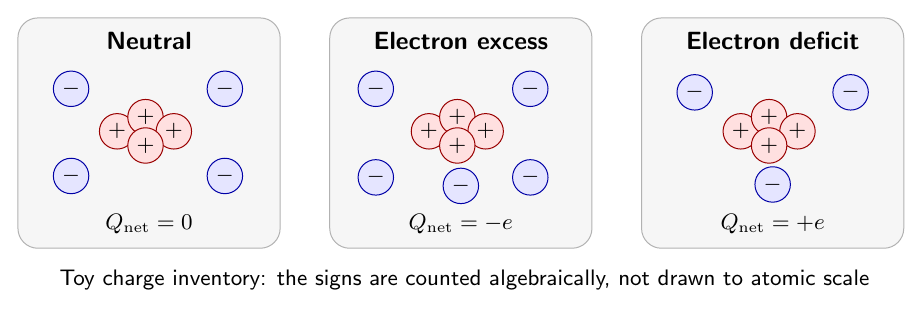
Figure 1. Schematic charge inventories. Equal positive and negative contributions cancel. An
electron excess produces negative net charge; an electron deficit produces positive net charge.
Symbols are not to scale.
An important distinction: object versus test charge
A source charge contributes to the electromagnetic field. A test charge is a small charge imagined
or placed in that field to probe the resulting force. We use a sufficiently small test charge when we
wish to avoid disturbing the source distribution significantly. An object may serve as a source of a
field in one calculation and a test object in another.
2 The coulomb and quantization of charge
The SI unit of charge is the coulomb, symbol C. Since current is the flow of charge per unit
time,
The elementary charge has the exact SI value
Thus an electron has charge −e and a proton has charge +e. This exact value follows from the
modern definition of the ampere.
For isolated ordinary objects, net charge occurs in integer multiples of e:
This property is called charge quantization. Quarks have fractional charges in units of e, but
isolated everyday objects do not exhibit free fractions of an elementary charge. For macroscopic
bodies, the value of n is usually so large that treating charge as continuously variable is an
excellent approximation.
Worked example 1: how many electrons make a nanocoulomb?
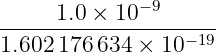
Suppose a body acquires charge Q = −1.0 nC. Its excess electron count is
| Nexcess | =  , | (7)
|
| =  , | (8)
|
| ≃ 6.24 × 10⁹. | (9) |
Therefore, a charge of only one nanocoulomb corresponds to about 6.24 billion excess electrons.
The object still contains vastly more positive and negative charge in its atoms than the small
imbalance responsible for its net charge.
3 The interaction between charges
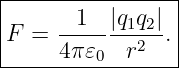
For stationary point charges q1 and q2 separated by distance r in vacuum, Coulomb’s law gives the
magnitude of the electrostatic force:
Here 𝜀0 is the permittivity of free space. The forces on both charges have equal magnitude
and opposite direction. The sign of q1q2 determines whether the force is repulsive or
attractive.
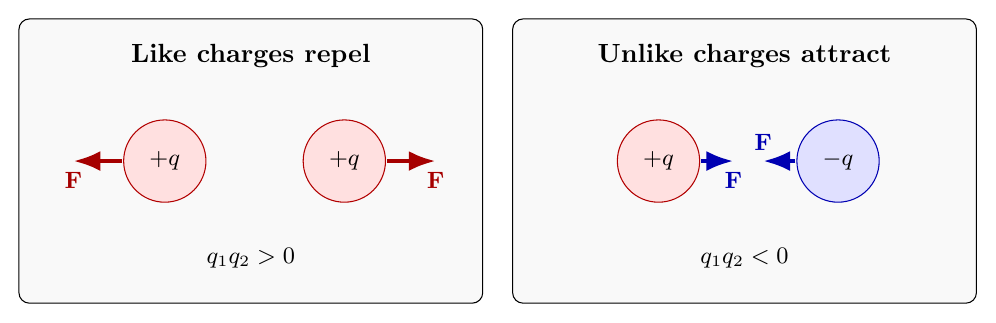
Figure 2. Like charges repel, and unlike charges attract. Each charge experiences a force of equal
magnitude, directed along the line joining the two particles.
The field of a point charge Q located at the origin is
A positive source produces an outward-pointing field, while a negative source produces an
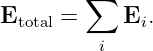
inward-pointing field. Fields from several sources add as vectors:
This is the principle of superposition. It permits us to build a field from many elementary charges,
then calculate the force on a test charge using F = qE.
The electric field is a physical description of the interaction in space, not a set of literal strings
connecting particles. The field-line pictures used later in the EM series are a visualization of its
direction and magnitude.
4 Conservation of charge and charge transfer
Conservation of electric charge means that the algebraic total charge of an isolated system remains
constant:
Charge may cross the boundary of an individual object, making its net charge change, without
changing the net charge of a larger closed system.
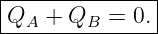
For example, let two bodies A and B initially be neutral. If N electrons move from A to B,
then
| QA | = +Ne, | (14)
|
| QB | = −Ne, | (15) |
and
The electron donor is positive because it has an electron deficit. The receiver is negative because it
has an electron excess.
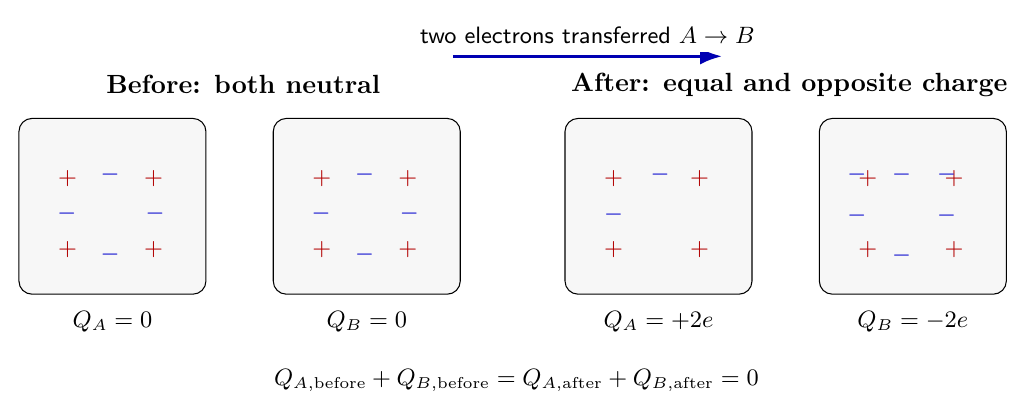
Figure 3. Transfer of electrons from one initially neutral body to another creates equal and
opposite net charges. The total charge remains zero. The numbered charges are an illustration,
not an atomic model of the materials.
Charging by friction and contact
When two different insulating materials contact and separate, electrons or other charge carriers
may be exchanged at their interface. The amount and even the sign of the charge left on either
material depend on the materials, their surfaces, contamination, and humidity. Rubbing can
increase the contact area and the number of charge-transfer events; the rubbing motion does not
manufacture charge.
A Conductor can also transfer charge to another conductor by direct contact. Charge then
redistributes according to the geometry and the surrounding electric field. Equal-sized identical
isolated conducting spheres brought into contact share their combined charge equally if
the final configuration is symmetric. That special result does not extend to arbitrary
shapes.
Worked example 2: equal and opposite transferred charges
If 2.0 × 10¹² electrons are transferred from body A to body B,
| |Q| | = Ne, | (17)
|
| = (2.0 × 10¹²)(1.602 176 634 × 10−19), | (18)
|
| ≃ 3.20 × 10⁻⁷ C. | (19) |
Hence QA = +0.320 μC and QB = −0.320 μC. The algebraic sum is zero.
5 Conductors, insulators, and mobile charges
A conductor contains charge carriers that can move readily through the material. In an
ordinary metal, some electrons are mobile within the material, while positive ions form
a nearly fixed lattice. A conductor redistributes free charge when an electric field is
present.
An insulator does not ordinarily allow charge to move freely over macroscopic distances. Charges
can nevertheless shift slightly within its atoms and molecules, and excess charge can remain
localized on its surface. The distinction is a matter of charge-carrier mobility, not whether the
material contains electric charge.
In an isolated conductor at electrostatic equilibrium, the free charges are no longer rearranging.
The electric field inside the bulk conducting material is zero. The conductor is an equipotential,
and any excess net charge of a solid conductor lies on its outer surface when there are no internal
cavities containing charges.
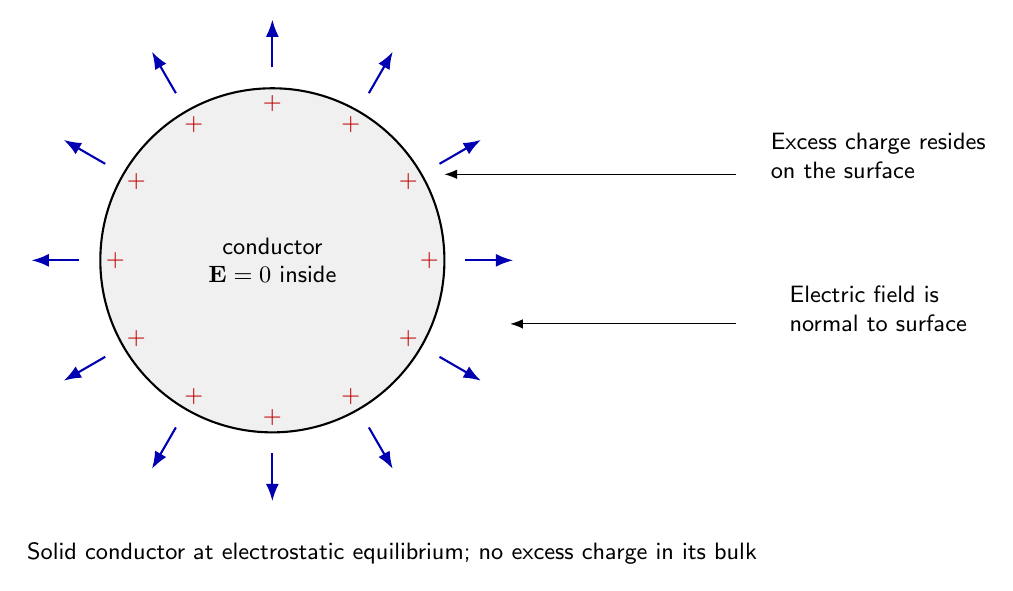
Figure 4. An idealized charged conductor at electrostatic equilibrium. The field vanishes within
the conducting material; excess charge resides on its surface. The spherical shape is used for
clarity.
This electrostatic result does not describe a conductor carrying a steady resistive current. Such a
conductor can have a nonzero interior electric field that drives its charge carriers.
6 Polarization: attraction without net charging
A body with Qnet = 0 can still respond to a nearby charged body. An external field can slightly
separate its positive and negative charge, or orient permanent molecular dipoles. This response is
called electric polarization.
A negatively charged rod approaching a neutral polarizable object repels negative charge toward
the far side and makes the near side relatively positive. Because the opposite charges on the near
side are closer to the rod, their attraction can exceed the repulsion of the more distant negative
charges. A net attractive force can result even though the object’s total charge remains
zero.
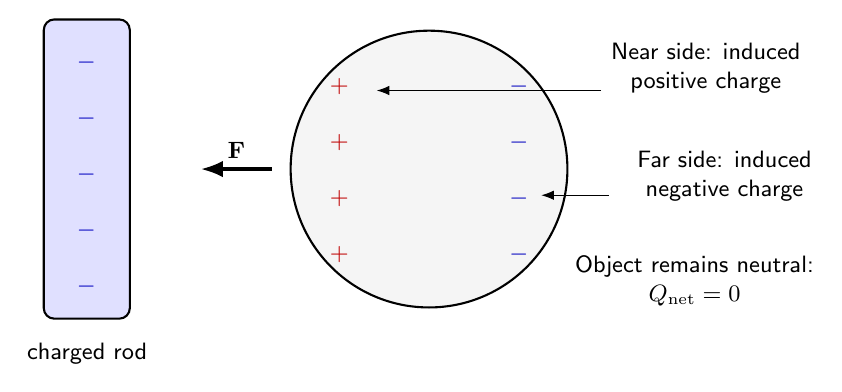
Figure 5. A negatively charged rod polarizes a nearby neutral body. The induced charge
separation can produce attraction while the net charge of the body remains zero.
A balloon sticking to a nominally neutral wall is a familiar example. The wall need not acquire a
nonzero total charge for the attraction to occur. The strength of the effect depends on the electric
field, the material’s dielectric response, and the geometry.
7 Electrostatic induction and grounding
Electrostatic induction is a method of charging an object without direct contact with the charged
source. In a conductor, mobile charges redistribute when another charged body approaches. If
a conducting connection to the Earth is then provided, charge can enter or leave the
conductor. Disconnecting the ground before removing the source can leave behind a net
charge.
Consider an isolated neutral metal sphere and a negatively charged rod:
- Bring the rod near the sphere without touching it. The sphere polarizes, but its net
charge remains zero.
- While the rod remains nearby, connect the sphere to ground. Electrons are repelled
and can flow to Earth.
- Remove the ground connection while holding the rod in place. The sphere now has an
electron deficit and therefore positive net charge.
- Remove the rod. The remaining positive charge redistributes over the sphere’s surface.
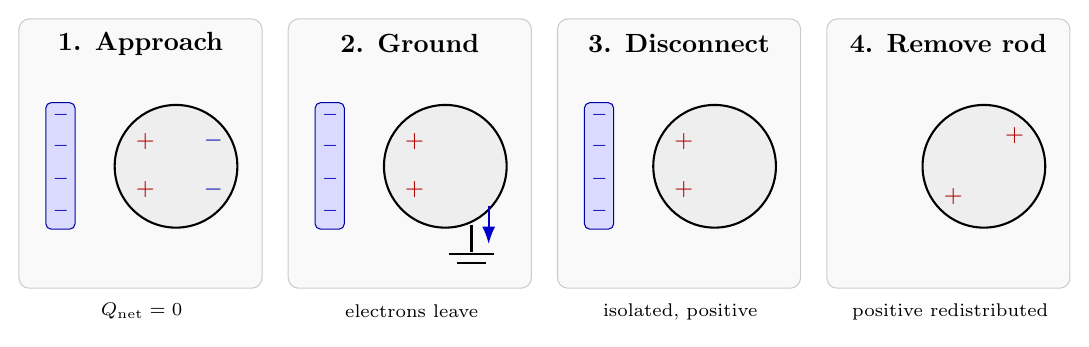
Figure 6. Charging a conducting sphere by induction using a negative rod. The correct sequence
is approach, ground, disconnect ground, then remove the rod. The Earth is part of the full charge
conservation bookkeeping.
The charge on the sphere is balanced by charge transferred to the Earth; no net charge is created.
If the ground connection is removed after the rod has already been taken away, the final outcome
can differ because the charges can return before isolation.
8 From discrete charges to charge density
At microscopic scales, a charge distribution can be written as a sum of discrete particles. At the
scale of ordinary experiments, there are so many charges that a continuous distribution is often a
simpler model.
Three common mathematical descriptions are:
| λ | =  | | (line charge density, C/m), | (20)
|
| σ | =  | | (surface charge density, C/m2), | (21)
|
| ρ | =  | | (volume charge density, C/m3). | (22) |
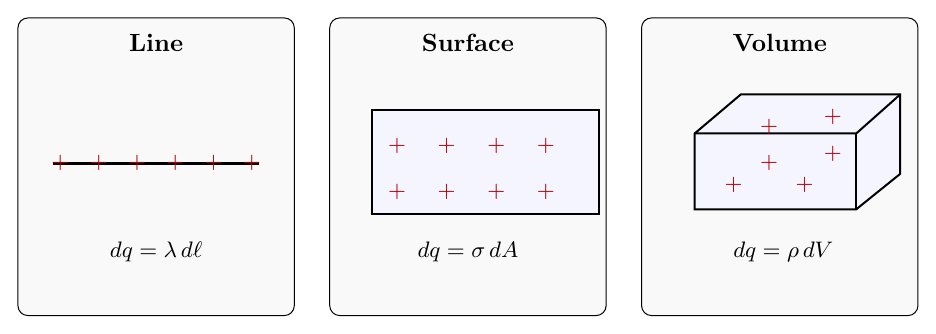
Figure 7. A distribution may be idealized by charge per unit length, area, or volume. Each small
element contributes to the total charge and, through superposition, to the electric field.
The total charge is found by integrating the appropriate density:
| Qline | = ∫
λdℓ, | (23)
|
| Qsurface | = ∫
σ dA, | (24)
|
| Qvolume | = ∫
ρdV. | (25) |
These densities can be positive or negative. A microscopic picture of separate electrons and
ions becomes a continuous distribution after averaging over volumes containing many
particles.
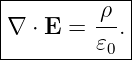
In vacuum, charge density is the source in Gauss’s Law:
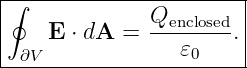
The equivalent integral law is
Charge conservation does not require a stationary field, and Gauss’s law is not restricted to
electrostatics. The use of Gauss’s law to calculate fields from simple stationary distributions
belongs to the later EM articles.
9 The role of charge in electrostatics
Electrostatics studies configurations in which macroscopic charge distributions are stationary
and electric fields are time independent. This includes the familiar cases of a charged
balloon, isolated charged conductors, capacitors, and fields around stationary point
charges.
The conceptual sequence is
The field is defined by the force on a small test charge. With sources held fixed, it can be described
by a scalar electric potential V :
This is the connection to the companion article E01 on electric potential and voltage. A charge
distribution is a source; voltage is a difference in electric potential. These are not interchangeable
quantities.
10 The role of charge in electrodynamics
Electrodynamics extends the description to charge in motion and to changing electromagnetic
fields. A moving charge responds to both parts of the Lorentz force:
Here v is the velocity of the charge in the selected reference frame and B is the magnetic field. The
magnetic-force term is perpendicular to the instantaneous velocity, so it does no instantaneous
work on a point charge.
When charge crosses a surface, it constitutes electric current. The conventional current is defined
in the direction of positive charge transport. In a metal, the mobile carriers are typically electrons,
and their average drift is opposite the conventional current.
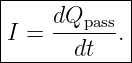
For charge Qpass(t) that has crossed a chosen oriented surface,
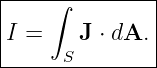
The unit is 1 A = 1 C∕s. For a continuous medium, current density J specifies the charge
transported per unit area and unit time with direction:
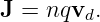
In a simple one-species continuum with carrier number density n, charge q, and average drift
velocity vd,
This expression is useful but is not the only source of current density; many species may carry
charge simultaneously.
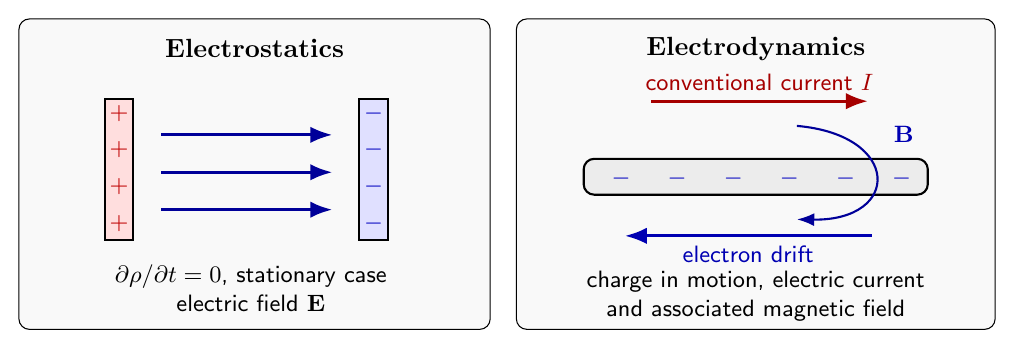
Figure 8. Electrostatics considers stationary macroscopic charge configurations; electrodynamics
also includes moving charge, current, magnetic fields, and time-dependent electromagnetic
phenomena. Electrostatic fields can exist in current-carrying circuits as well.
Where charge enters Maxwell’s equations
The charge density ρ and current density J appear as sources of electromagnetic fields. In vacuum,
two of Maxwell’s Equations are
| ∇⋅ E | =  , | (34)
|
| ∇× B | = μ0J + μ0𝜀0 . | (35) |
The first equation relates electric field divergence to charge density. The second relates magnetic
field circulation to current and changing electric fields. A moving charge generally contributes a
magnetic field, and electromagnetic fields can exist and propagate even in regions where no charge
is present.
11 Local conservation: the continuity equation
The earlier conservation statement describes the total charge of an isolated system. For
electrodynamics, we also need a local statement: charge in a small region changes only when charge
flows across its boundary.
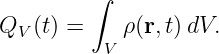
Choose a fixed volume V with outward-oriented surface element dA. The charge contained in the
volume is
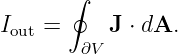
The outward flow rate is
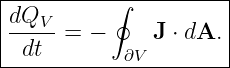
The minus sign in the bookkeeping equation is essential: charge flowing out reduces the stored
charge. Thus
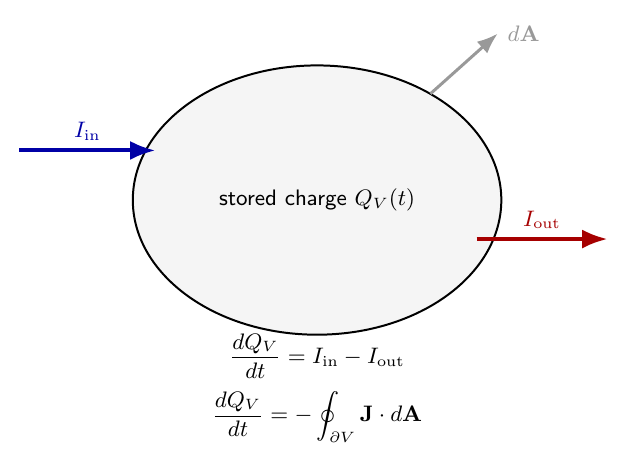
Figure 9. Charge conservation for a fixed volume. Positive outward current decreases the stored
charge. Inward current increases it. The surface Normal points outward.
For a fixed control volume, move the time derivative into the volume integral and apply the
divergence theorem:
∫
V  dV | = −∮
∂V J ⋅ dA, | (39)
|
| = −∫
V ∇⋅ JdV. | (40) |
Because the volume can be chosen arbitrarily,
This is the continuity equation for electric charge. It is the local form of charge conservation and
supplies the mathematical bridge to E02 on electric current and to Kirchhoff’s current
law.
Worked example 3: a charge balance
Suppose charge enters a small conducting region at Iin = 8.0 μA and leaves at Iout = 12.0 μA.
Then
 | = Iin − Iout, | (42)
|
| = −4.0 μA. | (43) |
Over an interval of 3.0 ms with constant currents,
| ΔQV | = (−4.0 × 10⁻⁶)(3.0 × 10⁻³) C, | (44)
|
| = −12 nC. | (45) |
The region loses 12 nC of stored net charge.
12 How these ideas appear in the home laboratory
These concepts can be observed with simple low-energy demonstrations. The objective is to
separate three different outcomes rather than treat all electrostatic phenomena as the same
event.
- Charge transfer: Rub an insulating balloon on a clean fabric and observe that it can
attract light paper fragments. Compare how strongly the effect depends on surface
condition and humidity.
- polarization: Bring a charged balloon near small neutral paper pieces without contact.
Their attraction need not mean they have acquired a net charge.
- Charge detection: Use a simple electroscope to observe charge transfer and distinguish
contact charging from induction.
An ordinary multimeter is designed to measure current, voltage, and resistance in connected
circuits. It is usually not a direct instrument for measuring the net electrostatic charge on an
insulating object. For that task, the later EDL electrostatics experiments introduce an electroscope
or electrometer. Work with low-energy sources only; do not connect improvised electrostatic
experiments to household mains or high-voltage capacitor supplies.
13 Common misconceptions
- Neutral does not mean uncharged at the particle level. It means that positive and
negative charges sum to zero.
- Friction does not create charge. Contact and separation can transfer charge between
bodies.
- A positively charged solid need not contain extra protons. It may have lost electrons.
- A neutral object can be attracted by a charged object. Polarization can create a net force
without net charge transfer.
- Induction is not identical to polarization. Polarization redistributes charge; grounding
during induction allows net charge to enter or leave.
- Electric current is not the same thing as net charge. A wire can carry current while
remaining approximately neutral.
- Charge and voltage have different units. Charge is measured in coulombs; voltage in
joules per coulomb.
14 Quick conceptual questions
- A neutral metal sphere is attracted to a charged rod. Does attraction prove that the
sphere had net charge before the rod approached?
- A plastic object loses N electrons. What is its final charge if it was initially neutral?
- Why does removing the ground connection first matter in charging by induction?
- Can current flow through a wire whose net charge is close to zero?
- If the outward flux of current density through a closed boundary is positive, what
happens to the enclosed net charge?
Answers
- No. Induced polarization can produce attraction in a neutral object.
- +Ne, because the object has an electron deficit.
- It prevents the transferred charge from returning while the rod is still influencing the
distribution.
- Yes. Oppositely signed charges can nearly cancel even while mobile carriers transport
current.
- It decreases, because dQV ∕dt = −∮
J ⋅ dA.
15 Summary and connection to the E series
Charge is an additive, conserved property of matter. Its elementary unit is e, and ordinary isolated
objects have net charge in integer multiples of e. The net charge of a body changes when charge
crosses its boundary, not when charge is created or destroyed.
A stationary distribution of charge produces an electrostatic field. Charge transfer explains
ordinary charging by contact or friction. Polarization explains the attraction of some
neutral objects. Grounding permits electrostatic induction to leave a conductor with a net
charge.
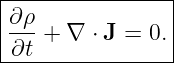
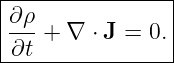
Charge in motion produces current. The local conservation law is
The next conceptual steps are to relate the electric field to electric potential (E01) and to develop
current and current measurements (E02).
References and further reading
References
[1] OpenStax, Physics, Section 18.1, “Electrical Charges, Conservation of Charge, and
Transfer of Charge.”
[2] OpenStax, University Physics, Volume 2, Sections 5.1–5.5 and 9.1.
[3] Bureau International des Poids et Mesures, The International System of Units (SI
Brochure), 9th edition, section on the ampere and the elementary charge.
[4] D. J. Griffiths, Introduction to Electrodynamics, chapters on electrostatics and
Maxwell’s equations.
[5] Wikipedia contributors, “Electric charge.” Consulted as an overview of terminology
and scope; historical discussion was deliberately excluded from the present article.