Physics Library
 An open source physics library
Encyclopedia | Forums | Docs | Random  

[parent] GRE Physics Companion: Center-of-Mass Motion and System Dynamics

(Example)

GRE Physics Companion: Center of Mass Motion and System Dynamics

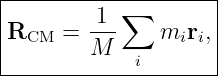
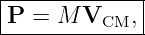
The central formulas are

|-----------∑--------|
|RCM  =  1--   miri, |
|        M   i       |
---------------------|
(1)

|------------|
P--=-M--VCM,--
(2)

and

|------------------|
|Fext,net = M ACM.  |
-------------------
(3)

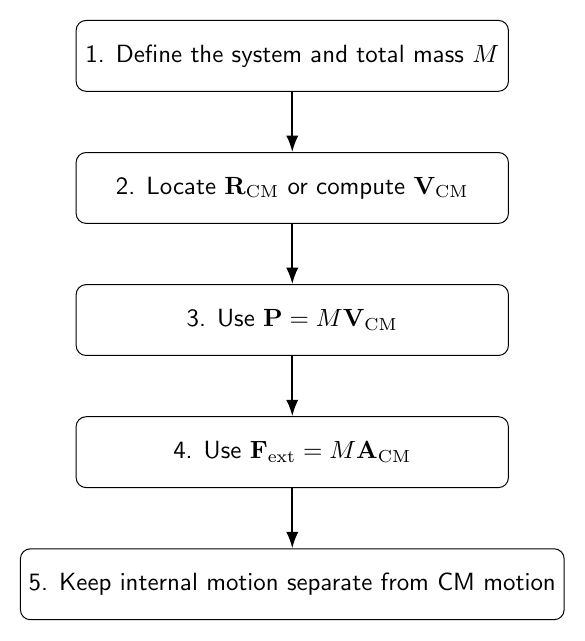
PIC

Figure 1. A compact strategy for center of mass problems. First locate or track the center of mass, then connect its motion to total momentum and net external force.

1 High-value GRE facts

  1. Center of mass is a mass-weighted average position.
  2. P = MVCM.
  3. Only net external force accelerates the center of mass of a fixed-mass system.
  4. internal forces can change relative motion but not center of mass velocity of an isolated system.
  5. The center of mass can lie in empty space.
  6. In uniform gravity, ACM = g if gravity is the only external force.
  7. For a perfectly inelastic collision, the common final velocity equals the pre-collision center of mass velocity.
  8. In the center of mass frame, total momentum is zero.
  9. For a free person-cart system, the center of mass position remains fixed horizontally.
  10. Continuous distributions use RCM = M−1 ∫ rdm.

Part I: Original GRE-style problems

Problem 1: two masses on a line

masses m and 3m are located at x = 0 and x = L. The center of mass is at

  1. L∕4
  2. L∕3
  3. L∕2
  4. 3L∕4
  5. L

Problem 2: total momentum

A system of total mass M has center of mass velocity VCM. Its total momentum is

  1. VCM∕M
  2. MVCM
  3. M2V CM
  4. zero
  5. dependent only on internal motion

Problem 3: isolated system

An isolated fixed-mass system has no net external force. Its center of mass

  1. position must be zero
  2. velocity is constant
  3. acceleration depends on internal forces
  4. kinetic energy must be zero
  5. must lie inside the material

Problem 4: internal explosion

A projectile explodes in flight while air resistance is neglected. The center of mass of the fragments

  1. stops instantly
  2. accelerates horizontally because of the explosion
  3. follows the trajectory the original projectile would have followed
  4. remains fixed in space
  5. moves with the fastest fragment

Problem 5: uniform gravity

A system of total mass M is acted on only by a uniform gravitational field. Its center of mass acceleration is

  1. zero
  2. g∕M
  3. Mg
  4. g
  5. dependent on internal configuration

Problem 6: ring center of mass

The center of mass of a uniform thin circular ring is

  1. on the material at the bottom
  2. on the material at the top
  3. at the empty geometric center
  4. undefined
  5. outside the ring plane

Problem 7: center of mass frame

In the center of mass frame,

  1. every particle is at rest
  2. total momentum is zero
  3. total kinetic energy is zero
  4. internal forces vanish
  5. total mass is zero

Problem 8: free person-cart system

A person walks to the right on a frictionless free cart. Relative to the ground, the cart moves

  1. right
  2. left
  3. upward
  4. not at all
  5. in a direction that cannot be determined

Problem 9: constant external force

A 6 kg system experiences net external force 18ex N. Its center of mass acceleration is

  1. 1ex m∕s2
  2. 2ex m∕s2
  3. 3ex m∕s2
  4. 6ex m∕s2
  5. 18ex m∕s2

Problem 10: impulse and center of mass

A 4 kg system receives an external impulse of 12 N s in the +x direction. The center of mass velocity changes by

  1. 0.33 m∕s
  2. 3.0 m∕s
  3. 4.0 m∕s
  4. 12 m∕s
  5. 48 m∕s

Problem 11: uniform rod

A uniform rod extends from x = 0 to x = L. Its center of mass is

  1. 0
  2. L∕4
  3. L∕2
  4. 3L∕4
  5. L

Problem 12: rigid body rotation

A rigid body rotates about its fixed center of mass with nonzero angular speed. Which statement is correct?

  1. Its total linear momentum must be nonzero.
  2. Its center of mass velocity can be zero while its kinetic energy is nonzero.
  3. Every material point is at rest.
  4. Its center of mass must lie outside the body.
  5. Internal motion changes P even with no external force.

Part II: Complete worked solutions

Solution 1

Use

        m-(0) +-(3m-)L-   3L-
XCM  =        4m       =  4 .
(4)

Answer: (D).

Solution 2

By definition,

P  = M  VCM.
(5)

Answer: (B).

Solution 3

If

F    = 0,
  ext
(6)

then

M A    =  0.
    CM
(7)

Thus

VCM   = constant.
(8)

Answer: (B).

Solution 4

The explosion forces are internal. Gravity remains the only external force, so

ACM  = g.
(9)

Thus the center of mass follows the original projectile trajectory.

Answer: (C).

Solution 5

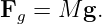
The total gravitational force is

Fg = M  g.
(10)

Thus

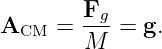
A    =  Fg-= g.
  CM    M
(11)

Answer: (D).

Solution 6

By symmetry, the center of mass is at the geometric center of the ring, even though that point contains no material.

Answer: (C).

Solution 7

In the center of mass frame,

P ′ = 0.
(12)

Individual particles may still move.

Answer: (B).

Solution 8

No external horizontal force acts, so the center of mass position cannot shift horizontally if the system starts at rest.

When the person moves right relative to the cart, the cart moves left.

Answer: (B).

Solution 9

Use

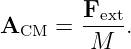
        Fext
ACM   =  M  .
(13)

Thus

        18             2
ACM   = ---ex = 3ex m∕s .
         6
(14)

Answer: (C).

Solution 10

Use

Jext = M  ΔVCM.
(15)

Therefore

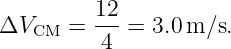
ΔV     =  12-= 3.0m ∕s.
    CM    4
(16)

Answer: (B).

Solution 11

A uniform rod is symmetric about its midpoint:

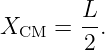
       L
XCM  = --.
        2
(17)

Answer: (C).

Solution 12

Rotation about a stationary center of mass contributes rotational kinetic energy even though

VCM   = 0
(18)

and therefore

P  = 0.
(19)

Answer: (B).

2 GRE checklist

  1. Use mass-weighted positions, not ordinary averages.
  2. Connect momentum to center of mass velocity with P = MVCM.
  3. Use only external force in MACM = Fext.
  4. Internal forces cannot accelerate the center of mass of an isolated fixed-mass system.
  5. Use symmetry before integrating a continuous distribution.
  6. In person-cart problems, use a fixed center of mass position when no horizontal external force acts.
  7. In the center of mass frame, set total momentum equal to zero.
  8. Do not apply fixed-mass center of mass equations blindly to open variable-mass systems.

References

References

[1]   J. R. Taylor, Classical Mechanics, University Science Books, 2005.

[2]   D. Kleppner and R. Kolenkow, An Introduction to Mechanics, 2nd ed., Cambridge University Press, 2014.

[3]   OpenStax, University Physics, Volume 1, Rice University, 2016.


"GRE Physics Companion: Center-of-Mass Motion and System Dynamics" is owned by bloftin.
(view preamble)
View style:
Other names:  M04-05G
Keywords:  GRE physics, center of mass, system dynamics, total momentum, external force, particle system, center of mass frame, recoil, continuous mass distribution, rigid body

This object's parent.

Cross-references: momentum, rotational kinetic energy, forces, total linear momentum, speed, rigid body, external impulse, particle, center of mass acceleration, field, resistance, kinetic energy, acceleration, masses, velocity, perfectly inelastic collision, isolated system, center of mass velocity, relative motion, internal forces, system, position, external force, total momentum, motion, center of mass, formulas

This is version 1 of GRE Physics Companion: Center-of-Mass Motion and System Dynamics, born on 2026-10-04.
Object id is 1397, canonical name is GREPhysicsCompanionCenterOfMassMotionAndSystemDynamics.
Accessed 9 times total.

Classification:
Physics Classification: 45.50.-j (Dynamics and kinematics of a particle and a system of particles)
 45.20.Dd (Newtonian mechanics)

Pending Errata and Addenda

None.

Discussion

No messages.

Interact