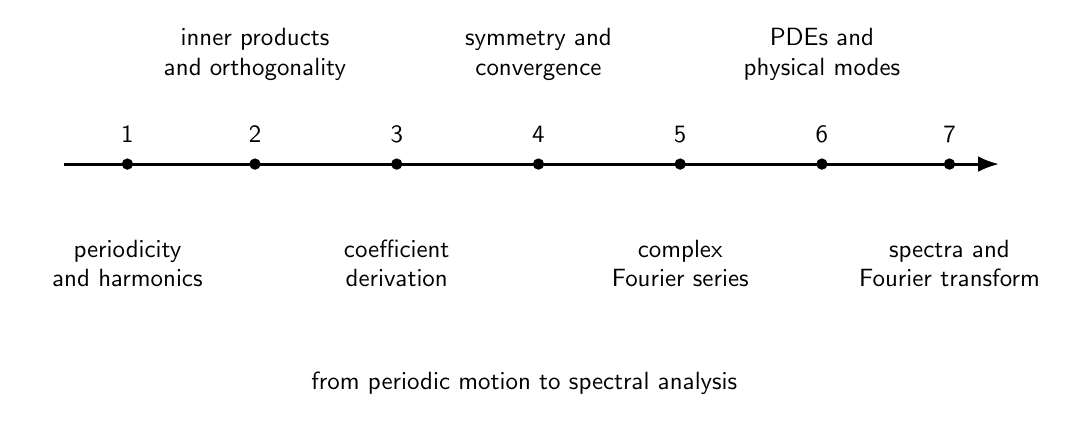
FS00: Fourier Series Roadmap, Motivation, and Learning Path
Fourier series answer a remarkable question:
How can a complicated periodic function be reconstructed from simple sinusoidal
building blocks?
A square wave has sharp corners. A sawtooth has jumps. A vibrating string can have an arbitrary
initial shape. A periodic driving force can be highly nonsinusoidal.
Yet all of these can be analyzed by decomposing the function into harmonics.
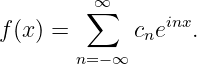
The central form is
The coefficients
measure how strongly the corresponding basis functions occur in the original function.
This roadmap is designed for self-learning. The aim is not to memorize Equation (1) and
immediately begin inserting functions into formulas. Instead, the series builds the subject from the
ideas that make the formulas inevitable:
Every major formula will be derived rather than merely stated.
1 What a Fourier series is
A Fourier series is an expansion of a periodic function in sinusoidal basis functions.
For a function with period
the fundamental angular frequency is
The frequencies
are the harmonics of the fundamental.
A real Fourier series combines sine and cosine functions at those harmonic frequencies. The
complex form instead uses
The two forms contain the same information.
The important conceptual point is that the Fourier coefficients are not arbitrary fitting constants.
They are projections of the function onto orthogonal basis functions. The first half of this series is
devoted to making that statement concrete.
2 The geometric idea behind the entire series
For an ordinary vector in three dimensions,
If the basis vectors are orthonormal, then
The dot product extracts one component of the vector.
Fourier analysis does something closely analogous with functions.
A function is expanded in basis functions such as
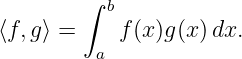
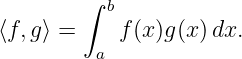
The role of the dot product is played by an integral:
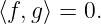
Orthogonality means
The Fourier coefficient of one basis function is obtained by projecting the function onto that basis
function.
This vector-to-function analogy is the conceptual spine of FS02 through FS05 and returns again in
FS11.
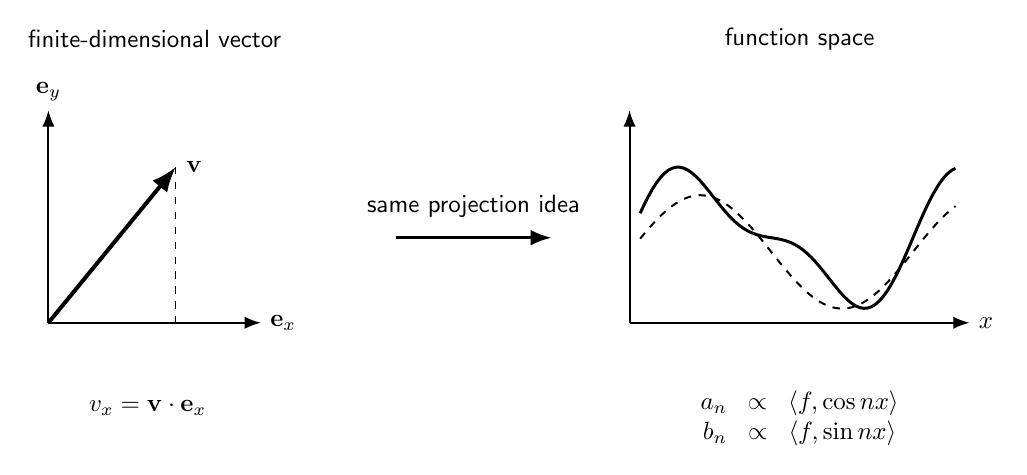
Figure 2. Fourier coefficients are function-space analogues of vector components. A dot product
extracts a component along a vector basis direction; an integral inner product extracts a
component along a function basis direction.
3 How the lectures are designed
The main lectures use the same learning pattern whenever possible.
- Begin with a concrete geometric or physical question.
- Introduce only the notation needed for that question.
- Derive the required integral identity from elementary algebra or trigonometry.
- Carry the derivation through every intermediate line.
- Check units, parity, signs, and limiting cases.
- work at least one complete example numerically or symbolically.
- Interpret the result geometrically or physically.
- End with a short set of exercises that test the exact derivation just developed.
Companion E1 entries then provide longer worked problems and complete solutions.
The series intentionally repeats important derivations in more than one language. For example,
Fourier coefficients will first appear through trigonometric orthogonality, later through
function-space projection, later through least-squares minimization, and finally through complex
exponentials.
That repetition is a feature. It exposes the same structure from several viewpoints.
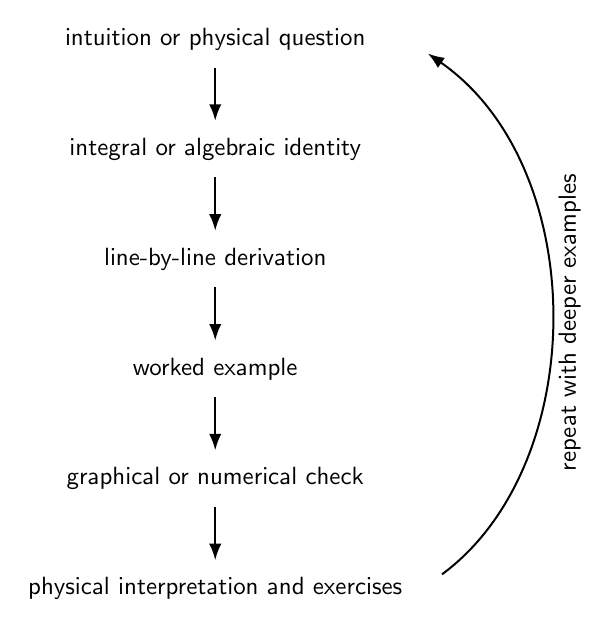
Figure 3. Recurring self-learning cycle. Each major topic moves from intuition to an identity, then
to a derivation, a worked example, a numerical or graphical check, and finally a physical
interpretation.
4 Stage I: periodic functions and orthogonality
The first stage develops the language needed before any Fourier coefficient formula is
introduced.
FS01: Periodic Functions, Harmonics, and Why Fourier Series Exist
FS01 begins with periodicity itself.
Topics include:
- period T,
- frequency f0 = 1∕T,
- angular frequency ω0 = 2π∕T,
- harmonics nω0,
- amplitude and phase,
- superposition of sinusoidal functions,
- the idea of approximating a nonsinusoidal periodic waveform by adding harmonics.
The article introduces the general Fourier-series form but does not yet derive the coefficient
formulas.
Companion: FS01E1. Graphical harmonic-building exercises and numerical partial
sums.
FS02: Inner Products of Functions
FS02 begins with ordinary vectors and gradually generalizes the dot product to functions:
The article develops:
- function norms,
- orthogonality,
- normalization,
- projection onto one function,
- the analogy between finite-dimensional vectors and functions.
Companion: FS02E1. Function inner-product and projection problems.
FS03: Orthogonality of Sines and Cosines
FS03 proves the trigonometric orthogonality relations from product-to-sum identities.
For example,
The article treats separately the cases
and
It derives the sine-sine, cosine-cosine, and sine-cosine integrals in full.
Companion: FS03E1. Orthogonality proofs and integral drills.
5 Stage II: deriving the Fourier coefficients
This stage derives the real Fourier-series formulas from first principles.
FS04: Derivation of the Fourier Cosine Coefficients
Start from a proposed expansion. Multiply both sides by
integrate over a full period, and watch every orthogonal term vanish except the mth cosine
term.
The result on [−π,π] is
The article emphasizes that this is component extraction, not a memorized trick.
Companion: FS04E1. Line-by-line cosine-coefficient derivations.
FS05: Derivation of the Sine and Constant Coefficients
Repeat the complete projection argument for
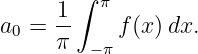
and derive the constant term
The article explains carefully why the series contains
rather than a0.
Companion: FS05E1. Sine and constant-coefficient derivations.
FS06: Fourier Series on a General Interval [−L,L]
FS06 rescales the basis from [−π,π] to [−L,L] and derives
It derives the general coefficient formulas and relates the interval length to the physical
period.
Companion: FS06E1. Rescaling and general-interval problems.
FS07: First Complete Fourier Series: the Square Wave
FS07 performs the first complete waveform decomposition.
It derives
for the standard odd square wave.
Partial sums are plotted so the learner can watch the waveform emerge harmonic by
harmonic.
Companion: FS07E1. Square-wave coefficient and partial-sum problems.
FS08: Sawtooth and Triangle Waves
FS08 derives both series and compares their coefficient decay.
The sawtooth naturally produces coefficients of order
while a triangle wave produces coefficients of order
This begins the connection between smoothness and spectral decay.
Companion: FS08E1. Sawtooth and triangle-wave derivations.
6 Stage III: symmetry, projection, and mathematical structure
FS09: Even and Odd Functions
Derive the parity rules directly from symmetric integration.
For an even function,
For an odd function,
The goal is to make symmetry an active calculation tool rather than a shortcut stated without
proof.
Companion: FS09E1. Parity and coefficient-elimination problems.
FS10: Half-Range Sine and Cosine Series
A function specified only on
can be extended evenly or oddly.
FS10 derives how those two choices create cosine-only or sine-only expansions. This becomes
essential for boundary-value problems.
Companion: FS10E1. Half-range extension and coefficient problems.
FS11: Fourier Series as Projection onto an Infinite-Dimensional Basis
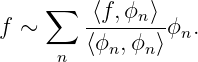
FS11 returns to FS02 and writes the general projection formula
Fourier series then become one example of an eigenfunction expansion.
This is the conceptual bridge to Hilbert spaces, Sturm-Liouville theory, quantum mechanics, and
normal modes.
FS12: Mean-Square Error and Why Fourier Coefficients Are Optimal
Define a finite trigonometric approximation SN and the squared error
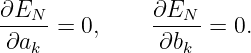
Then differentiate with respect to the unknown coefficients:
The Fourier coefficient formulas reappear from least-squares minimization.
This provides a direct conceptual bridge to the PhysicsLibrary calculus-of-variations and
optimization material.
Companion: FS12E1. Least-squares derivations and finite Fourier approximations.
FS13: Parseval’s Theorem and Energy in Harmonics
FS13 begins with a finite partial sum and uses orthogonality to evaluate its squared
norm.
The limiting result is
The physical interpretation is spectral energy accounting.
Companion: FS13E1. Parseval and harmonic-energy problems.
7 Stage IV: convergence and discontinuities
FS14: What Does It Mean for a Fourier Series to Converge?
FS14 distinguishes:
- pointwise convergence,
- uniform convergence,
- mean-square convergence,
- absolute convergence.
The article emphasizes pictures and counterexamples before theorem statements.
FS15: Dirichlet Conditions and Values at Discontinuities
At a jump discontinuity x0, a Fourier series approaches the midpoint of the one-sided
limits:
The article develops one-sided limits carefully and explains why the square-wave series takes its
midpoint value at a jump.
Companion: FS15E1. Convergence-at-jump calculations.
FS16: Gibbs Phenomenon
FS16 studies the oscillatory overshoot near a jump.
It distinguishes two effects:
- the oscillatory region narrows as more harmonics are added,
- the limiting overshoot amplitude does not vanish.
Numerical plots make the effect visible.
Companion: FS16E1. Partial-sum and overshoot experiments.
FS17: Differentiating and Integrating Fourier Series
FS17 derives formal term-by-term differentiation and integration and then asks when those
operations are justified.
Starting from
formal differentiation gives
Companion: FS17E1. Series differentiation and integration problems.
8 Stage V: complex Fourier series
FS18: Euler’s Formula and the Complex Exponential Basis
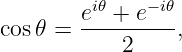
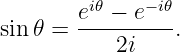
FS18 reviews
and derives
Positive and negative frequencies then arise naturally.
FS19: Derivation of the Complex Fourier Coefficients
Start from
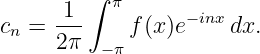
Multiply by e−imx, integrate, derive complex-exponential orthogonality, and obtain
Companion: FS19E1. Complex coefficient derivations.
FS20: Equivalence of Real and Complex Fourier Series
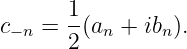
Derive
and
For real functions,
The article interprets conjugate symmetry geometrically and spectrally.
Companion: FS20E1. Conversions between real and complex forms.
9 Stage VI: differential equations and physics
Fourier series become especially powerful when the basis functions are also eigenfunctions of
differential operators.
FS21: Separation of Variables and Why Fourier Series Solve PDEs
Starting from an ansatz
FS21 shows how a partial differential equation separates into ordinary differential equations and an
eigenvalue problem.
The boundary conditions select a discrete family of spatial eigenfunctions. Those eigenfunctions are
exactly the functions used in the corresponding Fourier expansion.
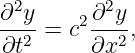
FS22: Fourier Series Solution of the Vibrating String
Start from
with fixed endpoints.
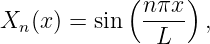
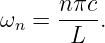
Derive
and
Then expand an arbitrary initial displacement in that sine basis.
Companion: FS22E1. Complete vibrating-string initial-value problems.
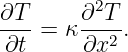
FS23: Fourier Series Solution of the Heat Equation
Start from
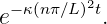
Derive modal decay factors of the form
The physical lesson is that fine spatial structure decays faster than broad spatial structure.
Companion: FS23E1. Heat-equation initial-value problems.
FS24: Periodic Driving and Fourier Decomposition of Forcing
For
write a periodic force as a Fourier series and solve the response to each harmonic independently.
The total solution follows by linear superposition.
This connects Fourier series directly to driven oscillations and steady-state phasor methods.
Companion: FS24E1. Nonsinusoidal periodic forcing problems.
10 Stage VII: spectra and the bridge to Fourier transforms
FS25: Frequency Spectrum of a Periodic Function
FS25 interprets Fourier coefficients as a discrete spectrum.
Topics include:
- spectral lines,
- fundamental frequency,
- harmonic amplitudes,
- phase spectrum,
- coefficient decay,
- bandwidth in a periodic signal.
FS26: From Fourier Series to the Fourier Transform
Let the period become very large:
Then the harmonic spacing
approaches zero.
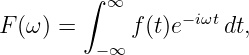
FS26 derives how a discrete sum becomes a continuous integral and develops
and
Companion: FS26E1. The series-to-transform limit worked in detail.
FS27: Wave Packets, Localization, and Dispersion
Construct
Develop:
FS27 connects directly to the PhysicsLibrary waves sequence and to M06-10 on Fourier analysis,
wave packets, and dispersion.
11 Advanced continuation
The first 27 lectures develop the core Fourier-series path. FS28 through FS31 show that Fourier
series are part of a much broader eigenfunction-expansion framework.
FS28: Sturm-Liouville Theory and Generalized Fourier Series
Develop
Derive weighted orthogonality and generalized eigenfunction expansions.
Companion: FS28E1. Elementary Sturm-Liouville eigenvalue problems.
FS29: Legendre Series
Derive Legendre orthogonality and expansion coefficients on
Connect the expansion to gravity, electrostatics, and spherical geometry.
Companion: FS29E1. Legendre projection problems.
FS30: Bessel Series and Cylindrical Eigenfunctions
Develop Bessel orthogonality and radial eigenfunction expansions.
Connect directly to circular membranes, cylindrical waves, and the existing PhysicsLibrary
Bessel-function material.
Companion: FS30E1. Bessel-series coefficient problems.
FS31: Fourier Series in Two Dimensions
For a rectangle, derive expansions such as
Then derive the double-projection formula for Amn.
Applications include rectangular membranes, heat flow, and waveguides.
Companion: FS31E1. two-dimensional coefficient and boundary-value problems.
12 Master roadmap table
The complete main-lecture sequence is summarized below.
ID | Lecture | Primary goal |
|
|
|
FS01 | Periodic Functions and
Harmonics | Build
periodicity, frequency, harmonic, phase, and
superposition intuition. |
FS02 | Inner Products of Functions | Generalize vector dot products to
function-space projection. |
FS03 | Orthogonality of Sines and
Cosines | Prove the trigonometric orthogonality
identities. |
FS04 | Fourier Cosine Coefficients | Derive an by projection. |
FS05 | Sine and Constant Coefficients | Derive bn and a0 and explain a0∕2. |
FS06 | General Interval [−L,L] | Rescale the basis and coefficient formulas. |
FS07 | Square Wave | Perform the first full waveform
decomposition. |
FS08 | Sawtooth and Triangle Waves | Compare spectra and coefficient decay. |
FS09 | Even and Odd Functions | Use symmetry to eliminate coefficients. |
FS10 | Half-Range Series | Build sine-only and cosine-only extensions. |
FS11 | Infinite-Dimensional Projection | Interpret Fourier series as basis expansion. |
FS12 | Mean-Square Optimality | Re-derive coefficients by least-squares
minimization. |
FS13 | Parseval’s Theorem | Connect function norm to harmonic energy. |
FS14 | types of Convergence | Distinguish pointwise, uniform, and
mean-square convergence. |
FS15 | Dirichlet Conditions | Understand convergence at discontinuities. |
FS16 | Gibbs Phenomenon | Study persistent overshoot near jumps. |
FS17 | Differentiating and Integrating
Series | Learn when term-by-term operations work. |
FS18 | Euler Formula and Complex
Basis | Build the complex-exponential
representation. |
FS19 | Complex Fourier Coefficients | Derive cn by complex projection. |
FS20 | Real versus Complex Form | Convert between an,bn and cn. |
FS21 | separation of variables | Explain why Fourier bases solve PDEs. |
FS22 | Vibrating String | Solve the wave equation by sine expansion. |
FS23 | heat equation | Solve diffusion by decaying Fourier modes. |
FS24 | Periodic Driving | Decompose a nonsinusoidal force into
harmonic responses. |
FS25 | Frequency Spectrum | Interpret coefficients as spectral lines. |
FS26 | Fourier Transform Limit | Derive the continuous spectrum from the
series. |
FS27 | Wave Packets and Dispersion | Build localized waves from continuous
spectra. |
FS28 | Sturm-Liouville Theory | Generalize Fourier expansion to weighted
eigenfunctions. |
FS29 | Legendre Series | Develop spherical-style orthogonal
expansions. |
FS30 | Bessel Series | Develop cylindrical radial expansions. |
FS31 | Two-Dimensional Fourier Series | Extend projection to two spatial coordinates. |
13 Dependency map
Not every article depends on every earlier article. The main dependency spine is
After FS10, the series branches temporarily:
- FS11–FS13 deepen the projection and energy viewpoint.
- FS14–FS17 deepen convergence and series manipulation.
- FS18–FS20 introduce the complex representation.
Those branches reunite before the PDE and spectral stages.
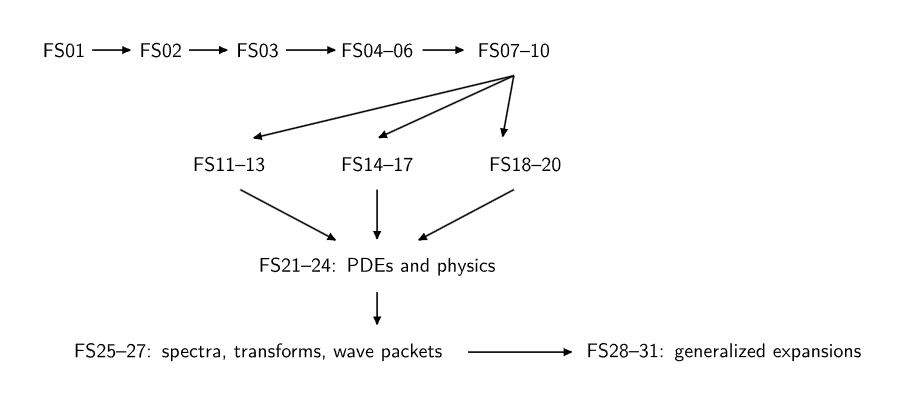
Figure 4. Simplified dependency map. The early orthogonality and coefficient-derivation sequence
is the common trunk. Projection, convergence, and complex-form branches deepen different
aspects before rejoining for PDEs, spectra, and transforms.
14 Recommended self-learning route
For a learner encountering Fourier series for the first time, the recommended route is not to rush to
the transform.
The first milestone is
At that point the learner should be able to derive and compute Fourier series for several standard
periodic functions.
The second milestone is
At that point the learner should understand symmetry, projection, least-squares optimality, energy,
convergence, Gibbs behavior, and term-by-term operations.
The third milestone is
At that point Fourier series become a working tool for complex notation, waves, heat flow, and
forced oscillation.
The fourth milestone is
At that point the discrete Fourier spectrum naturally develops into the Fourier transform and
wave-packet picture.
FS28 through FS31 can then be treated as an advanced mathematical-physics continuation.
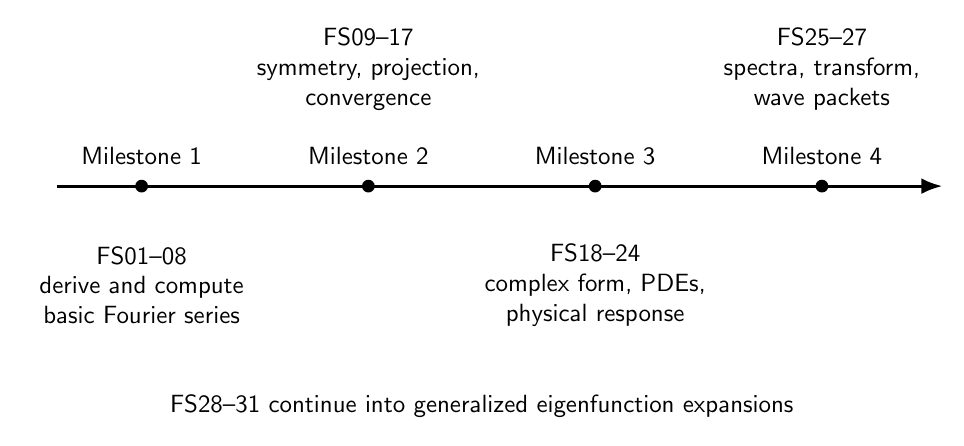
Figure 5. Four recommended self-learning milestones. Each milestone ends with a useful
capability before the learner proceeds to the next level of abstraction.
15 Recommended companion problem articles
The following companions are especially valuable because the associated main lecture contains a
derivation that benefits from repetition.
Companion | Worked focus |
|
|
FS01E1 | Harmonic addition, period, frequency, and partial-sum graphs. |
FS02E1 | function inner products, norms, orthogonality, and projections. |
FS03E1 | Trigonometric orthogonality proofs and integral drills. |
FS04E1 | Cosine-coefficient extraction from first principles. |
FS05E1 | Sine and constant coefficient derivations. |
FS06E1 | General-interval rescaling problems. |
FS07E1 | Square-wave Fourier series and partial sums. |
FS08E1 | Sawtooth and triangle-wave expansions. |
FS09E1 | Even/odd symmetry and coefficient elimination. |
FS10E1 | Half-range sine and cosine expansions. |
FS12E1 | Least-squares Fourier approximations. |
FS13E1 | Parseval and harmonic-energy calculations. |
FS15E1 | Convergence at discontinuities. |
FS16E1 | Gibbs-phenomenon numerical experiments. |
FS17E1 | Differentiation and integration of Fourier series. |
FS19E1 | Complex Fourier coefficients. |
FS20E1 | Conversion between real and complex representations. |
FS22E1 | Vibrating-string initial-value problems. |
FS23E1 | Heat-equation initial-value problems. |
FS24E1 | Periodic forcing of linear oscillators. |
FS26E1 | Detailed Fourier-series-to-transform limit. |
FS28E1 | Elementary Sturm-Liouville eigenvalue problems. |
FS29E1 | Legendre-series projection. |
FS30E1 | Bessel-series projection. |
FS31E1 | Two-dimensional Fourier expansions. |
16 Connections to existing PhysicsLibrary material
The Fourier series sequence is mathematical, but its motivation is strongly physical.
It connects naturally to existing mechanics and waves articles.
- simple harmonic motion supplies the basic sinusoidal building block.
- driven harmonic motion explains frequency response to a single sinusoid.
- Coupled Oscillators and Normal Modes introduce decomposition into independent
modes.
- Continuous strings show that boundary conditions select discrete mode shapes.
- Circular membranes introduce Bessel-function eigenmodes.
- M06-10 uses Fourier analysis to build wave packets and discuss dispersion.
- The complex-number and phasor articles supply the exponential representation used
in FS18 through FS20.
- Calculus-of-variations material provides a natural connection to the least-squares
minimization developed in FS12.
Fourier analysis also reaches beyond mechanics into Electromagnetism, acoustics, optics, quantum
mechanics, signal processing, and numerical methods.
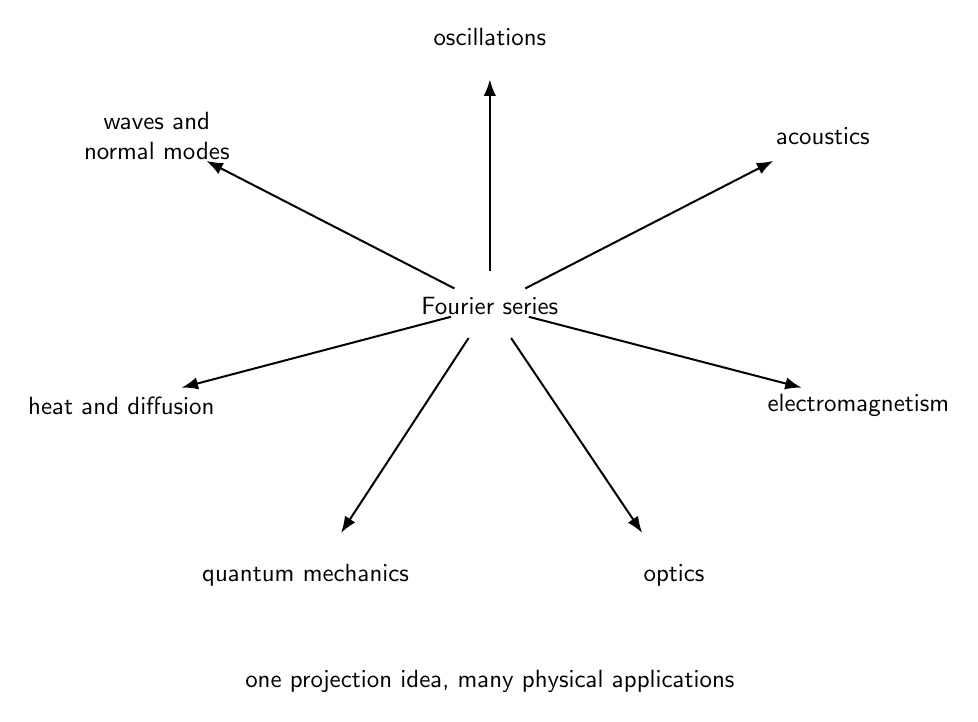
Figure 6. Fourier series sit at a junction between mathematical analysis and physical applications.
Oscillations and normal modes motivate the basis, while PDEs, waves, acoustics,
electromagnetism, optics, quantum mechanics, and signal analysis use the resulting spectral
representation.
17 What the learner should be able to derive by the end
A successful pass through the core sequence should make the following results derivable rather
than merely recognizable.
- The sine and cosine orthogonality relations.
- The real Fourier coefficient formulas.
- The coefficient formulas on a general interval.
- The square-wave, sawtooth, and triangle-wave series.
- The parity simplifications for even and odd functions.
- Half-range sine and cosine expansions.
- The function-space projection formula.
- The least-squares optimality of Fourier coefficients.
- Parseval’s theorem.
- The midpoint value at a jump discontinuity.
- The origin and behavior of the Gibbs phenomenon.
- Conditions and consequences of term-by-term differentiation and integration.
- The complex Fourier coefficient formula.
- The equivalence of real and complex Fourier forms.
- Fourier-series solutions of the wave and heat equations.
- Harmonic decomposition of periodic forcing.
- The interpretation of Fourier coefficients as a discrete spectrum.
- The limiting transition from Fourier series to Fourier transforms.
- The construction of wave packets and the distinction between phase and group velocity.
18 Notation used throughout the series
Unless a particular problem requires a different convention, the series will use:
- T for period,
- f0 = 1∕T for fundamental frequency,
- ω0 = 2π∕T for fundamental angular frequency,
- n for harmonic number,
- an and bn for real Fourier coefficients,
- cn for complex Fourier coefficients,
- SN for a finite Fourier partial sum,
- L for the half-length of an interval [−L,L],
- ⟨f,g⟩ for a function inner product.
When the independent variable is time, the notation will use t. When it is a spatial coordinate, the
notation will normally use x.
The distinction between cyclic frequency f and angular frequency ω will be maintained
carefully:
19 A note on proof depth
The series has two levels of proof.
The core lectures prove the identities needed for calculation from elementary calculus, algebra, and
trigonometry.
More advanced statements about convergence can require real analysis beyond the intended
starting level. In those cases the article will distinguish among:
- a complete elementary derivation,
- a physically motivated argument,
- a theorem stated with its hypotheses,
- an advanced proof deferred to a later article.
This prevents a self-learner from confusing an intuitive explanation with a rigorous
theorem.
20 A note on numerical experiments
Fourier series are especially well suited to small numerical experiments.
Many entries will therefore include suggestions such as:
- plot partial sums SN(x) for increasing N,
- numerically verify orthogonality integrals,
- compare analytic coefficients with numerical quadrature,
- measure Gibbs overshoot,
- compare time-domain waveforms with harmonic spectra,
- reconstruct PDE solutions with increasing numbers of modes.
The numerical experiment is not a substitute for derivation. It is a check on the derivation and a
way to make the structure visible.
21 Suggested article-production order
Although the full roadmap contains 31 main lectures, the recommended first production block
is:
- FS01: Periodic Functions, Harmonics, and Why Fourier Series Exist.
- FS02: Inner Products of Functions.
- FS03: Orthogonality of Sines and Cosines.
- FS04: Derivation of the Fourier Cosine Coefficients.
- FS05: Derivation of the Sine and Constant Coefficients.
- FS06: Fourier Series on a General Interval [−L,L].
- FS07: First Complete Fourier Series: the Square Wave.
- FS08: Sawtooth and Triangle Waves.
- FS09: Even and Odd Functions.
- FS10: Half-Range Sine and Cosine Series.
That block gives a self-learner a complete usable introduction before the sequence moves into
deeper convergence and function-space structure.
22 Summary
The FS sequence develops Fourier analysis as a progression of ideas rather than a collection of
formulas.
The early sequence establishes:
- periodicity,
- function inner products,
- orthogonality,
- projection,
- Fourier coefficient derivation.
The middle sequence develops:
- symmetry,
- half-range expansions,
- least-squares optimality,
- Parseval’s theorem,
- convergence,
- Gibbs behavior,
- complex Fourier series.
The later sequence applies those ideas to:
- vibrating strings,
- heat flow,
- periodic forcing,
- discrete spectra,
- Fourier transforms,
- wave packets and dispersion.
The advanced continuation then generalizes the same projection idea to Sturm-Liouville, Legendre,
Bessel, and multidimensional eigenfunction expansions.
The next article is FS01, which begins at the beginning: what periodicity means, what a harmonic
is, and why sums of sinusoids are plausible building blocks for complicated periodic
motion.
References
References
[1] J. Fourier, The Analytical Theory of Heat, English translation of the 1822 work.
[2] R. V. Churchill and J. W. Brown, Fourier Series and Boundary Value Problems,
McGraw-Hill.
[3] G. P. Tolstov, Fourier Series, Dover Publications.
[4] E. Kreyszig, Advanced Engineering Mathematics, Wiley.
[5] G. B. Arfken, H. J. Weber, and F. E. Harris, Mathematical Methods for Physicists,
Academic Press.
[6] R. Haberman, Applied Partial Differential Equations with Fourier Series and
Boundary Value Problems, Pearson.