EDL02E3: Electrostatic Polarization, Induction, and Charge Transfer with Pith Balls and
Balloons
Laboratory objective. Use the EDL02 electrostatic rod-and-cloth kit and coated pith
balls to make visible the differences between (i) polarization of a neutral conductor, (ii)
charging by physical contact, (iii) charging by induction with a temporary ground, and (iv)
polarization of a dielectric. The experiment connects everyday demonstrations to the
microscopic motion or displacement of charge and to a repeatable measurement of pith-ball
deflection.
Scope. The demonstrations are adapted to the PhysicsLibrary home laboratory from the concepts
shown in MIT 8.02 lectures on electrostatic induction and polarization. This article supplies an
independent apparatus design, measurements, diagrams, error analysis, and exercises. The
demonstrations do not require a Van de Graaff generator, a Coulomb balance, or a calibrated
electrometer.
1. What the experiment must distinguish
A neutral body can be attracted to a charged rod even though the body’s total charge is zero.
Conversely, after an appropriate charging operation, the same body can be repelled by the rod.
These are different physical states, and attraction alone is not sufficient evidence that the body has
a net charge opposite to that of the rod.
Three questions guide the laboratory:
- Can a nominally neutral conducting pith ball move toward a charged rod without
touching it?
- Can we reliably distinguish charge transfer by contact from charging by induction while
the ball is grounded?
- How does the response differ for a conductive pith ball, a dielectric latex balloon, and
an optional metallized foil balloon?
2. Equipment and supplier links
The apparatus deliberately reuses parts from EDL02 and EDL02E2. In the purchase
list below, “required” means needed for the main pith-ball sequence. Items marked
“alternative” replace rather than supplement another item. Prices are reference prices
observed on November 8, 2026; verify actual price, stock, shipping, and surcharges at
checkout.
2.1 Essential electrostatics equipment
-
Charging rod and cloth kit, one, required.
- PASCO Electrostatics Materials, SE-6658,
approximately $25, containing glass, ebonite, and acrylic rods and wool, cotton, and silk
cloths. Product page: PASCO SE-6658. PASCO advertises a possible tariff surcharge.
If this was purchased for EDL02, do not buy a duplicate.
-
Less expensive charging-kit alternative, one.
- Arbor Scientific Friction Rod Kit,
P6-1600, approximately $14.95, includes glass and hard rubber rods, silk, faux fur, and
bubble wrap. Product page: Arbor Scientific P6-1600. This is an alternative to the
PASCO kit, not an additional requirement.
-
Coated conducting pith balls, two plus spares, required.
- PASCO SE-7719 set of
ten, approximately $7, supplied with suspension threads and conductive coating:
PASCO SE-7719. Alternative: Arbor Scientific P6-1650, five pairs for approximately
$5.25: Arbor Scientific coated pith balls. A spare pair is valuable when a coating or
thread becomes contaminated.
-
Extra insulating suspension line.
- Thin, clean monofilament, preferably about 2 lb test;
example: Berkley Trilene XL 110 yd, approximately $4.97: Walmart 16911623. The
PASCO spheres already have threads; first check whether they are long enough.
-
Rigid support with horizontal arm, required.
- A wooden base (approximately 30 cm×
40 cm), a vertical timber upright (approximately 60–80 cm), and a removable
wooden dowel crossbar (approximately 25–30 cm) make a low-cost and electrically
insulating stand. Alternatively, purchase Arbor Scientific’s 20-in ring stand, 66-4220,
approximately $19.50: Arbor 20-in ring stand. The taller 36-in option 66-4240 is
approximately $29: Arbor 36-in ring stand. A separate nonconducting arm and clamp
are still needed. PASCO ME-9507 is a compatible right-angle multi-clamp for rods up
to 12.7 mm: PASCO ME-9507; request its current price and check the dowel diameter.
-
Background measurement scale, required.
- A printed millimeter grid or an existing
metric ruler. Mount the scale behind the spheres and keep a metal ruler sufficiently
distant that it does not change the field. A printable template is included in this bundle.
-
Neutralizing and grounding tool, required.
- A clean narrow conductor with an
insulating handle, for example a piece of bare copper wire attached to a wooden or
plastic stick. Use finger contact with the wire to give the pith ball a return path to the
body. No connection to an electrical outlet is required or permitted. A bare finger can
also be used on the pith ball if it is mechanically practical.
-
Draft control, required for repeatable measurements.
- Use a cardboard enclosure
with clear plastic film on the front, a clear storage box of suitable height, or an existing
transparent shield. The shield must not touch the suspension thread or approach the
charged ball closely enough to produce unintended forces. An improvised shield is
usually cheaper than a purpose-built instrument enclosure.
2.2 Useful optional additions
-
Latex balloons, optional but strongly recommended.
- Ordinary
uncoated latex balloons provide the dielectric comparison. One example is Party City’s
11-in 15-count assortment, approximately $3.99: Party City latex balloons. A smaller
or lightly inflated balloon may be easier to suspend.
-
Metallized foil balloon, optional.
- Choose a small helium-capable foil balloon with a
demonstrably continuous conductive outer layer. Party City’s balloon catalog is an
example starting point. Not every decorative metallic-looking balloon has a continuous
conductive surface. Verify continuity between several surface locations with a DMM
if necessary. Helium is optional; a tethered, air-filled foil balloon also demonstrates
polarization, but with less dramatic movement. Do not buy a helium tank solely for
this laboratory.
-
Digital multimeter, optional.
- Useful for checking a foil balloon’s coating or a grounding
wire but not for measuring the pith-ball charge. Reuse the DMM from EDL01 or
EDL02E1.
-
Hygrometer, optional.
- Records
relative humidity; helps explain charge-leakage differences between trials. An existing
room thermometer-hygrometer is sufficient.
-
Camera or phone with fixed stand, optional.
- A phone on a stable support makes
deflection measurements more reproducible. Use a remote shutter or short video rather
than reaching near the sphere during a reading.
-
Craft materials, optional.
- Aluminum kitchen foil, paper dots, painter’s tape, wooden
sticks, and plastic spacers are useful for supplementary charge and polarization
demonstrations. No power supply is required.
2.3 Budget and purchase priority
A minimal purchase for a lab already containing a stand, ruler, and camera can consist of the
Arbor friction-rod kit (about $14.95), PASCO pith balls (about $7), and optional latex balloons
(about $3.99): roughly $26 before tax and shipping. The PASCO charging-kit version is roughly
$36 for the same subset. A new 20-in stand adds about $19.50, and additional line about $5. These
are planning estimates, not delivered prices. The direct links above and the bundle’s CSV purchase
table include the vendor and part identifiers.
3. Assemble the pith-ball apparatus
Use a horizontal support at least 10 cm away from the nearest metal upright. The goal is a freely
moving pith ball whose equilibrium position can be photographed from the side. Select a
suspension length L of approximately 0.30–0.50 m if the stand permits. Mark a fixed vertical
reference directly beneath the suspension point. Hang a second ball from a nearby independent
hole or hook when testing ball-ball repulsion. For EDL02E2, measure the spacing between
suspension points; the point-separation idealization is not exact if the hooks are appreciably
apart.
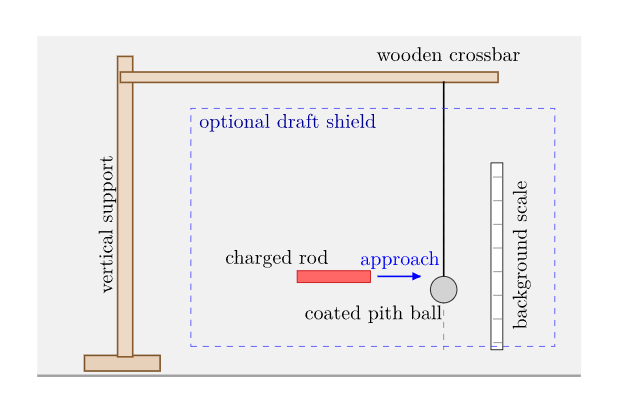
Figure 1. Recommended home-lab apparatus: a rigid insulating crossbar, suspended conducting
pith ball, moving charged rod, background ruler, and draft barrier. The diagram is schematic and
not to scale.
Preflight checks.
With no rod nearby, the ball should settle at the same reference position after small deflections.
Remove metal tools, charged plastic, and nearby sleeves. Check for residual charge by
briefly touching the conductive coating, then withdrawing your hand well away and
allowing the ball to settle. Record temperature and humidity if possible. Test at least
two rod-and-cloth combinations, because frictional charging varies with cleanliness and
humidity.
4. Theory I: charge separation by rubbing
Triboelectric charging is the transfer of electric charge resulting from contact and separation of
different materials. Rubbing increases the number of contacts and separations; Friction does not
manufacture charge. If a rod and cloth begin electrically neutral and the environment exchanges
negligible charge with them, conservation requires
Traditionally, glass rubbed with silk often becomes positively charged while hard rubber or ebonite
rubbed with suitable fabrics often becomes negative. The sign and magnitude are empirical, not
guaranteed for every material pair, humidity level, or contamination state. Use the signs in the
following figures as explicit examples, not as universal observations.
The Electric Field of a positive test charge points away from it. A positive rod can exert electric
forces on both free charges in a conductor and bound charges in a dielectric. The interpretation of
those forces depends on the target material.
5. Theory II: polarization of a neutral conductor
A conductor contains mobile charge carriers. When an external field is applied to an isolated,
initially neutral conductor, electrons redistribute until the conductor’s interior electric field
vanishes at electrostatic equilibrium. Its surface becomes an equipotential; the conductor’s total
charge remains zero if nothing enters or leaves.
For a positive rod to the left of a conducting pith ball, negative charge accumulates preferentially
on the nearer surface and positive surface charge on the farther side. Both regions exert forces on
the rod, but the closer opposite charge usually produces the stronger attraction. No contact, charge
transfer, or net charging is needed.
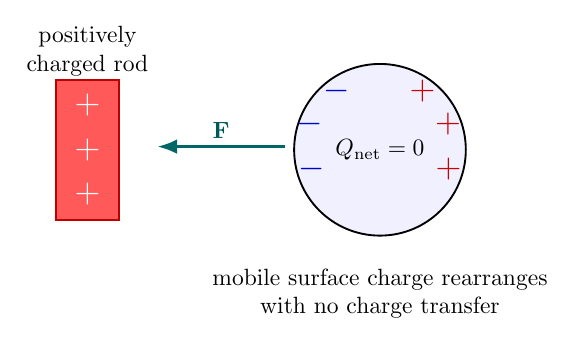
Figure 2. A neutral conductive sphere becomes polarized by a positively charged rod. Its negative
surface charge is preferentially nearer the rod; positive charge appears farther away. The sphere
remains neutral overall.
A useful far-field model represents the induced conductor dipole as
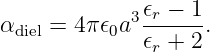
where α is its electric polarizability. For an isolated conducting sphere of radius a in
vacuum,
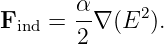
For an induced dipole in a nonuniform static field, the ideal quasistatic force is
The factor 1∕2 reflects that the dipole is induced rather than fixed. If the source of the
external field is approximated by a distant point charge Q, then E = k|Q|∕r2, giving a
force magnitude proportional to r−5 in the leading induced-dipole approximation. A
nearby finite rod is not a point source, and the pith ball is not necessarily an ideal
conductor. Therefore a neutral pith ball’s induced attraction should not be
interpreted as a direct measurement of the inverse-square Coulomb force law. That
quantitative test belongs in EDL02E2, using already charged spheres and carefully controlled
geometry.
6. Theory III: three processes that look similar
6.1 Induction without contact
The charged rod approaches a neutral isolated conductor and redistributes its mobile charges. The
conductor remains neutral. The ball is attracted while the external field is present. This is
polarization, often called electrostatic induction in demonstrations.
6.2 Charging by physical contact
An electrically charged object touches a conductor, allowing charge to transfer across the interface
if the materials and contact conditions permit. After the contact, the conductor can have nonzero
net charge. A newly charged ball may be repelled by the same rod if the resulting charges have the
same sign. With a charged insulating rod, charge transfer can be irregular: only a small contacted
region of the rod may participate, and the original rod need not act as an equipotential
electrode. Lack of repulsion after touching is therefore not proof that the polarization model
failed.
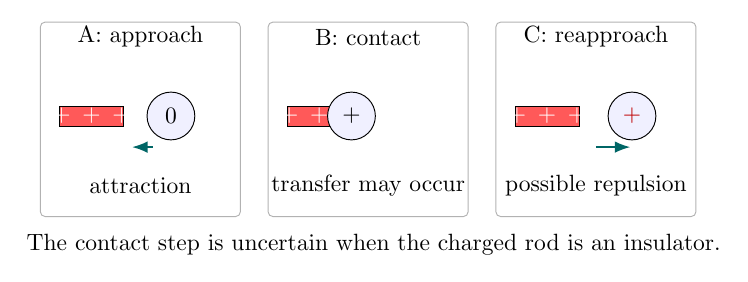
Figure 3. Idealized before-contact attraction, moment of possible charge transfer, and
after-contact like-charge repulsion. Transfer from a charged insulator is not guaranteed; repeat
and record both successful and unsuccessful trials.
6.3 Charging by induction using a temporary ground
A nearby charged rod polarizes the conductor. A temporary conducting path to the body or a
verified ground permits charge to enter or leave. Break the grounding contact while the rod is still
present, and only then withdraw the rod. A net charge remains on the isolated conductor if leakage
is sufficiently small.
For a positive rod: electrons are attracted from the body or ground to the ball, leaving the ball
with net negative charge. For a negative rod: electrons are pushed away, leaving positive
net charge. The rod never touches the ball during this procedure. Because the induced
charge is opposite to the rod, attraction after removing the grounding tool is expected;
repulsion from the original rod is not expected in the ideal case. A sign test should use an
independently prepared reference of known sign, since attraction can also occur for a neutral
object.
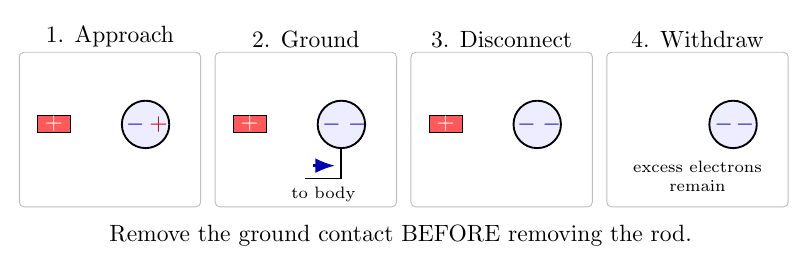
Figure 4. Charging by induction, shown for a positively charged rod: approach without contact;
connect the far side of the polarized ball temporarily to a body/ground reference; disconnect the
ground first; finally withdraw the rod. The final ball has excess electrons.
7. Experiment A: neutral-conductor attraction
Prediction. A charged rod attracts a neutral, isolated conducting pith ball over a useful range of
close separations without contacting it. The direction of the force does not by itself reveal the rod’s
polarity.
- Neutralize the pith ball by touching its conductive coating. Remove your hand and
wait for stillness.
- Charge a selected rod using the matching cloth, keeping hands away from the rubbed
portion.
- Approach slowly from the left at the height of the ball’s center; stop at a repeatable
surface-to-surface gap d, starting conservatively around 40–60 mm.
- Observe the sign of motion and record an approximate steady lateral displacement x,
if measurable. Do not let the rod touch the ball in this experiment.
- Withdraw the rod without disturbing the suspension; confirm that the ball returns
toward its initial rest position. Repeat three times.
- Neutralize again, then repeat with a different rod-and-cloth combination. Note whether
the observed attraction occurs regardless of the likely rod polarity.
Control. Approach with the same nominally uncharged rod and the same hand position. A residual
deflection can indicate drafts, nearby charged surfaces, or imperfect neutralization. Record it
rather than assuming zero.
8. Experiment B: contact charging and repulsion
Prediction. If the contacting rod actually deposits charge of the same sign on the ball, the ball
will repel the rod on a second approach.
- Begin with a neutralized ball and freshly charged rod. Confirm attraction before
contact.
- Lightly touch the rubbed part of the rod to the ball, avoiding large mechanical impulses.
Withdraw it and let the ball settle.
- Recharge the rod if necessary, then slowly re-approach without contact. Observe the
ball’s direction of motion.
- Repeat several trials and record the proportion showing initial attraction followed by
repulsion. Note ambiguous outcomes and apparent loss of charge.
- Optional: place two identical pith balls close together, and use the same rod to attempt
charging both. Their mutual repulsion, if observed, is evidence of like-sign net charge.
A repulsion observation is stronger evidence of same-sign net charge than an attraction observation
is of opposite-sign net charge. A charged object may attract either an oppositely charged object or
a neutral polarizable object.
9. Experiment C: charging by induction without touching the rod
Prediction. A conductor can acquire net charge without the charged rod ever contacting it,
provided a charge-transfer path exists temporarily during polarization.
- Neutralize the ball and recharge the rod. Keep the rod stationary near the ball, leaving
a gap so the two never touch.
- Use the insulated grounding tool, or a carefully controlled finger touch, to contact the
conducting coating briefly. Keep the charged rod in position.
- Remove the grounding contact first. Only afterward remove the rod.
- Record any subsequent response to the original rod and to a second rod with an
independently prepared reference sign. Do not infer sign from attraction alone.
- Repeat at least five trials, reversing the order of removal in a separate deliberately
labeled control trial: if the rod is removed while the ground is still connected, the ball
typically returns closer to neutrality.
A Light pith ball can be pushed by the touch tool. Distinguish immediate mechanical motion from
a persistent electrostatic response measured after the ball settles. The body serves only as a large
charge reservoir for this tabletop demonstration; a secure mains earth connection is neither
necessary nor appropriate.
10. Experiment D: conductor versus dielectric
Prediction. A neutral latex balloon is also attracted to a charged rod, even though mobile
electrons cannot redistribute throughout the latex as in a metal. Its molecules and local charge
distributions become polarized. A metallized foil balloon, if included, provides a larger conducting
comparison.
For a uniform linear isotropic dielectric sphere of radius a and relative permittivity 𝜖r in vacuum,
the ideal induced polarizability is
The simple formula is not an exact model of a thin inflated latex shell, but it illustrates how
bound-charge polarization can produce an induced dipole without free charge circulation over the
surface.
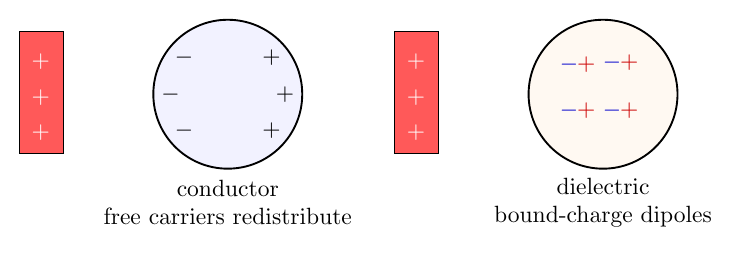
Figure 5. A conducting sphere redistributes free surface charge, whereas a dielectric experiences
many small induced dipoles or displaced bound charges. Both may be attracted to a charged rod,
but their microscopic mechanisms differ.
- Suspend an uncharged latex balloon on insulating thread or place it on a very
low-friction mount. Neutralize nearby objects and allow the balloon to settle.
- Approach with a charged rod, carefully avoiding rubbing or touching the balloon.
Record the direction of motion.
- Rub the balloon with cloth and try again. Its residual net charge may dominate the
response, so do not label this second test a pure dielectric-polarization experiment.
- Optional: repeat using a commercially metallized foil balloon with a conductive outer
layer. Check that the surface actually conducts and use a short nonconducting tether.
A helium-filled balloon can make small forces easy to see; an air-filled one is suitable
if freely suspended.
11. Quantitative extension: deflection versus distance
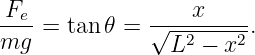
For a single ball hanging from length L, a sideways displacement x from the vertical
gives
Here normalized deflection η is a dimensionless response convenient for comparisons without
measuring ball mass. In a static model where the electrostatic force is predominantly
horizontal,
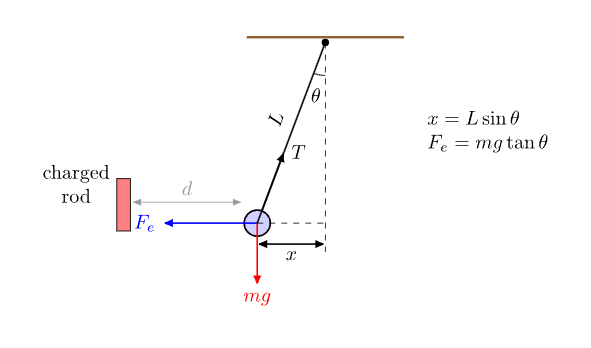
Figure 6. Deflection geometry and free-body balance. The horizontal electrical force is schematic;
it may vary strongly with rod-ball separation and ball polarization.
Measurement protocol. Use a fixed camera and ruler behind the suspended ball; choose three
rod surface-to-surface gaps, for example d = 50, 40, 30 mm, only if the ball does not touch the rod
and a reproducible static deflection is possible. Hold the rod at the same height and orientation.
Repeat each gap three times, randomize or reverse the sequence, and re-neutralize the ball before
each trial. Record humidity, rod/cloth combination, time since charging, L, d, x, and whether the
ball remained free of contact.
As an illustrative calculation only, let L = 0.350 m and x = 0.025 m. Then η = 0.0714, 𝜃 ≃ 4.10∘,
and Fe∕(mg) ≃ 0.0716. These are not predicted outcomes or measured data from the PASCO
apparatus.
For independent errors σx and σL,
Additional and often dominant systematic errors are charge drift, rod-to-ball geometry, rod
handling, friction or stiffness of the suspension, air motion, and changing body proximity. A larger
deflection at smaller gap is consistent with a stronger electrostatic interaction, but does not
establish a simple inverse-square law.
12. Troubleshooting and physics interpretation
-
No attraction.
- Re-neutralize; clean and dry the rod and ball; try a different cloth pairing;
reduce drafts; avoid touching the rubbed zone; allow time for a charged nearby person
or plastic shield to relax.
-
Attraction persists after the rod is removed.
- The ball, thread, shield, or nearby
surface may carry residual charge. Check for physical contact or transfer in the previous
trial; keep the shield farther away.
-
Repulsion fails after contact.
- A charged insulator may transfer too little charge, or the
deposited charge may leak away quickly. Repeat with lighter, brief contact; use the
two-ball mutual-repulsion check; report negative trials honestly.
-
Induction gives inconsistent sign.
- Confirm that the ground was disconnected before
removing the rod; check the grounding tool makes true conductive contact; use a
separately validated reference if testing charge sign.
-
Both glass and rubber rods attract the neutral ball.
- This is expected. Neutral
induced polarization commonly produces attraction for either polarity.
-
Large responses when a hand approaches.
- The hand changes the local electric
boundary conditions and often provides a capacitive charge reservoir. Keep hands at
fixed positions or use a rod holder for quantitative trials.
-
Humidity effects.
- Adsorbed moisture can accelerate charge leakage on insulating supports.
Record humidity and avoid comparing experiments performed under very different
conditions without noting this variable.
13. Safety and experimental limits
Use only conventional rubbing rods, cloths, balloons, and passive measuring equipment. Do not use
high-voltage generators, electrical outlets, igniters, or power-line ground connections. Keep charged
rods away from exposed semiconductor inputs and sensitive electronic equipment. Discharge
rods and conductors before storage where practical. Latex balloons may cause allergic
reactions and pose a choking hazard to young children. Do not inhale helium, release
balloons outdoors, or allow metallized foil balloons near Power lines. Do not perform
electrostatic demonstrations around flammable vapors. Handle any glass rod carefully to avoid
breakage.
14. Exercises
- A positively charged rod approaches an initially neutral, isolated conducting ball. State
the sign of the net charge before and after the rod approaches without contact. Explain
the attraction.
- A positively charged rod is held near a neutral conducting ball. The ball is briefly
touched with a grounded wire; the wire is removed first, and then the rod. Predict the
sign of the final ball charge. Repeat for a negatively charged rod.
- What happens if the rod is removed before the grounding wire? Explain why this serves
as a control.
- A neutral conductor and a neutral dielectric are each attracted to a charged rod. Can
either attraction, by itself, establish the sign of the charge on the rod? Explain.
- For a suspended pith ball with L = 0.400 m and x = 0.020 m, compute η, 𝜃, and
Fe∕(mg) in the approximate horizontal-force static model.
- Derive the r−5 dependence of the ideal induced force for a small conducting sphere
a large distance from a point charge, using Equations (2) and (4). Is this a suitable
quantitative model for a nearby finite insulating rod?
- Give two distinct reasons why contact with a charged glass rod might not leave a pith
ball with enough charge to show repulsion.
- Design a repeated-measures comparison that tests whether lower humidity produces
more persistent pith-ball charge, without assuming that the initial charge is identical
in every trial.
15. Worked exercise solutions
- The net charge is zero before and after mere approach. The field redistributes mobile
carriers, making opposite-sign induced surface charge closer to the rod than like-sign
surface charge.
- For a positive rod, electrons flow from the ground reservoir onto the polarized ball; the
ball retains negative net charge after the ground is disconnected. For a negative rod,
electrons flow from ball to reservoir and the ball remains positively charged.
- While the ball remains grounded, removing the rod allows the ground connection
to restore approximately neutral charge. Disconnecting the ground last generally
suppresses any persistent net charge, although accidental contact and leakage can
complicate observations.
- No. Polarization of either a neutral conductor or a dielectric can lead to attraction for
positive or negative rods. More information is needed to infer sign.
- η = 0.020∕0.400 = 0.0500. Then
| 𝜃 | = arcsin(0.0500) ≃ 2.87∘, | |
|
 | = 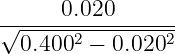 ≃ 0.0501. | | |
- For a point-charge field E = k|Q|∕r2, E2 = k2Q2r−4 and |∇E2| = 4k2Q2∕r5. Equation (4)
gives |F| = 2αk2Q2∕r5. A finite rod close to the ball violates the point-source and
far-field approximations, so the exponent is not a reliable predicted fit for the real
demonstration.
- Insulating rods do not redistribute their charge freely to the contact point; charge exchange
may be weak or localized. Also, charge can leak through humid supports, the thread,
contaminated surfaces, or accidental grounding before the second approach.
- Prepare the same rod/cloth combination and geometry in each condition; repeat
charge-preparation and fixed-gap response measurements multiple times. Record humidity,
the initial displacement x(0), and the displacement at later times x(t). Compare a
normalized decay such as x(t)∕x(0) for matched runs, not merely the absolute
initial displacements. Randomize trial order and document drift and variations in
geometry.
16. Connections to the PhysicsLibrary sequence
EDL02E1 turns a qualitative electric field effect into an electronic detection signal, but the JFET
charge detector is not automatically a calibrated charge meter. EDL02E2 tests Coulomb-force
scaling using two charged pith balls and controlled charge sharing. EDL03 and EDL03E1 extend
the same conductor and boundary-condition ideas into measured potential maps and solutions of
Laplace’s equation.
References and further reading
- Massachusetts Institute of Technology, 8.02, Spring 2002, lecture demonstrations on
polarization and the helium-filled conducting balloon: MIT lecture demonstration
index. Lecture 1 transcript: MIT 8.02 Lecture 1 transcript.
- PASCO, SE-6658 Electrostatics Materials and SE-7719 Coated Pith Balls product
information.
- Arbor Scientific, Electrostatics: A Force to be Reckoned, a complementary classroom
investigation with pith-ball apparatus.
- PhysicsLibrary.org, EDL02 Electrostatics, Charge, induction, and an Electrometer;
EDL02E1 electronic electroscope and Field Experiments; EDL02E2 Charge-Sharing
Test of Coulomb’s law.