Differential Cross Sections and Rutherford Scattering
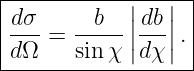
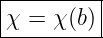
M04-10 introduced the classical scattering map
where b is the impact parameter and χ is the scattering angle in the relative or center of mass
description.
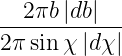
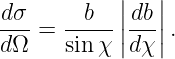
For an axially symmetric central force, the geometry of an incident annulus gives
while the corresponding outgoing solid-angle band is
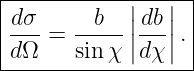
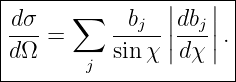
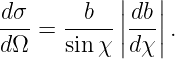
Therefore
This formula converts a trajectory calculation into a measurable angular distribution.
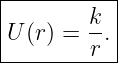
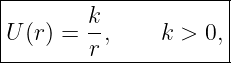
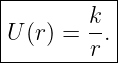
For the repulsive inverse-radius potential
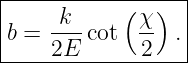
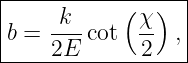
the orbit can be solved exactly. The result is
where E is the asymptotic relative kinetic energy.
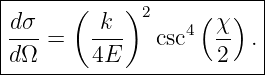
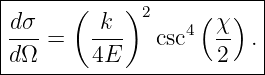
Substituting into the differential cross-section formula gives the classical Rutherford
result:
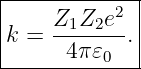
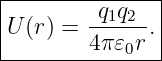
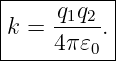
For two point charges,
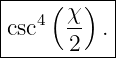
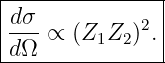
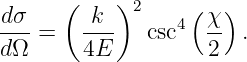
The striking angular dependence
is the hallmark of classical Coulomb scattering.
1 From trajectories to measured distributions
A single classical trajectory is specified by quantities such as
An experiment, however, sends many projectiles toward many targets.
The useful observable is not one trajectory but the number of particles scattered into a range of
directions.
The differential cross section answers the question:
Its customary units are
Since the steradian is dimensionless in SI, the fundamental dimensions remain those of
area.
2 Impact-parameter annulus
Consider incident trajectories whose impact parameters lie between
and
Because the central interaction is axially symmetric around the beam direction, these trajectories
form an annulus in impact-parameter space.
Its area is
If the map b χ is one-to-one, that annulus is scattered into a band of polar angles from χ to
χ + dχ.
χ is one-to-one, that annulus is scattered into a band of polar angles from χ to
χ + dχ.
The solid angle of that band is
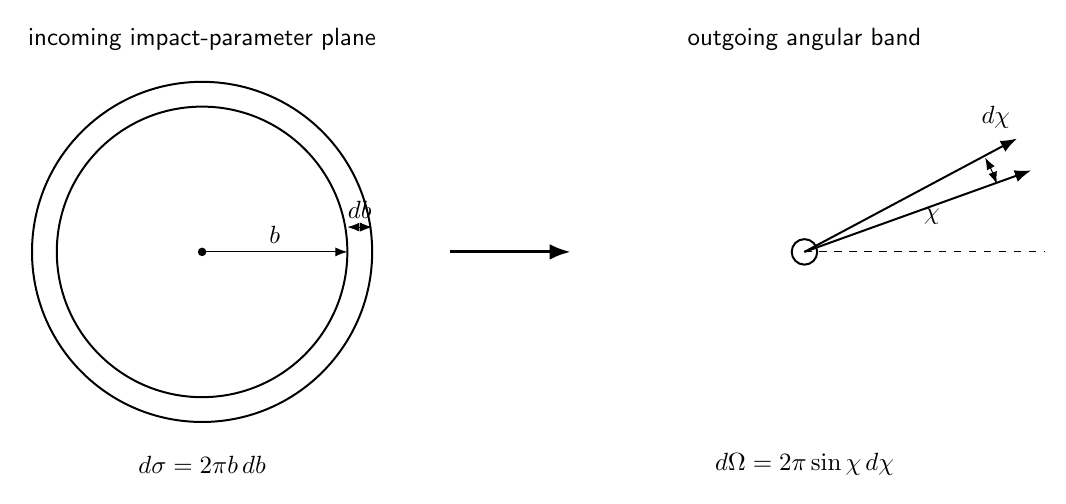
Figure 1. An annulus of incident impact parameters maps into an annular band of outgoing solid
angle. Equating the trajectory counts in the two descriptions produces the differential cross
section.
3 Derivation of the classical differential cross section
The same set of trajectories occupies
in the incoming impact-parameter plane and
in outgoing angle space.
Therefore
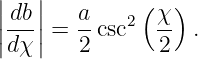
The absolute value is required because a common scattering map has
larger impact parameters give smaller deflections.
4 Scattering function
The relation
is often called the scattering function.
If it can be inverted,
then the differential cross section follows directly.
If several impact parameters lead to the same scattering angle,
the contributions add:
The Rutherford problem is simpler because the relevant repulsive Coulomb scattering map is
monotonic.
5 Rutherford interaction
For two point charges q1 and q2, the electrostatic potential energy is
Define
For like charges,
and the interaction is repulsive:
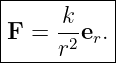
The force on the relative particle is
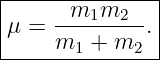
The reduced mass is
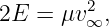
Far from the interaction,
| E | =  μv∞2, μv∞2, | (32)
|
| ℓ | = μv∞b. | (33) |
6 Why the orbit is a hyperbola
The potential tends to zero at infinity:
A scattering projectile arrives from infinity with
For an inverse-radius potential, positive-energy trajectories are unbound conic sections.
For the repulsive case, the physical branch is a hyperbola that bends away from the force
center.
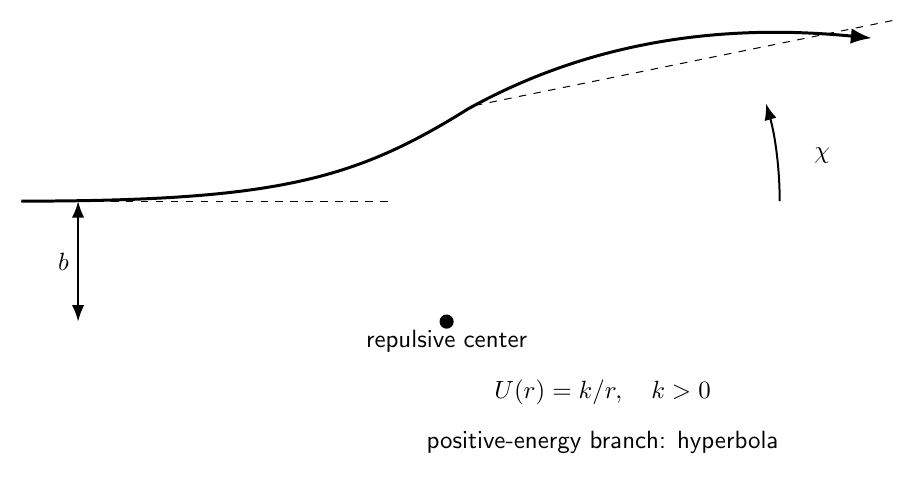
Figure 2. Repulsive Coulomb scattering follows a hyperbolic relative trajectory. The incoming and
outgoing asymptotes define the scattering angle χ.
7 Binet equation
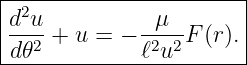
To solve the orbit, define
For a central force, Binet’s equation is
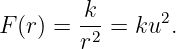
For repulsive Coulomb force,
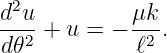
Thus
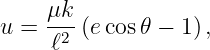
A convenient solution is
where e is a constant determined by the energy.
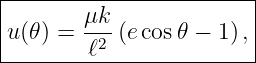
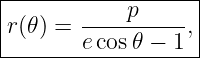
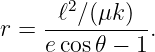
Therefore the orbit is
with
The angle origin has been chosen so that closest approach occurs at
8 Eccentricity from the energy
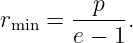
At closest approach,
From the orbit equation,
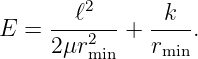
The energy at the turning point is
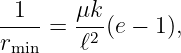
Using
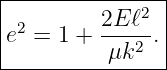
we obtain
| E | =  (e − 1)2 + (e − 1)2 +  (e − 1) (e − 1) | (48)
|
| =   . . | (49) |
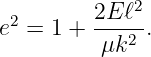
Therefore
For a scattering orbit,
so
This confirms the hyperbolic character.
9 Asymptotes of the Rutherford orbit
As
we have
From
the asymptotes satisfy
Thus
The hyperbola is symmetric about the closest-approach axis.
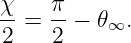
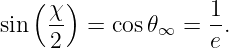
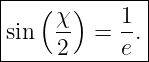
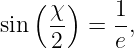
The angle between the incoming and outgoing velocity directions is
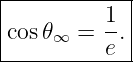
Therefore
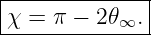
Hence
Thus
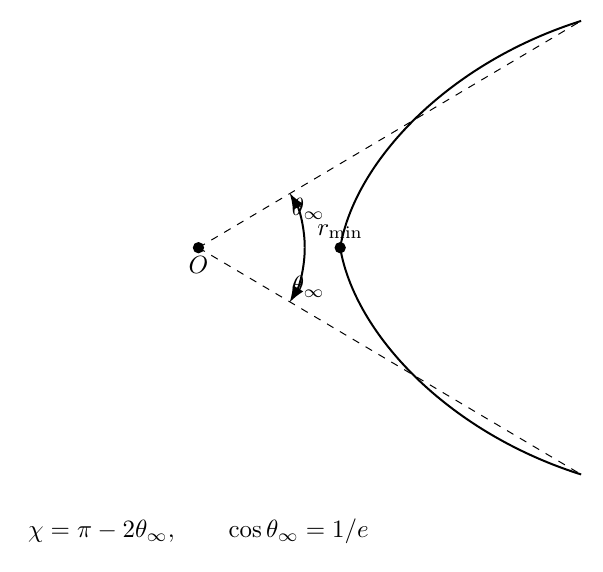
Figure 3. The hyperbolic orbit approaches asymptotes at 𝜃 = ±𝜃∞. Their geometry gives
χ = π − 2𝜃∞ and sin(χ∕2) = 1∕e.
10 Deriving the impact-parameter relation
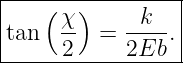
From
we have
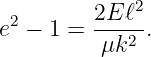
But
Using
and
we find
| e2 − 1 | = 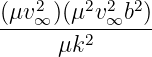 | (67)
|
| =  | (68)
|
| =  2. 2. | (69) |
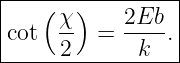
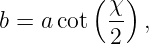
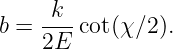
Therefore
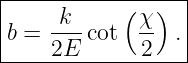
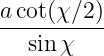
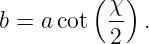
Solving for b,
Equivalently,
This is the Rutherford scattering function.
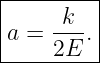
11 Coulomb scattering length
Define
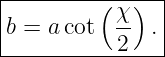
Then
The quantity a has dimensions of length and sets the characteristic scattering scale.
It is not the distance of closest approach.
For a head-on encounter,
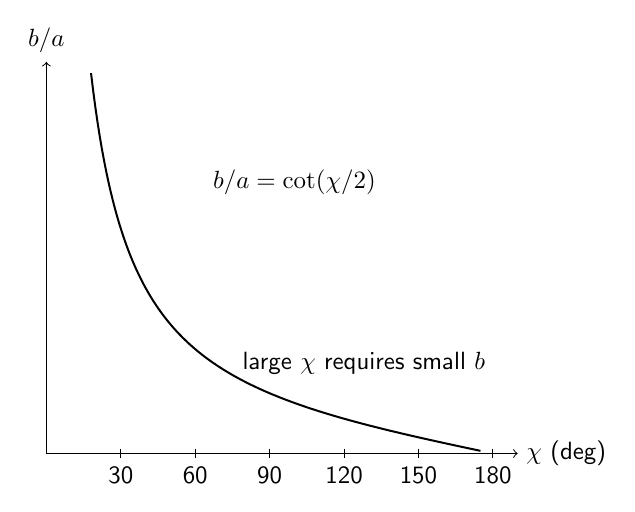
Figure 4. Rutherford impact parameter decreases monotonically with scattering angle:
b∕a = cot(χ∕2). Large-angle scattering requires small impact parameter.
12 Derivation of the Rutherford differential cross section
Start with
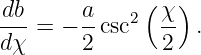
Differentiate:
Therefore
Use
Substitute:
Using
the trigonometric factors reduce to
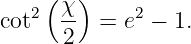
Since
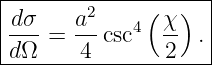
we obtain
This is the Rutherford differential cross section.
13 Rutherford formula for point charges
For charges
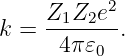
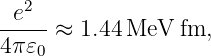
the Coulomb constant is
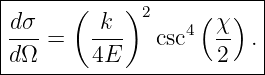
Therefore
Here E is the relative or center of mass kinetic energy at infinity.
For a very heavy target,
the center of mass energy approaches the projectile laboratory kinetic energy.
14 Angular dependence
The Rutherford formula contains
As
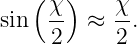
Therefore
for sufficiently small angles.
Small deflections are extremely common in a pure long-range Coulomb interaction.
Large-angle deflections require small impact parameters and are much less common.
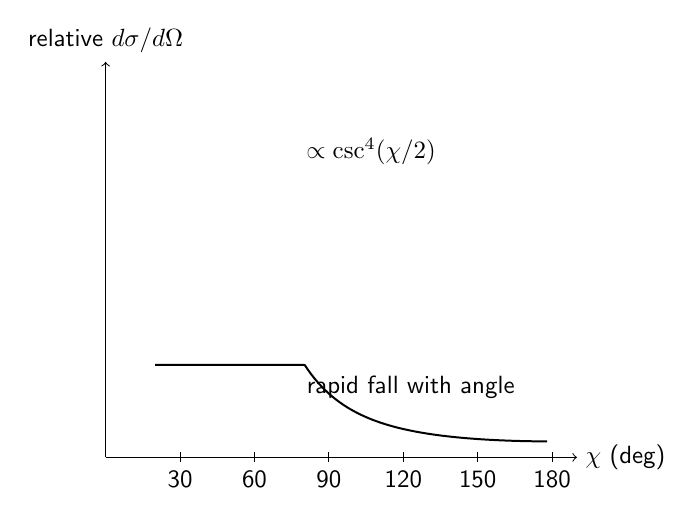
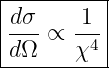
Figure 5. The Rutherford differential cross section falls rapidly with increasing scattering angle.
The small-angle behavior is proportional to χ−4.
15 Energy dependence
At fixed scattering angle,
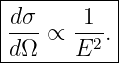
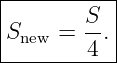
Therefore doubling the relative kinetic energy reduces the differential cross section at the same
angle by a factor of four.
Higher-energy particles are more difficult to deflect through a specified angle.
This agrees with the impulse picture from M04-10: a larger incoming momentum requires a larger
transverse impulse to produce the same directional change.
16 Charge dependence
At fixed E and χ,
Doubling either charge magnitude increases the classical Coulomb differential cross section by a
factor of four.
The sign of Z1Z2 determines whether the orbit bends away from or toward the force center, while
the ideal Coulomb cross-section magnitude depends on k2.
The Rutherford nuclear-scattering case uses repulsion between positively charged projectiles and
nuclei.
17 Closest approach and scattering angle
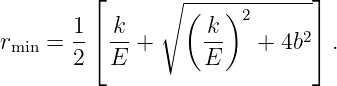
M04-10 derived the repulsive inverse-radius turning point
With
this becomes
Using
we have
Thus
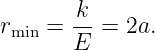
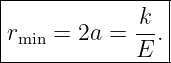
For head-on backscattering,
so
18 Integrated cross section above an angle
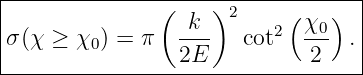
Suppose we count all particles scattered through angles
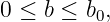
Because Rutherford scattering is monotonic, these events correspond to
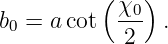
where
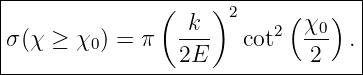
Therefore the integrated cross section is simply the impact-parameter disk:
Hence
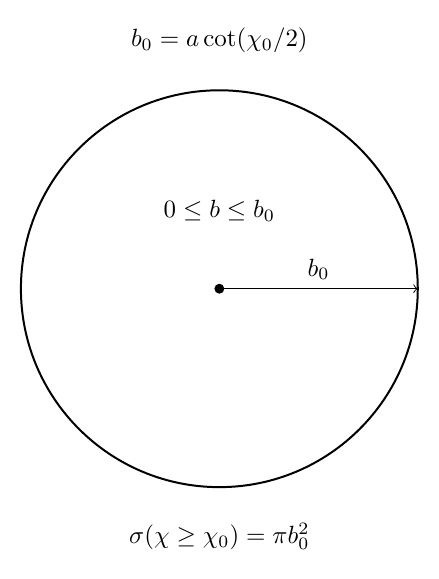
Figure 6. Scattering through angles at least χ0 corresponds to all incident trajectories inside the
impact-parameter disk b ≤ b0.
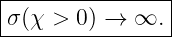
19 Why the total Coulomb cross section diverges
If one attempts to count all nonzero scattering angles, then
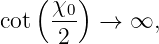
Since
the integrated Rutherford cross section diverges:
This is not a statement that an infinite number of particles are physically detected.
It reflects the infinite range of the ideal unscreened Coulomb force: arbitrarily distant trajectories
receive arbitrarily small deflections.
Real experiments always have finite angular resolution, finite beam geometry, and screening or
environmental effects.
20 Barns
Nuclear and particle cross sections are often reported in barns:
Since
we have
so
21 Example 1: alpha particle scattering from gold
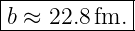
Consider a 5.0 MeV alpha particle scattering from a very heavy gold nucleus.
Take
Using
the Coulomb parameter is
| k | = (2)(79)(1.44) MeV fm | (117)
|
| = 227.5 MeV fm. | (118) |
Because gold is much heavier than the alpha particle, use
Then
For
Thus
22 Example 2: differential cross section at 90∘
For the same alpha-gold example,
At
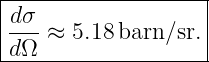
Also,
Therefore
 | = (11.38)2(4) fm2∕sr | (128)
|
| ≈ 518 fm2∕sr. | (129) |
Since
23 Example 3: head-on closest approach
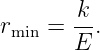
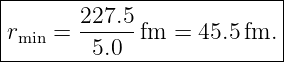
For the same 5.0 MeV alpha-gold encounter,
Thus
This is much larger than the characteristic nuclear radius of a heavy nucleus.
In this energy range, a head-on alpha particle turns around because of Coulomb repulsion before
reaching the nuclear surface.
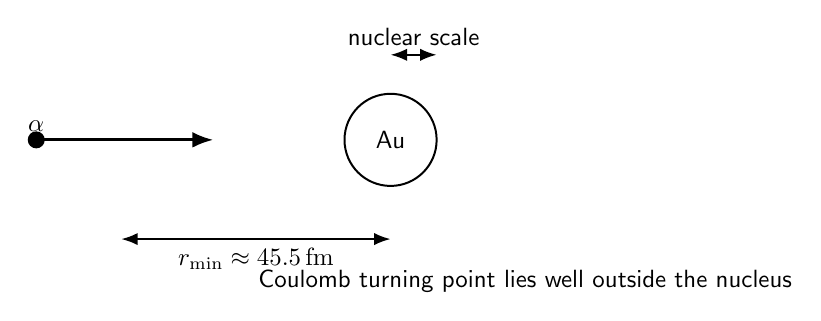
Figure 8. In the illustrative 5MeV alpha-gold example, Coulomb repulsion turns a head-on alpha
particle around at a distance much larger than the nuclear radius.
24 Example 4: energy scaling
Suppose the differential cross section at a fixed angle is
at energy
At energy
the Rutherford formula gives
Therefore
25 Example 5: angle scaling
Compare
and
at the same E and charges.
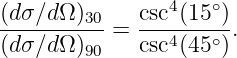
The ratio is
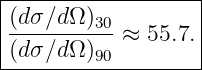
Numerically,
Thus
Small-angle scattering is dramatically more probable.
26 From cross section to count rate
Suppose a thin target has areal number density
and the incident beam rate is
For a detector subtending small solid angle
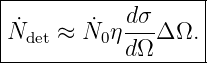
around angle χ, the ideal single-scattering count rate is approximately
A real experiment may also require detector efficiency, dead-time, energy-loss, and multiple-scattering
corrections.
This equation explains why the differential cross section is experimentally useful: it connects a
microscopic trajectory law to an observable rate.
27 Center of mass energy versus laboratory energy
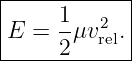
The Rutherford formula derived here uses the relative energy
Suppose particle 1 is the projectile and particle 2 is initially at rest in the laboratory.
Then
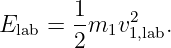
The projectile laboratory kinetic energy is
Therefore
| E | =  Elab Elab | (151)
|
| =  Elab. Elab. | (152) |
If
then
28 Center of mass angle versus laboratory angle
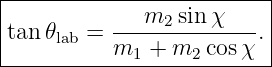
The reduced-coordinate calculation gives the center of mass scattering angle χ.
For a target initially at rest, the projectile laboratory velocity after scattering is
Using the two-body velocity decomposition,
| v1x,lab,f | =   , , | (156)
|
| v1y,lab,f | =  m2 sin χ. m2 sin χ. | (157) |
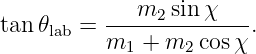
Therefore the projectile laboratory angle 𝜃lab satisfies
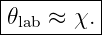
For a very heavy target,
this reduces approximately to
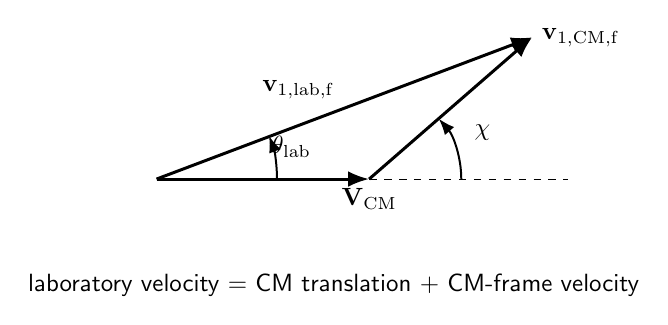
Figure 7. The center of mass scattering rotation must be combined with the center of mass
translational velocity to obtain a laboratory scattering angle.
29 Assumptions behind Rutherford scattering
The ideal Rutherford result assumes:
- Classical Mechanics,
- nonrelativistic motion,
- pointlike interacting charges for the Coulomb force,
- a pure 1∕r potential over the relevant distance range,
- elastic two-body scattering,
- negligible radiation loss,
- isolated single scattering,
- no important electron screening at the relevant impact parameters.
The formula is powerful partly because deviations from it reveal additional physics.
30 Screening at very small angles
Small scattering angles correspond to large impact parameters:
At sufficiently large distances, atomic electrons can screen the nuclear charge.
Then the interaction is no longer the unscreened nuclear Coulomb potential
over the entire trajectory.
Therefore the ideal Rutherford divergence as
is not physically realized without modification.
31 Short-distance deviations
Large scattering angles correspond to small impact parameters and smaller closest-approach
distances.
If the projectile approaches distances where:
- finite nuclear size matters,
- the strong interaction contributes,
- relativity becomes important,
- quantum effects cannot be neglected,
then the simple classical Rutherford model can fail.
Historically, large-angle alpha scattering was important because it showed that positive charge and
most atomic mass are concentrated in a very small region.
32 Classical and quantum significance
The Rutherford angular form is remarkable because the same
dependence also appears in the nonrelativistic quantum treatment of unscreened Coulomb
scattering.
That agreement is special to the Coulomb potential.
The interpretation differs:
- classical mechanics assigns trajectories labeled by b,
- quantum mechanics assigns a scattering amplitude and probability distribution.
The present article remains entirely within classical mechanics.
33 Common mistakes
- Using dσ∕dΩ without first identifying the scattering map b(χ).
- Dropping the absolute value in |db∕dχ|.
- Confusing total cross section with differential cross section.
- Forgetting the sin χ factor from the solid-angle element.
- Using sin χ where the Rutherford formula requires sin(χ∕2).
- Missing the fourth Power in csc 4(χ∕2).
- Using laboratory projectile energy in the exact finite-mass formula without converting
to center of mass relative energy.
- Using laboratory scattering angle in place of the center of mass angle without a frame
transformation.
- Confusing the Coulomb scattering length a = k∕(2E) with the head-on closest
approach k∕E = 2a.
- Assuming the ideal Coulomb total cross section is finite when arbitrarily small
scattering angles are included.
- Forgetting that large-angle scattering corresponds to small impact parameter.
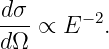
- Forgetting that increasing energy decreases the cross section at fixed angle as E−2.
- Applying the point-charge Rutherford formula in regimes where screening, nuclear
structure, relativity, or quantum corrections dominate.
34 Practice exercises
- Starting from the impact-parameter annulus and solid-angle band, derive
- Derive Binet’s equation for a particle of mass μ moving under a central force.
- Solve Binet’s equation for the repulsive Coulomb force F = k∕r2.
- Show that the repulsive Coulomb orbit can be written
- Derive
- Use the asymptote condition to prove
- Derive the Rutherford scattering function
- Derive the Rutherford differential cross section.
- Show that dσ∕dΩ ∝ E−2 at fixed angle.
- Show that the small-angle Rutherford cross section scales approximately as χ−4.
- Derive
- Derive the integrated cross section for χ ≥ χ0.
- Explain why the ideal unscreened Coulomb total cross section diverges as χ0 → 0.
- Derive the relationship between center of mass energy and projectile laboratory energy for a
target initially at rest.
- Derive
35 Summary
For an axially symmetric classical scattering problem,
For repulsive Coulomb scattering,
The relative orbit is hyperbolic and the scattering function is
Therefore
For point charges,
The integrated cross section for scattering through at least χ0 is
The clean Rutherford law completes the M04 progression from momentum and particle systems
through central forces, two-body reduction, and classical scattering.
References
References
[1] E. Rutherford, “The Scattering of α and β Particles by Matter and the Structure of
the Atom,” Philosophical Magazine, Series 6, Vol. 21, 1911.
[2] J. R. Taylor, Classical Mechanics, University Science Books, 2005.
[3] H. Goldstein, C. Poole, and J. Safko, Classical Mechanics, 3rd ed., Addison-Wesley,
2002.
[4] L. D. Landau and E. M. Lifshitz, Mechanics, 3rd ed., Pergamon Press, 1976.
[5] D. Kleppner and R. Kolenkow, An Introduction to Mechanics, 2nd ed., Cambridge
University Press, 2014.































 csc
csc 



![|------[--------]------------|
|dσ Z1Z2e2 2 4 (χ ) |
|--- = -------- csc -- .|
-dΩ------16π𝜀0E---------2----|](https://images.physicslibrary.org/cache/objects/1408/make4ht/DifferentialCrossSectionsAndRutherfordScattering93x.png)





![|------------------------|
| [ (χ )] |
|rmin = a 1 + csc -- .|
-------------------2-----](https://images.physicslibrary.org/cache/objects/1408/make4ht/DifferentialCrossSectionsAndRutherfordScattering106x.png)






















![[ ]
η targets∕m2](https://images.physicslibrary.org/cache/objects/1408/make4ht/DifferentialCrossSectionsAndRutherfordScattering147x.png)










![k
rmin = --- [1 + csc(χ∕2 )].
2E](https://images.physicslibrary.org/cache/objects/1408/make4ht/DifferentialCrossSectionsAndRutherfordScattering174x.png)