|
|
|
|||||||
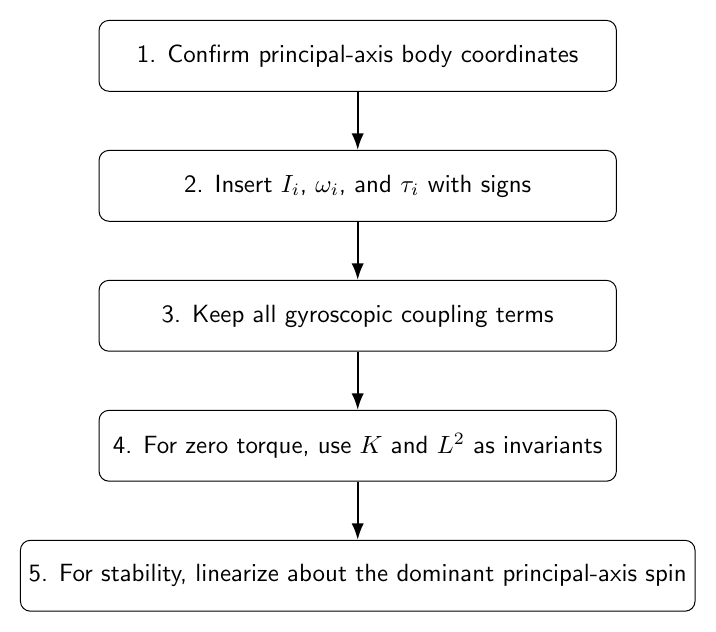
Figure 1. A compact strategy for Euler-equation problems: use principal axes, identify torque components, retain gyroscopic coupling terms, then apply conservation laws or linearization where appropriate.
1 High-value GRE facts
Part I: Original GRE-style problems
Problem 1: rotating derivativeFor a vector A expressed in a frame rotating with angular velocity ω,
Problem 2: first Euler equationWhich is Euler’s first principal-axis equation?
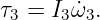
Problem 3: principal-axis spinA body rotates only about principal axis 3. Then Euler’s third equation becomes
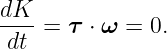
Problem 4: torque-free bodyFor a torque-free rigid body,
Problem 5: axisymmetric bodyFor a torque-free axisymmetric body with I1 = I2, which angular-velocity component is constant?
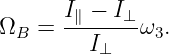
Problem 6: body-frame precession frequencyFor I1 = I2 = I⊥, I3 = I∥, the body-frame transverse frequency is
Problem 7: stable axesFor I1 < I2 < I3, which torque-free principal-axis rotations are linearly stable?
Problem 8: intermediate-axis theoremFor I1 < I2 < I3, rotation mainly about axis 2 is
Problem 9: energyFor a torque-free rigid body,
is
Problem 10: gyroscopic couplingIf τ1 = 0 but ω2ω3≠0 and I2≠I3, then
Problem 11: numerical Euler equationLet
and
Then ω1 is
Problem 12: attitude propagationEuler’s equations alone determine
Part II: Complete worked solutions
Solution 1The rotating derivative theorem is
Answer: (B).
Solution 2Euler’s first principal-axis equation is
Answer: (B).
Solution 3With
the coupling term in the third equation vanishes:
Answer: (A).
Solution 4Zero external torque implies
Thus angular momentum is constant as an inertial vector. Answer: (B).
Solution 5For
the third torque-free Euler equation becomes
Hence
Answer: (C).
Solution 6The transverse equations reduce to
where
Answer: (B).
Solution 7For ordered moments
small perturbations oscillate about axes 1 and 3. Both are stable. Answer: (D).
Solution 8Linearization about axis 2 produces an equation of the form
The growing exponential solution makes the intermediate-axis rotation unstable. Answer: (B).
Solution 9For torque-free motion,
Thus
Answer: (A).
Solution 10From
a nonzero coupling term requires a compensating
Answer: (B).
Solution 11
Therefore
Answer: (A).
Solution 12Euler’s equations propagate angular-velocity components. Orientation requires separate attitude kinematics. Answer: (C).
2 GRE checklist
References
References
"GRE Physics Companion: Euler's Equations for Rigid Body Rotation" is owned by bloftin.
This object's parent. Cross-references: gyroscopic coupling, spins, energy, tensor, center of mass, kinematics, position, static, frequency, rigid body, angular velocity, vector, rotational kinetic energy, torque-free rigid body motion, angular momentum, torque, principal axis, inertia tensor, theorem, Euler's equations This is version 1 of GRE Physics Companion: Euler's Equations for Rigid Body Rotation, born on 2026-10-17. Object id is 1485, canonical name is GREPhysicsCompanionEulersEquationsForRigidBodyRotation. Accessed 5 times total. Classification:
|
|
|
|
Pending Errata and AddendaNone.
|
DiscussionNo messages.
|
Interact |
![[parent]](https://images.physicslibrary.org/images/uparrow.png)