FS18: Euler’s Formula and the Complex Exponential Basis
In FS02 we learned to treat entire functions as vectors. In FS03 we learned that sines and cosines
can be orthogonal function-space directions. FS04–FS17 then used those directions to describe
periodic functions, waveforms, and their partial sums. There is now a powerful change of
coordinates available: instead of keeping the sine and cosine directions separate, we can combine
them using complex exponentials.
The reason is Euler’s formula:
This equation connects exponential functions, circular motion, and the trigonometric functions we
have already used for Fourier series. It also makes differentiation of a harmonic almost effortless.
We will derive the formula, visualize its geometry, construct the complex exponential basis, and
prove its orthogonality. In FS19 we will use that orthogonality to derive the complex Fourier
coefficients, while FS20 will systematically relate them to the real coefficients an and
bn.
1 A complex number is a two-component number
A complex number is written
where a and b are real. Its real and imaginary parts are Re z = a and Im z = b. On the complex
plane, z is the point (a,b) or the arrow from the origin to that point. The magnitude and complex
conjugate are
Multiplication by i rotates an arrow counterclockwise through 90∘. For example,
The pattern repeats after four steps. This cycling will become the mechanism behind Euler’s
formula.
A real physical displacement or voltage is not made imaginary by adopting complex notation. We
use a complex function as an efficient mathematical representation and eventually take its real
part. The imaginary part is an auxiliary quadrature component that helps us keep track of
phase.
2 Derive Euler’s formula from Taylor series
Recall the three Maclaurin expansions, where z may be complex for the exponential
series:
For real 𝜃, the sine and cosine series are
The exponential series converges absolutely for every complex z. Therefore we may substitute
z = i𝜃 and regroup its terms without changing the sum:
Step 1: calculate successive powers of i
Use
Thus, term by term, Equation (8) becomes
| ei𝜃 = | 1 + i𝜃 − − i  | |
|
| +  + i  −  . | (10) |
Step 2: separate the real and imaginary terms
Collect terms with no factor i:
Collect terms carrying i:
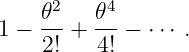
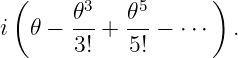
Comparing with Equations (6) and (7), the real group is cos 𝜃 and the expression multiplying i is
sin 𝜃. Consequently,
No new trigonometric assumption was needed. Euler’s formula follows from the same Taylor-series
machinery used in calculus.
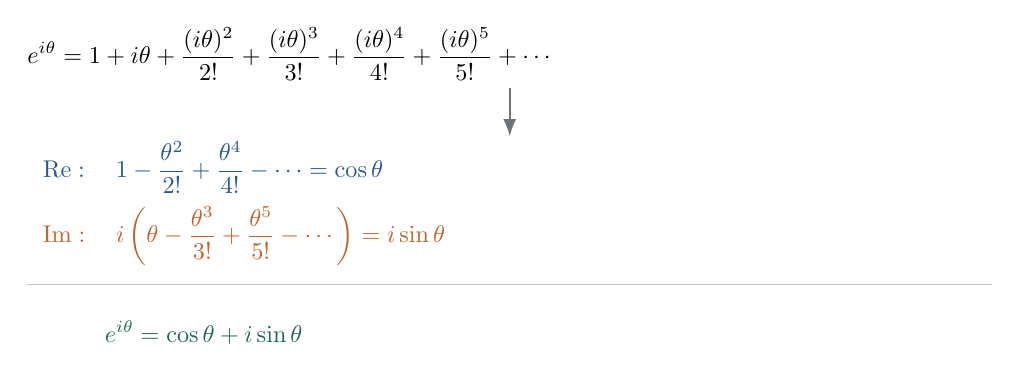
Figure 1. The Taylor series for ei𝜃 separates into a real cosine series and an imaginary sine series.
The cycling powers of i supply their alternating signs.
3 Visualizing Euler’s formula on the unit circle
In Equation (1), the real coordinate is cos 𝜃 and the imaginary coordinate is sin 𝜃. The
corresponding arrow ends at (cos 𝜃, sin 𝜃). Its length is
Thus ei𝜃 describes a point on the unit circle. Increasing 𝜃 moves it counterclockwise. The number
i𝜃 is in the exponent, but the result does not grow or decay in magnitude: it rotates in
phase.
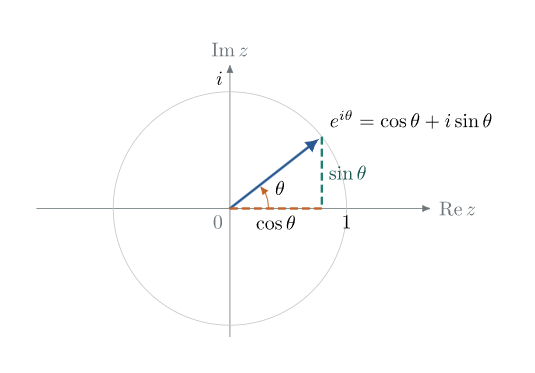
Figure 2. The complex exponential is a unit-length vector rotated by angle 𝜃. Its horizontal
projection is cos𝜃 and its vertical projection is sin𝜃.
Two checks anchor the geometry. At 𝜃 = 0,
At 𝜃 = π∕2,
At 𝜃 = π we obtain the celebrated special case
Complex phase and amplitude
If A is a positive real amplitude, then
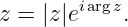
Its magnitude is A, and its phase is 𝜃. A general nonzero complex number can be written in polar
form
The phase is defined modulo 2π: 𝜃 and 𝜃 + 2πk describe the same direction for any integer
k.
4 Conjugation gives Euler’s formula in reverse
Replace 𝜃 by −𝜃 in Euler’s formula and use cos(−𝜃) = cos 𝜃 and sin(−𝜃) = − sin 𝜃:
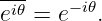
Taking the complex conjugate of a unit-length complex exponential therefore reverses the sign of
the phase:
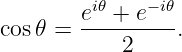
Add Equations (1) and (20):
Therefore
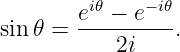
Subtract the second equation from the first:
Therefore
This is the first major connection to our Fourier-series work: each real sine or cosine harmonic
can be assembled from two complex exponential harmonics with opposite signs in the
exponent.
5 Positive and negative frequency are directions of rotation
Consider two rotating complex numbers,
The phase of z+ increases with time, so it rotates counterclockwise. The phase of z− decreases with
time, so it rotates clockwise. Both have magnitude one. Their real parts are the same, but their
imaginary parts have opposite signs:
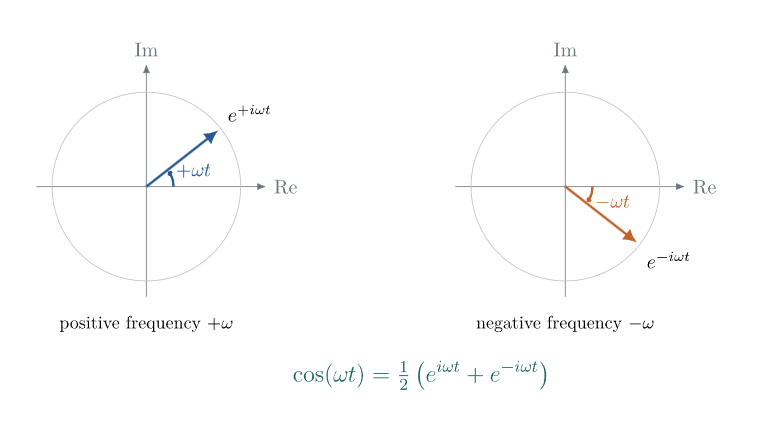
Figure 3. Positive angular frequency means counterclockwise rotation under the e+iωt convention;
negative angular frequency means clockwise rotation. A real cosine combines the two directions
equally.
Why the negative frequencies are not new negative-energy waves
A negative frequency in this representation means an opposite phase-rotation direction. It does not
mean the ordinary physical frequency meter reports a negative number, and it does not imply
negative mechanical energy. A real cosine cannot distinguish the two directions by itself because its
real projection is the same for both. The full complex representation retains that sign
information.
Why the exponential basis is convenient for differentiation
Let ϕ(t) = eiωt. Then
A derivative changes only the multiplying coefficient; the exponential shape is unchanged. This
property is one reason complex exponentials are so useful in differential equations and linear
systems. It converts differentiation of a harmonic into multiplication by iω.
6 Build the complex exponential Fourier basis
We now return to functions of the spatial variable x on [−π,π]. Define
The notation ℤ means all integers:
Unlike the real sine/cosine presentation, the complex exponential basis includes negative indices
explicitly. The index n = 0 gives
Thus the constant function is included as a mode rather than written separately. For n = 1 and
n = −1,
These are different complex functions even though their real parts coincide.
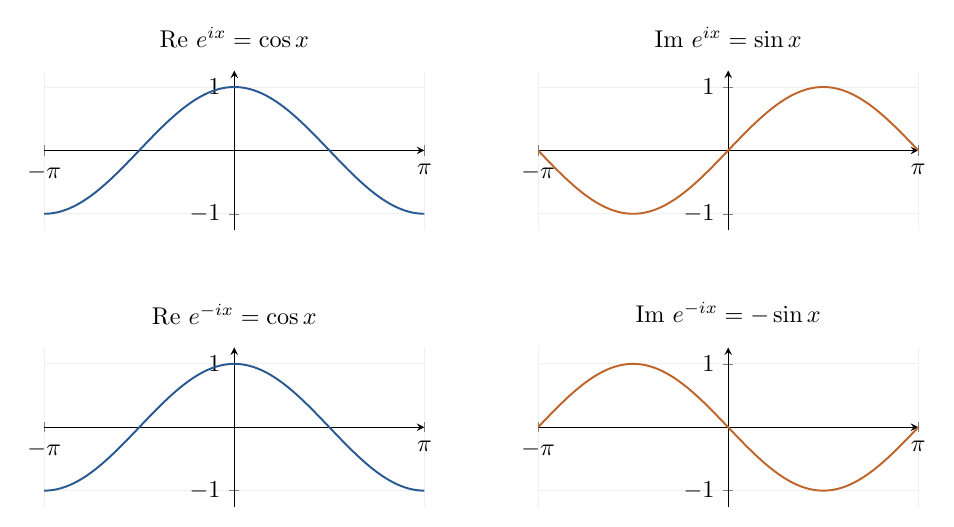
Figure 4. The real parts of eix and e−ix agree, but their imaginary parts have opposite signs. Both
directions are required to reconstruct the real sine and cosine modes by Equations (23) and (25).
General interval and physical period
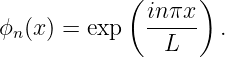
For a spatial interval [−L,L], whose periodic extension has length 2L, define
The permitted signed Wavenumbers are
For a time-periodic signal with period T, separately use
Here x and t are different physical variables. We obtain the time formula by substituting the
mathematical half-period L = T∕2 and replacing the coordinate x by t, not by identifying physical
length with physical time.
Mode counting
The set {einx}
n=−NN has 2N + 1 distinct complex directions: one constant direction, N
positive-frequency directions, and N negative-frequency directions. This matches the 2N + 1 real
directions in
when restricted to real functions and paired appropriately. We will make the change of coefficient
coordinates precise in FS20.
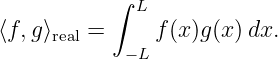
7 A necessary correction to the FS02 inner product
FS02 used real-valued functions and the inner product
For genuinely complex-valued functions, copying this definition without any change causes a
problem. For example, the integral of eixeix over [−π,π] is zero, despite the function eix being
nonzero. That would incorrectly give zero squared length.
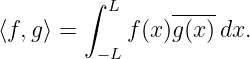
The correct complex inner product (with the first argument taken to be linear) is
The overbar means complex conjugation. This is called a Hermitian inner product. Some textbooks
place the conjugation on the first argument; that is an equally valid convention, provided it is used
consistently. We will use Equation (40) throughout FS18–FS20.
Why conjugation matters for length
For g = f, the integrand is
Thus
It is real, nonnegative, and zero only when f is zero almost everywhere. Just as in FS11, functions
that agree almost everywhere represent the same element of L2.
The complex inner product obeys conjugate symmetry,
and linearity in the first entry,
In the second entry it is conjugate-linear:
This distinction is essential when projections and coefficients become complex.
8 Derive orthogonality of the complex Fourier basis
Using the scaled basis in Equation (35), calculate
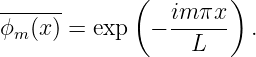
For real x, conjugation changes i to −i:
Multiply the two exponential factors and combine their exponents:
Therefore
Case 1: choose two different integers n≠m
Let q = n − m. Then q is a nonzero integer. Integrate the exponential:
Evaluate the endpoints:
Because q is an integer, both endpoint exponentials equal (−1)q. Their difference is zero.
Therefore
Case 2: choose the same integer n = m
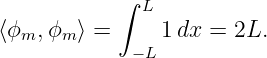
Now the exponent in Equation (49) is zero. We do not divide by n − m; instead, evaluate the
constant integrand directly:
Combine both cases using the Kronecker delta δnm introduced in FS03:
On [−π,π] specifically, this becomes 2πδnm.
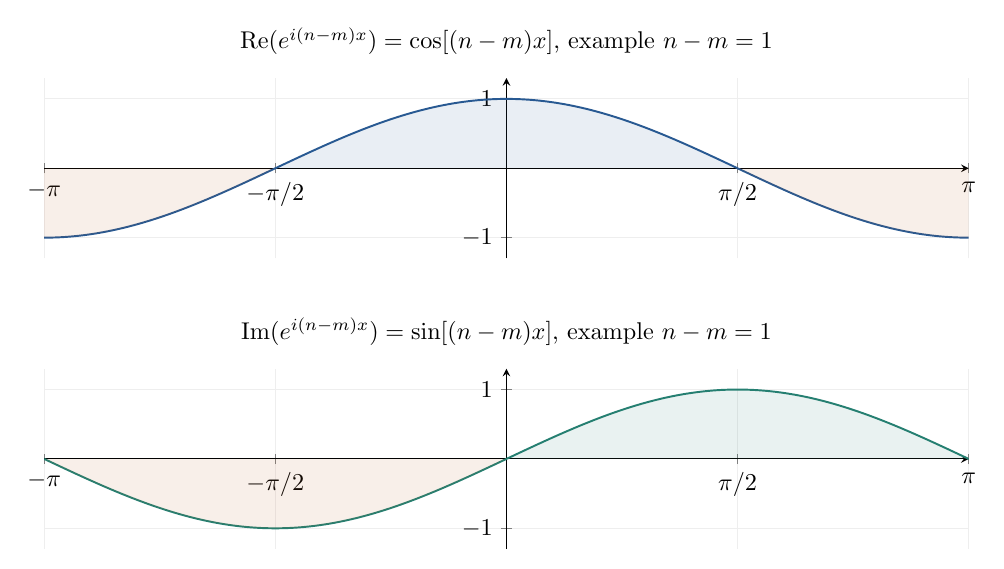
Figure 5. For two different modes, the inner-product integrand is a complex sinusoid with an
integer number of cycles over the full interval. Its real and imaginary parts each integrate to zero.
The curves here show the case n − m = 1 on [−π,π].
The normalized complex basis
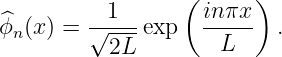
Because every exponential mode has squared norm 2L, its normalized form is
Then
The factor  is different from the
 used for the real sine and cosine modes, because the
complex exponential has magnitude one at every point, rather than a squared sine or cosine whose
average is 1∕2.
A common error worth checking
If the conjugate is omitted, the integral is instead
This is a legitimate integral identity, but it is not the complex inner-product orthogonality
identity. It couples opposite indices instead of matching equal indices. Equations (54) and (57)
should not be confused.
9 A first finite complex exponential expansion
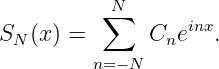
The complex basis allows us to write a finite periodic waveform as
At this stage, think of the Cn simply as the amounts of the selected function-space
directions. In FS19 we will derive their integral formula from the orthogonality result just
proved.
Example: rewrite a familiar real waveform
Take the real function
Use Equations (23) and (25) on each harmonic separately:
Consequently,
| f(x) = | 2 + 2ieix − 2ie−ix | |
|
| +  ei2x +  e−i2x. | (62) |
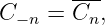
Notice that the coefficients of the negative-index modes are the complex conjugates of those of the
matching positive-index modes. That is not a coincidence.
10 Why a real signal has conjugate pairs
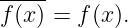
A real-valued waveform must be unchanged by complex conjugation:
Suppose a finite complex series has the form in Equation (58). Pair the positive and negative
indices:
If
then the pair is
which is real for every x. Also, the constant coefficient C0 must be real.
Conversely, for a real function represented by a unique complex Fourier expansion, its coefficients
obey this conjugate symmetry. FS19 will derive the coefficient formula, and FS20 will prove the full
equivalence with an and bn.
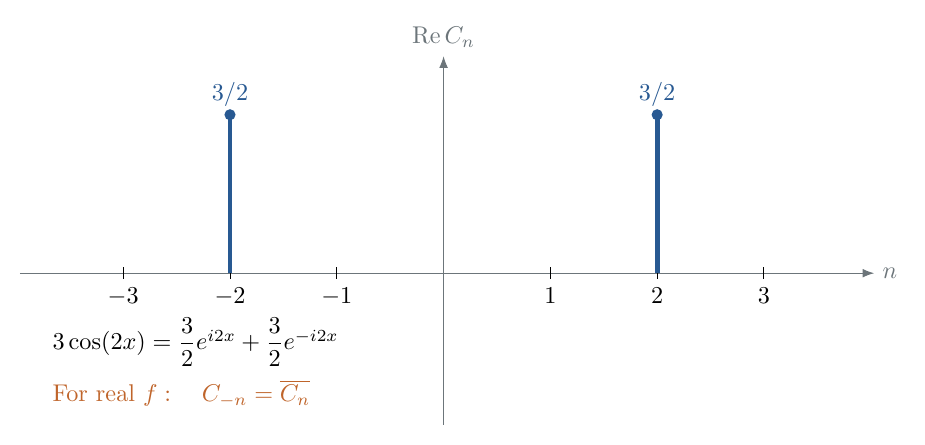
Figure 6. A real cosine has equal spectral contributions at positive and negative harmonic indices.
For 3cos(2x), both n = 2 and n = −2 have coefficient 3∕2. For general real signals the paired
coefficients need not be real, but they are complex conjugates.
Is a complex coefficient an amplitude?
Not quite: a complex coefficient encodes both amplitude and phase. For Cn = ρeiα, the real pair
is
Thus 2|Cn| is the amplitude of that real cosine pair for n > 0, while arg Cn supplies the phase. The
zero-frequency coefficient is handled separately and is not doubled.
11 Worked physics example I: forced harmonic motion
Consider a mass-spring-damper system,
where m is mass, b is damping coefficient, and k is spring stiffness. Assume b > 0, k > 0, and a
steady sinusoidal response after any transient has decayed.
The real forcing is the real part of a rotating complex exponential:
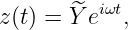
Seek the complex response
where Y is a constant but potentially complex amplitude, called a phasor. Our physical
displacement is y(t) = Re z(t).
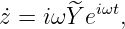
Differentiate without expanding into trigonometric functions:
Substitute into the complex version of Equation (68):
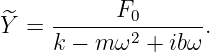
Cancel the common nonzero exponential factor:
Therefore
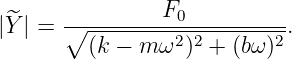
The magnitude of the phasor determines the displacement amplitude:
Its phase determines the timing relative to the driving force. If δ = atan2(bω,k −mω2), the steady
displacement is
The arctangent with two arguments keeps the quadrant correct when k − mω2 changes sign. The
complex notation has condensed a differential-equation calculation into an algebraic one because
eiωt is preserved under differentiation.
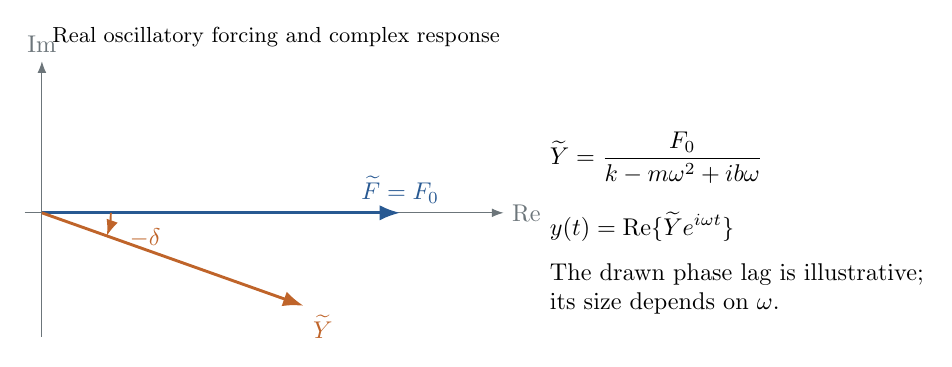
Figure 7. The real drive phasor is taken along the positive real axis. The complex response phasor
generally has a phase lag and a different magnitude. The diagram’s lag angle is illustrative; its
actual value follows from Equation (75).
12 Worked physics example II: a traveling wave
A traveling sinusoidal displacement can be written using a complex exponential:
For real positive A, Euler’s formula gives the familiar real waveform
The phase is
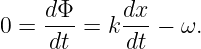
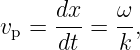
Track one crest by holding Φ constant. Differentiating that condition gives
Hence the crest moves at the phase velocity
for nonzero k. If both k and ω are positive in the chosen convention, it travels toward increasing
x.
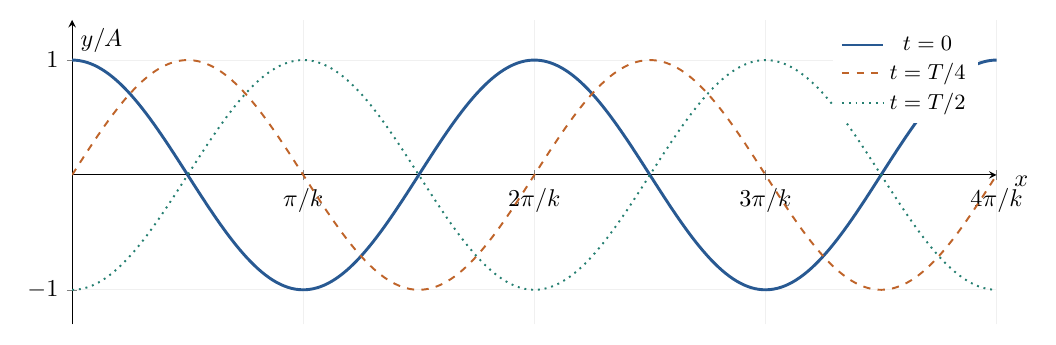
Figure 8. Three snapshots of cos(kx − ωt) for positive k and ω. The waveform translates toward
increasing x, while the complex exponential keeps the position and time phase contributions in a
single expression.
The same representation simplifies partial derivatives:
For the one-dimensional wave equation ytt = c2y
xx, substitution yields
The complex exponential is useful because the wave equation reduces to a relation between
frequency and wavenumber. The later FS22 and FS27 lectures will develop Standing Waves, wave
packets, and dispersion in depth.
13 Connection to vector projection and Hilbert space
FS11 treated Fourier series as projections onto orthogonal function-space directions. The
same interpretation applies here, but the directions are complex-valued. We use the
complex Hilbert space L2([−L,L]; ℂ), equipped with the Hermitian inner product of
Equation (40).
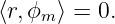
For a selected exponential mode ϕm, a one-direction projection has the form
with the residual r = f − pm required to satisfy
Substituting gives
using our convention of linearity in the first argument. Thus the geometry is unchanged from FS02,
except that the inner product includes conjugation.
The normalization already established in Equation (53) is
FS19 will take the final step: substitute the explicit exponential into the projection coefficient, then
show that the result generates the full complex Fourier series. We intentionally defer
that step so the meaning of the basis is established before the coefficient formula is
introduced.
14 Common mistakes and checks
- ei𝜃 is not a growing real exponential. It has magnitude one and encodes a rotation.
- ei𝜃 and e−i𝜃 have the same real part but different imaginary parts. They are distinct
complex basis functions.
- Negative frequency is a signed rotation rate in the complex representation. It does not
mean negative energy.
- For a real waveform, opposite-index coefficients occur as complex conjugate pairs. They
are not independent real-valued amplitudes.
- A complex inner product requires a conjugate; without it, the squared length of a
nonzero function may incorrectly vanish.
- The exponential mode norm over [−L,L] is 2L, whereas a nonconstant real sine or
cosine has squared norm L.
- Spatial wavenumber k has units of radians per unit length; temporal angular frequency
ω has units of radians per second. Do not identify them merely because they appear
similarly in exponents.
- A phasor is a complex computational representation. The physically observable
displacement or voltage is recovered by taking the real part.
15 Self-check questions
- Which powers of i generate the alternating signs in the Taylor expansion of ei𝜃?
- Why does |ei𝜃| = 1 for every real 𝜃?
- Show why cos 𝜃 requires both ei𝜃 and e−i𝜃.
- What does the sign of the frequency determine on a complex-plane phasor plot?
- Why is ∫
−ππeixeix dx = 0 not evidence that eix has zero norm?
- Compute ⟨ei2x,e−ix⟩ on [−π,π] with the correct complex inner product.
- How many complex exponential modes are retained when n = −3,−2,…, 3?
- Why must the coefficients for +n and −n be related if a finite complex Fourier sum
represents a real signal?
- What changes in the forced oscillator when a time derivative acts on eiωt?
- In cos(kx − ωt), why does the minus sign between kx and ωt represent travel toward
increasing x when k,ω > 0?
16 Further practice
- Use Taylor series to derive e−i𝜃 = cos 𝜃 − i sin 𝜃 independently.
- Rewrite 4 cos 3x + 2 sin 2x using complex exponential modes.
- Show that ei3x and e−i3x are orthogonal in the complex inner product on [−π,π].
- Derive the mode norm on a time interval of length T.
- Verify directly that ∥einx∕
 ∥ = 1 on [−π,π].
- Show why d2eikx∕dx2 = −k2eikx.
- Find the amplitude and phase of 3 + 4i, then write it in polar exponential form.
- Show how the complex pair Ceinx + Ce−inx becomes a real cosine with a phase shift.
17 What comes next
FS18 has demonstrated how the real trigonometric basis can be reorganized using rotating complex
exponential functions. The modes einx are orthogonal in the Hermitian inner product and their
differentiation is especially simple. The negative-index modes are as important as the
positive-index modes for reconstructing real signals.
FS19 will now derive the complex Fourier coefficient formula by projecting a periodic function onto
one chosen mode, just as we did for the real coefficients in FS04 and FS05. FS20 will show that the
real and complex Fourier series carry exactly the same information. The later FS25 and FS26
lectures will interpret the discrete complex coefficients as a frequency spectrum and then pass to
the Fourier-transform integral.
References
[1] E. M. Stein and R. Shakarchi, Fourier Analysis: An Introduction, Princeton University
Press, 2003.
[2] G. P. Tolstov, Fourier Series, Dover, 1976.
[3] E. Kreyszig, Introductory Functional Analysis with Applications, Wiley, 1978.
[4] A. V. Oppenheim, A. S. Willsky, and S. H. Nawab, Signals and Systems, 2nd ed.,
Prentice Hall, 1997.