Discrete Oscillator Chains and Dispersion
M06-04 and M06-05 showed that a finite linear mechanical system can be decomposed into normal
modes.
A chain of many coupled oscillators applies the same idea repeatedly in space.
The simplest model is a one-dimensional monatomic lattice:
- identical masses m,
- equilibrium spacing a,
- identical nearest-neighbor springs of constant κ,
- one longitudinal displacement un(t) for the mass at lattice site n.
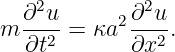
The equation of motion is
This is the discrete analogue of a wave equation.
Its normal modes are traveling lattice waves.
Unlike the ideal continuous wave equation, however, the lattice does not generally have a linear
relation between frequency and wave number.
Instead it has a dispersion relation.
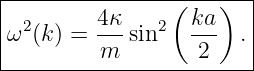
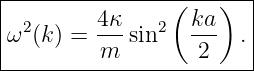
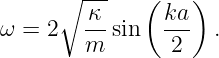
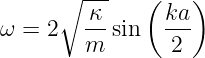
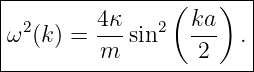
For the monatomic nearest-neighbor chain,
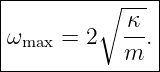
This one equation contains the long-wavelength continuum limit, a maximum lattice
frequency, wave-number periodicity, phase velocity, group velocity, and the onset of lattice
dispersion.
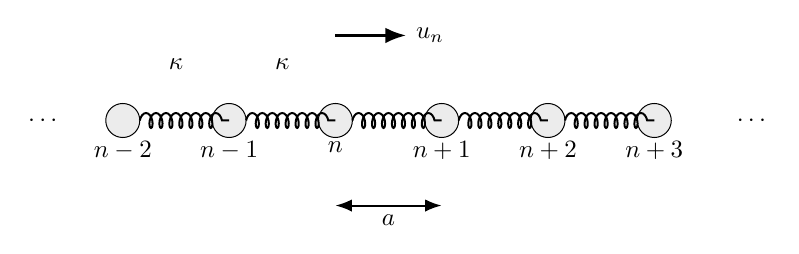
Figure 1. A monatomic oscillator chain consists of identical masses separated by equilibrium
spacing a and connected by identical nearest-neighbor springs of constant κ. The displacement of
lattice site n is un(t).
1 Force on one lattice mass
Consider the mass at site
The spring to the right changes length by
It therefore exerts the force
The spring to the left changes length by
Its force on mass
is
The total force is
| Fn | = κ(un+1 − un) − κ(un − un−1) | (9)
|
| = κ(un+1 − 2un + un−1). | (10) |
Newton’s second law gives
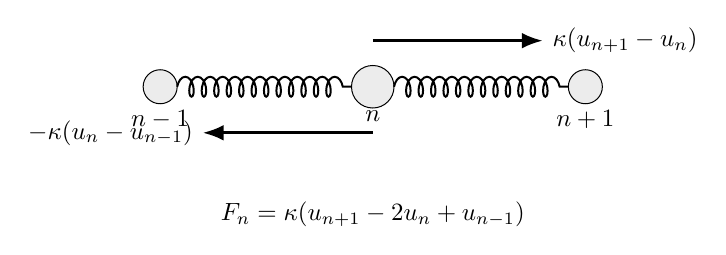
Figure 2. The net restoring force on mass n is the difference between the right-spring and
left-spring extensions. The resulting second spatial difference is the discrete counterpart of
curvature in a continuous medium.
2 Discrete second difference
The combination
is the centered second difference.
It measures how strongly the displacement at site
differs from the local average of its neighbors.
If
the springs are not differentially stretched and the net restoring force vanishes.
This is the discrete analogue of a continuous field with zero curvature.
3 Normal-mode trial solution
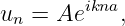
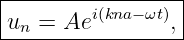
Because the chain is translationally repetitive, try a mode of the form
The physical displacement is the real part.
The neighboring displacements are
and
Also,
Substitute into the lattice equation:
Using
Since
4 Dispersion relation
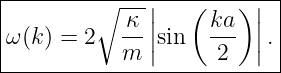
Choose the nonnegative frequency:
A relation of the form
is called a dispersion relation.
If
is proportional to
all wavelengths propagate with the same characteristic speed and the medium is nondispersive.
The lattice relation is nonlinear in
Therefore the discrete chain is dispersive except in its long-wavelength limit.
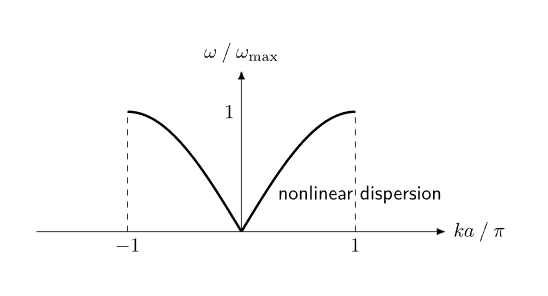
Figure 3. The monatomic-chain dispersion relation is approximately linear near k = 0 but bends
over and reaches its maximum frequency at the edge of the first Brillouin zone, |k| = π∕a.
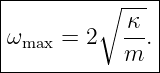
5 Maximum frequency
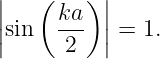
The sine magnitude cannot exceed unity.
Therefore
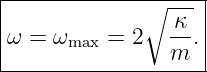
The maximum occurs when
Within the first Brillouin zone this is
Thus a discrete lattice has an upper frequency for this branch.
The continuous ideal wave equation has no corresponding lattice cutoff.
6 Wave-number equivalence
At the lattice sites,
Since
for integer
describe the same pattern on the discrete lattice.
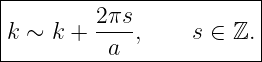
More generally,
This is reciprocal-lattice periodicity.
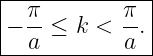
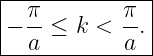
7 First Brillouin zone
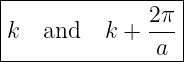
Because wave numbers separated by
are equivalent on the monatomic lattice, one complete set of distinct wave numbers can be chosen
as
This interval is the first Brillouin zone in one dimension.
Its width is
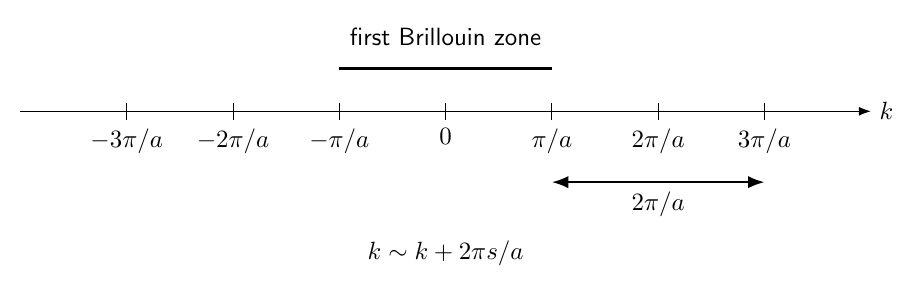
Figure 4. Wave numbers separated by a reciprocal-lattice vector 2π∕a give identical phase factors
at every lattice site. Distinct lattice modes can therefore be represented within the first Brillouin
zone.
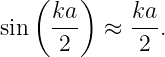
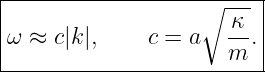
8 Long-wavelength limit
Suppose
Then
Therefore
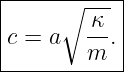
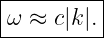
Define
Then
The lattice becomes approximately nondispersive at wavelengths much larger than
9 Continuum limit from Taylor expansion
Let
for a field that varies slowly over one lattice spacing.
Expand:
| u(x + a,t) | = u + a + +   + +  , , | (48)
|
| u(x − a,t) | = u − a + +   + +  . . | (49) |
Adding,
The lattice equation becomes
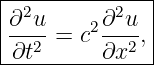
Thus
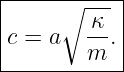
with
The continuous wave equation emerges as the long-wavelength limit of the discrete
chain.
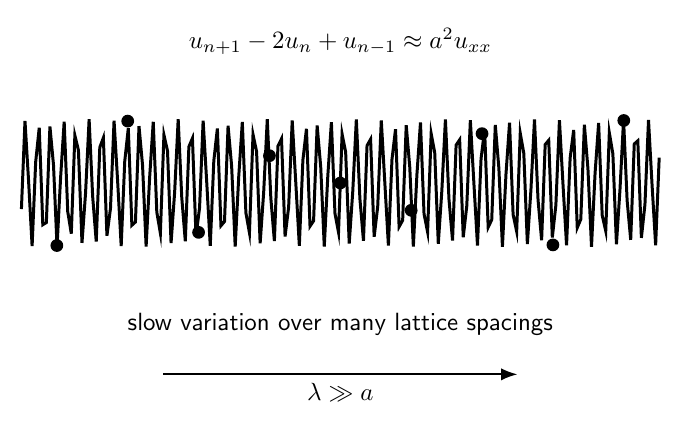
Figure 8. When the displacement varies slowly over many lattice spacings, the centered second
difference approaches a2∂2u∕∂x2, and the discrete oscillator chain approaches the continuous
wave equation.
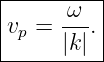
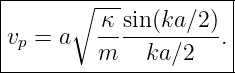
10 Phase velocity
For a sinusoidal mode,
For
Hence
Thus
as
For finite
the phase velocity depends on wave number.
11 Group velocity
A localized wave packet requires a range of nearby wave numbers.
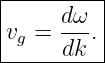
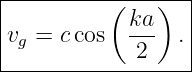
Its envelope propagates approximately at the group velocity
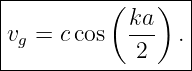
For
Therefore
At long wavelength,
At the zone boundary,
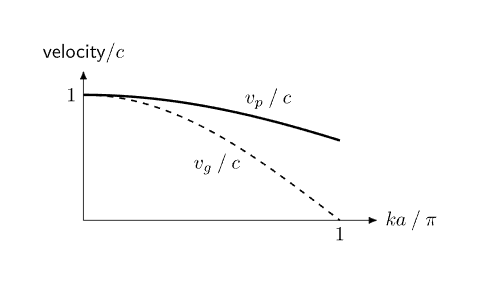
Figure 5. Both phase and group velocities approach the continuum speed c as k → 0. The group
velocity falls to zero at the zone boundary because the dispersion curve becomes horizontal there.
12 Why group velocity matters
A single infinite sinusoidal mode fills all space and has no localized envelope.
Physical disturbances are usually superpositions of modes.
For a narrow packet centered near
the envelope travels approximately at
In many conservative wave systems, group velocity is also closely connected to the transport of
energy.
Thus the shape of
determines how disturbances propagate through the lattice.
13 Wave-packet dispersion
If
were exactly linear, nearby Fourier components would have the same group velocity and a narrow
packet would preserve its shape.
For the lattice,
away from the continuum limit.
Different components then travel with slightly different group velocities.
The packet can spread or distort.
This is the physical meaning of dispersion.
14 Zone-boundary mode
At
the lattice phase factor is
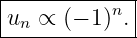
Therefore neighboring masses move in opposite directions:
This mode has
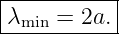
Its shortest distinct lattice wavelength is
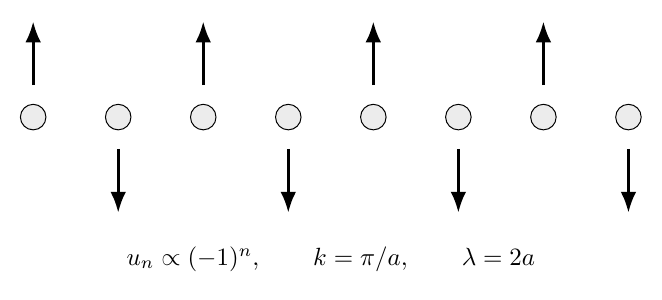
Figure 7. At the Brillouin-zone boundary, neighboring masses move exactly out of phase. The
corresponding lattice wavelength is 2a, the shortest distinct wavelength that can be represented
on the monatomic lattice.
15 The zero-frequency mode
At
all sites have the same displacement:
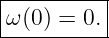
The dispersion relation gives
For a free or periodic chain, this is uniform translation.
No spring is stretched, so there is no restoring force.
This is the extended-chain version of the zero mode introduced in M06-04 and M06-05.
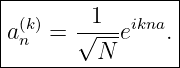
16 Periodic chain of N masses
Consider
masses with periodic boundary condition
For the traveling mode
periodicity requires
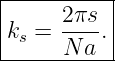
Therefore
where
is an integer.
Thus
Only
distinct wave numbers occur within one Brillouin zone.
These are the
normal modes of the
degree-of-freedom periodic chain.
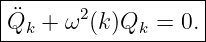
17 Fourier coordinates are normal coordinates
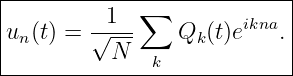
For a periodic chain, write the discrete Fourier expansion
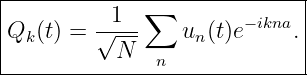
The inverse transform is
The Fourier amplitudes
are the normal coordinates of the translationally invariant chain.
Substitution into the equations gives, mode by mode,
Thus the discrete Fourier transform diagonalizes the chain dynamics.
18 Connection to the matrix eigenvalue problem
For a finite periodic chain,
The stiffness matrix is circulant.
Its eigenvectors are the discrete Fourier vectors
The generalized eigenvalue equation
therefore becomes exactly the lattice dispersion relation.
This is the many-site version of the normal-mode construction developed in M06-05.
19 Standing waves from opposite wave numbers
Because
the modes at
and
have the same frequency.
Their linear combinations can form real Standing Waves:
or
The traveling-wave and standing-wave descriptions are therefore alternative bases within the same
degenerate
subspace.
20 Finite chain with fixed ends
Now consider
moving masses between fixed endpoints:
Use the standing-wave form
The first boundary condition is automatic.
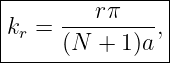
The second requires
Therefore
The corresponding frequencies are
There are exactly
normal modes.
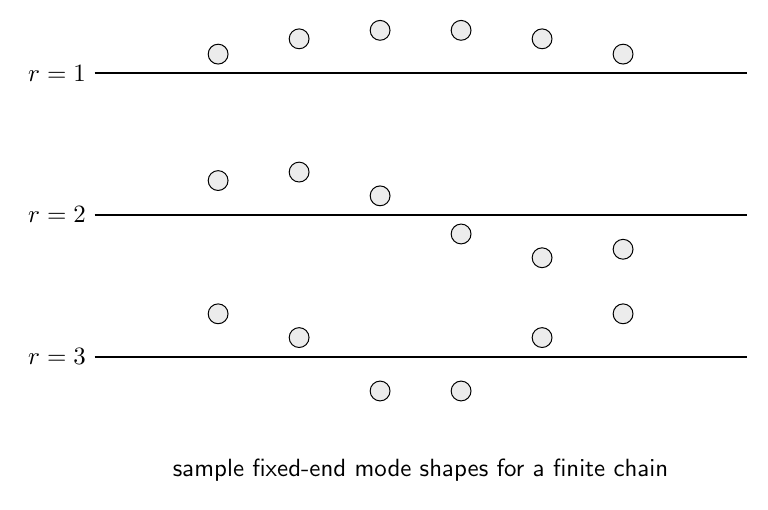
Figure 6. A finite fixed-end chain has discrete standing-wave mode shapes. Higher mode number
means shorter wavelength and higher frequency, until the lattice-scale zone-boundary pattern is
approached.
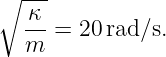
21 Example 1: four masses with fixed ends
Let
Then
The four frequencies are
Thus
| ω1 | ≈ 12.36 rad∕s , | (114)
|
| ω2 | ≈ 23.51 rad∕s , | (115)
|
| ω3 | ≈ 32.36 rad∕s , | (116)
|
| ω4 | ≈ 38.04 rad∕s. | (117) |
All lie below the infinite-chain maximum
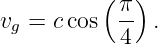
22 Example 2: group velocity
Let
The continuum speed is
At
Therefore
The group velocity is already below the long-wavelength speed.
23 Energy of the chain
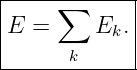
For a periodic chain, the mechanical energy is
In Fourier normal coordinates, the quadratic energy separates into independent modal
contributions.
Schematically,
Each normal mode is an independent harmonic oscillator.
A localized wave packet contains many
modes, and their differing phases and group velocities determine how energy moves through the
chain.
24 Discrete sampling and the shortest wavelength
The lattice samples displacement only at positions
Two continuous sinusoids whose wave numbers differ by
give the same values at every sample point.
This is mathematically analogous to aliasing in sampled-data systems.
The first Brillouin zone is therefore the natural nonredundant wave-number interval.
The zone-boundary wavelength
is the shortest distinct sinusoidal pattern on the lattice.
25 Continuum approximation error
The exact relation is
for
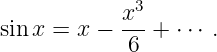
Expand the sine:
Then
| ω | = ck![[ ]
(ka-)2
1 − 24 + ⋅⋅ ⋅](https://images.physicslibrary.org/cache/objects/1498/make4ht/DiscreteOscillatorChainsAndDispersion135x.png) . . | (133) |
Thus the leading correction to the nondispersive continuum relation is of order
The continuum model improves rapidly when the wavelength is large compared with
26 Mode counting
A chain with
independent scalar displacements has
normal modes.
The wave description does not create additional degrees of freedom.
Instead, it relabels the same finite-dimensional modal basis by wave number.
For a very large periodic chain, the allowed
values become closely spaced and the normal-mode spectrum appears nearly continuous.
27 What dispersion means physically
The word dispersion refers to wave-number-dependent propagation.
In this chain:
- different wave numbers have different phase velocities,
- different wave numbers have different group velocities,
- a localized packet can spread,
- the group velocity approaches zero near the zone boundary.
The origin of the dispersion is the discrete microstructure.
At wavelengths much longer than the lattice spacing, that microstructure is not resolved and the
medium appears continuous.
28 Preview of a two-mass basis
The monatomic chain has one displacement degree of freedom per primitive cell and therefore one
frequency branch.
If each cell contains two inequivalent masses, the eigenvalue problem becomes two-dimensional for
every
Two branches result:
That extension is developed in M06-07.
29 Common mistakes
- Treating the lattice equation as if neighboring displacements were independent forcing
terms.
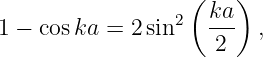
- Losing the factor of 2 when converting 1 − cos ka to sin 2(ka∕2).
- Confusing lattice spacing a with oscillation amplitude.
- Assuming ω is proportional to k for all wavelengths.
- Forgetting that k and k + 2π∕a are equivalent on the lattice.
- Counting wave numbers outside the first Brillouin zone as new independent modes.
- Confusing phase velocity with group velocity.
- Assuming group velocity remains equal to c near the zone boundary.
- Forgetting that vg = 0 at |k| = π∕a.
- Calling λ < 2a a distinct lattice wavelength.
- Forgetting that k = 0 is a zero-frequency translation mode for a free or periodic
monatomic chain.
- Applying the periodic-chain wave-number quantization to a fixed-end chain.
- Forgetting the N + 1 in the fixed-end result kr = rπ∕[(N + 1)a].
- Confusing the number of lattice sites with the number of reciprocal-lattice periods.
- Assuming a dispersive wave packet preserves its shape exactly.
30 Practice exercises
- Derive the force on lattice site n from its two neighboring springs.
- Starting from the complex traveling-wave ansatz, derive the monatomic dispersion
relation.
- Show explicitly that k and k + 2π∕a produce identical lattice displacements.
- Identify the first Brillouin zone and explain why it contains a complete set of distinct
wave numbers.
- Derive the maximum lattice frequency and the corresponding mode pattern.
- Derive the long-wavelength speed c = a
 .
.
- Derive the continuum wave equation from Taylor expansions of u(x ± a,t).
- Derive the phase velocity as a function of k.
- Derive the group velocity and show that it vanishes at the zone boundary.
- Show that the leading continuum-dispersion correction is proportional to (ka)2.
- Derive the allowed wave numbers for a periodic chain of N masses.
- Show that the discrete Fourier coordinates decouple the periodic chain equations.
- Derive the fixed-end normal modes and frequencies for N masses.
- Reproduce all four frequencies in Example 1.
- Explain why the monatomic chain has one branch and predict qualitatively what
changes when there are two masses per primitive cell.
31 Summary
The monatomic nearest-neighbor chain obeys
Its traveling normal modes have
with dispersion relation
One nonredundant wave-number interval is
The long-wavelength limit is
For
The maximum frequency occurs at the zone boundary:
For a fixed-end chain of
masses,
and
The oscillator chain therefore connects the finite-dimensional normal-mode eigenproblem directly
to wave propagation and dispersion.
References
References
[1] PhysicsLibrary, M06-05, Small Oscillations and the Normal-Mode Eigenvalue
Problem.
[2] PhysicsLibrary, M06-04, Coupled Oscillators and Normal Modes.
[3] PhysicsLibrary, M06-03, Driven Harmonic Motion and Resonance.
[4] A. P. French, Vibrations and Waves, W. W. Norton, 1971.
[5] C. Kittel, Introduction to Solid State Physics, 8th ed., Wiley, 2005.
[6] J. R. Taylor, Classical Mechanics, University Science Books, 2005.






































![[ ∘ -κ- ( ka ) ]
2 --sin ---
m 2](https://images.physicslibrary.org/cache/objects/1498/make4ht/DiscreteOscillatorChainsAndDispersion68x.png)
 cos
cos 
























![sin[k(N + 1 )a ] = 0.](https://images.physicslibrary.org/cache/objects/1498/make4ht/DiscreteOscillatorChainsAndDispersion113x.png)

![|------∘--------[---------]--|
| κ- ---rπ---- |
|ωr = 2 m sin 2(N + 1) .|
-----------------------------](https://images.physicslibrary.org/cache/objects/1498/make4ht/DiscreteOscillatorChainsAndDispersion115x.png)








![|------------------------------------|
| ∑ [ 1 1 ] |
|E = -m ˙u2n + --κ(un+1 − un)2 .|
| n 2 2 |
-------------------------------------](https://images.physicslibrary.org/cache/objects/1498/make4ht/DiscreteOscillatorChainsAndDispersion126x.png)








![|------∘---------------------|
| κ [ rπ ] |
|ωr = 2 --sin --------- .|
----------m------2(N--+-1)---](https://images.physicslibrary.org/cache/objects/1498/make4ht/DiscreteOscillatorChainsAndDispersion153x.png)