One of the first (mechanical) Resonance phenomena to have been reported was that discovered by
Galileo Galilei in his investigations of (coupled through support) pendulums beginning in
1602.
Definition 0.1. The very sharp (or marked) increase in amplitude of oscillation of a
mechanical, electrical or nuclear system O1 exposed to a periodic force Fr(t), or another
oscillator O2 whose frequency is equal to, or very close to, the natural undamped frequency of
the oscillating system O1. The intensity of oscillation is defined as the square of the amplitude
of the oscillations. More precisely, in the case of a linear oscillator with a resonance frequency
ω0, the intensity of oscillations I(ω) when the system O1 is driven with a driving frequency
ω2 is given by:
I(ω2) = const.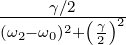 .
.
This oscillator intensity is a Lorentzian function which is characteristic of many resonant
systems, with γ being known as the linewidth of the resonance, or resonance linewidth at
half-heigth of the resonance peak which depends on the degree of damping of the oscillator.
Remark 0.1. Heavily damped oscillators have broad linewidths, and will respond to a wider
range of driving frequencies near the resonance frequency. The resonance linewidth γ is
inversely proportional to the quality factor, or Q-factor of the oscillating systems, which is
a measure of the sharpness of their resonance. As an example, for NMR and rf electrical
circuit probes, a high Q-factor is essential for high sensitivity detection of the signal by the
rf probe.
Definition 0.2. A system is called resonant if it has the property of oscillating by itself
(without external coupling) with a maximum amplitude only at a certain frequency or
frequencies, known as the resonance frequencies of the system.
