Physics Library
 An open source physics library
Encyclopedia | Forums | Docs | Random  

[parent] GRE Physics Companion: Euler's Equations for Rigid Body Rotation

(Example)

GRE Physics Companion: Euler’s Equations for Rigid Body Rotation

In a principal-axis body frame,

τ1 = I1ω1 + (I3 − I2)ω2ω3, (1)
τ2 = I2ω2 + (I1 − I3)ω3ω1, (2)
τ3 = I3ω3 + (I2 − I1)ω1ω2. (3)

PIC

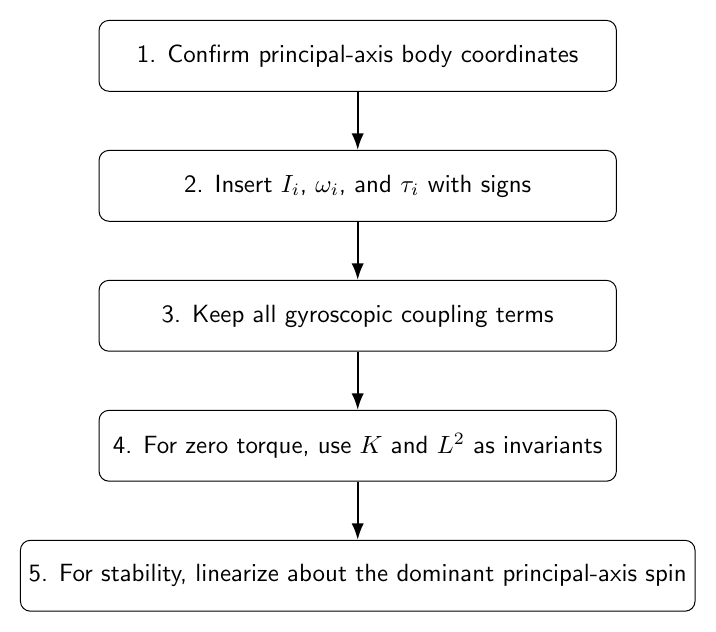
Figure 1. A compact strategy for Euler-equation problems: use principal axes, identify torque components, retain gyroscopic coupling terms, then apply conservation laws or linearization where appropriate.

1 High-value GRE facts

  1. Euler’s equations are most compact in a body-fixed principal-axis frame.
  2. The rotating derivative theorem produces the ω × L term.
  3. A diagonal inertia tensor does not eliminate dynamic coupling.
  4. Rotation exactly about one principal axis reduces to τi = Iiωi.
  5. Zero external torque does not imply constant body-frame angular-velocity components.
  6. Torque-free motion conserves angular momentum in inertial space.
  7. torque-free rigid body motion also conserves rotational kinetic energy.
  8. For an axisymmetric torque-free body, the symmetry-axis angular-velocity component is constant.
  9. Minimum- and maximum-moment principal-axis rotations are stable.
  10. Intermediate-axis rotation is unstable.

Part I: Original GRE-style problems

Problem 1: rotating derivative

For a vector A expressed in a frame rotating with angular velocity ω,

  1. (dA∕dt)I = (dA∕dt)B
  2. (dA∕dt)I = (dA∕dt)B + ω × A
  3. (dA∕dt)I = ω ⋅ A
  4. (dA∕dt)I = A ×ω only
  5. (dA∕dt)I = 0

Problem 2: first Euler equation

Which is Euler’s first principal-axis equation?

  1. τ1 = I1ω1
  2. τ1 = I1ω1 + (I3 − I2)ω2ω3
  3. τ1 = I2ω2 + (I1 − I3)ω3ω1
  4. τ1 = I1ω12
  5. τ1 = I2I3ω2ω3

Problem 3: principal-axis spin

A body rotates only about principal axis 3. Then Euler’s third equation becomes

  1. τ3 = I3ω3
  2. τ3 = I1ω1
  3. τ3 = (I2 − I1)ω1ω2 only
  4. τ3 = 0 necessarily
  5. τ3 = I3ω32

Problem 4: torque-free body

For a torque-free rigid body,

  1. all body-frame angular-velocity components must be constant
  2. angular momentum is constant in inertial space
  3. rotational kinetic energy must decrease
  4. angular momentum must vanish
  5. the body must rotate about the intermediate axis

Problem 5: axisymmetric body

For a torque-free axisymmetric body with I1 = I2, which angular-velocity component is constant?

  1. ω1 only
  2. ω2 only
  3. ω3
  4. all three necessarily
  5. none

Problem 6: body-frame precession frequency

For I1 = I2 = I⊥, I3 = I∥, the body-frame transverse frequency is

  1. ω3
  2. (I∥− I⊥)ω3∕I⊥
  3. I⊥ω3∕I∥
  4. (I∥ + I⊥)ω3
  5. zero always

Problem 7: stable axes

For I1 < I2 < I3, which torque-free principal-axis rotations are linearly stable?

  1. only axis 1
  2. only axis 2
  3. only axis 3
  4. axes 1 and 3
  5. all three

Problem 8: intermediate-axis theorem

For I1 < I2 < I3, rotation mainly about axis 2 is

  1. linearly stable
  2. unstable to small perturbations
  3. impossible
  4. possible only with I1 = I3
  5. always static

Problem 9: energy

For a torque-free rigid body,

      1    2      2      2
K  =  -(I1ω1 + I2ω2 + I3ω3)
      2
(4)

is

  1. constant
  2. always zero
  3. always increasing
  4. always decreasing
  5. equal to L

Problem 10: gyroscopic coupling

If τ1 = 0 but ω2ω3≠0 and I2≠I3, then

  1. ω1 must be zero
  2. ω1 can be nonzero
  3. ω1 is undefined
  4. angular momentum vanishes
  5. the body is in pure translation

Problem 11: numerical Euler equation

Let

I1 = 2,  I2 = 3,   I3 = 5,
(5)

ω  =  4,  ω  = 6,
  2        3
(6)

and

τ  = 0.
 1
(7)

Then ω1 is

  1. −24
  2. −12
  3. 0
  4. 12
  5. 24

Problem 12: attitude propagation

Euler’s equations alone determine

  1. the complete orientation history without any additional equation
  2. only translational position
  3. body-frame angular-velocity dynamics, while attitude requires separate kinematics
  4. only center of mass motion
  5. only the inertia tensor

Part II: Complete worked solutions

Solution 1

The rotating derivative theorem is

( dA  )    ( dA )
  ----   =   ----   + ω × A.
   dt  I     dt   B
(8)

Answer: (B).

Solution 2

Euler’s first principal-axis equation is

τ1 = I1 ˙ω1 + (I3 − I2)ω2ω3.
(9)

Answer: (B).

Solution 3

With

ω1 =  ω2 = 0,
(10)

the coupling term in the third equation vanishes:

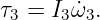
τ =  I ˙ω .
 3    3 3
(11)

Answer: (A).

Solution 4

Zero external torque implies

(dL ∕dt)I = 0.
(12)

Thus angular momentum is constant as an inertial vector. Answer: (B).

Solution 5

For

I1 = I2,
(13)

the third torque-free Euler equation becomes

I3 ˙ω3 = 0.
(14)

Hence

ω3 = constant.
(15)

Answer: (C).

Solution 6

The transverse equations reduce to

˙ω1 = − ΩB ω2,     ˙ω2 = ΩB ω1,
(16)

where

       I∥ −-I⊥-
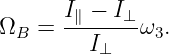
ΩB  =    I⊥   ω3.
(17)

Answer: (B).

Solution 7

For ordered moments

I1 < I2 < I3,
(18)

small perturbations oscillate about axes 1 and 3. Both are stable. Answer: (D).

Solution 8

Linearization about axis 2 produces an equation of the form

     2
¨𝜖 − λ 𝜖 = 0.
(19)

The growing exponential solution makes the intermediate-axis rotation unstable. Answer: (B).

Solution 9

For torque-free motion,

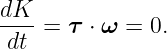
dK--= τ ⋅ ω = 0.
dt
(20)

Thus

K =  constant.
(21)

Answer: (A).

Solution 10

From

0 = I ω˙ + (I  − I )ω ω ,
     1  1    3    2  2 3
(22)

a nonzero coupling term requires a compensating

ω˙.
  1
(23)

Answer: (B).

Solution 11

0 = 2ω1 + (5 − 3)(4)(6) (24)
= 2ω1 + 48. (25)

Therefore

˙ω1 = − 24.
(26)

Answer: (A).

Solution 12

Euler’s equations propagate angular-velocity components. Orientation requires separate attitude kinematics. Answer: (C).

2 GRE checklist

  1. Use Euler’s component equations only in a principal-axis body frame unless using the more general tensor form.
  2. Keep the ω × L term when converting inertial derivatives to body derivatives.
  3. Remember that zero torque preserves inertial angular momentum, not necessarily body components of angular velocity.
  4. Use energy and angular-momentum invariants as fast checks in torque-free problems.
  5. For axisymmetric bodies, exploit I1 = I2 immediately.
  6. Minimum- and maximum-moment spins are stable; intermediate-moment spin is unstable.
  7. gyroscopic coupling can change one body component even when the matching torque component is zero.
  8. Separate rotational dynamics from attitude kinematics.

References

References

[1]   PhysicsLibrary, M05-10, Principal Axes and Principal Moments of Inertia.

[2]   J. R. Taylor, Classical Mechanics, University Science Books, 2005.

[3]   H. Goldstein, C. Poole, and J. Safko, Classical Mechanics, 3rd ed., Addison-Wesley, 2002.

[4]   K. R. Symon, Mechanics, 3rd ed., Addison-Wesley, 1971.


"GRE Physics Companion: Euler's Equations for Rigid Body Rotation" is owned by bloftin.
(view preamble)
View style:
Other names:  M05-11G
Keywords:  GRE physics, Euler equations, rigid body, principal axes, body frame, angular momentum, torque-free rotation, intermediate-axis theorem, symmetric top

This object's parent.

Cross-references: gyroscopic coupling, spins, energy, tensor, center of mass, kinematics, position, static, frequency, rigid body, angular velocity, vector, rotational kinetic energy, torque-free rigid body motion, angular momentum, torque, principal axis, inertia tensor, theorem, Euler's equations

This is version 1 of GRE Physics Companion: Euler's Equations for Rigid Body Rotation, born on 2026-10-17.
Object id is 1485, canonical name is GREPhysicsCompanionEulersEquationsForRigidBodyRotation.
Accessed 7 times total.

Classification:
Physics Classification: 45.40.-f (Dynamics and kinematics of rigid bodies)
 45.20.Dd (Newtonian mechanics)

Pending Errata and Addenda

None.

Discussion

No messages.

Interact