Tension and connected particles
Tension is the pulling force transmitted along a stretched string, rope, cable, chain, or similar
connector. In elementary particle mechanics the connector is often idealized as a massless,
inextensible string. Under that idealization the string constrains the motion of the particles
attached to it while transmitting a force directed along the string.
A useful tension model must distinguish the physical force from the assumptions used to simplify
it. In particular, a real massive rope can have different tension at different points, and a massive or
frictional Pulley can produce different tension on its two sides.
1 Physical meaning of tension
A string under tension is pulled at its ends. A small element of the string is pulled by its neighbors,
and the string in turn pulls on any object attached to it. The force exerted by an ideal string at a
point of attachment acts along the local direction of the string and away from the attached
body.
A flexible string can pull but cannot push. Consequently,
If a calculation predicts a negative value of T, the assumed taut-string configuration
is not physically valid; the string would instead go slack and the constraint must be
reconsidered.
Tension has the dimensions of force and is measured in newtons in SI units.
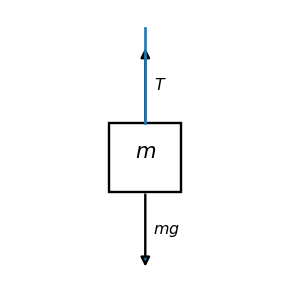
For a hanging particle of mass m, taking upward as positive,
The familiar result T = mg is therefore a special equilibrium or constant-velocity case, not a
general identity.
2 The ideal string model
The standard introductory model assumes that a string is
- massless,
- inextensible,
- perfectly flexible,
- taut unless stated otherwise.
When the string passes over a pulley, the usual additional idealizations are that the pulley is
massless and frictionless and that the string does not slip.
2.1 Why a massless straight string has uniform tension
Consider a small straight segment of an ideal massless string. Let the tensions at its ends be T1
and T2. Newton’s second law gives
For a massless segment, mseg = 0, so
Thus the tension magnitude is the same throughout one continuous ideal string, provided no
non-ideal element intervenes.
This derivation is more informative than memorizing “the tension is the same everywhere.” If the
string has appreciable mass, or if a massive pulley must be angularly accelerated, the premise
changes and equal tension need not follow.
3 Connected particles and kinematic constraints
Particles joined by an inextensible string do not move independently. The fixed total string length
imposes a constraint equation. For the simplest one-to-one connection,
where L is constant. Differentiating,
and differentiating again,
The accelerations therefore have equal magnitudes and opposite signs if the two coordinates are
measured in the same positive sense.
A reliable solution procedure is:
- draw a Free-body diagram for each particle;
- choose consistent positive directions;
- write Newton’s second law for each particle;
- write the string-length constraint;
- solve the simultaneous equations for acceleration and tension.
4 Two particles on a smooth horizontal surface
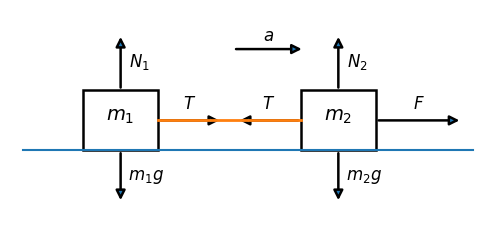
Consider masses m1 and m2 on a frictionless horizontal surface, joined by a light string, with an
external force F applied to m2.
The inextensible string gives
For m1,
For m2,
Adding the equations eliminates the internal tension:
so
This example also illustrates system boundaries. If the two blocks are treated as one system, the
tension is internal and cancels. If either block is isolated, tension is an external force on that
block.
5 A mass on a table connected to a hanging mass
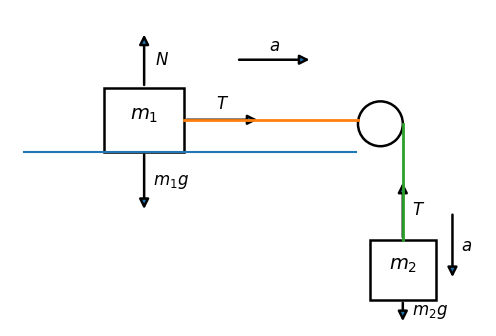
Let m1 lie on a frictionless horizontal table and let m2 hang vertically. The masses are connected
by one ideal string over a frictionless massless pulley.
Taking rightward as positive for m1 and downward as positive for m2,
Eliminating T gives
6 Atwood machine
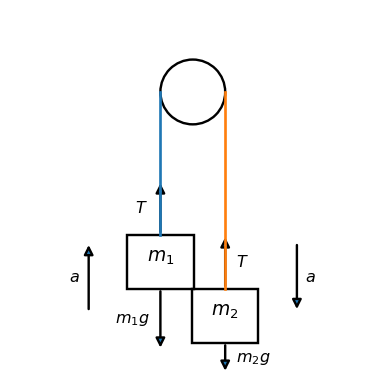
An Atwood Machine consists of two masses connected by a light inextensible string passing over a
frictionless massless pulley.
Assume m2 > m1. Choose upward as positive for m1 and downward as positive for m2.
Then
Adding,
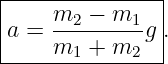
so
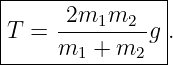
Substitution gives
If m1 = m2, then a = 0 and T = mg. If one mass is much larger than the other, the magnitude of
the acceleration approaches g.
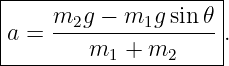
7 Incline connected to a hanging mass
Let m1 lie on a frictionless incline of angle 𝜃 and let m2 hang vertically.
Suppose m2 tends to move downward, pulling m1 up the incline. Along the string directions,
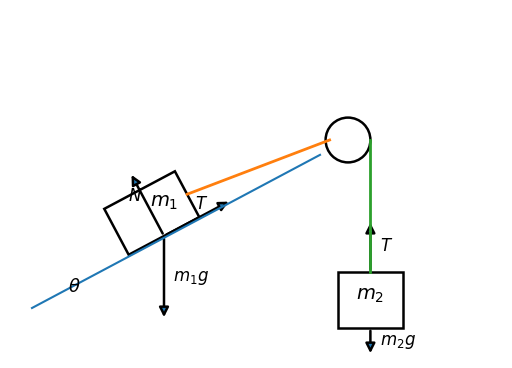
Hence
The sign of the numerator determines the actual direction of motion. The tension is
If kinetic friction acts on m1, the term μkN must be added with a sign opposing the relative
motion.
8 Several masses connected in series
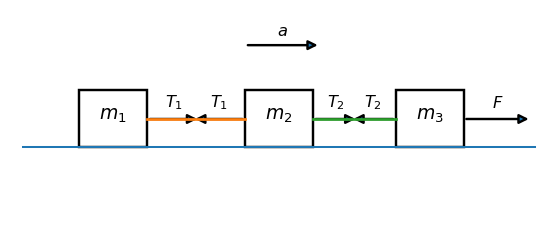
For three masses on a smooth horizontal surface joined by two different strings, the tensions need
not be equal because they belong to different strings.
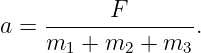
Let an external force F act on m3. All three masses have common acceleration
For m1,
For the subsystem m1 + m2,
Thus T2 > T1 for positive masses: the connector nearer the pull must accelerate more of the
system.
9 Massive ropes and nonuniform tension
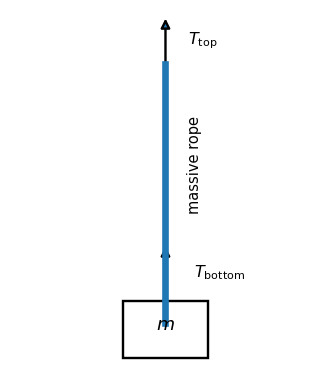
Equal tension is not a universal property of ropes. Consider a rope with nonzero mass hanging
vertically and supporting a load.
In static equilibrium the tension increases upward because each higher cross section supports the
load plus more of the rope’s own Weight. If λ is the linear mass density and y is measured upward
from the lower end of a uniform rope,
The massless-string result is recovered in the limit λ → 0.
10 Massive pulley: unequal tensions
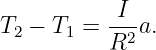
If the pulley has moment of inertia I and angular acceleration α, the tensions on its two sides
generally differ. For a string that does not slip,
The pulley torque equation is
so
Equal tension is recovered only in the ideal limit I → 0 when other dissipative effects are
absent.
11 Tension, tensile stress, and surface tension
The word “tension” is used in several related but distinct ways.
- In particle mechanics, T usually denotes a force transmitted along a string or cable.
- In solid mechanics, tensile stress is force per area:
- Surface tension is a different physical quantity with units of force per length.
12 Worked examples
Example 1: elevator cable
A 500 kg elevator accelerates upward at 1.2 m∕s2. Then
so
Example 2: two blocks on a table
Let m1 = 3 kg, m2 = 5 kg, and F = 24 N. Then
Example 3: table and hanging mass
Let m1 = 4 kg on the table and m2 = 2 kg hanging. Then
and
Example 4: Atwood machine
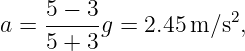
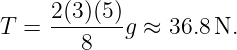
Let m1 = 3 kg and m2 = 5 kg. Then
and
Example 5: incline and hanging mass
Let m1 = 4 kg on a frictionless 30∘ incline and m
2 = 3 kg hanging. Then
The tension is
Example 6: three masses in series
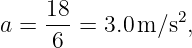
Let m1 = 1 kg, m2 = 2 kg, m3 = 3 kg, and F = 18 N. Then
13 Common mistakes
- Assuming T = mg for every hanging object.
- Assuming every rope in a problem has the same tension.
- Forgetting that equal tension applies only along one continuous ideal string.
- Giving two particles different acceleration magnitudes when an inextensible one-to-one
constraint requires equal magnitudes.
- Using inconsistent positive directions on the two sides of a pulley.
- Forgetting that a flexible string cannot push; T < 0 signals a failed taut-string model.
- Ignoring pulley inertia when the pulley is explicitly massive.
14 Practice exercises
- A 6 kg mass hangs at rest from a vertical rope. Find the tension.
- The same mass accelerates upward at 2 m∕s2. Find the tension.
- The same mass accelerates downward at 2 m∕s2. Find the tension.
- Two blocks of 2 and 3 kg are pulled on a smooth table by 20 N. Find the acceleration
and the tension.
- A 5 kg block on a smooth table is connected to a hanging 2 kg mass. Find a and T.
- Solve the ideal Atwood machine for m1 = 4 kg and m2 = 7 kg.
- Derive the general Atwood acceleration without first solving for T.
- A 4 kg block lies on a smooth 25∘ incline and is connected to a 3 kg hanging mass.
Determine the direction of motion.
- Repeat the preceding problem if μk = 0.15.
- Three masses in series have masses 1, 2, 4 kg and are pulled by 28 N. Find both string
tensions.
- A uniform rope of length L and mass M hangs vertically supporting a mass m. Find
the tension at the bottom and top of the rope.
- Show that a massless pulley implies equal tension if bearing Friction is neglected.
- For a massive pulley with I =
 MR2, derive T
2 − T1 in terms of M and a.
MR2, derive T
2 − T1 in terms of M and a.
- Explain physically what must happen if an algebraic solution gives T < 0.
15 GRE-style speed checks
- A mass m hangs motionless from a massless string. The tension is (A) 0 (B) mg∕2
(C) mg (D) 2mg. Answer: C.
- A mass m accelerates downward with magnitude a. The tension is (A) m(g + a) (B)
m(g − a) (C) ma (D) mg. Answer: B.
- Two blocks on a smooth table are connected by a light string. The string guarantees
that the two blocks have (A) equal forces (B) equal masses (C) equal acceleration
magnitude (D) equal momentum. Answer: C.
- In an ideal Atwood machine with m2 > m1, the tension satisfies (A) T > m2g (B)
T = m2g (C) m1g < T < m2g (D) T < m1g. Answer: C.
- A continuous ideal string passes over a massless frictionless pulley. The two tension
magnitudes are (A) always different (B) equal (C) zero (D) proportional to
pulley radius. Answer: B.
- If a calculated string tension is negative, the best interpretation is (A) compression
in the string (B) reversed gravity (C) the assumed taut-string model fails (D)
negative mass. Answer: C.
- A massive pulley accelerates angularly. In general the two string tensions are (A) equal
(B) unequal (C) both zero (D) independent of angular acceleration. Answer: B.
- For several masses connected in series and pulled from one end, the tension nearest
the pull is generally larger because it must accelerate (A) less mass (B) more of the
connected system (C) only the rope (D) gravity. Answer: B.
16 Source and licensing note
The opening definition and discussion of one-dimensional tension were informed by the Wikipedia
article Tension (physics), available under the Creative Commons Attribution–ShareAlike
license.
The connected-particle development, constraint treatment, worked examples, problem sequence,
and figures in this entry are newly written for PhysicsLibrary. Standard Newtonian results were
cross-checked against openly licensed LibreTexts material.
References
[1] Wikipedia contributors, “Tension (physics),” Wikipedia, The Free Encyclopedia.
Tension (physics)
[2] Physics LibreTexts, “Solving Problems with Newton’s Laws” and related
connected-particle examples. Physics LibreTexts
[3] Physics LibreTexts, “Atwood’s Machine.” Atwood’s Machine
Unless otherwise noted, this PhysicsLibrary entry is intended for release under the Creative
Commons Attribution–ShareAlike 4.0 International license.