Surface Integral: Definition, Geometry, Flux, and Physical Applications
A surface integral extends ordinary integration from an interval or planar region to a
two-dimensional surface embedded in three-dimensional space.
There are two closely related forms.
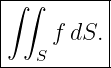
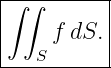
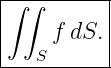
A scalar surface integral adds a scalar quantity over a surface:
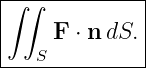
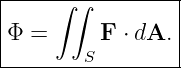
A flux surface integral measures how much of a vector field crosses an oriented surface:
Here S is the surface, f is a scalar field, F is a vector field, n is a chosen unit Normal, and dS is an
infinitesimal surface area.
Surface integrals describe:
1 From ordinary integration to surface integration
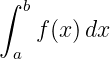
In one dimension,
adds contributions along an interval.
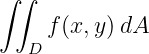
In two dimensions,
adds contributions over a planar region.
A surface integral replaces the flat area element dA by the actual area element dS on a curved
surface:
The central geometric problem is therefore to determine dS.
2 Parameterized surfaces
A surface can be parameterized by two variables:
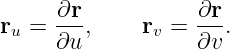
The tangent vectors are
For a small parameter rectangle dudv, the corresponding surface patch is approximately a
parallelogram with sides
and
The parallelogram area is the magnitude of their cross product:
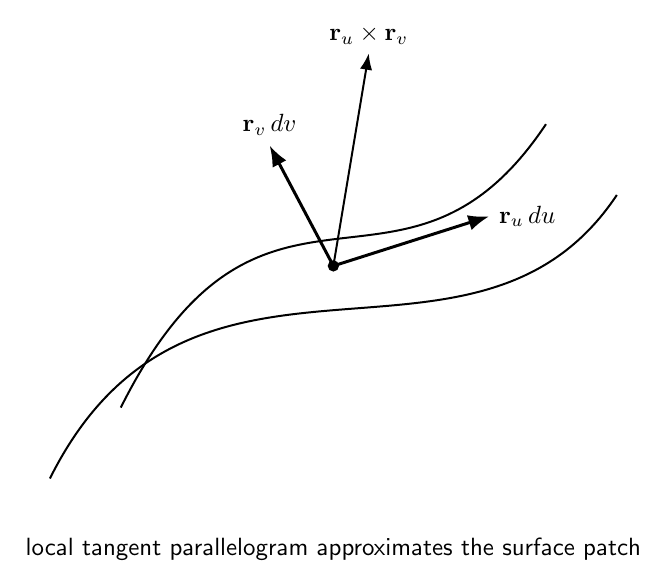
Figure 1. A small parameter rectangle maps to an approximately parallelogram-shaped surface
patch spanned by two tangent vectors.
3 Scalar surface integral
Substituting Equation (4),
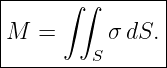
A thin shell with surface mass density σ has total mass
If σ = σ0 is constant,
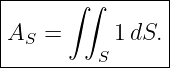
4 Surface area as a surface integral
Setting f = 1 gives
Surface area itself is therefore the simplest scalar surface integral.
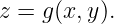
5 Surfaces given as graphs
Suppose
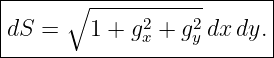
Use
Then
| rx | =  , , | (10)
|
| ry | =  , , | (11) |
and
Therefore
Thus
6 Example 1: area of a paraboloid patch
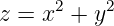
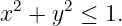
Consider
above
Since
we have
Using polar coordinates,
| A | = ∫
02π ∫
01 r dr dϕ r dr dϕ | (17)
|
| = 2π ∫
01r dr. dr. | (18) |
With
| A | =  ∫
15w1∕2 dw ∫
15w1∕2 dw | (20)
|
| =   | (21)
|
| ≈ 5.33. | (10) |
The curved surface has more area than its circular projection of area π.
7 Orientation
Scalar surface integrals do not require a direction.
Flux integrals do.
At each regular point, ru × rv selects one of the two normal directions.
Changing the order reverses the normal:
An oriented surface has a continuously chosen normal direction.
For a closed surface, the standard convention is the outward normal.
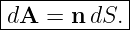
8 Vector area element
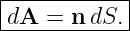
Define
For a parameterization consistent with the chosen orientation,
The vector area element contains both area and direction.
9 Flux surface integral
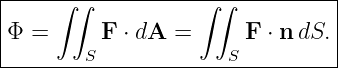
The flux of F through an oriented surface is
With a parameterization,
The dot product selects the normal component of the field.
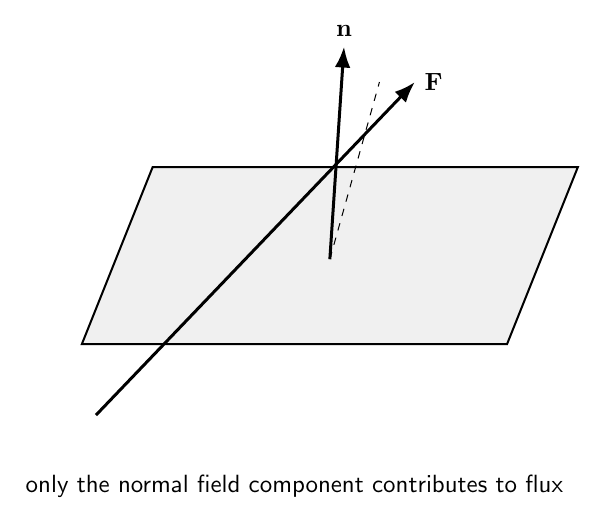
Figure 2. Flux depends on the component of the vector field normal to the surface. Reversing the
normal reverses the flux sign.
10 Physical interpretation of flux
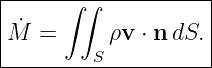
Suppose ρ is a fluid mass density and v is velocity.
Then the mass crossing S per unit time is
Positive contributions cross in the chosen normal direction.
Negative contributions cross in the opposite direction.
11 Example 2: constant field through a plane
Let
Take
with upward orientation.
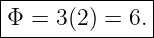
Then
and
The rectangle has area 2, so
With downward orientation the answer would be −6.
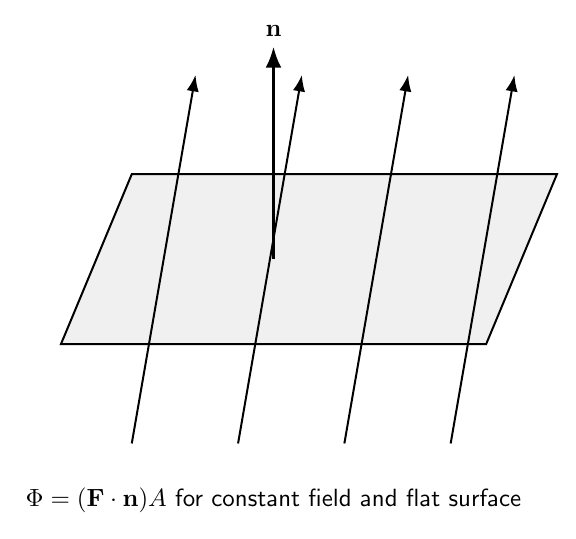
Figure 3. A constant field crossing a flat surface contributes only through its normal component.
Tangential components do not contribute to flux.
12 The sphere as a parameterized surface
A sphere of radius R can be parameterized by
with
| 0 | ≤ 𝜃 ≤ π, | (27)
|
| 0 | ≤ ϕ < 2π. | (28) |
The area element is
For outward orientation,
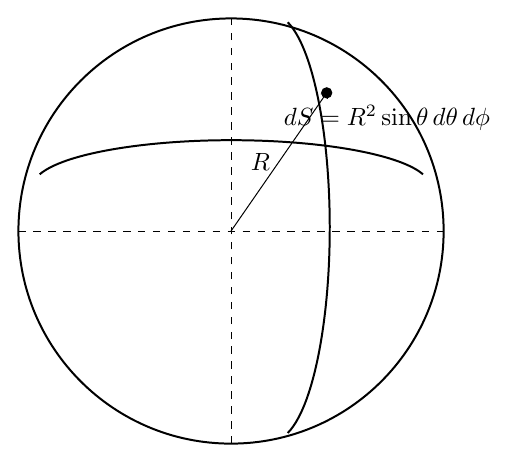
Figure 4. A sphere is naturally parameterized by two angles. Its area element contains the sine
theta factor because longitude curves converge near the poles.
13 Example 3: area of a sphere
Use Equation (18):
| A | = ∫
02π ∫
0πR2 sin 𝜃 d𝜃 dϕ | (29)
|
| = R2(2π)(2) | (30)
|
| = 4πR2. | (20) |
The familiar area of a sphere is itself a surface-integral result.
14 Closed surface integrals
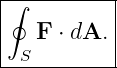
For a closed surface S, flux is often written
The circle indicates that the surface has no boundary.
The normal is conventionally outward.
15 Example 4: the inverse-square law
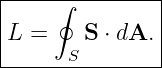
Consider an isotropic point source radiating energy at constant luminosity L.
Let
be the radial energy-flux vector.
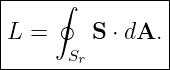
Energy conservation requires the same total Power to cross every centered sphere:
On the sphere:
- S is parallel to the outward normal;
- S(r) is constant over the sphere by spherical symmetry;
- the sphere area is 4πr2.
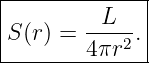
Therefore
| L | = S(r) ∮
SrdS | (32)
|
| = S(r)4πr2. | (33) |
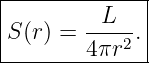
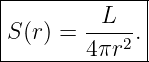
Solving,
This is the inverse-square law.
The exponent 2 arises from geometry: the available spherical area grows as r2 while the total
outward power remains fixed.
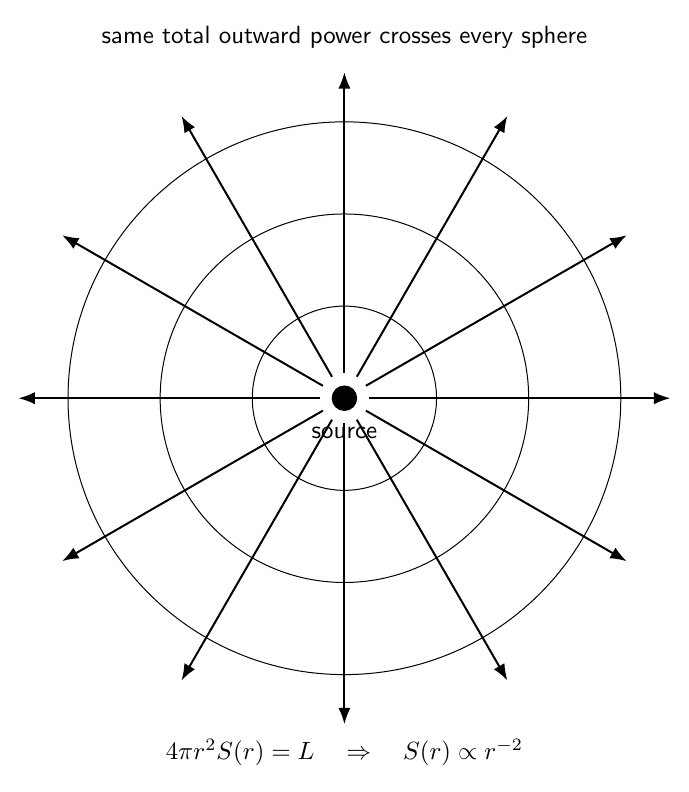
Figure 5. The same conserved luminosity crosses every surrounding sphere, so the energy flux
density falls as the inverse of the sphere area and therefore as one over radius squared.
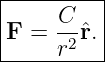
16 A general inverse-square radial field
Consider
The outward flux through any centered sphere is
| Φ | = ∮
Sr r ⋅rdS r ⋅rdS | (34)
|
| =  4πr2 4πr2 | (35)
|
| = 4πC. | (25) |
The radius cancels.
This geometric structure underlies several point-source laws.
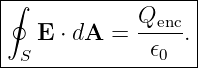
17 Electric-field example and Gauss’s law
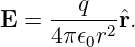
For a point charge q,
The flux through a centered sphere is
| ∮
SE ⋅ dA | =  4πr2 4πr2 | (37)
|
| =  . . | (26) |
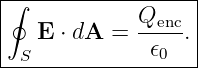
The general integral form is
A sphere is convenient for the point charge because it matches the symmetry.
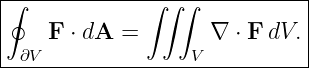
18 The divergence theorem
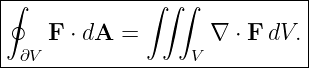
The divergence theorem states
It connects net outward flux through a closed boundary to the integrated divergence throughout
the enclosed volume.
19 Example 5: divergence theorem on a sphere
Take
On a sphere of radius R,
Therefore
| ∮
SF ⋅ dA | = R(4πR2) | (40)
|
| = 4πR3. | (29) |
Also,
Hence
 V ∇⋅ FdV V ∇⋅ FdV | = 3 | (42)
|
| = 4πR3. | (30) |
The surface and volume calculations agree.
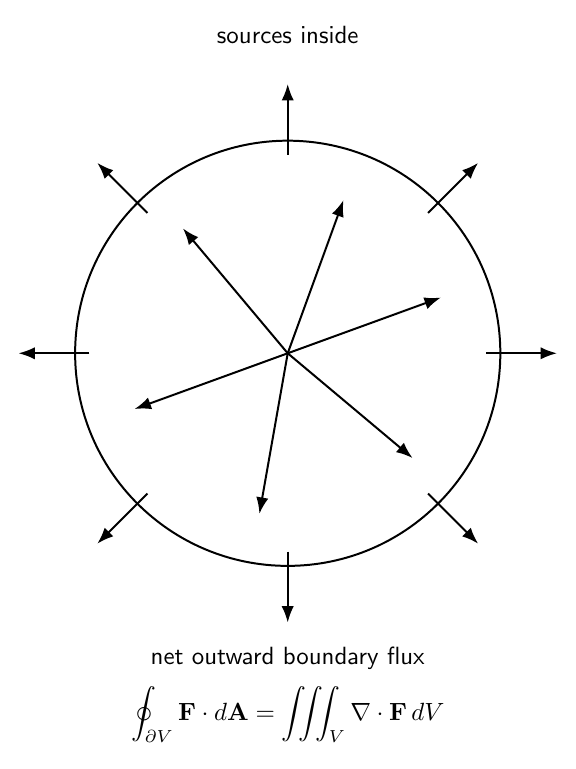
Figure 6. The divergence theorem equates net outward surface flux to the total divergence
integrated through the enclosed volume.
20 A subtlety of the inverse-square field
For
direct differentiation gives
for
Yet a sphere enclosing the origin has nonzero flux.
There is no contradiction because the field is singular at the origin.
The ordinary divergence theorem assumes sufficient smoothness in the enclosed region.
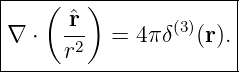
In distribution notation,
The point source appears as a delta-function divergence.
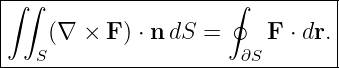
21 Stokes’s theorem
A second major theorem involving a surface integral is
The surface integral of curl equals the circulation around the boundary.
The boundary orientation and surface normal are related by the right-hand rule.
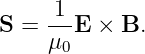
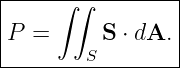
22 Electromagnetic energy flux
The Poynting vector is
The electromagnetic power crossing a surface is
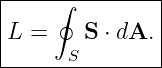
For a closed surface surrounding a radiating source,
This gives a field-theory interpretation of astrophysical luminosity.
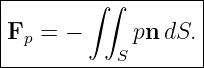
23 Pressure force as a surface integral
Pressure exerts a normal force on a surface element.
With outward normal n, the force on a material boundary can be written
Therefore
Surface integrals therefore also occur naturally in continuum mechanics and fluid mechanics.
24 Parameterization independence
A correctly defined surface integral is geometric and does not depend on the arbitrary
parameterization chosen to compute it.
Different parameterizations change the tangent vectors and parameter-area element, but the
cross-product factor compensates.
For scalar surface integrals, orientation is irrelevant because
is used.
For flux integrals, reversing orientation reverses the sign.
25 Common mistakes
- Using projected area dxdy instead of the curved-surface element dS.
- Forgetting
 in a scalar surface integral.
- Taking the magnitude of the cross product in a flux integral and thereby losing
orientation.
- Forgetting that a flux integral requires a normal direction.
- Using the wrong orientation on a closed surface.
- Confusing a scalar surface integral with a flux surface integral.
- Omitting the dot product in a flux calculation.
- Assuming tangential field components contribute to flux.
- Forgetting the sin 𝜃 factor on a sphere.
- Treating the inverse-square law as unrelated to spherical area growth.
- Applying the divergence theorem across a singular point without accounting for the
singularity.
- Confusing radiative flux in watts per square meter with total luminosity in watts.
26 Connections to other PhysicsLibrary articles
For luminosity,
For isotropic radiation,
For electrostatics,
For the divergence theorem,
Thus the same mathematical object describes area, accumulated surface density, flow, radiation,
electric flux, and continuum forces.
27 Summary
For a parameterized surface,
A scalar surface integral is
The oriented vector area element is
The flux of a vector field is
For an isotropic source with conserved luminosity,
so
The inverse-square law is therefore one of the most direct and important physical applications of
the surface integral.
References
References
[1] J. Stewart, Calculus: Early Transcendentals, Cengage Learning.
[2] H. M. Schey, Div, Grad, Curl, and All That, W. W. Norton.
[3] J. E. Marsden and A. J. Tromba, Vector Calculus, W. H. Freeman.
[4] D. J. Griffiths, Introduction to Electrodynamics, 4th ed., Pearson, 2013.
[5] G. B. Arfken, H. J. Weber, and F. E. Harris, Mathematical Methods for Physicists,
Academic Press.