Circular Membranes, Bessel Functions, and Radial-Angular Modes
M06-17 solved the fixed rectangular membrane by separating the wave equation in Cartesian
coordinates.
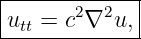
A circular membrane has the same local membrane physics but different geometry.
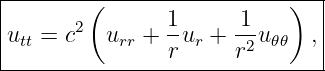
The wave equation is still
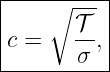
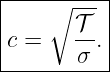
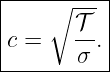
with
where 𝒯 is membrane tension per unit length and σ is surface mass density.
For a circular membrane, polar coordinates are natural:
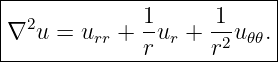
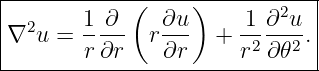
The two-dimensional Laplacian is
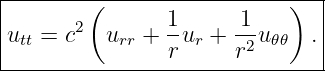
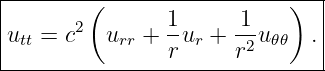
Therefore the circular-membrane equation is
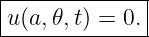
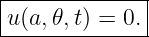
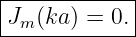
For a membrane of radius a fixed at its rim,
The normal modes are built from Bessel functions rather than ordinary sines.
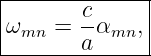
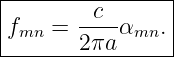
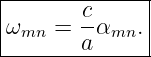
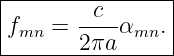
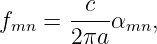
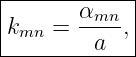
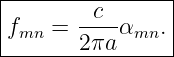
Their frequencies are
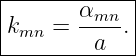
where αmn is the nth positive zero of the Bessel function Jm.
Equivalently,
Here:
- m = 0, 1, 2,… is the angular index,
- n = 1, 2, 3,… is the radial-zero index.
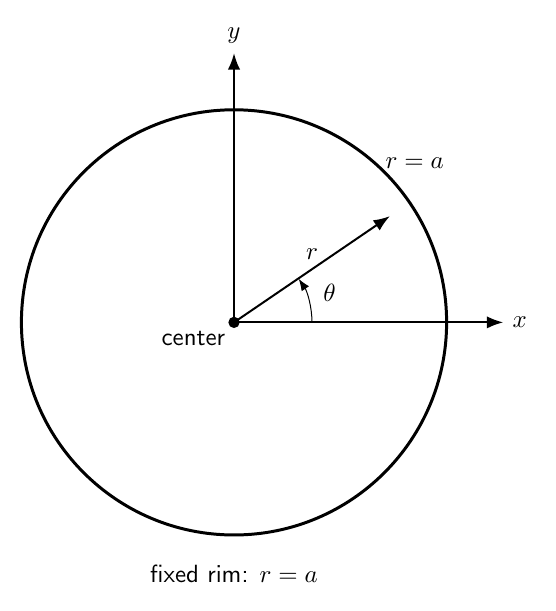
Figure 1. A circular membrane is naturally described by polar coordinates. The fixed boundary is
the circle r = a, while the angular coordinate 𝜃 runs around the membrane.
1 Membrane wave speed
The same local force balance used in M06-17 gives
Thus
Changing from a rectangle to a circle changes the boundary-value problem, not the local wave
speed.
2 Polar-coordinate membrane equation
For a scalar field in two-dimensional polar coordinates,
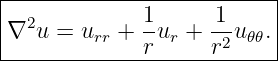
Expanding the radial derivative,
Therefore
3 Separation of variables
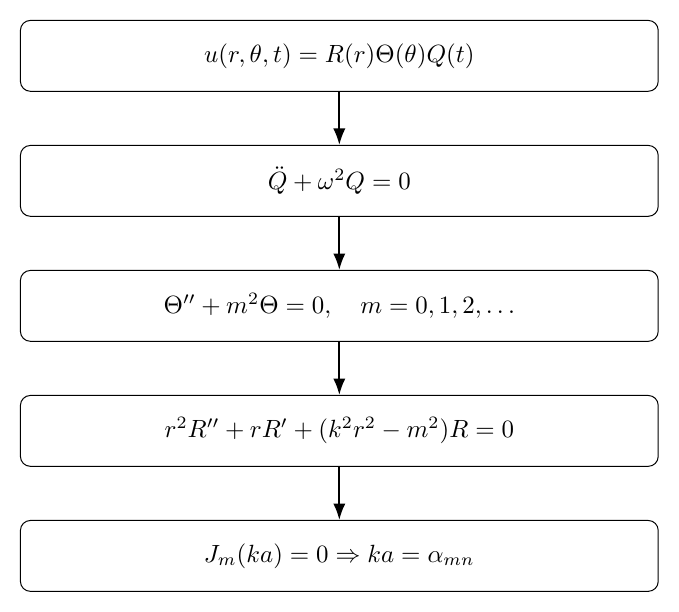
Seek a normal mode in the form
Substitution gives
| RΘQ | = c2 . | (15) |
Divide by
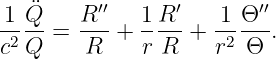
Then
The left side depends only on time.
Set both sides equal to
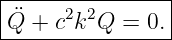
The time equation becomes
Thus
4 Separating radial and angular dependence
After separating time,
Multiply by
The left side depends only on r, while the right side depends only on 𝜃.
Therefore both sides equal a constant.
For periodic angular solutions, write the constant as
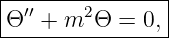
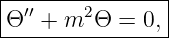
Then
and
5 Angular equation
The angular equation has solution
Physical displacement must be single-valued:
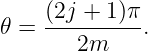
This periodicity requires
The integer m is the angular mode index.
6 Why m must be an integer
Suppose
After one full revolution,
For this to equal
for every angle, the phase increase must be an integer multiple of
Thus
must be an integer.
This is angular quantization produced by periodic boundary conditions.
7 Radial equation and Bessel’s equation
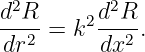
The radial equation is
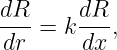
Introduce the dimensionless variable
Then
and
Substitution gives
This is Bessel’s differential equation of integer order m.
8 Bessel functions of the first and second kinds
The general radial solution for
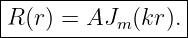
is
where:
- Jm is the Bessel function of the first kind,
- Y m is the Bessel function of the second kind.
For a membrane that includes the center
the displacement must remain finite.
The functions
are singular at the origin.
Therefore regularity requires
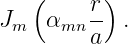
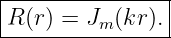
The physical radial factor is
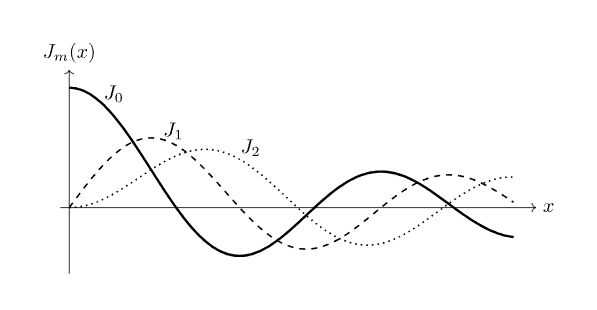
Figure 3. Representative Bessel functions J0, J1, and J2. Their oscillations are not equally spaced
near the origin, and the higher-order functions vanish increasingly strongly at the center.
9 Behavior at the center
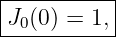
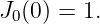
For the first-kind Bessel functions,
while
Thus:
- axisymmetric modes with m = 0 can have nonzero center displacement,
- all modes with m ≥ 1 vanish at the center.
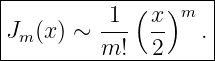
Near the origin,
This behavior is regular and finite.
10 Fixed-rim boundary condition
For a circular membrane of radius a fixed at the rim,
For a nonzero mode,
Since
we require
Thus
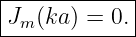
must equal a positive zero of
Let
denote the nth positive zero of
Then
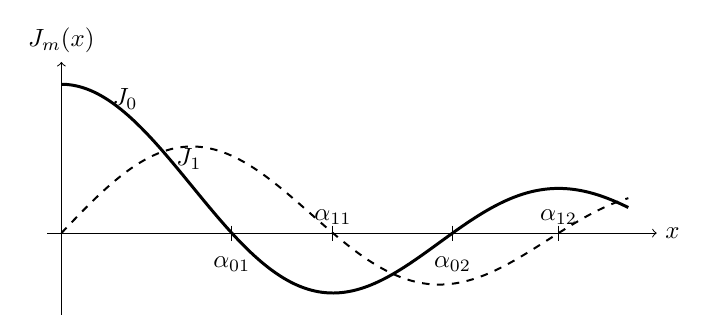
Figure 4. The fixed-rim condition selects zeros of Jm. Each allowed radial wave number satisfies
kmna = αmn.
11 Circular-membrane frequencies
Since
Therefore
The corresponding spatial modes are
and, for
12 Important low-order Bessel zeros
The first few positive zeros are approximately
| α01 | = 2.40483, | (64)
|
| α11 | = 3.83171, | (65)
|
| α21 | = 5.13562, | (66)
|
| α02 | = 5.52008, | (67)
|
| α31 | = 6.38016, | (68)
|
| α12 | = 7.01559. | (69) |
Unlike a rectangular membrane, the spectrum is not generated by a simple square root of two
integer squares.
The zero structure of Bessel functions determines the circular spectrum.
13 Fundamental mode
The smallest positive Bessel zero is
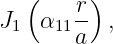
Therefore the fundamental mode is
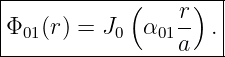
Its spatial shape is
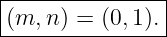
It is axisymmetric and has no interior nodal diameter or interior nodal circle.
The center has maximum magnitude because
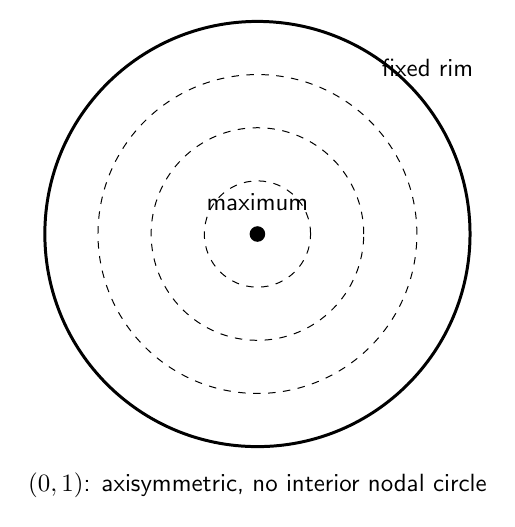
Figure 5. The fundamental (0,1) mode is axisymmetric. The rim is fixed, the center moves with
maximum amplitude, and there are no interior nodal circles.
14 Angular nodal structure
For a cosine angular factor,
when
These zeros form straight radial lines through the center.
Opposite radial lines belong to the same geometric diameter.
Therefore a mode with angular index
has
For
there are no nodal diameters.
15 Radial nodal structure
For a mode using the nth positive zero
the radial factor is
The fixed rim is one zero at
Before reaching that rim zero, the nth radial mode contains
interior nodal circles.
Thus:
- n = 1: no interior nodal circles,
- n = 2: one interior nodal circle,
- n = 3: two interior nodal circles.
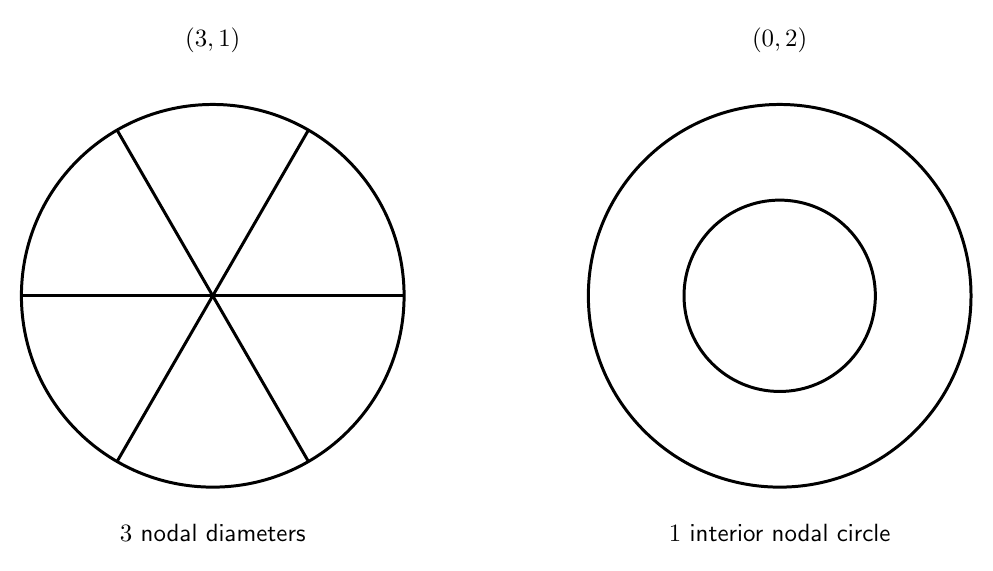
Figure 6. Circular-membrane nodal geometry. The angular index m counts nodal diameters, while
the radial index n gives n − 1 interior nodal circles.
16 The (1,1) mode
For
the radial factor is
and the angular factors are
or
There is one nodal diameter.
There are no interior nodal circles.
The two sides of the nodal diameter oscillate with opposite sign.
17 The (2,1) mode
For
there are two nodal diameters.
The membrane is divided into four angular sectors of alternating sign.
There are no interior nodal circles because
18 The (0,2) mode
For
there are no nodal diameters.
There is one interior nodal circle.
The inner disk and outer annular region oscillate with opposite signs.
19 Angular degeneracy
For every
the two angular functions
and
have the same radial equation and the same frequency.
Therefore each
circular-membrane mode is at least twofold degenerate in the ideal symmetric membrane.
The two independent mode shapes can be written
and
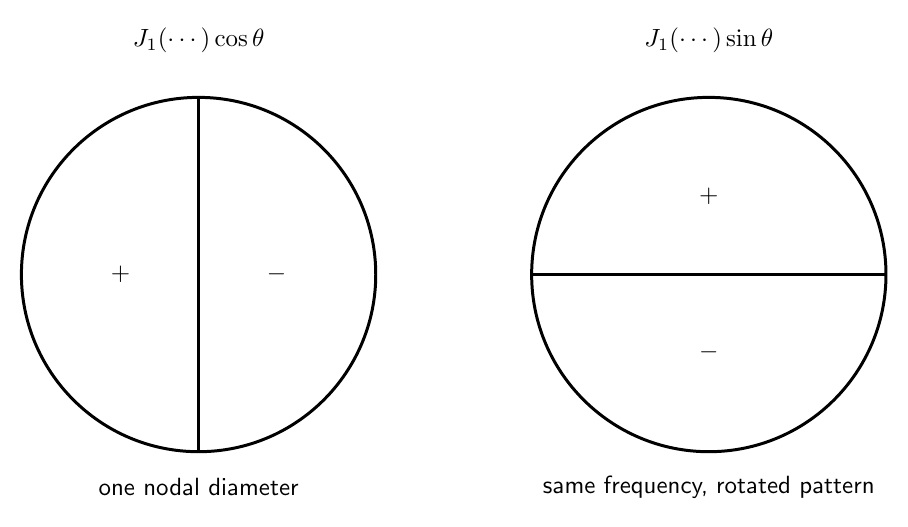
Figure 7. The cosine and sine versions of an m = 1 mode have the same frequency but nodal
diameters rotated by 90∘. More generally, linear combinations rotate the nodal pattern
continuously.
20 Rotating the nodal pattern
A linear combination
can be rewritten as
Thus changing the coefficients does not change the eigenfrequency.
It rotates the angular nodal pattern.
This is the geometric meaning of the sine-cosine degeneracy.
21 Axisymmetric modes are nondegenerate
For
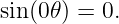
the sine solution vanishes identically:
The only nontrivial angular factor is constant:
Therefore the
axisymmetric modes do not have the same twofold angular degeneracy.
22 Example 1: wave speed
Take
Then
| c | =  | (103)
|
| ≈ 63.25 m∕s. | (104) |
23 Example 2: circular-membrane fundamental
Let the radius be
For the fundamental,
Therefore
| f01 | =  | (107)
|
| ≈ 96.83 Hz. | (108) |
24 Example 3: the first angular mode
For
| f11 | =  | (110)
|
| ≈ 154.28 Hz. | (111) |
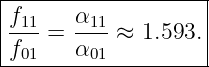
The frequency ratio to the fundamental is
25 Example 4: first axisymmetric overtone
For
Therefore
| f02 | =  | (115)
|
| ≈ 222.26 Hz. | (116) |
This mode has one interior nodal circle.
26 Why the circular spectrum is not harmonic
A one-dimensional string fixed at both ends has frequencies proportional to
Its overtones form exact integer multiples of the fundamental.
For a circular membrane,
The Bessel zeros are not integer multiples of
Therefore an ideal drumhead does not have a simple harmonic overtone series.
This is one reason a drumhead spectrum differs strongly from a stretched string spectrum.
27 Low-order spectrum
For a fixed radius and wave speed, the ordering of low modes begins:
then
then
then
for the first few distinct Bessel zeros.
The actual frequency spacing follows the Bessel-zero spacing.
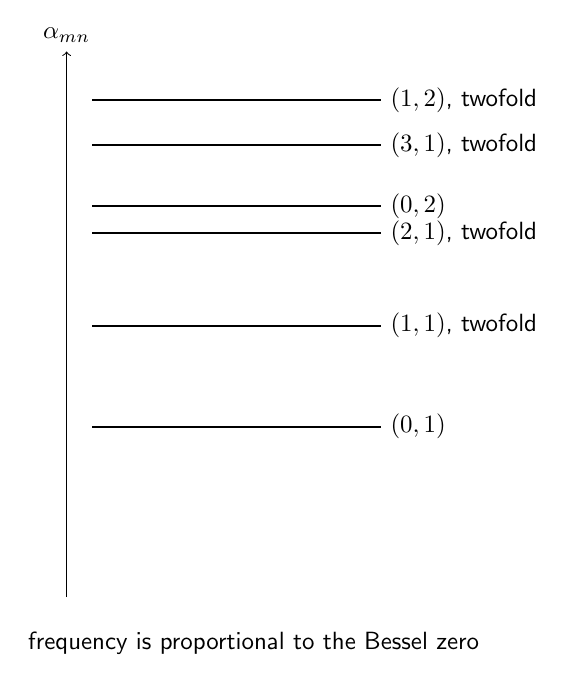
Figure 8. The low circular-membrane spectrum is controlled by Bessel zeros rather than integer
multiples. Modes with m ≥ 1 have a twofold angular degeneracy in the ideal circular membrane.
28 Radial orthogonality
For a fixed angular order
the radial eigenfunctions obey a weighted orthogonality relation.
For
The factor
is essential.
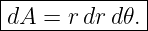
It comes from the polar area element
29 Radial normalization
For a zero
of
the normalization integral is
This relation is the circular analogue of the sine-function normalization used for a rectangular
membrane.
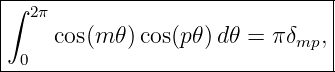
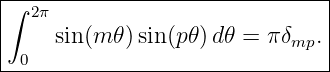
30 Angular orthogonality
For positive angular indices,
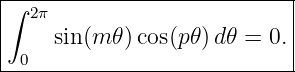
and
Also,
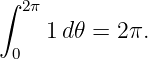
For
the constant angular factor has
31 Modal expansion
A general fixed circular-membrane displacement can be expanded in the circular eigenfunctions.
Schematically,
| u(r,𝜃,t) | = ∑
n=1∞q
0n(t)J0 | (137)
|
| + ∑
m=1∞∑
n=1∞ | (138)
|
| × Jm . | (139) |
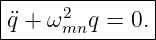
Each modal coordinate satisfies
Thus the circular membrane is again an infinite collection of independent harmonic
oscillators.
32 Axisymmetric initial displacement
If the initial displacement depends only on radius,
then no angular variation is present.
Only
modes are required.
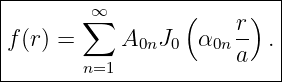
The expansion becomes
This is a Fourier-Bessel expansion.
The rectangular sine series of M06-17 has become a Bessel-function series.
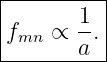
33 Effect of membrane radius
Since
all mode frequencies scale as
Doubling the radius halves every ideal circular-membrane frequency.
The dimensionless mode pattern as a function of
is unchanged.
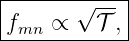
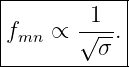
34 Effect of tension and surface density
Because
and
The same scaling found for the rectangular membrane applies here.
The geometry determines the dimensionless eigenvalues; the material parameters set the speed
scale.
35 Breaking circular symmetry
The sine-cosine degeneracy for
depends on rotational symmetry.
A perturbation such as:
- nonuniform Tension,
- elliptical boundary,
- added mass,
- asymmetric support,
can split the degenerate frequencies.
This is the continuous-system analogue of degeneracy splitting in symmetric finite-dimensional
eigenvalue problems.
36 Common mistakes
- Using the Cartesian Laplacian instead of the polar Laplacian for a circular membrane.
- Forgetting the (1∕r)ur term.
- Forgetting the (1∕r2)u
𝜃𝜃 term.
- Treating the angular separation constant as an arbitrary real number despite 2π
periodicity.
- Confusing the angular index m with the radial-zero index n.
- Keeping the singular Y m solution for a membrane that includes the origin.
- Setting the fixed-rim condition to Jm(k) = 0 instead of Jm(ka) = 0.
- Assuming Bessel zeros are integer multiples.
- Calling αmn the mth zero of Jn instead of the nth zero of Jm.
- Counting 2m nodal diameters instead of m diameters.
- Counting the fixed rim as an interior nodal circle.
- Forgetting that an nth radial mode has n − 1 interior nodal circles.
- Assuming m = 0 modes have the same sine-cosine degeneracy as m ≥ 1 modes.
- Forgetting the Weight factor r in radial orthogonality integrals.
- Expecting drumhead frequencies to form integer harmonics like an ideal string.
37 Practice exercises
- Write the two-dimensional Laplacian in polar coordinates and derive the
circular-membrane PDE.
- Substitute u = RΘQ and derive the separated time, angular, and radial equations.
- Explain why angular periodicity requires integer m.
- Transform the radial equation using x = kr and identify Bessel’s equation.
- Explain why regularity at the center excludes Y m.
- Starting from u(a,𝜃,t) = 0, derive kmn = αmn∕a.
- Derive the frequency formula fmn = cαmn∕(2πa).
- Determine the number of nodal diameters and interior nodal circles for a (3, 2) mode.
- Reproduce the fundamental and first-angular-mode numerical frequencies.
- Calculate the frequency ratio f11∕f01.
- Explain why the (1, 1) cosine and sine modes are degenerate.
- Show how a linear combination of the two degenerate angular functions rotates the
nodal pattern.
- Derive the radius scaling of the entire frequency spectrum.
- Explain the origin of the weight factor r in radial orthogonality.
- Describe how an axisymmetric initial displacement reduces the expansion to m = 0
Bessel modes.
38 Summary
The circular membrane obeys
with
Separation of variables gives
and
The regular radial solution is
The fixed rim requires
If αmn is the nth positive zero of Jm, then
and
The angular index m gives m nodal diameters.
The radial index n gives n − 1 interior nodal circles.
For m ≥ 1, the sine and cosine angular modes are degenerate.
Circular-membrane normal modes therefore combine Bessel radial structure, periodic angular
structure, and harmonic time evolution.
References
References
[1] PhysicsLibrary, M06-17, Separation of Variables, Membranes, and Two-Dimensional
Normal Modes.
[2] PhysicsLibrary, M06-16, Wave Equations in Two and Three Dimensions and
Spherical Waves.
[3] A. P. French, Vibrations and Waves, W. W. Norton, 1971.
[4] G. B. Arfken, H. J. Weber, and F. E. Harris, Mathematical Methods for Physicists,
7th ed., Academic Press, 2013.