Newton’s Law of Universal Gravitation
Newtonian gravitation begins with a remarkably compact statement.
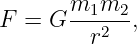
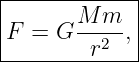
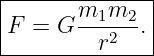
Any two point masses attract one another with a force whose magnitude is proportional to the
product of their masses and inversely proportional to the square of their separation.
If two point masses
and
are separated by distance
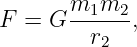
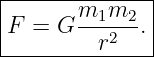
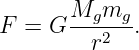
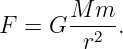
the magnitude of the gravitational force is
The constant
is Newton’s gravitational constant.
A commonly used numerical value is
The force acts along the line joining the two masses and is always attractive in Newtonian
gravitation.
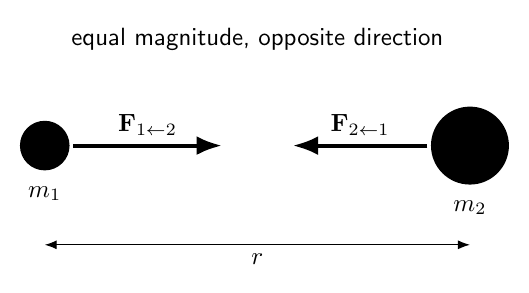
Figure 1. Two point masses exert equal-magnitude, opposite-direction gravitational forces along
the line joining them.
1 What the law says
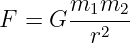
The scalar formula
contains three important scalings.
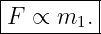
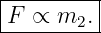
First,
Second,
Third,
Doubling either mass doubles the force.
Doubling both masses multiplies the force by four.
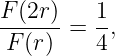
Doubling the separation reduces the force to one fourth.
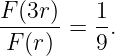
Tripling the separation reduces the force to one ninth.
2 Inverse-square behavior
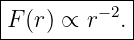
The inverse-square factor is central:
Thus
and
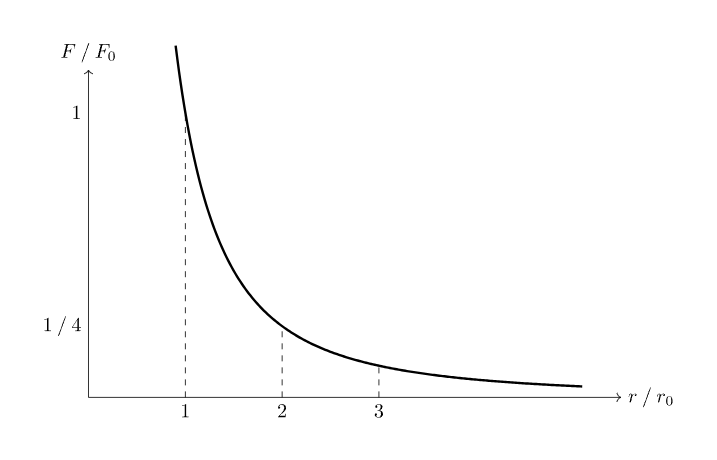
Figure 2. The inverse-square law decreases rapidly with separation. Relative force is shown as a
function of separation measured in units of a reference distance r0.
3 Dimensions of the gravitational constant
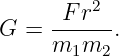
From
solve for
Since
| [G] | = 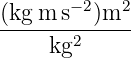 | (18)
|
| = m3 kg−1 s−2. | (19) |
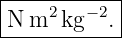
Equivalent units are
4 Point masses and separation vector
Let the masses occupy positions
and
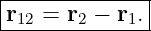
Define the displacement from mass 1 to mass 2:
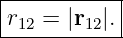
Its magnitude is
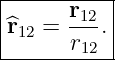
The corresponding unit vector is
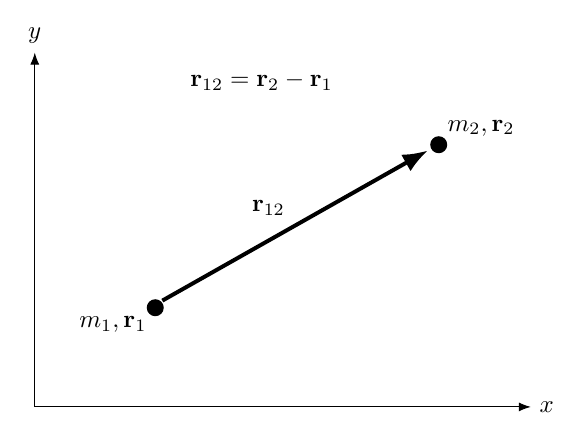
Figure 3. The separation vector r12 = r2 − r1 points from mass 1 to mass 2. Careful vector
definitions remove sign ambiguity from the gravitational-force law.
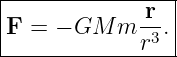
5 Vector form of the force
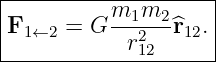
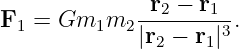
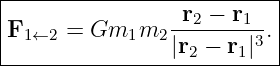
The force on mass 1 due to mass 2 points from mass 1 toward mass 2.
Therefore
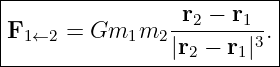
Equivalently,
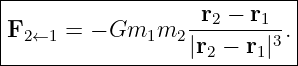
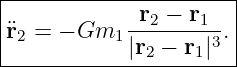
The force on mass 2 due to mass 1 points in the opposite direction:
Thus
6 An equally common vector convention
Some texts define
which points from source mass 2 toward test mass 1.
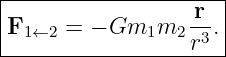
Then the force on mass 1 is written
The minus sign expresses attraction.
Both conventions are correct when used consistently.
The safest procedure is:
- define the separation vector explicitly,
- determine which direction attraction should point,
- then write the vector force.
7 Newton’s third law
The gravitational interaction satisfies Newton’s third law:
The forces have:
- equal magnitude,
- opposite direction,
- different points of application.
The forces are equal even when the masses are very different.
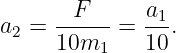
Their accelerations are not generally equal because
8 Example 1: unequal masses
Suppose
The force magnitudes remain equal:
But
while
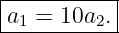
Therefore
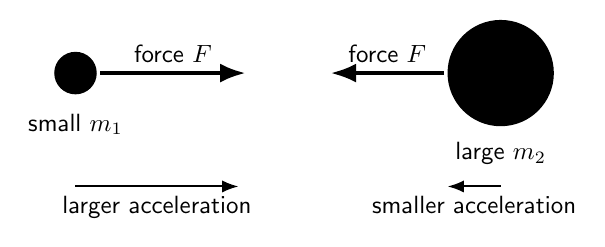
Figure 4. Gravitational interaction forces are equal and opposite, but the smaller mass has the
larger acceleration because acceleration is force divided by inertial mass.
9 Gravitational mass and inertial mass
Newtonian mechanics distinguishes two concepts.
Inertial mass
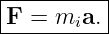
appears in Newton’s second law:
Gravitational mass
measures coupling to gravity.
For a test body near a source mass
Thus
so
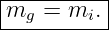
Experiment shows that gravitational and inertial mass are proportional to extremely high
precision.
With the conventional choice of units,
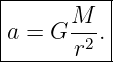
Then the test body’s mass cancels:
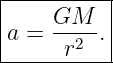
This is why objects in the same gravitational environment have the same gravitational acceleration
when nongravitational effects such as air resistance are negligible.
10 Mass independence of free-fall acceleration
Let a source mass
attract a test mass
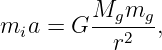
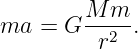
Newton’s law gives
Newton’s second law gives
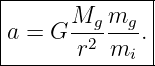
Equating them,
Cancel
The cancellation is one of the central features of Newtonian gravitation.
11 Example 2: force between laboratory masses
Let
and
Then
| F | = G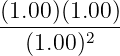 | (57)
|
| = 6.67430 × 10⁻¹¹ N. | (58) |
Gravity between ordinary laboratory-scale masses is extremely weak.
This small magnitude is one reason direct laboratory measurement of
is difficult.
12 Superposition
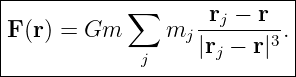
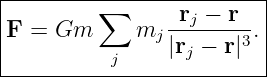
If several masses attract a test mass, the total gravitational force is the vector sum of the pairwise
forces.
For masses
at positions
acting on test mass
at
Gravity in Newtonian mechanics is pairwise additive.
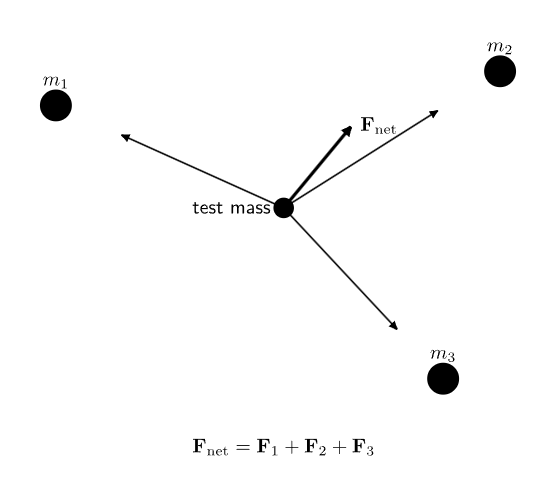
Figure 5. With several source masses, the total gravitational force is the vector sum of the
individual pairwise forces.
13 Example 3: two equal source masses
Place two equal source masses
symmetrically at
and
Place a test mass at the origin.
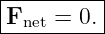
The two gravitational forces have equal magnitude and opposite direction.
Therefore
Zero net force does not mean there is no gravitational interaction.
It means the individual vector forces cancel.
14 Continuous mass distributions
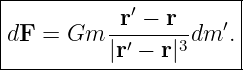
An extended body can be treated as a collection of infinitesimal mass elements.
For source element
at position
the force on test mass
at
is
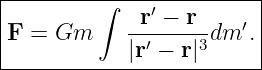
The total force is
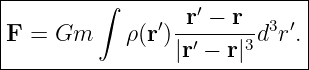
If the mass density is
then
Thus
M07-02 develops this superposition viewpoint in terms of The Gravitational Field.
15 Spherically symmetric bodies
A point-mass law applies directly to point masses.
For extended bodies, one must in principle integrate over the mass distribution.
A particularly important result is that a spherically symmetric body produces the same external
gravitational force as if all of its mass were concentrated at its center.
That statement follows from Newton’s shell theorem.
We will derive it later rather than assume it here.
Once that theorem is established, the point-mass formula can be applied outside spherical planets
and stars:
where
is measured from the center.
16 Gravity near Earth’s surface
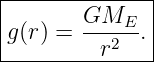
Using the spherical result for Earth,
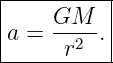
At Earth’s surface,
Using approximate values
and
| g | =  | (84)
|
| ≈ 9.82 m∕s2. | (85) |
This simple spherical model is close to familiar terrestrial gravitational acceleration.
Real local gravity also depends on Earth’s rotation, shape, altitude, and mass distribution.
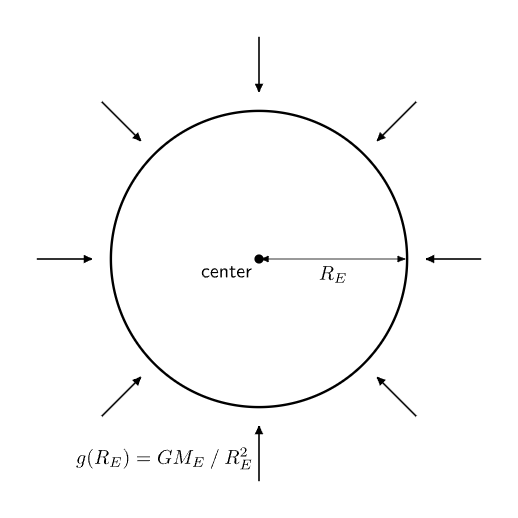
Figure 6. Outside a spherical Earth model, gravitational acceleration points radially inward and
has magnitude GME∕r2.
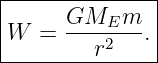
17 Weight
The gravitational force on an object of mass
is its gravitational Weight in the simple Newtonian model:
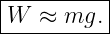
Near Earth’s surface this is often approximated as
The approximation treats
as nearly constant over the vertical distance of interest.
Mass and weight are not the same quantity:
- mass is measured in kilograms,
- weight is a force measured in newtons.
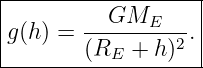
18 Altitude dependence
At altitude
above the spherical Earth’s surface,
Therefore
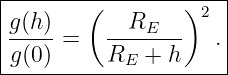
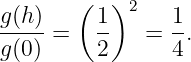
Relative to surface gravity,
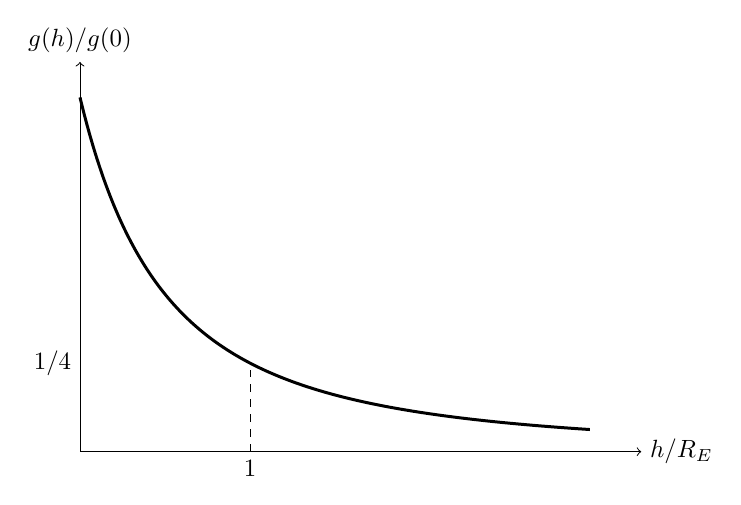
Figure 7. Gravitational acceleration decreases with altitude according to the inverse-square law.
The horizontal axis is altitude in units of Earth radius.
19 Example 4: gravity one Earth radius above the surface
Let
Then
Therefore
Thus
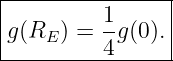
An object one Earth radius above the surface is not beyond Earth’s gravity.
Its gravitational acceleration is simply reduced to one fourth of the surface value in the spherical
model.
20 Two-body equations of motion
For two isolated masses,
and
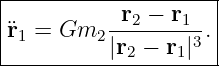
the force on mass 1 is
Hence
Similarly,
Subtract the equations.
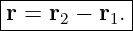
Define
Then
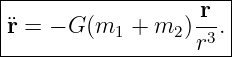
| r | = r2 −r1 | (104)
|
| = −G(m1 + m2) . | (105) |
Thus
The relative two-body motion is therefore another inverse-square problem.
21 One-body approximation
If
the acceleration of
is much smaller than that of
One often approximates the larger mass as fixed.
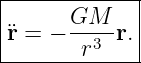
Then
This approximation is excellent for many satellite problems but is not exact.
The exact two-body treatment will be developed later in the M07 sequence.
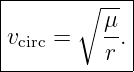
22 Circular orbit as a first application
Suppose a small mass
moves in a circular orbit of radius
around a much larger mass
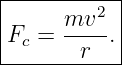
The required centripetal force is
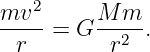
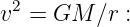
Gravity supplies this force:
Cancel
and one factor of
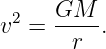
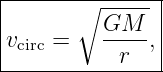
Therefore
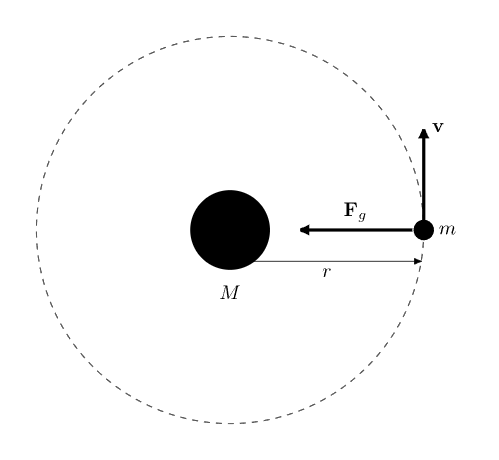
Figure 8. In an ideal circular orbit, the gravitational force points toward the central mass and
supplies the required centripetal acceleration.
23 Circular orbital period
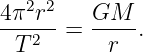
For a circular orbit,
Substitute
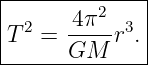
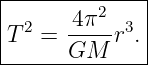
Therefore
This is the circular-orbit form of Kepler’s third law.
A later article will derive the more general orbital result.
24 Example 5: low circular orbit speed near Earth
Using
and taking
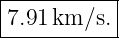
the idealized circular speed would be
| vcirc | = 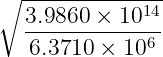 | (126)
|
| ≈ 7.91 × 10³ m∕s. | (127) |
This is about
A real orbit cannot exist at Earth’s solid surface because of terrain and atmosphere, but the
calculation establishes the orbital speed scale.
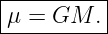
25 Gravitational parameter
The product
appears repeatedly.
It is often denoted
The quantity
is the gravitational parameter of the source body.
Then
and
For orbital calculations,
is often known more accurately than
and
separately.
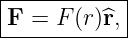
26 Why the force is a central force
A central force has the form
with direction along the line from a chosen center.
Newtonian point-mass gravity is a central force.
For a fixed source mass at the origin,
Because
and
are parallel or antiparallel,
Thus gravitational torque about the force center vanishes:
Therefore angular momentum about that center is conserved.
This connects Newtonian gravitation to the central force mechanics developed earlier.
27 Limits of Newtonian gravitation
Newton’s law is extraordinarily successful when:
General relativity replaces Newtonian gravitation when stronger gravitational fields, high precision,
or relativistic conditions require it.
Within ordinary classical mechanics and most elementary orbital problems, Newtonian gravitation
is the correct starting model.
28 Common mistakes
- Using 1∕r instead of 1∕r2 for the gravitational-force magnitude.
- Forgetting that gravitational force is attractive.
- Writing a vector equation without first defining the direction of the separation vector.
- Treating the equal-and-opposite gravitational forces as equal accelerations.
- Confusing mass with weight.
- Using altitude h in place of center-to-center radius R + h.
- Forgetting that the test mass cancels from gravitational acceleration when gravitational
and inertial mass are equal.
- Adding gravitational-force magnitudes instead of vectors.
- Applying the point-mass formula inside an extended body without checking the mass
distribution.
- Assuming zero net gravitational force means no gravitational forces are present.
- Treating the massive body as exactly fixed in every two-body problem.
- Forgetting the sum m1 + m2 in the exact relative two-body acceleration.
- Confusing G with the gravitational parameter μ = GM.
- Treating g as globally constant rather than an approximation near Earth’s surface.
- Forgetting that circular-orbit speed follows from gravitational acceleration equaling
centripetal acceleration.
29 Practice exercises
- Derive the dimensions of G from Newton’s gravitational law.
- If one mass is doubled and the separation is tripled, determine the new force relative
to the original force.
- Starting from r12 = r2 − r1, derive the vector force on mass 1 due to mass 2.
- Show explicitly that the two gravitational forces satisfy Newton’s third law.
- For m2 = 5m1, determine the ratio of the two acceleration magnitudes.
- Derive the cancellation of test mass from gravitational acceleration.
- Reproduce the force between two 1 kg masses separated by 1 m.
- Use superposition to show that two equal masses placed symmetrically about a test
mass produce zero net force at the midpoint.
- Write the gravitational-force integral for a continuous density ρ(r′).
- Reproduce the simple spherical-Earth value of surface gravitational acceleration.
- Find the value of g at altitude h = RE∕2 relative to surface gravity.
- Derive the exact relative two-body acceleration equation.
- Derive the circular-orbit speed vcirc =
 .
- Derive the circular-orbit form of Kepler’s third law.
- Explain why gravitational angular momentum about a fixed point source is conserved.
30 Summary
Newton’s law of universal gravitation states
The force is attractive and acts along the line joining the masses.
A useful vector form is
The interaction obeys
When gravitational and inertial mass are equal, the acceleration of a test body near source
mass
is
For many source masses,
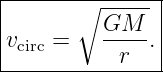
For a circular orbit around a much larger source mass,
and
Newton’s inverse-square law is the foundation for the gravitational fields, extended-body gravity,
potential energy, and orbital mechanics developed in the remainder of M07.
References
References
[1] PhysicsLibrary, M02-01, Newton’s Laws.
[2] PhysicsLibrary, M04-08, Conservation of Angular Momentum and Central Force
Motion.
[3] I. Newton, Philosophiae Naturalis Principia Mathematica, 1687.
[4] J. R. Taylor, Classical Mechanics, University Science Books, 2005.
[5] D. Kleppner and R. Kolenkow, An Introduction to Mechanics, 2nd ed., Cambridge
University Press, 2014.