|
|
|
|||||||
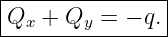
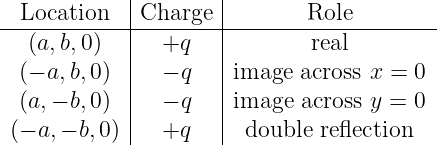
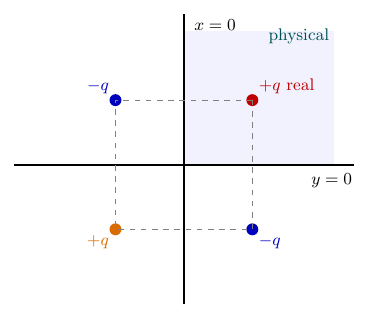
The last image must be positive: reflection changes the sign at each step.
Figure 1. The physical first quadrant contains only +q. Three images in the excluded quadrants cancel the potential separately on the two grounded boundaries.
2 Worked example 1: prove both boundary conditionsWrite r = (x,y,z) and the four source vectors as rst = (sa,tb, 0), where s,t ∈{+1,−1}. The charge at (sa,tb) is qst = stq. The trial potential for x > 0,y > 0 is
On x = 0, the distance to (a,tb) equals the distance to (−a,tb), and the associated coefficients st are opposites. Each pair cancels. On y = 0, the terms with t = +1 and t = −1 cancel at fixed s. Equation (2) has the correct real source, places all three images outside the physical quadrant, and vanishes at infinity. The uniqueness theorem establishes that it is the potential in the physical region.
3 Worked example 2: force on the real chargeThe physical Conductor force on q is the sum of its Coulomb forces from the three images, evaluated at (a,b, 0). For the image (−q) at (−a,b, 0), the separation is 2a horizontally:
For the image (−q) at (a,−b, 0),
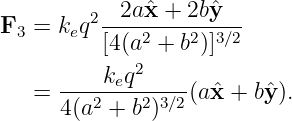
For the positive image at (−a,−b, 0), the displacement to the real source is 2ax + 2by, with length
2
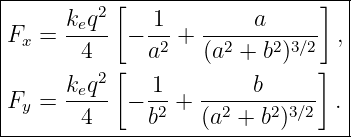
Adding the contributions gives
Both components are negative. For example, a∕(a2 + b2)3∕2 < 1∕a2, so the attraction to the x = 0 plane outweighs the double-reflection repulsion along x. The charge is pulled toward the grounded corner.
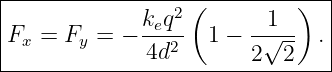
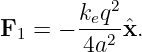
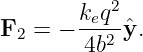
4 Worked example 3: equal distances and energySet a = b = d. By symmetry Fx = Fy. Equation (6) becomes
The force points along the bisector toward the corner. Its magnitude is
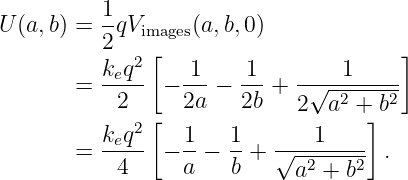
Differentiate U with respect to a and b while keeping the other parameter fixed: Fx = −∂U∕∂a and Fy = −∂U∕∂b, reproducing Equation (6). This is an independent sign and factor check.
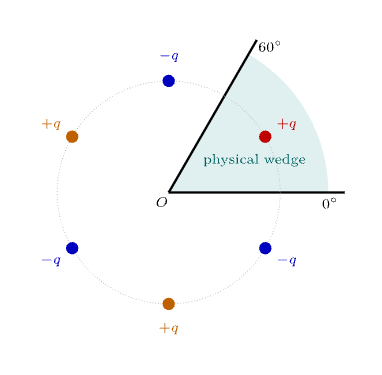
5 Worked example 4: a grounded wedge of opening π∕3Now let conducting half-planes meet at an angle α = π∕3 about the z axis. Work in the two-dimensional polar cross-section. Put the actual +q at radius r0 > 0 and angle 𝜃0 ∈ (0,α), with z = 0. To enforce V = 0 on both rays 𝜃 = 0 and 𝜃 = α, reflect source charges across each boundary repeatedly. For an opening α = π∕n, the reflections close after 2n angular placements. The n positive placements are
and the n negative placements are
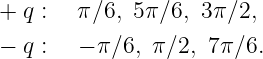
The positive placement with k = 0 is the real charge; the remaining 2n− 1 placements are images. For n = 3 and 𝜃0 = π∕6:
All the images are outside the physical wedge. At each grounded ray the sources form equal-distance, opposite-sign reflection pairs, so the potential vanishes there.
Figure 2. Six angular source positions for a 60∘ wedge. One +q is real inside the white wedge; five charges outside are mathematical images.
6 Worked example 5: when finite images stop being practicalThe simplest finite reflection construction works for wedge openings α = π∕n with a positive integer n. It then has 2n− 1 image charges. An arbitrary wedge angle generally does not produce a finite reflection orbit; adding a few reflections without closure need not satisfy both boundaries. The proper solution may require angular eigenfunctions and separation of variables, developed in ES07. Two parallel grounded planes lead to an infinite image array, not a finite collection.
7 Worked example 6: partition the induced charge between the corner wallsThe total induced charge is −q, but how is it divided between the two grounded surfaces? On the x = 0 wall the metal-to-vacuum Normal is +x. Evaluate σx = −𝜖0∂xV using Equation (2):
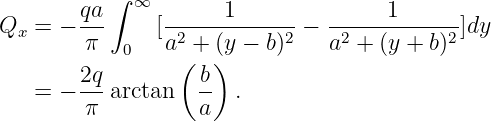
For y > 0, the first distance is shorter, so σx < 0. Integrate over the half-plane 0 < y < ∞, −∞ < z < ∞. The useful elementary identity is
After this integration the remaining y integral is a difference of two arctangents:
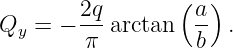
Interchanging a and b gives the charge on the other wall,
For positive a,b, arctan(b∕a) + arctan(a∕b) = π∕2, so
If a = b each wall carries −q∕2. If a ≪ b, most induced charge resides on the closer x = 0 wall. This result is a stronger verification than merely checking that the potential vanishes at both boundaries.
8 Exercises and complete solutions1. Boundary checks. What happens if the positive double-reflection image in Equation (1) is omitted? Solution. The contributions no longer pairwise cancel on either boundary after the second reflection, so the trial potential is not zero on both planes. 2. Unequal distances. Take b = 2a. Find Fx and Fy as multiples of keq2∕a2. Solution. Substitute into Equation (6):
Both are negative. 3. New wedge angle. How many image charges does a 45∘ grounded wedge require in the finite construction? Solution. α = π∕4 gives n = 4, with 2n − 1 = 7 images, in addition to one real charge. 4. Charge signs. If the real source has q < 0, what happens to the force direction? Solution. Every image sign changes with q; force products scale with q2. The conductor attraction and the force direction remain unchanged for the same geometry.
References
[1] D. J. Griffiths, Introduction to Electrodynamics, 5th ed., Cambridge University Press, 2023. [2] J. D. Jackson, Classical Electrodynamics, 3rd ed., Wiley, 1999. [3] H. Shi, Electrostatic Field Between Two Intersecting Grounded Planes, https://huanyushi.github.io/posts/electrostatic-field-between-intersecting-planes/. "Image Charges in Corners and Wedges" is owned by bloftin.
This object's parent. Cross-references: identity, Normal, separation of variables, image charges, positions, source charges, two-dimensional, work, parameter, magnitude, displacement, Conductor, uniqueness theorem, vectors, charge, boundary, energy, forces, grounded conducting planes, method of images This is version 1 of Image Charges in Corners and Wedges, born on 2026-11-28. Object id is 1648, canonical name is ImageChargesInCornersAndWedges. Accessed 5 times total. Classification:
|
|
|
|
Pending Errata and AddendaNone.
|
DiscussionNo messages.
|
Interact |


 . Thus