Physics Library
 An open source physics library
Encyclopedia | Forums | Docs | Random  

[parent] GRE Physics Companion: Two-Body Reduction and Relative Motion

(Example)

GRE Physics Companion: Two-Body Reduction and Relative Motion

The essential coordinate transformation is

|----m--r--+-m--r-------------------|
R  = --1-1-----2-2,     r = r1 − r2.|
-------m1--+-m2---------------------|
(1)

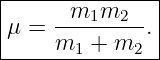
The reduced mass is

|--------------|
|    --m1m2--- |
|μ = m1  + m2 .|
----------------
(2)

For an isolated two-body system,

|------------------------|
|   ¨                    |
-M-R--=-0,-----μ¨r-=-F12.-
(3)

PIC

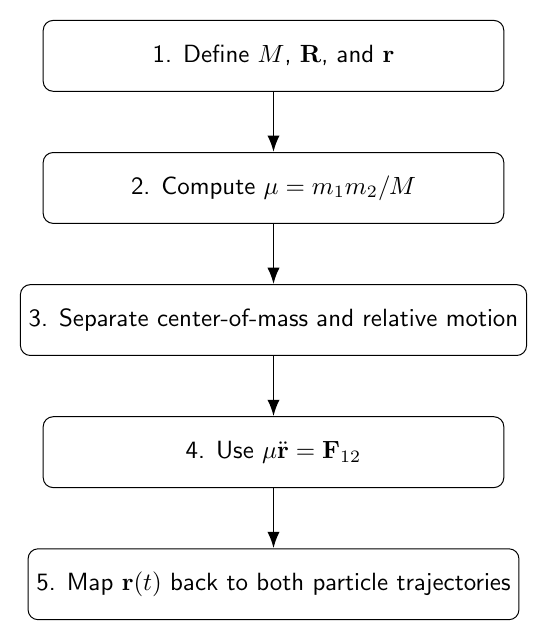
Figure 1. A compact strategy for two-body problems. Separate center-of-mass translation from relative motion, then use the reduced mass in the internal dynamics.

1 High-value GRE facts

  1. The relative coordinate is r = r1 − r2.
  2. The reduced mass is μ = m1m2∕(m1 + m2).
  3. In the large-heavy-mass limit, the reduced mass approaches the lighter mass.
  4. total momentum belongs entirely to center-of-mass translation.
  5. relative kinetic energy is 12μ|r|2.
  6. In the center-of-mass frame, the particle momenta are equal and opposite.
  7. For a central interaction, relative angular momentum is ℓ = μr ×r.
  8. For exact Newtonian two-body gravity, the relative acceleration contains G(m1 + m2).
  9. The heavier body follows the smaller barycentric orbit.
  10. Once the relative orbit is known, both individual center-of-mass-frame orbits follow by simple mass ratios.

Part I: Original GRE-style problems

Problem 1: reduced mass of equal particles

Two particles each have mass m. Their reduced mass is

  1. m∕4
  2. m∕2
  3. m
  4. 2m
  5. 4m

Problem 2: heavy-mass limit

If m2 ≫ m1, then the reduced mass approaches

  1. 0
  2. m1
  3. m2
  4. m1 + m2
  5. √ ------
  m1m2

Problem 3: relative velocity

If r = r1 − r2, then

  1. r = v1 + v2
  2. r = v1 − v2
  3. r = VCM
  4. r = 0
  5. r = (m1v1 + m2v2)∕M

Problem 4: relative kinetic energy

The relative kinetic energy of a two-particle system is

  1. 1
2M|r|2
  2. 12μ|r|2
  3. μ|r|2
  4. 1
2m1|r|2
  5. 1
2m2|r|2

Problem 5: center-of-mass frame momentum

In the center-of-mass frame,

  1. p1′ = p2′
  2. p1′ = −p2′
  3. both particle momenta vanish individually
  4. only the heavier particle has momentum
  5. momentum is undefined

Problem 6: relative equation

For an isolated pair with interaction force F12 on particle 1,

  1. Mr = F12
  2. μr = F12
  3. m1r = F12
  4. m2r = F12
  5. r = 0

Problem 7: barycentric distance

For two masses separated by distance r, the distance of m1 from the center of mass is

  1. (m1∕M)r
  2. (m2∕M)r
  3. r∕2 always
  4. (M∕m1)r
  5. (M∕m2)r

Problem 8: relative angular momentum

For a central two-body interaction, the relative angular momentum is

  1. Mr ×r
  2. μr ×r
  3. m1r ×r
  4. m2r ×r
  5. zero for every central force

Problem 9: gravitational relative acceleration

For exact Newtonian two-body gravity, the relative acceleration is

  1. −Gm1r∕r3
  2. −Gm2r∕r3
  3. −G(m1 + m2)r∕r3
  4. −Gμr∕r3
  5. zero

Problem 10: circular relative angular frequency

For a circular gravitational two-body orbit of separation r,

  1. ω2 = G(m 1 + m2)∕r3
  2. ω2 = Gμ∕r3
  3. ω2 = Gm 1m2∕r3
  4. ω = G(m1 + m2)∕r2
  5. ω2 = Gr3∕(m 1 + m2)

Problem 11: uniform external gravity

Two nearby masses experience exactly the same uniform gravitational acceleration. In the relative equation, this external field

  1. doubles the internal force
  2. cancels out
  3. makes the reduced mass zero
  4. changes μ with time
  5. reverses r

Problem 12: shape of barycentric orbits

If the relative orbit r(t) is known, the two center-of-mass-frame trajectories are

  1. unrelated curves
  2. scaled copies of the relative orbit on opposite sides of the center of mass
  3. always circles
  4. always straight lines
  5. identical curves with identical scale and orientation

Part II: Complete worked solutions

Solution 1

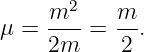
    m2     m
μ = ----=  --.
    2m     2
(4)

Answer: (B).

Solution 2

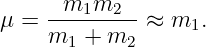
For m2 ≫ m1,

μ = --m1m2--- ≈ m1.
    m1  + m2
(5)

Answer: (B).

Solution 3

Differentiate

r = r1 − r2.
(6)

Thus

˙r = v1 − v2.
(7)

Answer: (B).

Solution 4

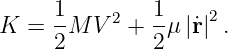
The exact kinetic-energy decomposition is

     1-   2   1-    2
K =  2M  V  + 2 μ|˙r| .
(8)

Answer: (B).

Solution 5

The center-of-mass frame has zero total momentum:

 ′    ′
p1 + p2 = 0.
(9)

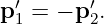
Therefore

 ′      ′
p1 = − p2.
(10)

Answer: (B).

Solution 6

The reduced relative equation is

μ¨r = F12.
(11)

Answer: (B).

Solution 7

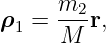
From

ρ1 =  m2-r,
      M
(12)

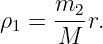
the magnitude is

ρ1 = m2-r.
     M
(13)

Answer: (B).

Solution 8

For two-body relative motion,

ℓ = μr × r˙.
(14)

Answer: (B).

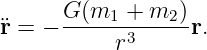
Solution 9

The exact relative gravitational equation is

      G(m   + m  )
¨r = − ----1-3---2-r.
           r
(15)

Answer: (C).

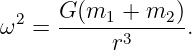
Solution 10

Circular relative motion requires

  2   G-(m1-+-m2-)
ω  =       r3     .
(16)

Answer: (A).

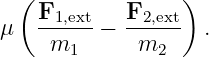
Solution 11

The external term in the relative equation is proportional to the difference in external accelerations:

 (               )
μ  F1,ext−  F2,ext- .
    m1       m2
(17)

If those accelerations are equal, the term vanishes. Answer: (B).

Solution 12

The barycentric coordinates are

ρ1 = m2-
Mr, (18)
ρ2 = −m1-
Mr. (19)

Thus both are scaled copies of the relative trajectory on opposite sides of the center of mass. Answer: (B).

2 GRE checklist

  1. Define the relative-coordinate direction before using signs.
  2. Use the reduced mass in relative kinetic energy and relative dynamics.
  3. Separate center-of-mass translation from relative motion.
  4. In the center-of-mass frame, use equal-and-opposite particle momenta.
  5. For central interactions, replace the one-particle mass in central-force formulas by μ.
  6. For exact gravitational relative motion, use G(m1 + m2).
  7. The more massive body lies closer to the barycenter.
  8. Uniform external acceleration cancels from the relative equation, but differential external acceleration does not.

References

References

[1]   J. R. Taylor, Classical Mechanics, University Science Books, 2005.

[2]   D. Kleppner and R. Kolenkow, An Introduction to Mechanics, 2nd ed., Cambridge University Press, 2014.

[3]   OpenStax, University Physics, Volume 1, Rice University, 2016.


"GRE Physics Companion: Two-Body Reduction and Relative Motion" is owned by bloftin.
(view preamble)
View style:
Other names:  M04-09G
Keywords:  GRE physics, two-body problem, relative motion, center of mass, reduced mass, relative coordinate, relative momentum, gravitational two-body problem, barycenter

This object's parent.

Cross-references: formulas, magnitude, internal force, field, central force, center of mass, force, momentum, acceleration, angular momentum, particle, relative kinetic energy, total momentum, relative motion, system, mass

This is version 1 of GRE Physics Companion: Two-Body Reduction and Relative Motion, born on 2026-10-04.
Object id is 1405, canonical name is GREPhysicsCompanionTwoBodyReductionAndRelativeMotion.
Accessed 6 times total.

Classification:
Physics Classification: 45.50.-j (Dynamics and kinematics of a particle and a system of particles)
 45.20.Dd (Newtonian mechanics)

Pending Errata and Addenda

None.

Discussion

No messages.

Interact