Physics Library
 An open source physics library
Encyclopedia | Forums | Docs | Random  

[parent] GRE Physics Companion: General Plane Motion of a Rigid Body

(Example)

GRE Physics Companion: General Plane Motion of a Rigid Body

For two points A and B on the same planar rigid body,

|---------------------|
vB--=-vA-+-ω--×-rB∕A,--
(1)

and

|------------------------2-----|
-aB-=-aA-+--α-×-rB∕A-−-ω--rB∕A.-
(2)

PIC

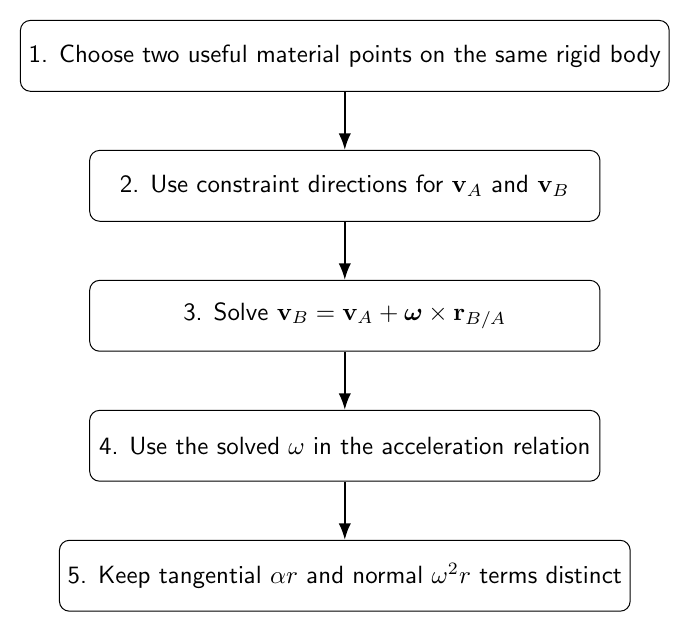
Figure 1. A compact strategy for general plane motion: select two useful points, exploit known constraint directions, solve velocity first for ω, then solve acceleration using both tangential and Normal relative-acceleration terms.

1 High-value GRE facts

  1. General plane motion is translation plus rotation.
  2. For a planar rigid body, ω and α are perpendicular to the motion plane.
  3. Relative velocity is perpendicular to the line joining two material points.
  4. Relative acceleration contains both αr tangential and ω2r normal terms.
  5. The instantaneous center is mainly a velocity tool.
  6. A zero-velocity instantaneous center need not have zero acceleration.
  7. Pure translation corresponds to ω = 0.
  8. fixed-axis rotation is the special case with a stationary reference point.
  9. Rolling contact is an instantaneous center during pure rolling.
  10. General plane kinetic energy is translation of the center of mass plus rotation about the center of mass.

Part I: Original GRE-style problems

Problem 1: relative velocity direction

For two points A and B on the same rigid body, the relative velocity vB − vA is

  1. parallel to rB∕A
  2. perpendicular to rB∕A
  3. always zero
  4. always vertical
  5. independent of angular velocity

Problem 2: pure translation

If a planar rigid body has ω = 0, then at that instant

  1. all point velocities are equal
  2. all point velocities are zero
  3. all point accelerations are zero
  4. the body must be fixed
  5. the body has infinite angular acceleration

Problem 3: fixed point

If point A is fixed and the rigid body rotates in a plane, then

  1. vB = vA
  2. vB = ω × rB∕A
  3. vB = α× rB∕A
  4. vB = −ω2r B∕A
  5. vB = 0

Problem 4: relative speed

Points A and B are separated by 0.50 m on a rigid link rotating instantaneously at 4 rad/s. The magnitude of their relative velocity is

  1. 0.125 m/s
  2. 0.50 m/s
  3. 2.0 m/s
  4. 4.0 m/s
  5. 8.0 m/s

Problem 5: normal relative acceleration

A rigid link has ω = 3 rad/s and points separated by 0.40 m. The magnitude of the normal relative acceleration is

  1. 1.2 m/s2
  2. 3.0 m/s2
  3. 3.6 m/s2
  4. 9.0 m/s2
  5. 12.0 m/s2

Problem 6: zero angular acceleration

If α = 0 but ω≠0, then for two distinct points on a rigid body

  1. their accelerations must be equal
  2. their relative acceleration can be nonzero
  3. their velocities must be zero
  4. the body is in pure translation
  5. the instantaneous center must be fixed

Problem 7: instantaneous center

At an instantaneous center of zero velocity,

  1. velocity and acceleration are both necessarily zero
  2. velocity is zero but acceleration need not be zero
  3. acceleration is zero but velocity need not be zero
  4. angular velocity must be zero
  5. angular acceleration must be zero

Problem 8: locating instantaneous center

If velocity directions are known at two points on a rigid body, the instantaneous center is located by

  1. extending the velocity vectors until they intersect
  2. intersecting lines through the points parallel to their velocities
  3. intersecting lines through the points perpendicular to their velocities
  4. taking the midpoint between the points
  5. using only the center of mass

Problem 9: sliding bar geometry

A bar has endpoint A moving horizontally and endpoint B moving vertically. The instantaneous center lies

  1. at the midpoint of the bar
  2. at the intersection of the vertical through A and horizontal through B
  3. at the center of mass only
  4. at infinity
  5. on the bar necessarily

Problem 10: kinetic energy

A rigid body has M = 4 kg, vCM = 3 m/s, ICM = 2 kg m2, and ω = 2 rad/s. Its total kinetic energy is

  1. 9 J
  2. 18 J
  3. 22 J
  4. 26 J
  5. 36 J

Problem 11: pure translation instantaneous center

For pure translation, the instantaneous center can be viewed geometrically as

  1. at the center of mass
  2. at a fixed pin
  3. at infinity
  4. at the fastest point
  5. at the origin

Problem 12: acceleration analysis

Which quantity is needed for the normal relative-acceleration term?

  1. only α
  2. only ω
  3. only center of mass position
  4. only mass
  5. only torque

Part II: Complete worked solutions

Solution 1

v   − v  = ω  × r   .
  B    A         B∕A
(3)

A cross product is perpendicular to rB∕A. Answer: (B).

Solution 2

If ω = 0,

vB =  vA.
(4)

Thus all points have the same instantaneous velocity. Answer: (A).

Solution 3

For a fixed point A,

vA =  0.
(5)

Hence

vB =  ω × rB ∕A.
(6)

Answer: (B).

Solution 4

vB ∕A = ωr = (4)(0.50) = 2.0m ∕s.
(7)

Answer: (C).

Solution 5

a =  ω2r = 9(0.40) = 3.6m ∕s2.
 n
(8)

Answer: (C).

Solution 6

When α = 0,

              2
aB − aA =  − ω rB∕A,
(9)

which is nonzero if ω≠0 and A≠B. Answer: (B).

Solution 7

The instantaneous-center definition requires

vI = 0.
(10)

It imposes no requirement that

aI = 0.
(11)

Answer: (B).

Solution 8

For instantaneous rotation about I,

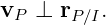
vP  ⊥ rP∕I.
(12)

Therefore I lies on the line through each point perpendicular to its velocity. Answer: (C).

Solution 9

The horizontal velocity at A implies a vertical radius from I to A. The vertical velocity at B implies a horizontal radius from I to B. Answer: (B).

Solution 10

K = 1
--
2MvCM2 + 1
--
2ICMω2 (13)
= 1-
2(4)(9) + 1-
2(2)(4) (14)
= 18 + 4 (15)
= 22 J. (16)

Answer: (C).

Solution 11

In pure translation, all velocities are parallel. The perpendicular lines used to locate an instantaneous center are therefore parallel, corresponding to an instantaneous center at infinity. Answer: (C).

Solution 12

The normal term is

   2
− ω rB ∕A.
(17)

Thus it depends on angular speed. Answer: (B).

2 GRE checklist

  1. Start with two material points whose motion constraints are known.
  2. Use vB = vA + ω × rB∕A.
  3. Remember that relative velocity is perpendicular to the line joining the points.
  4. Solve velocity before acceleration when possible, because acceleration needs ω.
  5. Include both αr and ω2r relative-acceleration terms.
  6. Use the instantaneous center for velocity geometry, not blindly for acceleration.
  7. Recognize pure translation, fixed-axis rotation, and rolling as special cases.
  8. For energy, separate center of mass translation and rotation about the center of mass.

References

References

[1]   J. R. Taylor, Classical Mechanics, University Science Books, 2005.

[2]   D. Kleppner and R. Kolenkow, An Introduction to Mechanics, 2nd ed., Cambridge University Press, 2014.

[3]   OpenStax, University Physics, Volume 1, Rice University, 2016.


"GRE Physics Companion: General Plane Motion of a Rigid Body" is owned by bloftin.
(view preamble)
View style:
Other names:  M05-08G
Keywords:  GRE physics, general plane motion, rigid body, relative velocity, relative acceleration, instantaneous center, planar kinematics, center of mass, linkage kinematics

This object's parent.

Cross-references: energy, speed, cross product, torque, mass, position, vectors, instantaneous center of zero velocity, magnitude, angular acceleration, angular velocity, center of mass, kinetic energy, fixed-axis rotation, material points, Normal, acceleration, velocity, general plane motion, rigid body

This is version 1 of GRE Physics Companion: General Plane Motion of a Rigid Body, born on 2026-10-17.
Object id is 1479, canonical name is GREPhysicsCompanionGeneralPlaneMotionOfARigidBody.
Accessed 3 times total.

Classification:
Physics Classification: 45.40.-f (Dynamics and kinematics of rigid bodies)
 45.20.Dd (Newtonian mechanics)

Pending Errata and Addenda

None.

Discussion

No messages.

Interact