|
|
|
|||||||
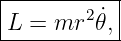
For a central force,
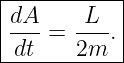
and
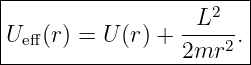
For a conservative central force,
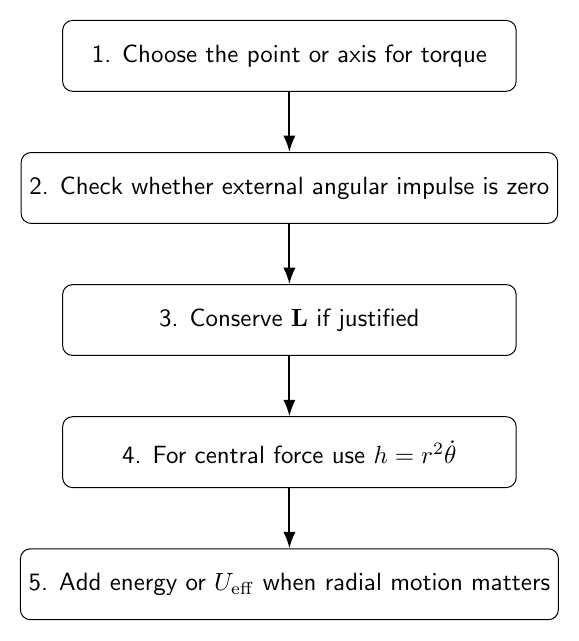
Figure 1. A compact strategy for angular momentum conservation and central force problems. Choose the torque point first, conserve angular momentum when justified, then use polar or energy relations as needed.
1 High-value GRE facts
Part I: Original GRE-style problems
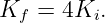
Problem 1: changing moment of inertiaA rotating system has negligible external torque. Its moment of inertia decreases from 4I to I. If its initial angular speed is ω, its final angular speed is
Problem 2: rotational kinetic energyIn Problem 1, the final rotational kinetic energy is what multiple of the initial rotational kinetic energy?
Problem 3: central force torqueA particle is acted on by a force F = F(r)er. Its torque about the force center is
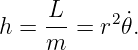
Problem 4: specific angular momentumFor planar central force motion, specific angular momentum is
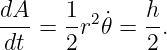
Problem 5: areal velocityA particle has specific angular momentum h. Its areal velocity is
Problem 6: apsis speedAt two apses of a central-force orbit, rp = ra∕3. If the apoapsis speed is va, the periapsis speed is
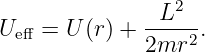
Problem 7: effective potentialFor a conservative central force, the angular-momentum contribution to the effective potential is
Problem 8: radial turning pointAt a radial turning point,
Problem 9: circular orbitA circular orbit in an effective potential occurs at a radius where
Problem 10: gravitational circular speedFor a circular orbit about fixed mass M, the orbital speed is
Problem 11: radial force and workA radial force has zero torque about the center. Which statement is also necessarily true?
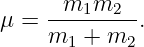
Problem 12: reduced massFor two particles of masses m1 and m2, the reduced mass is
Part II: Complete worked solutions
Solution 1Conservation gives
Thus
Answer: (E).
Solution 2Use
Since If = Ii∕4 at fixed L,
Answer: (E).
Solution 3A central force is parallel to r, so
Answer: (C).
Solution 4
Answer: (C).
Solution 5
Answer: (B).
Solution 6At each apsis,
Thus
With rp = ra∕3,
Answer: (D).
Solution 7
Answer: (B).
Solution 8A radial turning point reverses the radial direction, so instantaneously
Answer: (A).
Solution 9For a circular orbit,
which requires a stationary point of the effective potential:
Answer: (B).
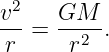
Solution 10Equate gravitational acceleration to centripetal acceleration:
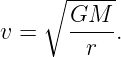
Therefore
Answer: (A).
Solution 11Zero torque means the force has no moment about the center. If radial velocity is nonzero, then
can be nonzero. Answer: (B).
Solution 12
Answer: (D).
2 GRE checklist
References
References
"GRE Physics Companion: Conservation of Angular Momentum and Central force Motion" is owned by bloftin.
This object's parent. Cross-references: centripetal acceleration, acceleration, kinetic energy, displacement, work, turning point, particle, rotational kinetic energy, speed, moment of inertia, system, mass, relative motion, effective potential, velocity, apsis, areal velocity, specific angular momentum, motion, force, angular momentum, central force This is version 1 of GRE Physics Companion: Conservation of Angular Momentum and Central force Motion, born on 2026-10-04. Object id is 1403, canonical name is GREPhysicsCompanionConservationOfAngularMomentumAndCentralForceMotion. Accessed 8 times total. Classification:
|
|
|
|
Pending Errata and AddendaNone.
|
DiscussionNo messages.
|
Interact |
![[parent]](https://images.physicslibrary.org/images/uparrow.png)