GRE Physics Companion: Kinetic Energy and the Work-Energy Theorem
This companion develops fast problem-solving habits for the material in M03-02. The central
GRE idea is that work-energy problems often let you bypass time and acceleration
completely.
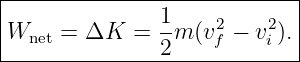
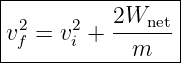
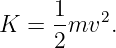
The core relation is
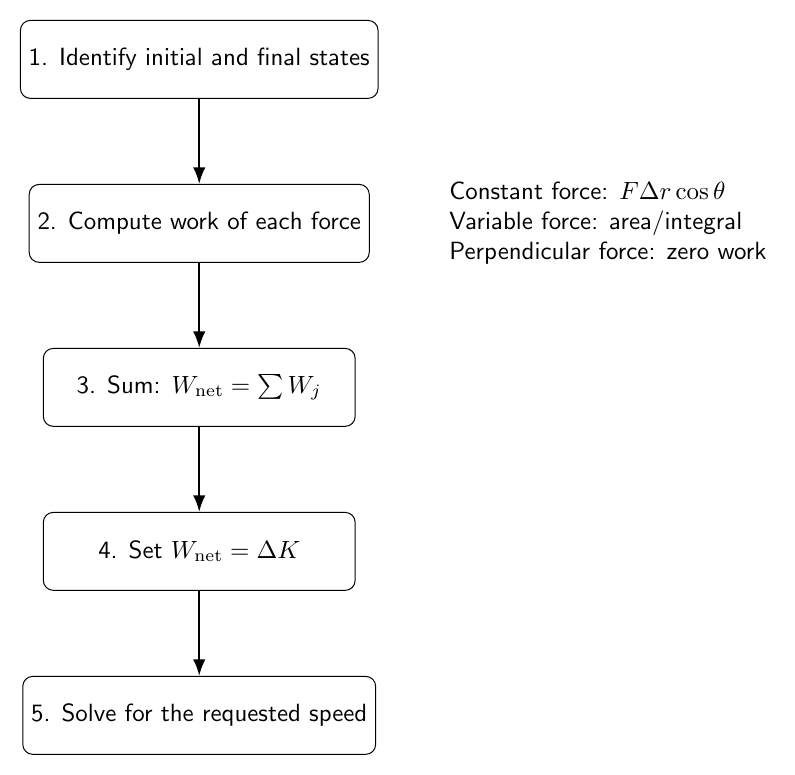
Figure 1. A compact decision path for work-energy problems. Identify the initial and final states,
compute the work of each force, sum to obtain net work, and convert the result into a change in
kinetic energy.
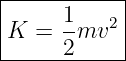
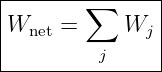
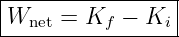
1 Core formulas to know
For a constant force over displacement Δr,
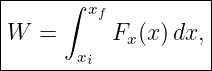
For a one-dimensional variable force,
so work is the signed area under an Fx versus x graph.
2 High-value GRE observations
- K depends on v2. If speed doubles, kinetic energy quadruples.
- Wnet > 0 means the final speed is greater than the initial speed.
- Wnet = 0 means the initial and final speeds are equal. It does not mean the force was
zero.
- A force perpendicular to the instantaneous displacement does no instantaneous work.
This is why the centripetal force in uniform circular motion does not change speed.
- The theorem requires net work. Individual forces can do positive, negative, or zero
work.
- The square root in a final-speed calculation gives speed only. It does not determine the
sign of a one-dimensional velocity.
- Kinetic energy is frame dependent. Always use work and kinetic energy measured in
the same inertial frame.
- If an Fx versus x graph crosses the axis, areas below the axis count as negative work.
Part I: Original GRE-style problems
Problem 1: speed scaling
A particle of fixed mass has kinetic energy K at speed v. Its speed is increased to 3v. Its new
kinetic energy is
- 3K
- 6K
- 9K
- 27K
- K∕9
Problem 2: net work from a speed change
A 2.0 kg cart speeds up from 3.0 m∕s to 7.0 m∕s. What net work is done on the cart?
- 20 J
- 32 J
- 40 J
- 64 J
- 80 J
Problem 3: zero net work
Which statement must be true if the net work on a constant-mass particle over an interval is
zero?
- The particle is at rest throughout the interval.
- The net force is zero throughout the interval.
- The acceleration is zero throughout the interval.
- The initial and final speeds are equal.
- The initial and final velocity vectors are equal.
Problem 4: force-displacement graph
A 1.0 kg particle starts from rest. From x = 0 to x = 4.0 m, the net force in the x direction
increases linearly from 0 to 8.0 N. What is the particle’s speed at x = 4.0 m?
- 2.0 m∕s
- 4.0 m∕s
- 5.7 m∕s
- 8.0 m∕s
- 16 m∕s
Problem 5: incline with friction
A 2.0 kg block starts from rest and slides 5.0 m down a straight incline that is 30∘ above the
horizontal. The kinetic-friction force has constant magnitude 4.0 N. Take g = 9.8 m∕s2. What is
the block’s speed after the 5.0 m slide?
- 3.0 m∕s
- 5.4 m∕s
- 7.0 m∕s
- 8.5 m∕s
- 9.9 m∕s
Problem 6: circular motion
A satellite moves in a circular orbit at constant speed. During one quarter of an orbit, the net force
on the satellite does
- positive work because the satellite moves in the force direction
- negative work because the force points inward
- zero work because the force is perpendicular to the instantaneous velocity
- zero work only if the quarter orbit begins on the positive x axis
- positive or negative work depending on the reference direction
Problem 7: equal kinetic energy
Particles A and B have masses m and 4m, respectively, and have equal kinetic energies. If A has
speed v, the speed of B is
- v∕4
- v∕2
- v
- 2v
- 4v
Problem 8: stopping distance under a constant force
A 1000 kg CAR moves at 20 m∕s. A constant braking force of magnitude 5000 N acts opposite the
motion. Neglect all other horizontal forces. What stopping distance is predicted?
- 10 m
- 20 m
- 40 m
- 80 m
- 100 m
Problem 9: return to the same height
A projectile is launched from a point and later returns to the same height. Air resistance is
negligible. Between launch and return to that height, the work done by gravity is
- positive
- negative
- zero
- equal to the maximum kinetic energy
- impossible to determine without the launch angle
Problem 10: frame dependence
A particle has kinetic energy K in inertial frame S. Another inertial frame S′ moves at constant
velocity relative to S. Which statement is generally correct?
- The particle has the same kinetic energy in both frames.
- The particle’s kinetic energy can differ between the frames.
- Kinetic energy changes only if the particle accelerates.
- Kinetic energy is invariant under Galilean transformations.
- The work-energy theorem can hold in only one of the two frames.
Part II: Complete worked solutions
Solution 1
Kinetic energy is proportional to the square of speed:
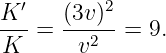
Therefore
Hence
Answer: (C).
Solution 2
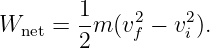
Use
Substitute:
| Wnet | =  (2.0) (2.0)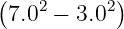 | (12)
|
| = 1.0(49 − 9) | (13)
|
| = 40 J. | (14) |
Answer: (C).
Solution 3
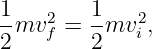
The work-energy theorem gives
If Wnet = 0, then
For constant mass,
so the speeds are equal:
The velocity directions can differ, as in uniform circular motion.
Answer: (D).
Solution 4
The work is the area under the force-displacement graph. The graph is a triangle with base 4.0 m
and height 8.0 N:
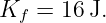
The particle starts from rest, so
For m = 1.0 kg,
 mvf2 mvf2 | = 16, | (21)
|
| vf2 | = 32, | (22)
|
| vf | = 5.66 m∕s. | (23) |
Answer: (C).
Solution 5
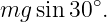
The component of Weight along the incline is
The work of gravity is
| Wg | = mgd sin 30∘ | (25)
|
| = (2.0)(9.8)(5.0)(0.5) | (26)
|
| = 49 J. | (27) |
The work of friction is
The Normal force does zero work, so
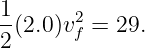
Starting from rest,
Thus
Answer: (B).
Solution 6
For uniform circular motion, the net force is radial while the instantaneous velocity is
tangential:
Thus
so the force does no work and the speed remains constant.
Answer: (C).
Solution 7
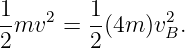
Equal kinetic energies give
Cancel common factors:
Therefore
Answer: (B).
Solution 8
The initial kinetic energy is
The final kinetic energy is zero. Therefore
The braking work is
Hence
| − (5000)d | = −2.0 × 10⁵, | (40)
|
| d | = 40 m. | (41) |
Answer: (C).
Solution 9
Gravity is conservative, but potential energy is not needed to answer the question. The work done
by gravity depends only on the vertical displacement:
The projectile returns to the same height, so
Therefore
Answer: (C).
Solution 10
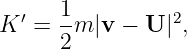
Under a Galilean transformation,
Therefore
which is generally not equal to
The work-energy theorem remains valid when all quantities are evaluated consistently in the
chosen inertial frame.
Answer: (B).
3 GRE checklist
Before committing to a long force calculation, ask:
- Is the question asking for speed rather than time?
- Can I calculate the work of each force over the known displacement?
- Is a force-displacement graph giving me work as an area?
- Are any forces perpendicular to the displacement and therefore doing zero work?
- Have I used net work rather than one selected force?
- Did I remember that kinetic energy scales as v2?
- If the net work is zero, did I conclude only that the initial and final speeds are equal?
References
References
[1] J. R. Taylor, Classical Mechanics, University Science Books, 2005.
[2] D. Kleppner and R. Kolenkow, An Introduction to Mechanics, 2nd ed., Cambridge
University Press, 2014.
[3] OpenStax, University Physics, Volume 1, Rice University, 2016.

![[parent]](https://images.physicslibrary.org/images/uparrow.png)